“Real/Surreal” explores the haunted intersection of realist and surrealist American art

Sage-No_Passing_HR

American painter Kaye Sage blends symbolic abstraction with a Surrealist dreamscape in “No Passing” from 1954, on display in “Real Surreal.”

Real/Surreal, Madison Museum of Contemporary Art, 227 State St., Madison, WI www.mmoca.org (608) 257-0158.

Heart-plucking Americana pictorial art, brash Abstract Expressionism, impishly ironic Pop Art and postmodern spin-offs can all make claims as “real American art.”

But is real American art also surreal? That underlying question of Real/Surreal is a good reason to see this show, aside from its fun-house array of conceptual, psychological and artistic pleasures. Many of these artists’ interests parallel psychiatry and psychology –asking one to inwardly question, probe one’s past or self-assurance or – one’s subconscious fears, and dreams.

Curator Rick Axsom set many of the freestanding display panels at odd angles to convey Surrealism’s skewed reality, says MMoCA director Stephen Fleischman. Running through April 27 and organized by the Whitney Museum of American Art, the exhibition signifies “the tension and connections between two powerful currents in 20 century art: realism and Surrealism,” Axsom says.

Surrealism dominated European modernist art of the ‘30s and ‘40s, and many Surrealists moved to America and would deeply influence American abstract expressionism’s intuitive spontaneity. But this show represents primarily how Surrealism weirdly adulterated the intent and act of realistic representation, well past WWII.

Federico Castellon’s 1938 painting “The Dark Figure” depicts his own dazed and disembodied head amid a configuration of limbs, and an enigmatic woman engulfed in black, their flesh rendered with a chilling bloodlessness.

Castellon-The_Dark_Figure_HR

Federico Castellón, The Dark Figure, 1938. Oil on canvas. 17 3/8 x 26 1/4 x 1 1/8 inches. Whitney Museum of American Art, New York; purchase 42.3. Permission courtesy Michael Rosenfeld  Gallery LLC, N.Y. Photography by Sheldan C. Collins 

More intriguing are artists who walk a finer line between realism and the psychological edge. Joe Jones’ Depression-era “American Farm” shows a meager homestead atop a cloud-shrouded hill, which resembles a voracious tidal wave about to devour the farm.

George Tooker superbly calibrates his 1950 tempera “The Subway.” A worried woman stands surrounded by various men — some with undead-like, lidded eyes, others peering anxiously from alcoves, and one man weeps against a wall. Both moving and unsettling, the painting blends fragments of multiple stories, feeling like a metaphor for American societal angst and isolation, even amid many people, a not-uncommon subway experience.

AMER_ART495340

George Tooker, The Subway, 1950. Egg tempera on composition board, 18 1/8 x 36 1/8inches. Whitney Museum of American Art, New York; purchase, with funds from the Juliana Force Purchase Award 50.23. Courtesy of the Estate of George Tooker and D.C. Moore Gallery, N.Y. Photography by Sheldan C. Collins. 

Among the most ambitious and thought-provoking works is Henry Koerner’s 1946 “Mirror of Life,” which reflects a post-war scrutiny of reality and its troubled underpinnings. In the foreground, a man peers out of a hotel window revealing his mistress lying nude on a bed, along with a card game beside the bed. Yet he’s compelled to look out over an extraordinary panorama of life that reaches back into time to the Biblical scene of betrayal in the background. Cain kills Abel, both as naked as the philandering observer — wearing only his watch — and his mistress. Koerner’s virtuosic and ambiguous handling of a sprawling scenario defies accusations of heavy-handed moralism, and befits the surrealist tradition of bringing disturbing dreams to life on canvas.

Koerner-Mirror_of_Life_HR

Henry Koerner, Mirror of Life, 1946. Oil on composition board, Overall: 36 x 42 inches. Whitney Museum of American Art, New York; purchase 48.2. With permission of  Joseph and Joan Koerner. Digital Image © Whitney Museum of American Art.

I left the exhibit with the feeling that this intersection of realist and surrealist insight suggests that we Americans don’t spend enough time in reflective self-examination.

Remember, film noir — deeply laced with mind-twisting psychological scenarios – also took off in the 1950s. You begin to see how attuned to the times American surrealism was, and may remain.

The show includes work by Thomas Hart Benton, Charles Burchfield, Marsden Hartley, Edward Hopper, Rockwell Kent, Andre Kertesz, Man Ray, Yves Tanguy,  Grant Wood, Andrew Wyeth and others. An accompanying show features Wisconsin Surrealists, (including Santos Zingale’s “Triangle Inn No. 1,” below) and a third celebrates MMoCA’s collection of Mexican modernists.

Zingale-Triangle_Inn_No._1-HR

Santos Zingale, Triangle Inn No. 1, 1942. Oil on canvas, 30 x 39 ½ inches. Madison Museum of Contemporary Art. Madison Art Association Purchase Award, 1942 Wisconsin Salon of Art. © Santos Zingale Estate. 


“He IS the guitar.” Blues pioneer Michael Bloomfield finally gets his due

Bloomfield head_heart_hands

Michael Bloomfield From His Head to his Heart to his Hands: An Audio/Visual Scrapbook (Columbia Legacy) 

Finally, this extraordinary Chicago-born guitarist is no longer playing the blues in history’s alleyway. Al Kooper — who met Bloomfield when both played on Bob Dylan’s epochal “Like a Rolling Stone” — curates this “” with love and diligence. 1

The four-disc set includes a new DVD documentary film Sweet Blues: A Film about Mike Bloomfield that tells the moving human story of a hot-wired musical genius, with a photographic memory. Hear Bloomfield trip the lights on for the psychedelic era and much of his era that grew from the blues. He seemed ill-suited for stardom by temperament and trait — a scholarly type afflicted with chronic, perhaps bi-polar insomnia, and a pedestrian Joe Blow singing voice.

But what a guitarist! A relentless woodshedder, Bloomfield encompassed myriad moods, and played more blues styles than virtually anyone. His guitar’s searing intensity beamed a pearly, sweet tone that kissed the listener’s ear while electrifying it. He filtered B.B. King through his own voracious sensibility and mensch-like Jewish exuberance. He broke barriers with a prototype racially integrated music group — the brash, churning Paul Butterfield Blues Band — which set rock musicians on their ears.Butterfield

The Paul Butterfield Blues Band, on Chicago’s South side, around the time of their eponymous debut album (l-r) Paul Butterfield, Jerome Arnold, Michael Bloomfield, Elvin Bishop, Sam Lay. Courtesy article.wn.com. 

You hear the 1966 title tune from their second album, East-West, a magnificently precipitous bridge spanning blues, jazz and Eastern raga. Bloomfield soon formed The Electric Flag, a forerunner of many blues-R&B-jazz horn groups, including the Tedeschi Trucks Band. Bloomfield’s electric picking peaks on the midnight jam Super Session and subsequent live performances; then his band launches Janis Joplin’s solo career. “One Good Man” from Joplin’s first solo album I’ve Got Dem Ol’ Kozmic Blues Again Mama! yearns with the lonesome blues expression both these artists understood deeply. Wherever he went, Bloomfield exuded ideas and passion as unquenchable fire. He followed his talent, vision, historical acuity and his generosity. He did what he wanted to do, but not as a careerist.Blooomfield

Mike Bloomfield “is the guitar,” says Country Joe McDonald. Courtesy examiner.com.

The set’s previously unreleased bookends are his startling 1964 rehearsals for the historic producer John Hammond — and his 1980 live gig with Dylan, three months before he died at age 37. In the 1964 sessions he astounds Hammond (who had discovered Billie Holiday, Benny Goodman, Bob Dylan, Aretha Franklin, Bruce Springsteen and other greats) who, after Michael’s impromptu “Hammond’s Rag” the producer tells him through the studio intercom, “We’ve exploited you enough; I just want you to know I’m signing you.” “Oh!” Bloomfield cries.

But first, he had to play the blues and beyond, with Butterfield for several crucial years. 2 Bloomfield composed the band’s brilliantly conceived and executed 13-minute instrumental “East-West,” which revealed a superb ensemble attunement to a long-form exploratory context. The piece opened up many musicians of Bloomfield’s generation to the possibilities of jazz and world music, yet few extended works from that generation equal East-West in power, imagination or cohesion.

This insomniac suffered mightily through the Butterfield band’s greatly increased touring. So he quit, to form The Electric Flag (“an American music band”) just in time to debut at the historic Monterey Pop Festival of 1967, when Joplin, Jimi Hendrix and others discovered Bloomfield as a live-performance force. In 1964, he and his Butterfield band mates had been the transgressors responsible for Dylan’s notorious “going electric” at the Newport Folk Festival, in effect the birth of folk-rock.Bloomfield Dylan Newport Bob Dylan shocked many listeners at the 1964 Newport Folk Festival by playing with an electric band including Michael Bloomfield (far left) on electric guitar and Bloomfield’s Paul Butterfield Blues Band mates, Sam Lay on drums and Jerome Arnold on bass. Courtesy Sony/Legacy

In Sweet Blues, Country Joe McDonald (famous for his “Feel Like I’m Fixin’ to Die Rag” at Woodstock) recalls noticing Bloomfield’s peculiarly intimate relationship to his instrument: “He was like a noodle. It was the way he became at one with his guitar, the way he bent over it, like his fingers melded into the guitar. He’s not playing the guitar, he is the guitar.” But Bloomfield could not hold together the Electric Flag, which was poisoned by excess drug use. After one album with some dynamite performances, they broke up.

Electric flag

The cover of the lone studio album by the genre-crossing “American music band” that Bloomfield led long enough for it to make a stylistic impact that echoes to such current rock-blues-with-horns bands such as The Tedeschi Trucks Band. Courtesyeuescuto.com.br

Kooper seized the opportunity, wanting to capture Bloomfield unadulterated. He booked a Columbia Records recording studio which would produce the best-selling album Super Session. But this proved also symptomatic of Bloomfield who, after one night’s recording, went sleepless again, simply went home with a note on his hotel bed. Kooper scrambled to find another guitarist to finish the session, and Stephen Stills came through. Bloomfield’s solution for insomnia proved ominous. He took heroin to control his overactive brain, explains Electric Flag singer and long-time friend Nick Gravenites. Here’s Bloomfield wringing the blues out to dry on “Albert’s Shuffle” from Super Session. http://www.youtube.com/watch?v=UHFPVOEKEfA

Bloom on floor

My favorite photo from the “Super Session” date was of Bloomfield lying on the studio floor, doing everything he could with his body and mind to get the music he wanted out of this Gibson Les Paul. He also did the session barefoot because he was suffering from a very painful ingrown big toenail, aside from this ongoing insomnia. That’s some kind of blues, but even a guy with his quirky sense of humor was probably too embarrassed to write a blues about it. That’s really the blues. Bassist Harvey Brooks offers encouragement. Courtesy luizwoostock.blogspot.coml

But the Kooper-Bloomfield partnership produced some expansive and meaty live recordings afterwards — and enough fleeting hype to get famed Americana artist Norman Rockwell to paint the pair for a live album cover (see below).Bloomfield RockwellNorman Rockwell’s painted cover for “The Live Adventures of Michael Bloomfield and Al Kooper.” Courtesy popscreen.com

Among the most character-defining of Bloomfield’s later recordings included here is Bloomfield’s puckish little self-portrait called “I’m Glad I’m Jewish” with a bluesy mock-boast, “you know those Christian girls can’t leave those Jew boys alone.” He understood his gift, and its fundamental and deep human appeal.

The final disc, a DVD of Bob Sarles’ new film Sweet Blues is filled with the precious few film clips of Bloomfield playing and talking, and a litany of testimonials and memories from Dylan (“He was the best guitarist I ever heard.”), B.B. King, Carlos Santana, Jefferson Airplane guitarist Jorma Kaukonen, and Grateful Dead singer-guitarist Bob Weir: “The way he could bend a note and then do a vibrato was way beyond the limits of human ability at that time.”

As a teen, Bloomfield fled to the South Side blues scene and defied his “brute” of a father who called Michael’s guitars “fruit boxes” and would literally smash them to pieces. He poorly understood the gifts of a son who learned to play right-handed guitar despite being left-handed. His son could recall whole pages of books, word for word.

“But the best thing about him he was fearless,” says former Butterfield band mate Elvin Bishop. Yes, that’s what allowed him to dive into his bottomless passion, to go for broke and the musical outer limits.

There’s also telling and touching stories from his brother Alan, his ex-wife Susan Beuhler and his mother Dottie Shinderman, to whom Bloomfield remained very close to his whole life.

The film’s only flaw is not addressing the significance and impact of the composition “East-West,” instead using it as a musical backdrop to that point in the Butterfield Band’s career. As John Coltrane’s great drummer Elvin Jones once said of “East-West” on a Down Beat blindfold test: “Very well done. This has a nice feeling. I’d give that five stars.”

After Bloomfield’s gradual demise in the late 70s, Dylan finally located him in 1980 on a West Coast stop, almost as an intervention. He persuaded Michael to come out and play at his gig. From that concert we hear — on “The Groom’s Still Waiting at the Altar” — how Bloomfield almost doesn’t make it out to the stage after Dylan’s long introduction of him.

And then, a few months later, Bloomfield was found mysteriously dead in his car, from a mixture of drugs he didn’t ordinarily use. Al Kooper heard the news and says, “I just played the Super Session record all night long.”

Perhaps he was trying to somehow bring his musical brother back to life. Kooper finally got the real opportunity to conjure Bloomfield, from his head to his heart to his hands.

Bloom grave

____________________

* Bloomfield box set photo courtesy musicfourheart.me. Bloomfield grave stone courtesy findagrave.com

In 2011, Rolling Stone magazine declared Dylan’s “Like a Rolling Stone” as number one among “the 500 greatest songs of all time.”:  http://www.rollingstone.com/music/lists/the-500-greatest-songs-of-all-time-20110407/bob-dylan-like-a-rolling-stone-20110516 Dylan instructed Bloomfield: “No B.B. King shit” for this song. The guitarist showed great restraint on “Rolling Stone,” mainly playing a rusty-edge rhythm guitar shuffle (He literally had to wipe snow off his guitar, as he showed up with his Fender Telecaster strapped over his back, without a case).

You hear more of Bloomfield’s characteristic blues lacerations on the following tune on Highway 61 Revisited:  “Tombstone Blues.” The guitar highlight of Highway 61 is “Desolation Row,” of course. I’m pretty sure most of the elegant acoustic-guitar filigrees are by Nashville studio ace Charlie McCoy. But it sounds at times like three guitars (including Dylan’s strumming), so I think 22-year-old Bloomfield was adding some fills, and learning on the fly from the master country picker.

Al Kooper’s curatorial choices on the new Bloomfield set are almost flawless although my quibble is his opting for  the breezy medium-tempo “Blues with a Feeling” to the exclusion of “I’ve Got a Mind to Give up Living” (from East-West) — only a half-minute longer in length –  but braced by two of Bloomfield’s most piercingly soulful guitar solos. The latter song was a slow blues which is a strong measure of a blues player, just as a ballad is for a jazzer, because both modes are about quality and depth of expression more than speed chops.

2 Bloomfield signed with Columbia in 1964 but fitfully pursued his career as a leader with the large label. This new set greatly expands on the 1994 Bloomfield CD Don’t Say I Ain’t Your Man: Essential Blues 1964-1969 and Bloomfield: A Retrospective a two-LP anthology from 1983 which never made it to CD. Kooper lobbied for years to produce a set to do Bloomfield justice. This writer did as well, in my very first blog post on NoDepression.com in 2012. Sony/Legacy seems to abide by ten-year reissue intervals.

Robert Hilburn’s “Johnny Cash: The Life” feels like a definitive biography

johnny-cash-the-life

Johnny Cash: The Life by Robert Hilburn (Little, Brown) $32  679 pages

 The steely quaver in Johnny Cash’s voice seemed to ring out of the blackest, most-bedeviled corner of the male American psyche. It conveyed the resolute self-assurance of a guy you could count on standing up for the little guy — if not for showing up for a concert date. But to know the man’s life story is to understand all the fault lines cracking the foundation of that heroic American voice and vision.

His John Wayne-esque musicality never sounded slight, even for a few goofy if tough-minded songs like “A Boy named Sue,” which became an improbable hit. It tempered his voice’s natural gravity while revealing a slipstream of humor in a man who often suffered miserably through his life.
Cash hauled his deep-bottomed baritone like a riverboat skipper through a sort of upstream river odyssey, which often felt like the challenging stuff of a novelist. Cash found an outlet to trace his sense of humanity’s tragic arc in his pioneering concept albums. These he dedicated to the truth and poetic mythology of America’s varied strains of “huddled masses,” as they dispersed and faced their often harsh destiny.

These albums were a central aspect of an artistic ambition unmatched in country music history. In many circles he would eventually be proclaimed as the greatest artist in the history of the genre, finally surpassing Hank Williams. He would care for other people’s souls much more than his own, while struggling mightily to control the day-to-day impulses that a fast-rising and descending superstar faced with life on the road.

That’s where the wide-ranging pathos and, yes, the juiciness of this biography arises.
Hilburn is frank without indulging voyeurism on a man with a large appetite for life.
He seems to have been through much of it with Cash, albeit with the proper journalistic distance. He is touted as the only journalist to have witnessed Cash’s legendary concert at Folsom Prison (a photo in the book verifies his presence there, actually standing beside Cash.)
So Hilburn manages the delicate balance of opportunity that a posthumous work provides while treading carefully through Cash’s large, extended natural and musical family, and among the profusion of memoirs they produced, along with Cash’s own two autobiographies. In Hilburn’s picaresque scenario, Johnny Cash’s complicated life of drug addiction, unpredictable behavior and infidelity puts a great onus on him as a performer, artist and as a man.

But Lordy, we feel Cash’s own suffering and the travails of those closest to him, especially the four daughters he sired with his first wife Vivian, whose domestic ways perhaps doomed her prospects as a lifelong mate of such a driven and charismatic performing artist. The admiring females came a-callin’, as did the siren song of drugs, to help ease the pressures of the road. He stayed hooked on amphetamines fitfully through much of his career and a number of crazy scenes resulted, including driving his second wife June Carter’s Cadillac into a telephone pole and breaking his nose and knocking out four front teeth. Or accidentally helping ignite a 500-acre National Park forest fire that resulted in 53 dead condors.

Yes, Cash fell down, down, down, into a ring of fire.  But he improbably managed to become the most popular American recording artist of the late ’60s and early ’70s, by the force of artistic will and unshakable human and spiritual values. In 1969, he help Bob Dylan perform a transcendent “Girl from the North Country” on the iconic folk-rock singer’s country album Nashville Skyline. Cash’s Grammy-winning liner notes to the album may be the most poetic evocation of Dylan’s genius ever penned. A sampling of the notes:

This man can rhyme the tick of time
the edge of pain, the what of sane
And comprehend the good in men,
Can feel the hate of fight,
the love of right
And the creep of blight
at the speed of light
The pain of dawn,
the gone of gone
the end of friend,
the end of end… 1

That year, Cash sold more records (6 million)  than anyone had in a year. This would lead to his extraordinarily pioneering television variety show.

What also led to that point was the path he took championing America’s most embattled and forsaken peoples. He’s best known for the often blistering and virtually unprecedented prison albums at Folsom and San Quentin (he’d served jail time for a drug bust in El Paso). In the slightly chaotic San Quentin performance, you get the uncanny feeling that Cash has managed a shift of moral grounding — and that the prisoners have covertly taken over the prison, akin to Melville’s Benito Cereno, and righteously so.

johnny_cash_folsom_prison_10-x600 Johnny Cash at Folsom Prison  in 1968. Courtesy experimentaltheology.blogspot.com

After those, his most famous humane interest was for the Native American, whom he identified with deeply and realized that their cause had received short shrift during the civil rights movement of the ’60s. The cover of his album Bitter Tears: Ballads of the American Indian shows him dressed unironically as an Indian. The various paeans and story-songs include included a savage portrait of General Gorge Custer — then still depicted in school textbooks as a hero — for his slaughter of Native Americans.

Then there’s the unforgettable “Ballad of Ira Hayes.” Hayes was a Pima Indian, one of six Marines in the historic photo of the flag raising on Iwo Jima during World War II, perhaps the most celebrated image of the war. Hayes struggled with all the attention and returned to his native Arizona and tried to lead a normal life. The iconic photo’s fame wouldn’t let him be. He felt unworthy — other soldiers had given their lives in the battle. “He sank deeper into alcoholism was and arrested 52 times for public drunkenness before he was found dead in an abandoned adobe hut,” Hilburn reports.

johnny-cash-bitter-tears

The LP cover to Cash’s “Bitter Tears,” also reissued as a CD. Photo courtesy joannasvision.com 

Cash planned the song as his set’s centerpiece at the 1964 Newport Folk Festival, run by George Wein, who founded the celebrated Newport Jazz Festival and was widely admired for artistic integrity more than commercial values.

It was a historic event, with the first appearance of Bob Dylan the festival broke its attendance record with 70,000 paid customers. But the date epitomizes Cash’s challenges and triumphs. His mounting nerves addled by drugs, he missed his plane flight to Rhode Island and was re-scheduled for the end of the festival.

“He didn’t look good. With his drawn face and his unfocused manner, he resembled a man on a wanted poster,” Hilburn recalls.

Nevertheless, “Cash sang (“Ira Hayes”) with a commitment and purpose that transformed his set. It was the moment he had been waiting for. This was his message for Newport. This was who he was and what he believed…’Ira Hayes’ was a revelation for an audience that knew Cash chiefly for his hits.” 2

What Johnny Cash brings to his performance as a singer-songwriter, and as a man living a life he struggled with, makes him so compelling. He seemed to exert no effort to impress with stylistic manner or pretense.  He rarely strayed far from the spare boom-chicka-boom rhythmic groove of his longtime backup band the Tennessee Three. But he knew how to exercise poetic license.

On The Johnny Cash Show he sang “The Man in Black” and explained that he wore the funereal color for all the struggling and bereft humans in America, though some saw this explanation as insincere, as he’d worn black for many years.

It didn’t matter — he made his point brilliantly. That sense of artistic license also meant he set a broad definition of what valuable music constitutes. His TV program bridged the cultural gap between traditional country and the emerging pop counterculture, besides great country artists he also presented Dylan, Joni Mitchell, Derek and the Dominoes, Stevie Wonder, Creedence Clearwater Revival, Linda Ronstadt, Kris Kristofferson and, showing his sense of history, Louis Armstrong, wherein Cash and Satchmo re-created Armstrong’s recording of “Blue Yodel #8” with Cash’s country music role model Jimmie Rogers.

At least one of the daughters inherited much of her father’s gift. So we’re fortunate that Roseanne Cash’s body of work is simpatico and complementary to her father’s. Neither here nor in her wonderful memoir Composed, does as Roseanne let dad off the hook. And yet, we come to know how much he finally redeemed himself in her eyes.

a-rosanne_and_johnny_cash-1538511

Daughter Roseanne and Johnny Cash, late in his life. Courtesy hqwallbase.com

Besides personal reconciliation with Roseanne, he spoke to her, and to millions, through extraordinary art, such as the song “Hurt,” one of the high points of the album The Man Comes Around, part of an unlikely ongoing collaboration between Cash and rock producer Rick Rubin which produced several magnificent autumnal career albums. Cash laid claim of a new medium brilliantly with his music video of “Hurt,” a lacerating testament to moral suffering written by Trent Reznor, lead man with Nine Inch Nails.

With wife June — just diagnosed with cancer — looking on, the Grammy-winning “Hurt” depicts Cash shouldering a tremendous burden with a sort of naked grace.

Amid artifacts of a lifetime, Cash sings: “I hurt myself today/to see if I still feel…Everyone I know goes away/ in the end/ and you could have it all/ my Empire of dirt/ I will let you down/ I will make you hurt.”

Here’s the video: http://www.youtube.com/watch?v=SmVAWKfJ4Go&feature=kp

Roseanne saw it this way: “Dad showed me the video in his office at the house and I cried all the way through it. I told him, ‘You have to put it out. It’s so unflinching and brave and that’s what you are.’ I was tremendously proud of him. I thought it was enormously courageous. It was a work of art, excruciatingly truthful. I thought, ‘How could that be wrong in a way?'”  3

Perhaps that is the best way to view Cash’s career and his deeply troubled life. He did most everything, in this story, for the sake of his art, in all its history-laden beauty and excruciating truth.

Hilburn unflinchingly and humanely follows the long, rocky road to its end. And yet, let Kris Kristofferson have the last biographical word, here in his comment in Rolling Stone’s list of the 100 greatest artists of all time. “Johnny Cash was a biblical character. Like some old preacher, one of those dangerous old wild ones. He was like a hero you’d see in a Western. He was a giant. And he never lost that stature.” 4

________________

* Ira Hayes’ story is also dramatized in the Clint Eastwood film Flags of our Fathers.

1. from liner notes by Johnny Cash for the album Nashville Skyline by Bob Dylan, 1969 Columbia Records, reissued 2003 Sony Music Entertainment, Inc.

2.Johnny Cash: The Life, by Robert Hilburn, Little, Brown, 2013. p 260-61

2. Ibid, p. 603

3.  http://www.rollingstone.com/music/lists/100-greatest-artists-of-all-time-19691231/johnny-cash-20110420#ixzz2s1XNbcYQ


A very behind-the-beat blog on my favorite jazz recordings of 2013.

Monk_Paris1969_cover Courtesy bluenote.com

My computer plays mind games with me at times, which is why this blog on my choices of best jazz recordings of 2013 is, um, behind the beat. (Dexter Gordon fans, among others, might be forgiving) I put it together for a European-based creative music/jazz website and then my list disappeared into the computer limbo of my files.

I just stumbled upon it — and felt 2013 still isn’t that far in the past. So I wanted to share the list (at the bottom of the posting) and commentary, with you readers.

I’ll start with an invaluable and  fascinating previously unreleased historical recording that includes a DVD film of The Thelonious Monk Quartet performing at the renowned Salle Pleyel concert hall of Paris on December 15, 1969.

Thelonious Monk Paris 1969 on Blue Note is actually my choice for best CD/DVD of the year, and I focus on it partly because, with a lot of excellent recordings, nothing stood head and shoulders above the rest for me, among pure CD music recordings. However, I list them in order of preference.  

Despite it being mid-December, we see Monk sweating profusely — and fully immersed in the music. Perhaps part of the challenge was working with a “pick-up” rhythm section, because his long-time band mates bassist Larry Gales and drummer Ben Riley had recently quit.

And, according to annotator and Monk biographer Robin D. G. Kelly, the bandleader was “tired, ill and frustrated” on this European trip, which may account for the perspiration. That makes this sterling performance all the more unforgettable. Long time saxophonist Charlie Rouse remains here, a sort of musical security blanket, and springboard.

But the surprise is how well the two newcomers work — the bassist Nate Hygelund was still a student at The Berklee School of Music. And drummer Austin “Paris” Wright was only 17 and Monk had asked his father, the bassist Herman Wright, for permission to take his son on the road.

Wright is no Tony Williams — who had joined the Miles Davis Quintet in 1963 at 17 and had proved a wunderkind and a great innovator — which maybe Monk secretly hoped for with this slender young man. (Monk never spoke much about the music, so an interview with a French writer afterwards is amiable, but Monk seems guarded about discussing his major role in modern jazz history. Yes, he seems under the weather.)

But these two youngsters could play. Drummer Wright especially dances along in Monk’s buoyantly swinging groove, right from his first solo on “I Mean You.” It’s a testament to the new generation’s talent, schooling and dedication, and to the common yet pliant bond of jazz rhythm — swing should not be undervalued.

But it’s hard to know if anyone expected what happened after the third tune “Straight, No Chaser.”  The camera captures Monk hearing some offstage conversation, then peering stage left into the semi-darkness. A small smile lights his face — and the great drummer Philly Joe Jones walks onstage. The unspoken jazz pecking-order etiquette of an elder musician “sitting in” unfolds, as young Wright shakes Jones’s hand, and walks off, as Philly Joe settles in (Of course, elder jazzers often allow younger players to sit in, especially at jam sessions.)

They dive into Monk’s “Nutty” and the music suddenly cracks open with a delicious burst of musical protein. The great drummer — best known for his stint in the first great Miles Davis Quintet of the ‘50s — immediately boosts the rhythmic dynamics with his powerful style, comparable only to Art Blakey among his peers. Philly Joe’s bristling swing, bomb-dropping, and the pugnacious accents — jabbing and counterpunching like a heavyweight boxer — give Monk’s music a sudden boost. I recall seeing Jones in the early 1980s and witnessing the same superbly controlled explosiveness. One tune, including an authoritative drum solo, and Jones is gone.

Monk

Despite being road-weary and ill, Thelonious Monk rose to the occasion for the concert captured in the CD/DVD “Paris 1969.” Courtesy Republic of jazz blogspot.com

The film also contains some of the best footage of Monk’s piano playing and technique I’ve seen — shedding more light on the “mysterioso” of this truly monumental American original. You see his mind at work — through his body, meaty hands and fingers — and sense the profound wit, pithy eloquence and improbable beauty of the creative man inside.

Another of the most enjoyable recordings of year is Unsung Heroes: A Tribute to Some Unsung Trumpet Masters Vol. 2 by trumpeter Brian Lynch, which I wrote about at length recently on Culture Currents.

Many readers of this blog should also easily dig the deep simpatico of saxophonist/flutist Charles Lloyd and pianist Jason Moran on the duo album Hagar’s Song. The recording attracted me partly because Hagar is the mother of Ishmael in the Bible — both forsaken outcasts — and, of course, Ishmael became the name of Herman Melville’s narrator in Moby-Dick. I hope to ask Jason Moran about that connection soon. But on its own purely musical terms Hagar’s Song is a warm and probing call-and-response between two great jazz men of successive generations, often parlaying the vibrant power of gospel music into large-hearted chamber jazz intimacy. Especially memorable are readings of Gershwin’s “Bess, You is My Woman Now” and an ingenious instrumental  cover of Beach Boy Brian Wilson’s “God Only Knows.”

The Darcy James Argue Secret Society’s vividly imaginative tone poem Brooklyn Babylon, reveals how the Duke Ellington/Gil Evans tradition lives on in a whole new generation of jazz orchestra leaders and arrangers, which also includes Maria Schneider and Ryan Truesdell. Argue has his own  colorful, sometimes brash sensibility, with irrepressible maximalist Charles Mingus and perhaps minimialist composer Steve Reich as other influences. He makes it work magnificently. 

Darcy

Composer, arranger and jazz orchestra leader Darcy James Argue (far right) conducts The Secret Society, one of the most imaginative and resourceful big bands on the scene today. Courtesy stereofile.com

The recordings by pianist Craig Taborn, guitarist Mary Halvorson, trumpeter Dave Douglas and drummer, composer and bandleader John Hollenbeck (and his dazzlingly intuitive and interactive Claudia Quintet) demonstrate how musicians working on the cutting edges of jazz are finding fresh solutions to musical and artistic challenges in the dialectical push-pull between tradition and innovation.

hollenbeck-claudia-quintet-2

The sonic textures and interplay of vibist Matt Moran (far left) and accordionist Red Weirenga (second from left) provide much of the distinctive identity of The Claudia Quintet, led by drummer John Hollenbeck (far right) Courtesy eyeshotjazz.com

On Holding it Down: The Veterans Dreams Project, Pianist Vijay Iyer and poet/performer/librettist Mike Ladd take perhaps the greatest chances of any on this list in an engrossing and sometimes harrowing literary evocation/documentation of the experience of American military veterans recalling the hell of war and its devastating aftermath in their lives.

Finally we have two veteran jazz masters. On Wislawa, the Polish trumpeter Tomas Stanko delves into some of the darkest curtains of lyrical reverie imaginable on his instrument, with a new American quartet, including brilliant young pianist David Virelles and drummer Gerald Cleaver. A frequently gorgeous and ambitious two-CD statement.

 And Without a Net, Wayne Shorter, a modern legend as a saxophonist and composer, proves that, at 81, is he’s as utterly fearless as a great old eagle soaring into the proverbial void of deep improvisation and unknown inspiration, with all the music resources he’s acquired over a half-century of finding mystery, strange beauty, and even the mythos of tragedy, in music.

Culture Currents best jazz recordings of 2013:

 Claudia Q


  1. September — The Claudia Quintet (Cuneiform)
  2. Brooklyn Babylon — Darcy James Argue’s Secret Society — (New Amsterdam)
  3. Hagar’s Song — Charles Lloyd and Jason Moran (ECM)
  4. Wislawa — Tomas Stanko New York Quartet (ECM)
  5. Time Travel — Dave Douglas Quintet (Greenleaf)
  6. Illusionary Sea — Mary Halvorson Septet (Firehouse 12)
  7. Chants — Craig Taborn Trio (ECM)
  8. Unsung Heroes: A Tribute to Some Unsung Trumpet Masters, Vol. 2 – Brian Lynch (Hollistic)
  9.  Holding It Down: The Veterans’ Dreams ProjectVijay Iyer & Mike Ladd (Pi)
  10.  Without a Net — Wayne Shorter Quartet (Blue Note)

Best Recording from the Jazz Hinterlands: The Day after Yesterday — Steve Lindeman with BYU Synthesis (Jazz Hang). A pretty darn hip jazz orchestra recording from the Mormon intellectual mother lode Brigham Young University, of all places. Will wonders never cease?

Historic recording and DVD of the year: Paris 1969 — Thelonious Monk (Blue Note) (See commentary above)

Best hard-to-find recording unearthed in used CD bins: Shades — Andrew Hill Trio and Quartet (Soul Note). A warm yet deeply substantial statement by the late, iconoclastic pianist-composer Hill. I gave up my vinyl version when painful circumstances forced me to sell my vinyl collection.

Evans

Best 180g vinyl re-issue: Conversations with Myself — Bill Evans (Verve) It’s an incomparable treat to hear Bill Evans playing piano with two double-tracked versions of himself, in gloriously enveloping analog sound. This now-classic experimental recording includes resplendent versions of Monk’s “‘Round Midnight” and “Blue Monk,” also “Stella by Starlight” and “Theme from ‘Spartacus'” and others, in triplicate Evans.

_______________________________

The Claudia Quintet September CD cover courtesy soundcloud.com

Bill Evans Conversations with Myself CD cover courtesy en.wikipedia.org

Gorky’s “Garden in Sochi” might give new meanings to the Olympics.

Sochi 1 “Garden in Sochi,” Arshile Gorky, oil, 1940- 41. Courtesy studiointernational.com

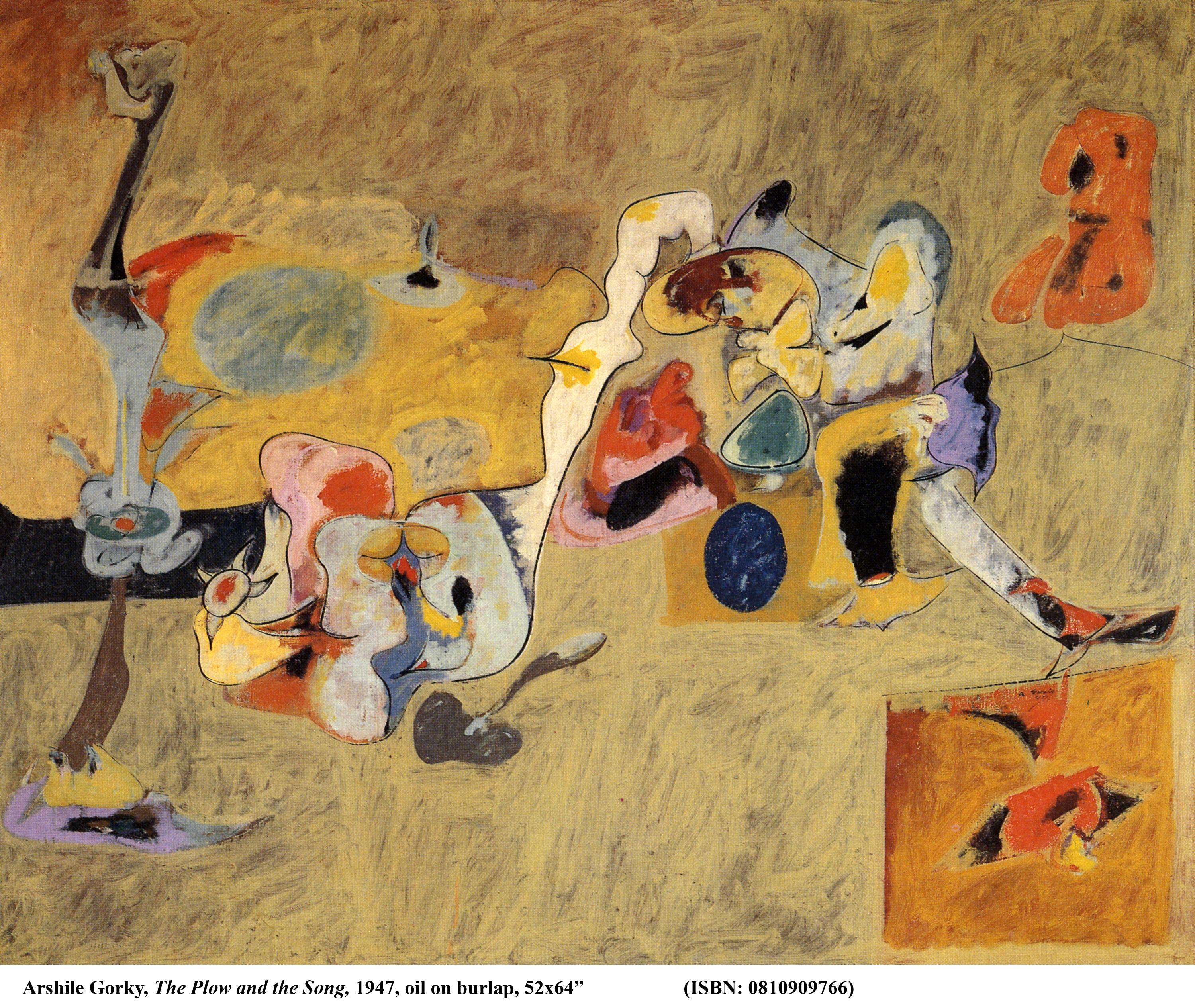
When I first heard that the winter Olympics would be held in Sochi, I thought it must be a beautiful place, endowed with sumptuous Russian landscapes. That’s because my primary association with the city is a series of paintings that Arshile Gorky (born, Vosdanig Adoian) created in 1940 through 1943, titled Garden in Sochi. So I present several digital reproductions of them with commentary inspired not only by these wonderful paintings but by two aspects of the Olympics that have grabbed me.

The first event was the performance at the Cultural Olympiad in Sochi by the Brian Lynch Quartet, led by the Grammy-winning, Milwaukee-raised trumpeter who has worked in the bands of many jazz greats including Art Blakey and the Jazz Messengers, Horace Silver, Toshiko Akiyoshi, Phil Woods, and Eddie Palmieri. I recently wrote at length about Lynch’s recent recordings on another Culture Currents posting. But he played a time-honored role as an American cultural ambassador and he’s a product of both Nicolet High School and the Wisconsin Conservatory of Music, and the surprisingly vibrant jazz scene of Milwaukee in the late 1970s and early 1980’s.

I’m also celebrating the first gold medal ever won by America in ice dancing, thanks to the dazzlingly executed and sublime performance of Meryl Davis and Charlie White, a duet performance that few artistic athletes could equal, a testament to youthful dedication and vision.

So my subject is art and its resonances and, if they had asked me, the Cultural Olympiad would have borrowed one of Gorky’s Sochi paintings and used it as a motif in their promotional efforts for the Olympics. These beautiful works are both evocative of the region’s natural splendor while being distinctly modern in their abstract and dynamic lyricism. I now see certain athletic postures and gestures in these forms.

In the painting above, see the figure in the upper left, seemingly balancing on one leg and holding other limbs and bodily forms out in a complex and exuberant manner. Throughout the composition, the undulating forms can be seen as expanding and contracting muscles and tendons amid exertion and artful self control. Gorky surely never consciously intended such associations, but they seem valid now, because this is an art of allusion.

“By allusion the thing alluded to is both there and not there,” the critic Harold Rosenberg wrote of Gorky’s abstract work. “Allusion is the basis upon which painting could, step-by-step, dispense with depiction, without loss of meaning.” Thus, I contend the meaning could become multi-various, like the forms that arise in a garden each spring, related to forebears, yet each possessing unique character.

Allusion’s regenerative meaning was achieved through “emotional reference, evoked by color, shape, by movement…” Rosenberg wrote, which brings us back to physical art of movement, like ice dancing. 1

Rosenberg and a number of other observers also see the weight of history in Gorky’s work, as did the artist himself. His art testifies to the plight of the almost perennially oppressed Armenian people, an experience that many indigenous cultures of the sprawling regions of greater Russia endured as well, through that nation’s troubled, tragic and powerfully human history.

As a teenager, Gorky tried to flee with his mother and his sister Vartoosh to escape the Turkish genocide of Armenia. These children and Lady Shushanik were forced on the 100-mile “death march” of 1915 to the frontier of Caucasian Armenia. The mother grew sick as she refused most food and water that her children frantically searched for, because she cared about their health and welfare over her own. According to Vartoosh’s son Karlen Mooradian, “In a frenzied effort to obtain food money, Gorky, aided by Vartoosh, carved traditional Armenian women’s combs from ox and bull antlers acquired from street vendors, and tried to sell them.” 2 This experience may be a genesis of one of his most famous paintings,  The Liver is the Cock’s Comb which, though a later and more complex work, actually contains compositional parallels to the Garden in Sochi series. the-liver-is-the-cock-s-comb “The Liver is the Cock’s Comb,” Arshile Gorky 1944: Courtesy wiki paintings.com

The Adoian family had hoped to reach the Georgian capital, about 100 miles to the north and toward Sochi. But they never got beyond Yerevan, because the mother became critically ill from malnutrition and refused to leave the soil of Armenia.

After the government refused to allow the children to place their mother in a hospital for homeless genocide orphans, the brother and sister tried to care for her in an old “war-torn room in a dusty abandoned structure whose inhabitants had been killed,” wrote Mooradian. The roof leaked when the snow began melting near the end of the winter of 1919, and each morning before leaving, Arshile and Vartoosh “lifted up their mother and placed her on the window ledge to lessen the chance of forgetting wet.”

On March 20th of that spring, 39-year-old Lady Shushanik collapsed in the arms of her children — dead of starvation and of the genocide that killed two million Armenians, or three-quarters of the nation. The Turks were also warring with Russia, so Armenia became a great battlefield. At the time, Vartoosh was 13 and Gorky was nearly 15, and beginning to develop strong artistic sensibilities. 3

Vartoosh says that his mother taught her brother “the poetry of Van’s nature. Of the sea, plants, animals, the mountains and valleys, the earth and clouds. She was the port Queen. Gorky never forgot what she had taught him.’ Someday,’ he told me, ‘my paintings of mother will make her live forever.”  4 66512de13fdb7dfc318a40d0d0782e35 “Portrait of the Artist with his Mother,” Arshile Gorky, 1926-29, Whitney Museum of American Art. Courtesy pinterest.com

And a couple of paintings and drawings of their beautiful mother are among Gorky’s most famous works of art and show his mastery of traditional and modernist artistic portraiture. Gorky wrote in a 1943 letter that he should have really titled the Sochi series Garden in Khorkom, for a Gorky family garden in Armenia. Nevertheless, one can imagine that he envisioned this garden in Sochi as signifying the family’s deliverance — Sochi was the closest city in Russia that would not be under Turkish influence. In the letter,  he referred to the family garden, perhaps to gratify family members: “In that series I have, for example, depicted most prominently the beautiful Armenian slippers father and I used to wear, the ones we purchased in Armenia’s Van from the Armenian artists when uncle Grikor and I rode there by horse.”

Sochi 2 Another variation in Arshile Gorky’s “Garden in Sochi” series from 1943 nowritza.pwp.bluyonder.co.uk

The artist also depicts “my translations of mother’s soft Armenian butter churn, that pearl in the crown of our hard-working village women. How vividly those days imprint themselves in my heart.” (Note: There is controversy over some of the Gorky letters published by the late Mooradian, whom some art scholars accuse of forging or changing some of his uncle’s letters.) 5

This evocation also reveals Gorky’s deep affinity for Armenia’s ancient and widely influential culture, what Mooradian extensively argued is Gorky’s predominant “hylozoist” outlook. One can begin to sense the dark and deeply personal historical complexities of expression in Gorky’s inherently lyrical abstractions.

Rosenberg saw Gorky’s as work as less biographical while acknowledging their historical heft. Gorky was an extremely erudite amateur historian of art and his early work clearly claimed Picasso and Cézanne as influences. Joan Miro’s influence is also evident underlying some of the Armenian artist’s fanciful forms and compositions.

Gorky’s went on to become among the greatest of the first generation of American abstract expressionists, which included many immigrants who fled war-ravaged Europe, Russia and the Middle East. Willem de Kooning, who once shared a studio with Gorky, commented: “He knew lots more about painting and art—he just knew it by nature—things I was supposed to know and feel and understand. . . . He had an extraordinary gift for hitting the nail on the head.” 6

So, given Arshile Gorky’s sense of art’s historical threads of development, Rosenberg saw the abstract art as products of a program “experimental research.” : “Each of the different versions garden in Sochi is a rap upon a different stylistic door to the future, and a disappointed turning away when no answer comes.

“We can see today that the 1940s Garden was a sufficient opening through which unexplored regions might have been reached. Unfortunately, history, when it does supply answers, never labels them as such.” 7

So the Sochi paintings’ echoes of artistic allusion resonate with the dark clouds of historical experience, and yet remain alive with the inspiring energy of springtime — and of indomitable human achievement.

To make them a world community experience, pan-cultural events like the Olympics need all the historical resonance they can get.

Garden-in-Sochi-1941-by-A-001 3 A third “Garden in Sochi,” variation by Gorky, from the Museum of Modern Art. courtesy the Guardian.com

____________________________

1. Harold Rosenberg, Arshile Gorky: the Man, the Time, the Idea, , Horizon, 1962, 55-56

Karlen Mooradian, Arshile Gorky Adoian, , Gilgamesh, 1978,143

3. Ibid. 147-48

4. Ibid. 148

5. Ibid. 277 (NOTE: Arshile Gorky Adoian and sister Vartoosh escaped to America in 1920, a story recounted in a previous Culture Currents posting  https://kevernacular.com/?p=1848 which further details Gorky’s artistic development and relationship to his mother, and my visit with Vartoosh Adoian Mooradian and Karlen Mooradian. I was fortunate to meet them in Chicago, after they noticed a review I wrote of the 1981 Gorky retrospective at the Guggenheim Museum.

6. Melissa Kerr, Gorky Life Chronology, The Arshile Gorky Foundation http://arshilegorkyfoundation.org/gorkys-life/chronology

7. Rosenberg, 82-83.

Thelonious Monk died today in 1982. An obit column from back then

jazzmonkdizzy1

Monk and Dizzy Gillespie. Courtesy indulgo.com 

I guess I’ll call this posting “played twice” in honor of a composition by Thelonious Sphere Monk, the genius of musical cubism that danced and dwelled in its uncanny depths, which no one ever completely understood. But that didn’t matter. They understood more than enough, in the head and the heart.

As he once told Down Beat magazine: “Sometimes it’s to your advantage that people think you’re crazy.”

I realize my “played twice” is a recycled obituary column, but today, February 17, is the anniversary of Monk’s death in 1982. I wrote this for The Milwaukee Journal at the time, and as a fairly immediate response to the news of his death, so it has that emotional authenticity. Quite a few people liked this piece and I think it still holds up. Thanks to pianist and composer Frank Stemper for reminding me of the occasion.

For some reason, my blog editing is not allowing me to enlarge this scanned text. My apologies. If you can do so on your computer please do.

Or, try a right click to open this link in a new file: Monk obit doc
PLEASE NOTE: Readers with tablets ought to be able to expand the text of this obit to read it easily. For example, a Kindle Fire HD does the job well.

______________

*check out “Played Twice” on 5 by Monk by 5 on Original Jazz Classics from 1959.

Better yet, check out this video of Monk playing his “Crepescule with Nellie,” written for his long-time and beloved wife, Nellie. https://www.youtube.com/watch?v=QIVoOwOMq2c

Monk obit 1982 by K Lynch

Culture Currents adopts a new theme image from the Appalachian mountains

Welcome to Culture Currents, and its new header theme photo (above the headline of this post). I enjoyed using the Grand Tetons as a theme image but I recently contemplated the subject of a header and came up with this image as more apropos in its symbolism. It’s a picture of the Delaware River in the Delaware Water Gap of the Pocono Mountains. The Gap and this part of the river are actually in New Jersey and part of the great Appalachian Trail, the footpath stretching over 2,000 miles from Georgia to northern Maine.

So the river and trail signify a current running through the Appalachian culture that produced some of America’s great indigenous music, like bluegrass and country music.

And of course, the river is the key Culture Currents image because one of America’s greatest waterways, the mighty Mississippi, spread the profound and central currents of American vernacular music: the blues, gospel music, R&B and jazz.

And as previous readers know, this blog may explore virtually any noteworthy development or event of common (and uncommon) culture, regardless of medium, as well as political strains of culture.

So enjoy the new theme image and come on up and down the rivers and trails with me, and hear the vernaculars speak. We’ll stop off at virtually any port on the cultural map, from low-down folk to “high” art.
— Kevernacular (Kevin Lynch)

Grammy-winning trumpeter Brian Lynch salutes unsung heroes of his art

unsung_heroes_vol-1

Brian Lynch — Unsung Heroes: A Tribute to Some Underappreciated Trumpet Masters, Volumes 1 and 2 (Hollistic Musicworks)

Recent jazz rarely swings or sings with the fire and verve of these straight-ahead sessions. Brian Lynch, perhaps Milwaukee’s greatest baby-boomer gift to jazz, has trumpeted for such iconic names as  Art Blakey, Horace Silver, Phil Woods, Eddie Palmieri and Toshiko Akiyoshi.

With scholarly artfulness, Lynch mines compositions from unheralded trumpeters. He digs deep into their now-cold cases, like a detective with enough of a criminal mind to always get his man.

Lynch (no relation to the writer) earned the 2006 Best Latin Jazz Album of the Year Grammy for his album,  “The Brian Lynch/Eddie Palmieri Recording Project – Simpatico,”  It’s a near-definitive statement of Palmieri’s mature art and Lynch arranged all its large ensembles and produced the record. Still, he’s slightly undervalued in the landscape of brass giants, which may have inspired his sense of justice regarding these nearly forgotten musician-composers.

I heard Lynch often in his developing years in Milwaukee, and unforgettably once in a small inner-city club owned by a relative of the great saxophonist Sonny Stitt, who played there that night. Lynch was blowing when Sonny noticed something. While Brian played, the bebop legend bent over, grabbed the startled trumpeter’s upper back and jammed his palm into his gut, forcing him into a more erect posture to improve his projection. It worked, and Brian’s song burned brighter from that day on. Now it illuminates another layer of songfulness buried in the jazz tradition.

This recording project amounts to serious jazz archeology. Lynch says that almost all of the tunes on the two volumes were never recorded by other artists than the composers and two, by Idrees Sulieman and Tommy Turrentine on Vol. 2, though published, evidently have never been recorded.

There’s something special about Lynch’s dusting off these relative unknowns — as if you’re hearing trumpet bells that gleam fleetingly in sunlight that teases us amid clouds that beckon the blues. And yet here they are, captured in aural amber.

Brian Lynch - blog - vale esta

Trumpeter and bandleader Brian Lynch. Courtesy mwanaafrica.com

Tommy Turrentine is a street-corner poem in name and music. Add these names: Idrees Sullivan, Joe Gordon, Donald Byrd, Claudio Roditi, Ira Sullivan, Howard McGee, Charles Tolliver, Louis Smith, Kamau Adilifu.

These amount to dances with bebop spirits. Lynch’s own sinuous playing never calls undue attention to itself, yet it proclaims these compositions’ timelessness, and mourns the loss of their clarion call.  The project mixes of righteous covers and a few pitch-perfect Lynch originals.

Among volume one highlights: “Household of Saud” by Charles Tolliver, which searches ardently like a hunter traversing the peaks and valleys of time.

Here’s a video of the recording of Tolliver’s “Household of Saud”:

http://vimeo.com/channels/unsungheroes

Louis Smith’s bebop maze “Wetu” unfolds with effortless grace; the chops-busting changes seen as natural as breathing. Meanwhile, “RoditiSamba,” a Lynch composition dedicated to Roditi, saunters like a rake surveying the sun-blessed pulchritude on a Rio beach.

These recordings’ professional sheen never allows inspiration, conviviality or gutsy swing to take a backseat, thanks to saxophonists Vincent Herring, Alex Hoffman, pianist Rob Schneiderman, bassist David Wong, drummer Pete Van Nostrand and conga player Vicente “Little Johnny” Rivero.

Here’s a video of the recording of Tolliver’s Household of Saud:

http://vimeo.com/channels/unsungheroes

unsung2

Volume 2:

This 2013 release is  a separate CD but, coming from Volume one’s same three-day sessions, they fit together like a twin bros. Howard McGee’s floating “Sandy” pinpricks the soul with the sad majesty of memory. Idrees Sullivan’s “Short Steps” enchants while demonstrating how intervals shape melody and harmonic motion. Suddenly you hear Lynch’s own “Marissa’s Mood” (dedicated Ira Sullivan) — a more complex weave of changes and rhythmic phrasing — and understand how composers appeal, with the deftest strokes, to our head and our heart. Lynch’s solo, a gem of sustained melodic invention, and the ensuing ensemble carry the romantic torch like a handful of dancing long-stemmed roses.

Lynch dedicates the album to “the great Tommy Turrentine,” brother of renowned sax man Stanley, and includes Tommy’s “Gone but not Forgotten” which might aptly title this project, if not for the actual title’s click-the-heels salute to these trumpeters’ unsung glory, as a kind of fading musical ideal. The “heroes” add up to a substantial and satisfying reassessment of hard-bop history.

brian seated

                                           Lynch relaxin’ at Camarillo? Courtesy berkeleyagency.com

Among recent releases on Lynch’s Hollistic Music Works label are two albums that reveal his loyal appreciation of the Midwest jazz scene, and he’s featured on both. Lynch returns to Milwaukee frequently for residencies at the Wisconsin Conservatory of Music, one of which led to Combinations: Live at the Jazz Estate, co-led by Milwaukee-based trumpeter Eric Jacobson and saxophonist Eric Schoor, billed as the Eric Jacobson Schoor Quintet + Brian Lynch, and recorded at Milwaukee’s premier jazz club. It also features a rarely recorded Milwaukee legend on piano, Barry Velleman, a Monk-esque modernist, and the Conservatory’s crackling faculty rhythm section, Jeff Hamann on bass and Dave Bayles on drums.

The second recent Hollistic recording Naptown Legacy is nominally dedicated to Naptown a.k.a. Indianapolis, with its great tradition of musicians like the Montgomery brothers, Freddie Hubbard, J.J. Johnson, James Spaulding, David Baker, Slide Hampton and others. The date is led by drummer and Indianapolis native Ray Appleton, who has played with many of those Naptown greats as well many years with Wes Montgomery’s pianistic brother Buddy, who spent much of his career in Milwaukee. This date however, features a Milwaukee native, the swinging piano virtuoso Rick Germanson who’s making a strong name for himself in Manhattan and as a recording artist. (Full disclosure: Germanson played at my wedding, but don’t count that against him.)

Check out all the CD, video, educational and digital download offerings at Lynch’s label website: http://hollisticmusicworks.com/

CD cover photo credits: Vol. 1 — atane.net . Vol. 2 — brianlynchband.com 

A shorter version of this review was published in the Shepherd Express

_______________________

What are the most “popular” posts on Culture Currents? Here’s a full list.

Dear Culture Currents readers,

I thought that you browsing visitors might find this list of interest. This post contains the titles of each blog post that I’ve written here, ranked by WordPress according to the number of hits each has received.

So it’s a list of the most popular blogs in descending order. The most hits by far to date was at the home page/archives, representing people checking out my latest posting or searching through the archives, which are listed by months only on the home page sidebar.

So this new list allows a reader a little easier access to the archives. Simply click on any title and you’ll be directed straight to it. 

The most popular single post to date is my Moby Dick-like interpretation of Santiago Calatrava’s celebrated addition to the Milwaukee Art Museum (pictured above). I was also happy to see that many culturally attuned people apparently find it significant that Milwaukee has lost its last black talk radio station.

I realize “The Day the United States Hanged a Woman” is a provocative title, but the movie review amounts also to a fascinating true historical story that resonates today, regarding capital punishment.

And the Duane Allman posting is a testament to that great guitarist’s ongoing legacy, evident most notably in the work of Derek Trucks, co-leader of the marvelous Tedeschi-Trucks Band which, in my book, has no peer today among groups attempting to combine and expand on a wide range of roots music styles.
I hope this information helps you to enjoy Culture Currents (Vernaculars Speak) a bit more.
As always, thank you very much for visiting, reading and commenting.
Best,

Kevernacular (Kevin Lynch)

All Culture Currents postings in order of number of hits (listed after each title):

1.Home page / ArchivesMore stats3,108

2. Discovering a Famous Seafaring Scene in Calatrava’s PavilionMore stats490

3. The loss of Milwaukee’s black talk radio stirs memories of Marvin GayeMore stats485

4. “In Memory of Elizabeth Reed” — and Duane Allman *More stats479

5. The Day the United States Hanged a WomanMore stats463If These Quilts Could Talk: Signals along the Underground RailroadMore stats436Will the Wolf Survive — or Attack? Examining “The Grey” ControversyMore stats328Rembrandt: Last Chances To See a Life-Changing Work of ArtMore stats306A remarkable Mother’s Day story of an unforgettable “Lady” and her gifted son, Arshile GorkyMore stats242My All-time Best Americana/Roots albums.More stats221The Deadly Attack of the Smart Phone ZombiesMore stats205Ishmael and Queequeg: the Original Pan-Cultural Odd Couple?More stats175Samsara: A Wordless World of Magnificent Images (opens Friday)More stats173The Magician Behind Miles: Reviving the American Individualism of Gil EvansMore stats146Blogger bioMore stats133Garry Wills exposes the cultural roots of America’s gun mentalityMore stats124Kathy Mattea’s “Coal Journey” Back HomeMore stats116If Dylan wanted to back him up, he must’ve been a hell of a leader. On mountains, he was.More stats115A graphic version of T. Monk (but not Bud Powell) getting unfairly busted by racist cops…More stats112Jeffrey Foucault: Songwriter on a Train to YouMore stats112ResourcesMore stats99An Elegy to a Symphonic Musician — Bill BennettMore stats90Manty Ellis builds a new foundation for Milwaukee’s jazz sceneMore stats89Edward S. Curtis preserved America’s Vanishing Race for PosterityMore stats86Milwaukee’s Revived Jazz Gallery: A Beacon for Creative Freedom Burns AgainMore stats81Undecided Voters (in Swing States?): Who Are Those Guys?More stats81Gifted trumpeter-composer Philip Dizack will play three Milwaukee datesMore stats77The “Magic Book” of Weather Report and Zawinul interviewMore stats71More images from Edward Curtis and The Vanishing RaceMore stats69Eagle Wings and Byrd Calls, and a Gust of Defiantly Mystical RomanticismMore stats68Clyfford Still? Yes, the great American painter still holds up, in a whole museumMore stats64A grand dame of jazz presents a celebration of “Dexter Gordon @ 90.”More stats60The Aura of the African-American in Visual Art and CultureMore stats59Is the Tedeschi Trucks Band the Best American Group Working Today?More stats56They’ve got the back of the Man in Black: Johnny CashMore stats56Political Call and Response and The Falling Man Who Still HauntsMore stats55The paranoid and racist John Birch Society is alive in new guises.More stats51Tedeschi Trucks Band – Part 2: A Comparison and a Closer LookMore stats50Edo de Waart records Mahler/Harvey Taylor’s new trumpetingMore stats50Following the inextiguishable flight of The Grateful Dead’s “Dark Star”More stats50Riding with another African American as “guilty” as Trayvon Martin, and PipMore stats50My Best Jazz Experiences of 2012 (in memory of James Hazard)More stats49The Perpetual Adolescence of Match.com: Social Network Bans Moby-DickMore stats49Collage: Piecing Together Snips and Heaps of a Common Cultural Act — in ColoradoMore stats46Weather Report: From the First Lightning Bolt to the Rise of a Jazz TsunamiMore stats46Why Gore Vidal (1925-2012) Still MattersMore stats45Singer Jackie Allen’s Sophistication and Soul comes home to MilwaukeeMore stats45Out There in the Life and Time of Dave Brubeck (1920-2012)More stats44Photos That Made History and Make You RememberMore stats43The Adventures of Madame Maggie, or the Return of the Hound of the Baskervilles.More stats42Levon Helm and The Band: A Speculative Fictional Fragment and a TributeMore stats41The original Milwaukee Jazz Gallery’s Shadow and ActMore stats38Guy Clark and Darrell Scott: Country Troubadours for Our TimesMore stats38Bandleader Maria Schneider walks a wintry tightrope over her jazz successMore stats37Stepping Inside the Outside the Box New Music FestivalMore stats37My best albums of 2012 in roots vernacular musicMore stats34Thoreau on newsworthiness/ Environmental writing anthologyMore stats33Superband leader Christensen survives, but still fights for his financial lifeMore stats33Bluegrass inventor Bill Monroe (Sept. 13, 1911-Sept. 9, 1996) Springs a SurpriseMore stats32A Musical Meditation on Honor and Barack ObamaMore stats30Rediscovering a Cezanne Chateau in my BasementMore stats30Plucking Musical Fruit Deep in AppalachiaMore stats30Three Decisive Days of the Civil War, 150 years ago this weekMore stats30Paul Ryan: The Story of the Peanut Butter-munching Automaton and his GrannyMore stats29Night Thoughts of a Baffled Humanist: Marilynne RobinsonMore stats26Kenneth Lonergan’s “Margaret” endures a modern-day “Shock Corridor.”More stats25Rodney Crowell’s long and winding road back to EmmylouMore stats24Antler reaches for sky-born ideas and touches people down hereMore stats23Is She Safe Because Buddha is on the Smart Phone?More stats22Culture Currents moves to the Grand TetonsMore stats22P.S. On Trayvon Martin post. Is Zimmerman a provoker or a victim? (Give us The Watchman!)More stats22Riding with another African American as “guilty” as Trayvon Martin, and PipMore stats21Sand County Songs: Aldo Leopold’s Words and Ideas Make Beautiful Music.More stats21Maria Schneider just nabbed 3 Classical Grammies. Deservedly?More stats20Inside a real wild animal sanctuaryMore stats20“Edward Curtis and the Vanishing Race,” two more memorable samplesMore stats19Did I see yo mammy steal somebody’s Grammy? Kudos and KomplaintsMore stats19Toni Morrison on Melville and the Language of DenialMore stats19“Hope Springs” Bubbles Below the Oscar RadarMore stats18On 9/11 Anniversary: How Another City Survived its own Fallen Men (Women and Children)More stats18Five Visionary Musicians Travel to the Apocalypse and BeyondMore stats17Another list of ideas for action from Walter MosleyMore stats17The Tedeschi Trucks Band: As Timeless as the Red Rocks of ColoradoMore stats17P.S. On Trayvon Martin post. Is Zimmerman a provoker or a victim? (Give us The Watchman!)More stats17A Coen Brothers movie reaches for a rootsy wrinkle in timeMore stats16A Walmart Cinderella Sweeps Up on Desolation RowMore stats15“Big Miracle”: A video movie gem hidden below an icy Alaskan surfaceMore stats15“Trains That Passed in the Night” — How photographer O. Winston Link told a classic American storyMore stats14John Mellencamp and Stephen King conjur the Ghost Brothers of Darkland CountyMore stats14Wall Street on the Edge: A Deadly Margin for ErrorMore stats14The Flatlanders head for the hills, or was it for a sure-bet payday?More stats14A very brief photo essay on driving into AppalachiaMore stats14How can the government be everywhere stealing our guns, Senator Lee?More stats13Santana, Trucks and Tedeschi feelin’ goodMore stats13Climber-skiier-banojist Bill Briggs redux and a correctionMore stats12Trumpeter Jamie Breiwick plays at his CD release party Saturday at the Jazz EstateMore stats12Does Marion Cotillard forge an anti-Ahab heroine for our time in “Rust and Bone”?More stats12Heyyy watermelon man, the whole world hears you playin’ that jazz!More stats12While Republicans filibuster (and fiddle), the grieving wall of Newtown may come to lifeMore stats12You Doubt Ryan Thinks of Humans as Mathematical Digits?More stats12Thoughts of a saddened and bemused Bee Gees fan from 1967More stats12Paul Geremia Dwells in the Obscure Depths of the Blues He Brings to LightMore stats12Another trip, with abundant comic relief from politics and other ugly human doingsMore stats11WORDS, SOUNDS AND IMAGES OF COMMON (AND UNCOMMON) CULTUREMore stats11More thoughts on Levon Helm from Louie Perez of Los Lobos and a great videoMore stats10Jeffrey Foucault’s Cold Satellite Transmits a Yeats-like VibeMore stats10More stats9Digging (up) the Year’s Vernaculars, Roots and AllMore stats9Two Guys and Their GuitarsMore stats9More stats8Another dose of too-slippery-to-peg AmericanaMore stats8A few thoughts on “Take Five.”More stats7Getting down off your horse and savin’ a little face is as American as apple pie in the face.More stats7Fair is Foul and Foul is Fair. Hover through the Fog and Filthy Air!More stats7A Gust of Cooling Emily DickinsonMore stats7Amiri Baraka: A Native Son of Racial Reality and NecessityMore stats6“Black Radio” Radiates Across Milwaukee’s Great DivideMore stats5Local labor movement struggles for job creation.More stats4As Mittor Romsa awoke one morning from uneasy dreams…More stats4National Literacy Month is hereMore stats4Something to do, to be responsible for.More stats3Happy About a Hanging?More stats3now vote to recallMore stats3Does Walker walk the walk, too? Nah, he just pushes a pile he treats like garbage (cartoon by Kevin Lynch).More stats3#2 (loading title)More stats2What’s Scott Walker up to now?More stats2#1 (loading title)More stats2Moby rises again (intact) on match.comMore stats1

Russell Banks returns to short stories with a great novelist’s sagacity for human nature


15book Russell BanksÕ A PERMANENT MEMBER OF THE FAMILY.

Russell Banks  — A Permanent Member of the Family (Ecco) $25.99 228 pages.

From a son’s massive saga of his father, Civil War firebrand John Brown, to his incisive story collection, Russell Banks has demonstrated acute insight into human relations, in a myriad of their intensely pressurized, comic and tragic permutations.

Ostensibly about family in the broadest sense, these stories rarely comfort but reveal how most all of us strive upstream for human connection, an instinct often as haphazard as a windblown leaf.

Banks is best known as a novelist, and two of his books have been made into acclaimed films, Affliction and The Sweet Hereafter. His 2004 novel, The Darling, about the odyssey of a wanted 1960s radical, is in development with Jessica Chastain in the title role. His epic John Brown novel, Cloudsplitter, was a finalist for the Pulitzer Prize, and stands up to any historical novel in recent memory.

244717413_11321100_gal_answer_11_xlarge

James Coburn (right) won an Academy Award for best supporting actor in the film adaptation of  “Affliction,” Russell Banks’ novel of a troubled and divorced working-class man. The character is played by Nick Nolte. Courtesy sodahead.com

Two of his most provocative novels involve young protagonists. Rule off the Bone is a sort of picaresque mix of Huckleberry Finn and The Catcher in the Rye. Banks’ last novel, Memory of Lost Skin, follows the struggles of a very young man who has done a sentence for a sex offense, and must fend for himself in a fearful world that refuses to understand much, including his crime’s context, until a sociology professor takes interest in him. And yet, Banks was always a masterful short story writer. The previous collection Angel on the Roof contained all his short fiction, until this one.

The opening story, “Former Marine” exposes the fault lines of desperate paternal pride and love to heartbreaking and shocking effect. An ex-Marine can’t bring himself to admit to his three grown sons the precipice he has recklessly reached in his life. Along the way comes a scene in which the father stops in a movie theater to watch the recent film Lincoln. It seems an incongruous act for this man on the edge, yet very telling of humanity’s crooked path, following perhaps the instinct to find succor or salvation in the past.

The rest of the stories in A Permanent Member of the Family are comparatively muted in final effect, until the last story, but each illuminates the strange, comical and provisional beauty of human interaction in a seeming harsh world.

NY-CR529_SPEAKE_G_20131111172126

Author Russell Banks. Courtesy online.wsj.com

The title story concerns a divorcing family hanging onto the pet dog like a life buoy that each must pass among them in a manner that may not really save any of them. The father, struggling hard to keep the family intact despite diminishing odds, finally has all of his four daughters in his car at once. Hope springs anew. Then he makes a fatal mistake. A heavy pick and cold, hard earth come to signify the damage done to a family’s heart.

“Searching for Veronica” involves a mother’s enigmatic quest to find her missing daughter, but may be a search to find herself just as much. One conversation has a meta-consciousness aura, a rather literary contemplation of how blood and identity entwine. But it works completely as real-life dialogue, the mark of a master fiction writer.

Sometimes Banks’ people do find tender if temporary connections that strike deep chords of joy and pain. In “Lost and Found” a middle-aged man and woman rekindle romance after five years:

“It wasn’t male vanity. It was Ellen herself, a very specific woman, whose smoky low voice, green eyes, dry humor and right, interesting words, and yes, slender legs, that had got to him. That and the way she made him feel about himself…funny, smart, good-looking, and lonely. These were feelings about himself that he had lost, bit by bit, over the years of his marriage in middle-age, small increments of loss, so that he wasn’t even aware of the loss, until that night when they ended up alone in his room at the Marriott. Lost and, because of her, found. And then all of a sudden lost again. Until now.”

“Blue” is almost surreal, yet utterly plausible — a black woman, shopping for a car, is trapped in a far corner of the dealer’s large lot by a vicious guard dog. The salesmen, having pegged her a “tire-kicker” who’ll leave and return, close the lot. After hours, a young male Good Samaritan finally offers her hope of rescue, like a long lost son.

The closing story, “The Green Door” concerns a drunken family man fatefully attracted to a sex club, and a casino bartender-narrator, playing the classic role of social facilitator.

Yet, in these tales, nothing is quite as it seems, and Banks, with no contrivance, shines lyrical light and shadow upon his characters’ yearning and risk, suffering and loss, with sage understanding of the deep corners of human nature.

I suspect that these are stories, like those in Angel, that I will return to, and make permanent members of my family.

Here’s a video of Democracy Now’s Amy Goodman interviewing Russell Banks about his writing and his choice of writing through the voices of outcasts, criminals and revolutionaries. It includes a scene from the film The Sweet Hereafter, a story about “lost childhood.”http://barclayagency.com/speakers/videos/banks.html/1

A shorter version of this review was published in The Shepherd Express.

Editorial assistance by Ann K. Peterson

______________________