Milwaukee’s Riverwest is Restless and Alive

Linneman's

April showers Wisconsin with good music and wise words from Craig Taborn, Dave Stoler, and the Earth Poets and Musicians

Pianist-composer Craig Taborn. Courtesy Down Beat

Craig Taborn, solo piano, Café CODA, 1224 Williamson St., Madison, 7 p.m. Thursday, April 14. $30. For tickets:

https://cafecoda.club/2022/01/20/apr-14-2022-craig-taborn-piano-solo-bluestem-7-pm/

***

Earth Poets and Musicians, The Coffee House, in Plymouth Church, 2717 E. Hampshire St., Milwaukee, 7:30 p.m. Saturday, April 16, in . Donations will benefit the Indian Prairie Project via the Milwaukee Audubon Society. Pre-registration is required due to ongoing COVID concerns. Register Here

***

Dave Stoler Trio, Blu Nightclub, Pfister Hotel, April 22 (Earth Day). No Cover.

***********

If you are anywhere in southern or central Wisconsin right now, be alerted: pianist Craig Taborn,  will give a solo piano concert at Café CODA in Madison tonight, at 7 p.m. Thursday, April 14.

The Minnesota native has a load of contemporary and cutting-edge jazz performance and recording credits. After early influence from heavy metal and contemporary classical music, he discovered how such dynamics might reflect the profound cross currents of jazz when he assimilated pianist-composer Cecil Taylor’s brilliant 1985 orchestral album Winged Serpent (Sliding Quadrants). 

From there, Taborn proceeded to learn the jazz idiom, and eventually work with James Carter, Tim Berne, Roscoe Mitchell, Chris Potter, Dave Holland, John Zorn, Vijay Iyer, Kris Davis among others. In Madison, you’ll likely hear a generous sampling from his most recent ECM solo album’s Shadow Plays. These are mostly storytelling vignettes of certain concerns and concepts he values (“Bird Templars” or “Now in Hope”) or he thinks need highlighting (“Conspiracy of Things” or “A Code with Spells”).

For example, the album opener, “Bird Templars,” in a minimalist pulse, acts out the fluttering life-breath of a bird, with basso notes and tender, increasingly tensile interactive treble phrases that gradually suggest the growing symbiotic relationship between bird protectors and their aviary friends.

***

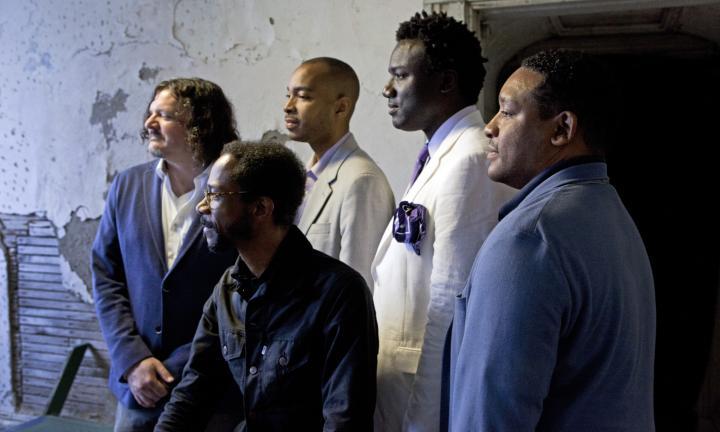
The Earth Poets and Musicians (pictured at top) will perform their 35th annual Earth Day concert on Saturday, April 16. The event will also include ecologist Jim Uhrinak (lower left) and and poet/singer Margaret Noodin (lower right) who is an Indigenous studies professor at UWM and and Director of the Electa Quinney Institute for American Indian Education.

Then on Saturday, the interdisciplinary Earth Poets and Musicians will present their 35th annual concert to celebrate Earth Day ( which actually isn’t until Friday, April 22) at Plymouth Church. It will feature Jahmes Finlayson, Holly Haebig, Suzanne Rosenblatt,  Harvey Taylor, ecologist Jim Uhrinak, and poet/singer Margaret Noodin who is an Indigenous studies professor a and Director of the Electa Quinney Institute for American Indian Education. Here’s a Youtube of a TEDxUW-Milwaukee Noonan presentation:  https://www.youtube.com/watch?v=ddyFh1Rdho4&t=65s

This event will focus this year on the Indian Prairie Project, and reclaiming awareness and appreciation of the Indigenous Menominee Community. Donations will benefit the Indian Prairie Project via the Milwaukee Audubon Society. The event will be streamed at 7:30 p.m. and archived for later access. Check the website the week of the concert to see if the show will be live.

***

Finally, if you’re planning (like me) on helping clean up your city’s natural spaces on Saturday, April 23 with Milwaukee Riverkeepers, you might fortify your body and spirit the night before (Earth Day evening) with a heaping helping of the Madison-based Dave Stoler Trio: protein-packed, hard-swinging, straight-ahead jazz, at Blu Lounge, at the top of the Pfister Hotel, 424 E. Wisconsin Ave., in Milwaukee, from 7 to 11 PM, Friday, April 22. (There’s no cover, so don’t forget the musicians’ tip jar).

Pianist Stoler’s straight-ahead bona fides (powered significantly by his long-time trio mates, bassist Chuck Ledvina and drummer Dave Bayles) don’t suggest his range and versatility. The Madison native assembled his own full jazz orchestra for a tribute concert of the music of the great composer and arranger Thad Jones a few years back for the Isthmus Jazz Festival.

He’s also the co-founder and keyboardist of the coolly ebullient 16-member Steely Dan tribute band Steely Dane, and has long held up the pianistic end of the Tony Castaneda Latin Jazz Sextet, and The Ben Ferris Octet and The Darren Sterud NOLA Tribute Band.

Among national and regional musicians in the know, he’s highly esteemed. Quiet as it’s kept, Stoler’s recording, Urban Legends is a classic of its kind, and remains available on cdbaby.com. and Spotify, and features drummer Billy Hart, bassist Ron McClure and tenor saxophonists Rick Margitza and Rich Perry, of the Maria Schneider Orchestra.

Stoler performs regularly with his trio and quartet at Smalls Jazz Club in New York City.

And if you miss this Friday date, the same trio will be performing at Blu on Saturday night at 7 p.m., under the guise of The Dave Bayles Trio, with a completely different repertoire. Actually, this might be the most seasoned working jazz piano trio in Wisconsin. Stoler, Bayles, and Ledvina served as the house band for about a decade in the night club atop the rotating Hyatt Regency Hotel in Milwaukee. So they may have unparalleled experience performing at high altitudes (for downtown Milwaukee). And answer me this: How often you can get “nosebleed” seats that are only a few feet away from the stage area?

Color your music Blu next weekend.

________


A Tale of Two Tails (Or Almost That Long)

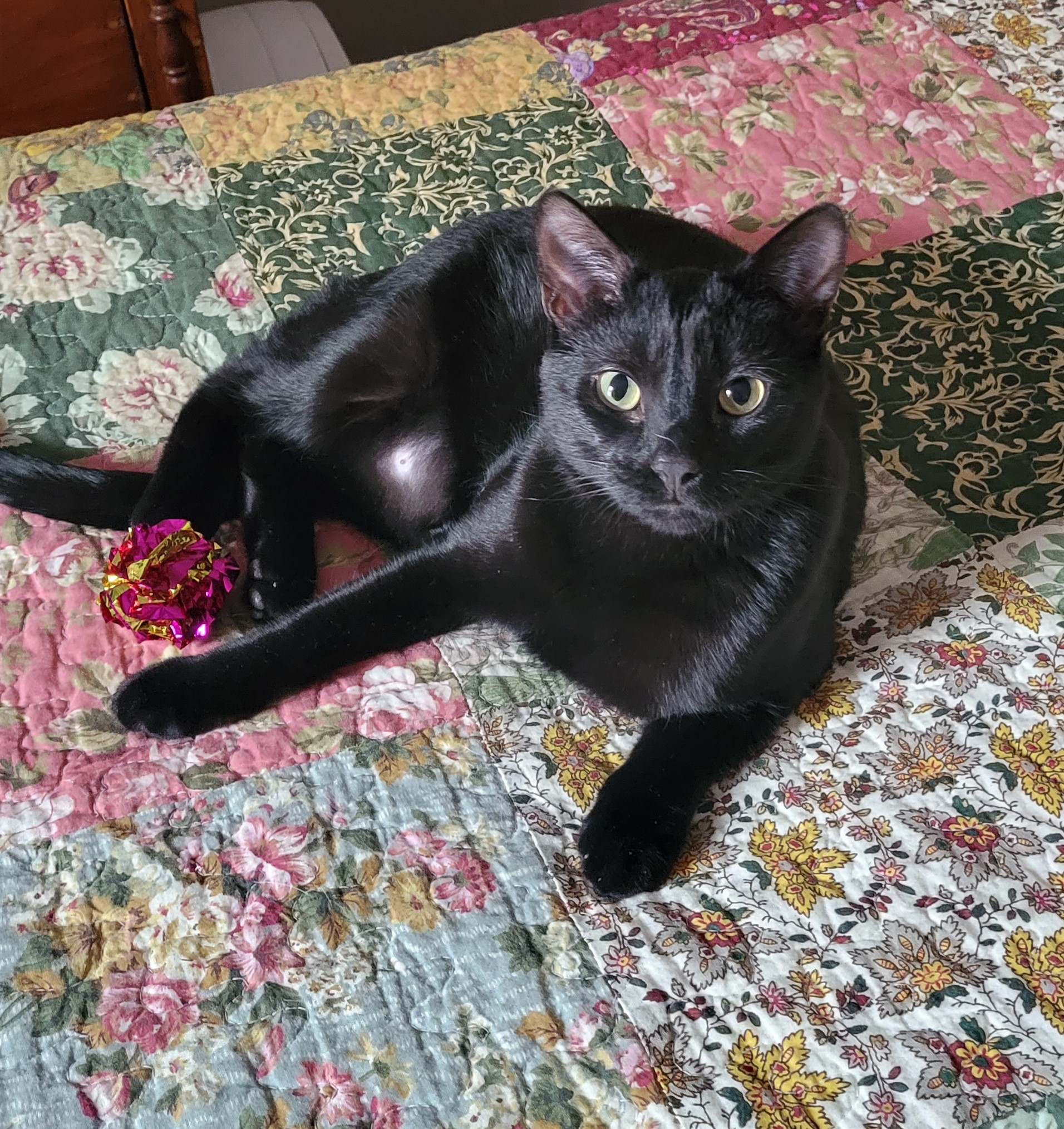
Eddie “Little Count Dracula.” Photo by Kevin Lynch

***************

Chapter 1: Taking “the leap” with a little black cat who thinks he can Fly.

It was the best of times, with our two aging cats, slowly and uncertainly getting to know each other. Then, it was the worst of times, though Ann and I had the best of intentions, when we brought “Eddie” into the house.

It’s debatable whether, for me and my gal pal Ann Peterson, it was “the age of wisdom,” as Dickens once proclaimed, to begin a famous tale. When I moved in with Ann last year, we instantly became a three-cat household, deeply exacerbating the absurdity of me being a cat owner my whole adult life, while being allergic to cats. Before too long, my asthmatic wheezing started getting worse, despite Ann’s assiduous dusting and vacuuming.

But Taj, her big, crazy black cat, got sick about five months after we moved together and, as cats will do, he died quite soon afterwards. It was a great loss I’m sure for Ravi, her creamy-white semi-Siamese scaredy-cat, who had been housemates with Taj since Ravi’s kittenhood. 1

Ann Peterson with our first set of three cats (L-R) Chloe, Ravi (in background) and Taj (facing Ann), before the black cat passed away. Photo by Kevin Lynch

But it seemed an even greater loss for Ann, I think. First of all, Taj was unbelievably attached to her. A “pet psychic” she had once hired, did a phone “reading” long distance and declared of Taj: “That is the neediest cat I have ever encountered.” He was persistently jealous of any book she was reading and tried to horn in past the book, to stick his face into hers, especially when she was reading prone, in bed. Ann loved and hated Taj’s clinginess in seemingly equal measure, and his often hyper-goofiness entertained her no end, well, until the end.

However, she is also the most squishy-hearted, animal-centric person I’ve ever met (She claims her two sisters are “worse” and, indeed Cary and Jennifer both own more pets than we do). She actually had two cats and two dogs when I first met her although, by the time she moved to the east side from Wauwatosa, the two dogs had died.

So, she began to make up for those losses by volunteering to walk dogs at the Humane Society on Saturday mornings. Now, she daily checks on the current dogs on her cell phone, to see which ones might’ve been adopted overnight and, to her great chagrin, which end up being returned to the Humane Society for not quite fitting into the household.

“Oh, Capone is back!” she cried out yesterday. Of course, you wonder why the dog ended up with that name. “But he’s the sweetest guy, so polite,” she always says of most any returning dog who apparently violates parole. Yeah, sweet like crafty Capone was, just before he pulled his gun to waste an old crony who’d betrayed him.

Ann promised me she would never again try to bring a dog into her house, despite all her angst and strong affection for these mangy, sometimes handsome, and eager dogs. So, I was hardly surprised the day she suggested we look for a kitten who might begin to replace the playmate/pal role that Taj made in Ravi’s life. By then it had become clear that Ravi and my cat, Chloe, though now beginning to peaceably coexist, would unlikely ever be close buddies, as Chloe had been in a one-cat household for so long.

So, I agreed to the idea, somewhat warily, and sure enough, Ann quickly found a three or four-month- old black kitten in a foster home, waiting for just the right real home.

We went to visit the cat — a lean, wiry shorthaired little critter, unlike the fat and long-haired black Taj. He was just as charming and crazy as you would expect a kitten to be, so we were hooked.

Chapter Two: Life (and Fear and Loathing?) with Eddie “Little Count Dracula” the cat.

When we brought him home, almost instantly all hell broke loose. I only slightly use the term figuratively, as it wasn’t long before the cat, whom we named Eddie, took on the role of a satanic intruder. I thought Eddie was a fine name, not because it’s my middle name, but because he right away reminded me of Eddie Haskell, the smart-ass neighborhood troublemaker on Leave it to Beaver. He even talked a bit like Eddie, with sort of a whiny, scratchy voice, not at all like my Chloe’s almost lyrical meow.

And when it’s time for chow he schmoozes me with intense body rubbings against my legs, just like Eddie Haskell would schmooze Beaver’s mom — “Good-afternoon, Mrs. Cleaver, you’re looking especially lovely today” — and might get rewarded with a piece of cake, despite having just dunked her son’s face in a mud puddle in the backyard. Otherwise, Eddie the cat often runs away from me because I’ve begun to become sort of the “bad cop” in our disciplinary efforts. Of course, that mad dash is at least as much his manic energy at work, as cat toys of all sorts bounce and skitter around the floor.

Ann and I quickly got dizzy watching Eddie zoom back-and-forth through our Riverwest flat, but that was laced with anxiety because Eddie was often chasing either my Chloe, or Ann’s Ravi, and usually tackling and roughing up the victim a bit. If it were football he would be repeatedly charged with a personal foul for unsportsmanlike conduct.

Eddie soon was creating chaos for all of us while, of course, charming us with his kittenish playfulness and goofiness. It’s as if he had memorized the book a cat is reading in a New Yorker cartoon: How to Be Very Annoying and Cute. Part of the problem and the charm is that Eddie seems to be an extremely smart cat, which is saying something giving the superior intelligence of the species in general. So, he’s crafty, stealthy, cunning, and seemingly, at times, cold-blooded. In other words, he’s an unrepentant scoundrel.

Okay, here’s a cute example of his smarts. He invented a game with one of the little sparkly squishy balls he and the other cats play with. When an empty laundry basket is on the kitchen floor, Eddie will toss the ball into the basket, and then tip the basket over sideways. So now the ball is caught in the side webbing of the basket. But rather than simply pull the ball out again, Eddie delights in the fact that it is “in jail,” perhaps like he should be. So, he starts pushing the tipped basket around and it rotates across the floor on a circular axis, with the squishy ball dancing around along its sides. Neither I nor Ann, another lifelong cat-owner, have ever seen a cat do such a thing.

Watch Eddie in action: Eddie and the rolling basket

On the downside, at the most, shall I say, existential level for me, my asthma was once again getting worse, with three cats and Eddie often infiltrating our bed at night. Oh joy.

So, for my health and Ann’s relative nightly peace, we’re trying to keep Eddie out of the bedroom at night, another challenging “game” the elusive rascal’s too good at. Even when we successfully get him out of the room, our early morning slumber is often roused by the unnerving sound of Eddie jiggling the doorknob, trying to open it. If he had opposable thumbs, I would readily imagine him, already up on his hind legs, marching in upright, putting his paws on his hips and staring at us indignantly.

Ann wasn’t blind to the ever-complicating situation and a couple of times even broke down in tears, declaring her notion of finding a new playmate for fraidy-cat Ravi “was all a bad idea.”

Let’s step back just slightly. This story’s title comes from perhaps Eddie’s most distinguishing physical trait, which may also have symbolic value. As you’ll see in the top photograph, he has what Ann admits to being “a ridiculously long tail,” nearly two tails long. It does make you wonder, and I’ve begun to think of Pinocchio and his mythical nose, which would grow longer every time he told a lie. Perhaps Eddie’s tail grows just a tad longer every time he commits a household transgression, which is quite often. After apparently learning his lesson, Pinocchio, the wooden marionette, one day turned into a real boy, his fondest wish. If Eddie the real cat one day turned into a wooden marionette, someone’s fondest wish might come true, and things would be quieter and, um, “safer” around here, with no strings attached.

If one of these days his tail tip begins to grow a satanical spear-blade tip, we’ll know something is, um, following him and maybe us. Should I have honored Poe, not Dickens, in this tail of two black cats? Or perhaps Dr. Seuss, given the scene illustrated below? Taj’s bushy black tail actually had a crooked kink in it. By contrast, my calico cat’s black -and-brown-speckled tail has a lily-white tip, a signifier or not (Of course, Ravi can attest, Chloe has proven no angel in this house).

Understand, poor Ravi was an almost neurotically meek and fearful cat since the first time I met him, although Ann claims he improbably would initiate wrestling matches with Taj. Since his “black bro” has passed, and since Eddie arrived, Ravi has taken on the “clinging cat” role, and to a whole new level – from Taj’s in-Ann’s-face to on-her-head, that is, starting each nap or evening bedtime by laying literally on her head, and often kneading her hair into a rat’s nest, though I suspect Ravi might run away if he saw a small furry marsupial scampering around the house.

Ann prefers not to have her picture taken but, one day, realizing the situation’s ludicrousness, she wryly took a selfie, of her and Ravi (see below). Now she has finally begun to protest to minimize the hair kneading.

“The Cat as a Hat”: Ann (holding back a giggle) and Ravi, in bed. Photo by Ann Peterson

I think these photographs speak for themselves, worth the proverbial thousand words. So, as this little story has exceeded a thousand words already, I need to close. Things are getting a bit better around here, though I know any number of new owners would have by now deemed Eddie as severely violating his parole, and shipped him back to the Humane Society. I’ve never wanted to do that, while biting my lip when “Little Count Dracula” bites Ann’s neck or elsewhere, yet again. She has tearfully admitted she could never return him, despite the household strife. His high zaniness quotient does keep all four of us entertained, each in our ways.

We can only hope, somewhere over the horizon and a lucky rainbow, the worst of times around here come closer to the best of times.

_______________

  1. Culture Note: Despite Ann’s doubts of how much I liked her first two cats, I had been predisposed to do so partly because of their names. Her daughter Teresa had named Ravi after the great Indian sitar player Ravi Shankar who of, course, turned George Harrison and the Beatles onto Indian classical music and its spiritual implications. Shankar also influenced guitarist-composer Mike Bloomfield, who witnessed the sitarist’s Western star-making performance at the Monterey Pop Festival in 1966, and then wrote the title tune of the Butterfield Blues Band’s profoundly influential second album East-West. Though Ann doesn’t recall the genesis of Taj’s name, I prefer to think that a name-giver in her family really liked the music of Taj Mahal, the marvelously eclectic blues musician.


World-renowned jazz pianist Lynne Arriale comes home with a new album celebrating social and political heroes

Lynne Arriale has traveled a long ways since she left her hometown of Milwaukee. When she returns to Wisconsin for concerts in Madison and Milwaukee, it will be as a brilliantly mature pianist and composer whose music has grown and evolved into something profoundly attuned to social and political conditions of our time.

The Lynne Arriale Trio, with John Christensen on bass and Mitch Shiner on drums, will perform Saturday, April 2 at Café CODA, 1224 Williamson St., in Madison, at 7 and 9 p.m. Tickets are $25 per show. For information, visit https://cafecoda.club/.

Then, the trio performs in Milwaukee on Sunday, April 3 at The Jazz Estate, 2423 N. Murray Ave., at 7 p.m. Tickets are $20-$27. For information, visit https://jazzestate.com/.

Finally, Arriale will perform a master class on Monday, April 4 from 6 to 8 p.m. at The Helen Bader Recital Hall, of the Wisconsin Conservatory of Music, 1584 N Prospect Ave, Milwaukee. The class is free and open to the public.  For more information, visit https://www.wcmusic.org/concerts-events/master-class-series/  or https://fb.me/e/2k1sFSB4C

Always a fabulous musician, since winning the 1993 international great American jazz piano competition, she has come to realize the confluence of art and life, for its better and worse.

But before addressing her mature artistry further, I’ll suggest it’s probably too easy for those from a musician’s hometown to always think of her as “our musical daughter,” and never realize the scope of the artist’s accomplishments and acclaim. Jazz Police’s declaration of her as “the Poet Laureate of her generation” may sound a tad high-falutin’ for hometown folk. Yet, in a still culturally under-recognized city, we might take pride in a native’s success where we can get it. Arriale’s growth derives from her talent and drive, and the vast reach of her world-wide touring, recording and educating experience, accompanied by consistent acclaim.

Her full biography is rather dizzying. Awards and jazz chart-topping among her previous 15 albums aside, one of Arriale’s most distinctive honors was to be the only woman among a gaggle of ten all-star pianists in a tour of Japan titled “100 Golden Fingers,” which included Tommy Flanagan, Hank Jones, Cedar Walton, Kenny Barron, Harold Mabern, Monty Alexander, Roger Kellaway, Junior Mance and Ray Bryant.  It’s doubtful that a larger aggregate of distinguished mainstream jazz piano masters has ever toured together. Her musical collaborators include Randy Brecker, George Mraz, Benny Golson, Rufus Reid, Larry Coryell, and Marian McPartland.

Nor has it been all about Arriale the artist; this comparably dedicated educator was the first woman accorded a cover story for the magazine JazzEd. She has conducted master classes and clinics internationally throughout the US, UK, Europe, Canada, Brazil and South Africa. She’s also Professor of Jazz Studies and Director of Small Ensembles at The University of North Florida in Jacksonville.

Nevertheless, as much as any pianist of her generation, Arriale has dedicated herself to the distinctive art form of the jazz piano trio, as the late Bill Evans and company came to define it. As demonstrated in her new album The Lights Are Always On, she continues developing her synchronistic relationship with bassist Jasper Somsen, and drummer E.J. Strickland, one of my favorite percussionists of his generation. Yet, like most dedicated touring professional jazz musicians not named Keith Jarrett, she’s also an ace at working with local trio mates, as she’ll do in Wisconsin.

None of which, is to say that, on her own, she’s averse to sometimes enhancing the purity of the trio form. This was evident in stunning fashion in her magnificent previous album Chimes of Freedom. As I wrote at the time, “The title song, by Bob Dylan, and Paul Simon’s ‘American Song,’ both sung by K.J. Denhert, tenderly render portraits of humanity.”

Lynne Arriale. Courtesy JazzTimes

Arriale’s finely attuned and powerful playing and arrangements eloquently expanded upon the implications of those verses by two of our nation’s supreme songwriters.  Arriale increasingly reached musical and expressive inroads into the essence of the American experience, in all of its joy and suffering, celebration and loss.

Her new album furthers that quest, while asserting her own vision by composing all the music. The Lights Are Always On is a suite of compositions that reflect the world-wide, life-changing events of the past two years. Several of the pieces nominally honor heroes around the world, including “those who served as caregivers on the front lines of the COVID pandemic and as defenders of democracy,” amid the crisis of the last five years, and the Jan. 6 Capitol mob insurrection.

In the liner notes, Arriale explains the pointed and poignant meaning behind the title tune:

“This collection was inspired by the doctor and all front-line health care workers,” she says. “For me, Dr. (Prakash) Gada, (an esophageal and robotic surgeon in Tacoma, Washington) crystallized the workers’ sense of mission during
this extraordinarily challenging time. He said, ‘Here I am back at work after
COVID…I fled Kuwait after the invasion. No matter what happens, no one works
at home. The lights are always on. Babies are being born; bones are being set.
This hospital, this profession…we are in a league of our own; we’ll take care of you,
I promise. I stand next to the most fearless people I have ever seen.’ ”

The title tune coveys care and tenderness in Arriale’s delicate yet forthright phrasing and, as the piece develops into rising phrases and searching tonalities, a measure of dedication and courage, and the “better angels of our nature,” which she still believes in.  The tune is brief, as in a dedication.

The album opener “March On,” evokes dogged determination in a steady sequence of  minor Tyner-esque chording, as in the steady, tireless dedication of protest marchers for justice in America and worldwide. “notably in the 2017 Women’s March on Washington and those marching to protest the murder of George Floyd.” writes album annotator Lawrence Abrams.

Similarly spirited, “Sisters” is a feel-good, gospel-tinged aria for the advancement of women’s rights and equality, an anthemic statement of full-throated chords, octaves, and shining linear pronouncements, all riding Strickland’s groove-splashing cymbals.

Honor” alludes to Col. Alexander Vindman’s extraordinary courage and righteousness as a witness addressing the impeachment hearings “regarding Donald Trump’s scheme to withhold congressionally approved foreign aid to Ukraine, and thereby extort from that country a sham investigation of Trump’s rivals,” Abrams writes.

Somson’s bass solo seems to evoke the National Security expert’s very personal dedication to his father, who led him to emigrate from Russia forty years ago. Vindman’s story is all the more pointed amid the current Russian attack on Ukraine, after Trump’s weird “bromance” with Vladimir Putin. We know too, that Vindman was fired by Trump for his honesty.

Here and throughout the album, Arriale’s soloing is concise and emotionally to the point, as a performing composer, never lapsing into mere virtuosic display.

“Into the Breach” addresses the Capitol Police who braved the Jan. 6 mob trying to stop the certification of Joe Biden’s presidency win. Arriale doesn’t try to dramatically evoke the chaos, rather again focusing on the heroes, and the sense of dedicated bravery. Her chords and phrases halfway through reach into the upper register, suggesting rising blood pressure and stress. Again, a bass solo allows for thoughtful breathing room, while sustaining the urgency. “Into the Breach” conveys a grave almost Zen-like serenity, which may engender such courage, in the face of overwhelming danger.

The album also features “The Notorious RBG,” a dedication to the pioneering Supreme Court Justice Ruth Bader Ginsburg.

Especially memorable is the penultimate tune “Walk in My Shoes,” dedicated to the late Rep. John Lewis. The fairly chromatic dissonance of the chording conveys a masculine righteousness, steely passion and dignity — the essence of the spirit of this bloodied demonstrator in the Civil Rights era in the racist South, followed by a distinguished career as an eloquent firebrand for justice in Congress. I even like the way the tune fades out at the end, as if, even in Lewis’ passing, his spirit may come back, around the bend someday, in some form.


Milwaukee Jazz Institute will stage a concert to benefit a new scholarship for women jazz musicians

Saxophonist Juli Wood and vocalist-accordionist Robin Pluer will be among the performers Sunday at the Pat Petry Scholarship Concert at the Jan Serr Studio. Courtesy urbanmilwaukee.com

The Pat Petry Celebration Concert will be held from 3 to 6 p.m. this Sunday, March 27 in the Jan Serr Studio, in the Kenilworth Building, one of the city’s newest event venues, at 2155 N. Prospect Avenue, in Milwaukee.

Though most of the Milwaukee Jazz Institute’s more visible musicians are male, things are changing. The aggregation understands its “motherlode” roots as a strong independent music organization, growing notably with the city’s modern history of women musicians. Those include singers Jessie Hauck, Penny Goodwin, Adekola Adedapo, Donna Woodall, Marcya Daneille, and vocalist-accordionist Robin Pluer. There’s also pianists Lynne Arriale, Martha Artis, pianist-organist Beverly Pitts, violinist Sonya Robinson, the duo Mrs. Fun, and saxophonist Juli Wood, among others. 1 The Institute’s co-founder and managing director is also a woman, Erin Davis.

The late jazz singer Jessie Hauck with Manty Ellis on guitar and Berkeley Fudge on tenor sax. Courtesy “Milwaukee Jazz” by Joey Grihalva 

Milwaukee organist and pianist Beverly Pitts. Courtesy Wisconsin Black History Museum/Facebook

 Then there was one Marilyn “Pat” Petry, a patron extraordinaire, during the star jazz student heyday in the 1980’s, when young Wisconsinites emerged with national reputations, including Arriale, multiple Grammy-winner Brian Lynch, David Hazeltine, Gerald Cannon, Carl Allen, and others.

So, time has come to honor that legacy, and the MJI’s ongoing one, for the sake of Women’s History Month – in Milwaukee. The Institute has founded a scholarship for aspiring women jazz musicians in Pat Petry’s name, and will present a two-day fund-raiser event, both live and virtual. 

. The Pat Petry Celebration Concert will include members of the all-star jazz sextet We Six: trumpeter Eric Jacobson, pianist Mark Davis, guitarist Paul Silbergleit, and drummer Dave Bayles. Other featured performers include vocalists Adekola Adedapo and Marcya Daneille, vocalist-accordionist Robin Pluer, bassist Clay Schaub, saxophonist Juli Wood, Mrs. Fun (keyboardist-vocalist Connie Grauer and drummer Kim Zick) and drummer Bob Ellicson’s trio.

Then, on Monday, March 28, the Institute aims for a broader educational celebration as guitarist and jazz historian Silbergleit hosts an online program Women in Jazz: Keys & Frets. This will investigate women jazz keyboardist, pianists, and guitarists in jazz history.

The late Marilyn “Pat” Petry, with her son Daniel Petry, attending the grand opening of the Jan Serr Studio, which will be the site of the Pat Petry Celebration Concert on Sunday. The event is a fundraiser for a scholarship, in her name, for aspiring women jazz musicians. Photo courtesy Daniel Petry

None of this would’ve happened but for the legacy left by Pat Petry, a woman who supported jazz with a zealous heart and, in her distinctive way, might be compared to Lorraine Gordon of Village Vanguard fame, or Pannonica de Koengiswarter, Thelonious Monk’s longtime patron.

She grew up in Menomonee Falls, married and raised three sons on a dairy farm. In the 1970s she began travel industry work, which allowed her to travel to favorite cities, New York, Hong Kong, London, San Francisco, and New Orleans, while deeply cultivating her appreciation of jazz, according to her son, Daniel Petry, a scholarship organizer.

From the 1980’s until 2021, Pat Petry was a fixture at Milwaukee’s jazz clubs. In the crucial 1980’s, she friended the jazz faculty and students of the Conservatory, including Berkeley Fudge, Manty Ellis, David Hazeltine, Brian Lynch, Mark Davis, Juli Wood, Adekola Adedapo, Dave Bayles, Paul Silbergleit, and many others. As a travel consultant, she arranged trips for Lynch to and from New York and around the United States. She also worked with Wood on her many performance trips to Denmark, Sweden, and Norway in the late 1980s and 1990s.

In the 1980s and 1990’s, Pat shared a weekend apartment in New York and regularly attended theatre, then haunted jazz clubs at night, rubbing shoulders with many jazz legends.

Pat’s other passion included Women’s Rights, as a volunteer for many organizations, including Sojourner Peace Center.

Pat died on July 11, 2021. “Thus, the Pat Petry Jazz Scholarship was established by family and friends as a tribute to Pat’s passions for jazz, young women and education,“ Petry said.

For tickets and information, visit: Jazz benefit information

____

This article was previously published in The Shepherd Express, here: Shepherd Express article on jazz benefit

1 See forthcoming Culture Currents post about Lynne Arriale


Grace Slick and Jefferson Airplane fly into a storm of American discord

The situation begins to deteriorate quickly during a Jefferson Airplane performance which preluded the death of five people later at the infamous Altamont Motor Speedway concert. Photos courtesy The New Yorker
I just came across this video of Jefferson Airplane, which is illuminating and demonstrative in two contrary ways. The first is how it shows that Jack Casady is, in my book, the greatest bass player in rock history (as an ensemble player he exceeds Jack Bruce, perhaps a better improviser). It still amazes me how the propulsive power and rhythmic acumen of Casady’s playing drives this group. I think you can also feel how his bass intoxicates festivalgoers, along with some illicit drugs. His decades-long synchronicity with lead guitarist Jorma Kaukonen is also evident (The two went on to form the longer-lasing blues-roots duo Hot Tuna.) 1
The photos above of Altamont suggest how extraordinary these
live outdoor events had become for my generation, especially in that critical year of 1969. I make that claim with deeply bittersweet sentiment. That’s because the second demonstration of the video is the sad and ugly one. 
This was at the Altamont Motor Speedway Free Festival, which later in the evening turned deadly when Hells Angels killed at least one audience member during the Rolling Stones performance. 2
Here we see things not quite that bad. But the photo at top reveals a perhaps under-discussed aspect of the problem. The San Francisco-based Airplane, which had gained enormous popularity in the previous couple years, is on a small bandstand barely above ground level, and easily accessible by members of a crowd of stimulated young people that probably numbered several hundred thousand.
What we have here is a failure to plan properly. I mean this was a  “free” festival, for crying out loud. Other concert planners had been overwhelmed by the gargantuan crowd in rural Woodstock ,a short time earlier, so something should have been anticipated, even if Woodstock was a truly peaceful event.
In the video we see particularly the efforts of the band’s lead singer Grace Slick (and singer-guitarist Paul Kantner) in trying to get things under control, in her own inimitable way. Slick cajoles for calm, then points out that, even though Hells Angels are the heavies here, people in the audience are also getting out of hand by scrambling on stage.
It was the prelude to what many declared the death of the ideals of the Woodstock generation. Those ideals hardly died that night, but they began to face up to the harsh realities of life in America, as it teetered like a troubled neurotic between the Man in the Gray Flannel Suit complacencies of the 1950s and the Revolutionary 1960s. The Airplane, of course, embraced the later ethos with almost desperate heroism in their album Volunteers, released only months after Altamont. There’s very telling irony in the song the band was playing in this video: “The Other Side of this Life.”
Because of the visible violence, the video is age-restricted:

Here’s the YouTube clip:

____

  1. For those further interested in this era from the viewpoint of a key Jefferson Airplane musician, Kaukonen’s engaging recent autobiography Been So Long is worthwhile.

2 For a far more in-depth piece on this event here’s an essay from The New Yorker: https://www.newyorker.com/culture/cultural-comment/the-chaos-of-altamont-and-the-murder-of-meredith-hunter

Mary LaRose the singer resurrects Dolphy; LaRose the artist captures many jazz musicians in pastel

Reviews: Mary LaRose – Out Here (Little i Music), and Out There: Visions of a Sound, jazz portraiture art book by LaRose

Jazz singer/visual artist Mary LaRose embarked on one of the most daring and enlightening projects I’ve heard in a long time. Out Here lovingly reimagines compositions by, an associated with, Eric Dolphy, the supremely gifted multi-instrumentalist who died tragically at 36, in a Berlin hospital, of a diabetic coma after physicians presumed him merely a drugged-out jazzer. 1

LaRose and an excellent quintet resurrect Dolphy. 2 Jeff Lederer’s clarinets superbly evoke Dolphy’s exclamatory, sinuous playing style. Drummer Matt Wilson goes “out there” like a dancing tightrope walker. LaRose ingeniously sets Dolphy’s music to vocalese and scatting. She reveals the meaning of tune “245” — the Carlton Street address in Brooklyn, where many jazz musicians resided. She’s a “fly on the wall” in this hippest of abodes.

She shows that Dolphy’s “Out There” — “You’ve got to push yourself, get out there.” — is cutting-edge but not free jazz, sustained like a gyrating thread of many colors. Her singing lends warm humanity to Dolphy’s wide intervals, his way of releasing, and containing, musical expression. “Music Matador” revels in Dolphy’s underexposed roots in lilting Panamanian rhythms.

“Serene,” is a Zen-like meditation on the sublime relationship between syncopation and relaxation. “Love Me” (a Victor Young standard Dolphy recorded in duet with Madison-based bassist Richard Davis), is here a duet between LaRose and bass clarinetist Lederer, who are married, and they radiate nearly erotic sensual interplay.

Finally, a Mal Waldron tune that Dolphy debuted, “Warm Canto” glows, accompanying LaRose’s poetic ode to death, as strangely moving as anything modern jazz song has produced: “When I am dead, make art of my bones, bleach and dry them in the sun/ pure white, startling as stars…”

LaRose recites these lyrics, in the first person, in a tender yet declamatory tone. She seems to strive to both honor and inhabit Dolphy’s long-passed but ever-present spirit. A vividly-imagined, wholly-personalized evocation of the man and the artist.

Give thanks that time has allowed her, and the sun Out Here, to rise and shine on his legacy, to lengthen it to more proper fulfillment.

This album review Was lowercaseriginally Published in the Shepherd Express in slightly shorter form:https://shepherdexpress.com/music/album-reviews/out-here-by-mary-larose-little-i-music/

***

Jazz singer-songwriter-artist Mary LaRose in her studio, where she produced the art for her new book “Out There.” Courtesy Jazz Times

During LaRose’s period of this creativity, largely the pandemic, she produced far more than just a great album of music. She is also an accomplished visual artist, who studied with the famous realist painter Philip Pearlstein. She has also published, in conjunction with the album Out Here, a book of her portraits of jazz saxophonist’s, titled Out There: Visions of a Sound, (the main title is also the title of a well-known Eric Dolphy album).

The book is a limited edition of 100 copies, and at least as comparable an accomplishment as the album, in its own way. It’s one of the finest collections of jazz portraiture artwork I’ve seen, given that jazz portraits are far better-known in photography. 3 How many people can say they transmuted the year of the plague into so much quality productivity? 

LaRose consciously chose to set her work apart from jazz photography by not basing her portraits on photographs, but rather on videos of the musicians. That way, she could strive to capture more of the dynamic essence of the musician, without venturing far beyond her realistic discipline. Rather than hard-edged realism, she uses pastel crayons on black paper to highly evocative effect, on all of the portraits except for the color cover portrait of Dolphy, which is oil on canvas, and also the cover of the album.

That painting is much more of a painterly exercise, with dancing red tones around Dolphy and his flute, which seems to evoke, and perhaps defy, Dolphy’s famous quote, “When you hear music, after it’s over, it’s gone in the air; you can never recapture it.”

Otherwise, she contains her interpretive and expressive skills in the depiction of the musician himself. In the No. 9 portrait of Yusuf Lateef, the musician who first inspired her to do this series, his eyes glint amid his most prominent features, all hovering in darkness, as striking as the ghost of Hamlet’s father.

Yusef Lateef, by Mary LaRose, pastel on textured art paper, 2021

Pastel crayon is a still-underappreciated medium (which I myself have used extensively). It provides a palpable presence that is perfectly enhanced by the textured black art paper. This embraces the blackness of most of these musicians, but these could be called “noir jazz” portraits, given that noir aesthetics in film, typically accompanied by jazz scores, emerged in the 1940s and ’50s, when most of these musicians got their starts. Time after time, LaRose reveals how shadows haunt and mystify, to varying degrees, each musician, even as her colors render the face vibrant. Most features a distinctly sculpted, though alto saxophonist Jimmy Lyons, who played for years with the great pianist Cecil Taylor, is almost abstracted into a dream of a jazz face on Mount Rushmore.

Overall though, there is little mistaking most every musician. So, a fun game to play — for those knowledgeable of jazz reed players from the ’60s and beyond — is to see how many you can identify, without seeing the name on the facing page.

However, the greater value of the book is the expressive artistry LaRose brings to her rough-hewn realism. She superbly she captures the facial traits along with the physical effort and technique necessary to play a reed instrument. In other words – – as her reed-playing husband and musical collaborator Jeff Lederer notes in the book’s introduction – she focuses on the embouchure of each musician, a fair assessment.

Still, it is her hand and eye, guiding the meandering line of pastel crayon on black paper that lends the vitality to these interpretive portraits. That attuned line and mottled texture almost work like a lasso, whirling and catching each subject or, as Miles Davis once put it, “chasing down the voodoo.” This cumulative effect renders them as “black saints,” the title character-type whom Charles Mingus addressed in his masterful album The Black Saint and the Sinner Lady. That titular character was reportedly inspired by Dolphy.

Among her most haunting portraits are two successive ones of the late Albert Ayler, who was found dead in New York’s East River in 1971, a mysterious “drowning” to this day. Ayler possessed a large-eyed countenance of radiant spiritual innocence. In the first portrait, Ayler is not playing. Rather he gazes directly into the viewer’s eyes, possessing here a curious serenity. In the second rendering (below), he’s playing his tenor sax but the eyes still remain riveted on the viewer. Does he see his darkly looming destiny? Or is it a spirit, reflected in you, the recipient of his fire music?

Albert Ayler, by Mary LaRose. Pastel on textured our paper 2021

There are many monochromatic portraits executed in white pastel, and others amount to lively masks of many colors. One of the most striking of those is of Guiseppe Logan who, in a life-worn face of crevasses and cavities, seems to feel “the black man’s burden” Here for every day that his life of abject obscurity subject him to.

Guiseppe Logan, By Mary LaRose, Pastel on textured our paper, 2021

There are six more portraits of Eric Dolphy’s handsome and sensitive face, aside from the cover painting, signifying the importance he holds in LaRose’s eyes. Here we see the range of his virtuosity on flute, alto sax, and bass clarinet. That brings a measure of justice to this musician, especially considering how his career was cut short – by what may have been racist stereotyping judgment by attending doctors when he died, just as this refined man was reaching full maturity as an artist. Not all these men are dead. Yet, such superb portrayals of such blacks saints who were, to varying degrees, “Invisible Men” in their lifetimes, amount to a tender, precious honor to them. With the music, it’s almost as if we can freeze-frame them in our mind’s eye – a moving image of musical life in the very breath of creative ferment.

The book also includes an artist’s statement, an introduction by Lederer, and an index of the video sources for each of the portraits.

Along with the innovative album Out Here, the book Out There is a treasure trove I will revisit often, and learn from, as a visual artist working in the same medium. Yet Out There has traveled far further than any mere academic exercise.

Both the album Out Here and the portrait book Out There are available at the record label’s Bandcamp page, here: https://littleimusic.bandcamp.com/merch

__________

1 Apparently unbeknownst to doctors, Dolphy was a teetotaler who didn’t smoke cigarettes or take drugs.[11]

Ted Curson, a trumpeter who worked with Dolphy in Mingus’s band, remembered: “That really broke me up. When Eric got sick on that date [in Berlin], and him being black and a jazz musician, they thought he was a junkie. Eric didn’t use any drugs. He was a diabetic—all they had to do was take a blood test and they would have found that out. So he died for nothing. They gave him some detox stuff and he died, and nobody ever went into that club in Berlin again. That was the end of that club”.[62] Shortly after Dolphy’s death, Curson recorded and released Tears for Dolphy, featuring a title track that served as an elegy for his friend.

2. LaRose previously did an excellent album titled Reincarnation, taking the same approach to compositions of Charles Mingus, the great bassist, composer and bandleader, who was Dolphy’s longest employer before he went solo.

3. The only recent jazz portrait artist I can think of with comparable quality is Madison-based Martel Chapman, who works in a very different, cubistic style of portraiture.


“Solve for X” finds Jamie Breiwick and Jay Mollerskov as a musical Holmes and Watson?

Review: Jamie Breiwick & Jay Mollerskov – Solve for X (B Side)

Jamie Breiwick emerged by leaps and bounds as the most important jazz musician on the Milwaukee scene in 2021. The trumpeter-composer-conceptualizer works in both straight-ahead and cutting-edge realms.

His hip-hop/jazz trio KASE opened for Terence Blanchard’s E-Collective at the Marcus PAC, and he released a stunning bevy of albums, mostly on his own B Side label, but also, The Jewel (Live at The Dead Poet), a trio date on Ropeadope, with internationally-known drummer Matt Wilson, recorded live in New York.

Among the self-released albums, his latest, Solve for X, may be his strongest experimental album yet. The album cover by local printmaker Jay Arpin, depicting a massive iceberg, suggests the project’s quietly vast ambition and its “granular synthesis.” The album comprises “electronic works based completely on Jamie’s trumpet playing as the sole sound source.” The enigmatic title, borrowed from the Arpin print’s, suggests a creative inquiry as profound as the dimensions and revealing textures of the largely-submerged iceberg – the two musicians as a sort of musical Holmes and Watson, investigating a mysterious symbol perhaps signifying evidence of climate catastrophe.

Breiwick’s longtime friend, guitarist-synthesist Jay Mollerskov, took recordings of the trumpeter’s themes and solos, and mutated them into “granular landscapes” for the elegantly winged horn, a myriad of textures and tones. Breiwick displays exceptionally sustained lyricism.

On “Strata,” the ascending atmospheric spaciousness seems to virtually lift you out of your chair, beyond yourself, as if gazing down on the earth (in another strata), even suggesting a pensive moral pondering of humanity below. Here and elsewhere, the minimalist tonal aesthetic offers maximal textural effect.

“Traces of Things,” with its episodic fragments, suggests Thelonious Monk’s “Evidence.” Finally, “Reflect” delicately grounds the sonic outer limits like a mile-high kite-string, with rather gorgeous horn playing, including Breiwick’s son, Nolan, dueting with his father on trumpet.

Yet another Breiwick-brainchild album, KASE + Klassik Live at the Opera House, was just released this week, featuring Klassik, the brilliant Milwaukee-based hip-hop singer-songwriter and multi-instrumentalist.

For more information, visit:

B Side Recordings

_____________

This review was originally published in slightly shorter form, in The Shepherd Express: https://shepherdexpress.com/music/album-reviews/solve-for-x-by-jamie-breiwick-b-side/

Trumpeter Brian Lynch honors the late Neal Chandek with his recording of “Chandek’s Den.”


Pianist and trumpeter Neal Chandek (1955-2022) Courtesy Transfer Pizzeria Cafe


Music makes for memory that lives on, in the deep vibration and pulse of life everlasting.

Multiple-Grammy-winning trumpeter-composer Brian Lynch has done eloquent honor to a dear friend and to some of his musical roots by posting his composition “Chandek’s Den,” on the Facebook link to my blog tribute to Neal Chandek, 1 the remarkable Milwaukee keyboardist and trumpeter who died last week of complications of Covid-19, at 66.

When he still lived in Milwaukee, Lynch was a once a roommate of Chandek’s, and his composition honors the open-door crib that Chandek maintained in Riverwest for backroom jamming and music listening during the 1980s and early ’90s. This was when Lynch, Chandek, and the pianist on this album, David Hazeltine, were among a generation of musicians coming of age during a Renaissance for jazz in Milwaukee. I delve into this story in my forthcoming book Voices in the River: The Jazz Message to Democracy.

Lynch’s composition is a superb historical signifier of that era. He actually wrote it for Art Blakey and the Jazz Messengers, the legendary jazz ensemble for which he played trumpet in its final edition. “Chandek’s Den” was recorded on Blakey’s album Chippin’ In, but this is a recording by Lynch’s own quintet on his 1989 album Backroom Blues, and the album title itself evokes that informal scene of creative ferment and dialogue.

The tune is characteristic of Lynch’s writing, with a sinuous, tricky, 16-bar theme in a propulsively swinging but easy blues mode, the sort of groove you might hear at a classic straight-ahead jam session, say, at Chandek’s Den. Though the extended theme is played in tight harmony, it has a give-and-take feel, resembling players in musical conversation. The soloing sections are highlighted by Milwaukee-native Hazeltine’s piano solo, which has a nimble, “leapin’ and lopin’ ” quality, reminiscent of the great post-bop pianist Sonny Clark.

The saxophonist is Javon Jackson, the bassist is Peter Washington and the drummer is the great Lewis Nash.

Here’s “Chandek’s Den” —  for Neal, and for everyone he ever played with, hung with, entertained and enlightened.

Thanks Brian:


____________

1 My blog remembrance of Neal Chandek:

Neal Chandek is gone. May his trumpet bellow from the heavens, and shake our souls with his power.