“My Thanks, My Tears” – In Honor and Memory of Bill Schaefgen

Bill S

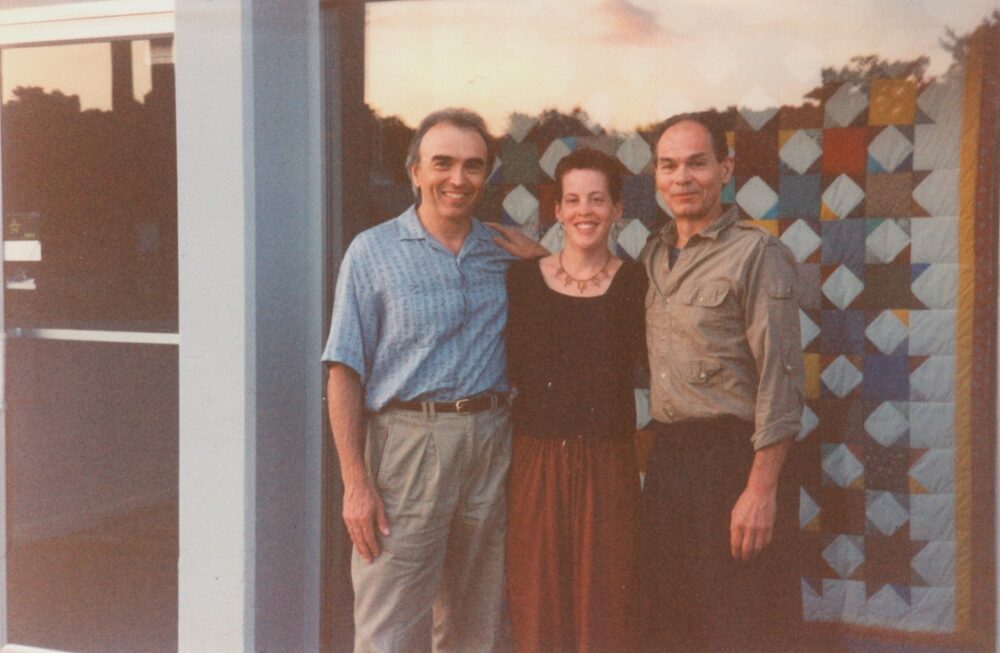
The late trombonist and composer Bill Schaefgen, attending a book reading of mine at Habeas Lounge Riverwest at the Jazz Gallery Center for the Arts / Riverwest Artists Association in August 2014. Photo by Linda Pollack

 The duende “pierced her with a dart … for having stolen his deepest secret, the subtle bridge that unites the five senses with the raw wound, that living cloud, a stormy ocean of Love freed from Time.” — Federico Garcia Lorca from “Play and the Theory of Duende.” (for Lee Brady)

This is my own personal eulogy for my longtime friend, the esteemed and remarkable musician and composer Bill Schaefgen, co-founder and principal composer of the remarkably courageous and forward-thinking Milwaukee jazz group What On Earth?

Bill died on Sunday, June 26, at 76, of cancer. The group thrived, at least artistically, from 1974 to the early 1980s, but they never released a recording. However, a reunion of the group — sadly without Bill, who could no longer play the trombone — has made a recording of his music. Schaefgen had been stricken a couple decades ago by a rare neuropathic disease, which cruelly disabled his arms and prevented him from holding up and playing a trombone. Longtime WOE? guitarist Jack Grassel hopes that reunion recording will be released soon. Check with this blog for information on that.

I meant to present this eulogy at Bill’s lovely memorial a few weeks ago at Hoyt Park’s Great Hall but, because of a hectic day, I witlessly left a copy of it at home. Sorely missing from the event was a segment devoted to listening to Bill’s music. A small boombox played What On Earth? in the far corner of the large hall was largely obliterated by all the socializing. (I neglected to mention when I first posted this, Jack Grassel provided complimentary CDs from a What On Earth? live concert from January 22, 1978 at the Water Street Arts Center. The CD, not commercially available, was a valuable memento for mourners. And most of the remembrances of Bill were warm, thoughtful and often humorous) So I offer some music here, for anyone who knew Bill and his music, and anyone who may be curious about it.

The eulogy starts out as a comment on Bill’s composition called “Cleansing” from a private WOE recording from 1974 that I helped Bill get transferred from tape to CD, with the assistance of the great Madison recording and production studio Audio for the Arts. Then my comment transitions into a more personal eulogy.

Fate often toys cruelly with art, as with life. Bandleader, principal composer and trombonist Bill Schaefgen’s ability to perform music was killed off some years ago by a terrible neuropathy, which has slayed the arms and hands that hoisted the eloquent trombone.

So What on Earth? has laid dormant for decades but now it’s music finally rises Phoenix-like from dust into a living cloud. This recording opens with Bill Schaefgen’s tune “Cleansing,” Here’s a sample of it:


“Cleansing” is one of the most moving and profound trombone performances I’ve ever heard. I hope the whole piece becomes available because, as fine a trombonist as he was in his prime, Schaefgen was a greater composer. And this piece is beautifully conceived as a ten-and-a-half-minute tone poem This music can provide a deep inlet to whatever one brings to this title’s meaning. Schaefgen’s life seems abjectly bared, his secrets and his soul. The performance unfold like a holy ritual. The melody, radiating unadorned beauty, is a fraught offering, rising deliberately to a quiet crest of open spirit, then it modulates to a higher plaintive register of sorrow.  Grassel underpins Schaefgen’s wounded horn with a high guitar drone. Schaefgen’s brief unaccompanied solo chills me, a man exposed with his deepest thoughts and feelings. Grassel joins in tender dialogue, and then Leigh Cowen showers his limpid, pearlescent Fender Rhodes piano over it. Mitar Mitch Covic’s bowed bass appears as a spectral, groaning ghost. The tonality and mood carry a deep Spanish tinge. Miles Davis’ magnificent “Saeta” from the classic album Sketches of Spain comes to mind.

And here is where I hear the Spanish poet Lorca’s sense of duende, “that mysterious power that everyone feels but no philosopher can explain,” as the poet wrote. Lorca explains duende as profoundly melancholy awareness of the struggle between good and evil within each person, and how that plays out invariably as some sort of bloodletting, at least in the Spanish tradition. Thus, at some point, the need or desire for cleansing, literally or spiritually.

The whole recording carries comparable power and eloquence, even as a very early document of the band. It includes a disarming reading of Ornette Coleman’s classic “Peace” which, like many of the originals here, shows how beautifully a so-called avant-garde band could play. The group (which then also included drummer Andy LoDuca) recalls at times the pioneering fusion band The Fourth Way. The music is as good as anything you’ll hear, ever. God, I miss this band.

The tremendous poignancy of “Cleansing” is the tip of the proverbial iceberg. The group produced nearly 60 original tunes. Schaefgen also produced a major work for quintet and the orchestra, called “Three Seemingly Inscrutable Pieces for Wacko Band and Orchestra,” premiered in 1979 with the Milwaukee Symphony Orchestra. Here you also sense the humor that frequently pervaded group’s music and irreverent attitude. But Schaefgen’s inability to play the trombone today is no laughing matter.

At a personal level, Bill sometimes postured as a cynic, especially back in the days when he had a few too many beers in him. But this reflected also the plaintive doubting of the modern artist. Yet, beneath the gruff and sometimes-profane German beer-hall carouser was an absolute sweetheart of a man, a big teddy bear with glasses and a dank mop of dark hair, who happened to be a quiet genius.

I think some of that comes out in the long profile I did on Bill in 1979, shortly before the big symphony gig, and I made some copies of it for you to take and read, if you care to.

And I know Bill appreciated the article. The next year, I foolishly attempted to interview all six of the group’s unpredictable and sometimes zany members at once, for a feature for The Milwaukee Journal. The interview grew multi-voiced and slightly chaotic, like a Robert Altman movie scene and, at one point, trumpeter Kaye Berigan dubiously asked how I was ever going make coherent sense out of this, a fair question. Bill Schaefgen, bless his heart, leapt to my defense: “Don’t worry about Kevin, he can write his ass off.” To this day, I cherish Bill’s spontaneous declaration as one of the finest compliments I’ve ever received.

Bill knew what he and the other excellent musicians of What On Earth? did was substantial, if sometimes challenging, art. And yet, like many genuine artists, I think he had a deep reservoir of insecurity, and the loss he suffered from illness in the late years didn’t help. But there is also redemption of sorts.

I hadn’t really thought this through, until now, his death. Lord, I wish I could say some of this to him now. Bill, could you come back, for five minutes? Damn. This is as close as I’ll get.

You see, to me it seems that he is one of the “voices in the river” that I write about in my forthcoming book, Voices in the River: The Jazz Message to Democracy.  It is about jazz as a template for the democracy process and about how this is manifested in the music, and through many creative writers who understand this relationship. It’s also a partial memoir of my experience in Milwaukee in the 1980s, when I covered jazz for The Milwaukee Journal.

I don’t mean this to be a book pitch but I often think metaphorically. It’s rather a way to contextualize for myself, and to express how valuable, beautiful and important Bill’s music was. 1

As with the other musical artists I talk about in the book, he is a voice in the river because his music is submerged to some degree, his voice is not heard as it should be, under the mad rush of the humdrum everyday bustle-and-hustle, the struggle for power and mere survival and yes, the noise of hatred, truth be told. That all prevents most of us from taking the time to hear voices beneath the surface. The metaphor comes to mind to me, too, when I hear “Cleansing,” and feeling the man’s reservoir of insecurity.

Bill and I spent a lot of time in his basement, listening to old What On Earth? cassette and reel-to-reel tape recordings in an effort to assemble them into the eventual private CD recordings. I would frequently feel the need to comment and boost up his judgment, especially of his own playing. But only when I did this he would usually agree and acknowledge the quality of the music.

I also wanted very much to release at least one of the recordings to the public, but Bill consistently shied away from that, for reasons he never made clear. But it may have to do with his insecurity, or a sense that the music’s time had passed. I’m here to tell you the music is as vital, inventive and transporting as ever today.

I also recall a number of conversations when Bill would call on the phone because he wanted to talk, ostensibly about the music, but also about life. Last year he called several times and meekly left voice messages to apologize for missing my sister Maureen’s funeral. I thought Bill, thanks, but it’s OK. I think in the big picture, he wanted me, and anyone who cared to hear him, to know he was trying to make a human connection with the music — that it stood up on its own terms like a great, strange, beautiful, life-giving sculpture, even though the music’s presence exists only in the elusive realm of passing time, but as an extraordinary vibrational presence that you can feel in your body and soul.

So, despite the suffering and profound loss of his later years, I believe Bill found succor in his music in all the personal CDs. I believe the music helped “cleanse” his own failings, and the spiritual grime of the burdens, suffering and loss, and the duende he endured so long, But through it all and in much of his music, Bill always saw the humor and the absurdities of life, and his great ability to laugh also cleansed him. What else to make of tunes titled “Eat My Shorts” and “Funky Disco Honky Suckin’ Funk”?

And his own compositions allowed him to process his appreciation for musicians that provided musical gifts for him, such as “Song for Berk,” a lovely ballad written for the great Milwaukee saxophonist Berkeley Fudge, and “My Thanks, My Tears,” written to honor Milwaukee jazz musicians Sig Millonzi and George Pritchett.

So now I like to think of “Cleansing” as Bill’s deliverance, into the sunlight that comes down and reflects off the river’s dancing, refracted mirror. So, if you can envision that…the watery mirror, you see the river takes him back into its depths, even as he rises to the blue yonder and white light.

We’re with you, Bill, we’re with you. And for me, it feels like a blessing. The man wandered the earth like a slightly-crazed prophet prompting people to sometimes utter, “what on earth?” His essence produced great artistry, but his physical being also included something that grew into a horrible albatross. Ah, but now he has gone home.

Which brings to mind the closing verse of the old Negro spiritual, “Goin’ Home,” which I’d like to close by quoting:

Nothing’s lost, all is gain, no longing for the day
No more stumbling on the way
No more fret nor pain
Goin’ home, goin’ home, I’m a goin’ home
Quiet like, still some day, I’m a goin’ home

Here’s a performance of “Goin’ Home” in honor of Bill Schaefgen, a gorgeously rough-hewn performance by saxophonist Archie Shepp and pianist Horace Parlan. It seems a long lost brother to “Cleansing.”

________________

  1. Their influence of What On Earth? may be somewhat limited, because they predated easy self-recording and the Internet. Still, they showed the way for many Milwaukee musicians and groups in terms of how they could free their music from the constraints of conventional genres, while combining styles and retaining aspects that marked their identity as an individual group, and one coming from Milwaukee’s distinct musical and ethnic culture. One very well-known group that was influenced by What On Earth? is the internationally renowned Milwaukee folk-rock-jazz trio The Violent Femmes. The band’s bassist Brian Tairaku Ritchie and original drummer Victor DeLorenzo are big WOE? fans, and Bill Schaefgen played trombone on their album Blind Leading the Naked, produced by Jerry Harrison of The Talking Heads.
  2. Special thanks to Lee Brady, Kaye Berigan, Mitar Covic, Jack Grassel, Chuck LaPaglia, Frank Stemper and Ed Valent.

Trump, as Melville’s “Confidence Man,” echoes spookily for another observer

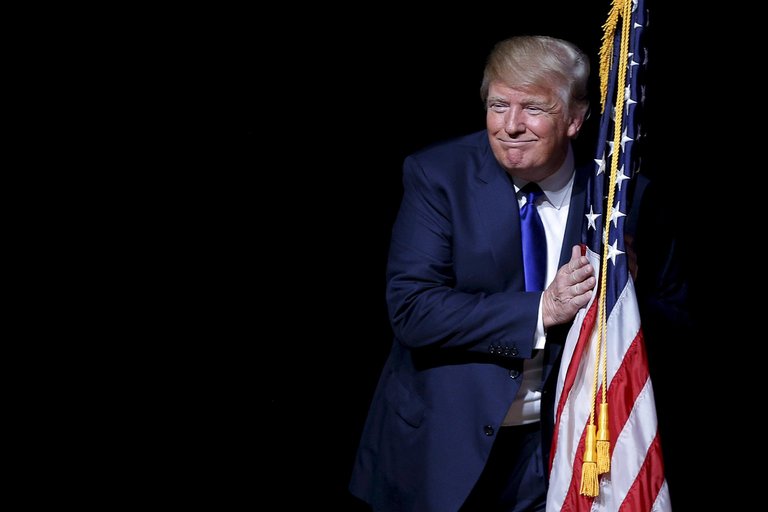
Trump flag

“If you buy this old flag from me cheap I’ve got a lovely beachfront property for you, in hell.” nytimes.com

Because I believe that the lessons of Herman Melville’s extraordinary post-modern novel The Confidence-Man (published in 1857!) resonate so prophetically and urgently today with the improbable rise and persistent spectre of Donald Trump, I’m happy to report I’m not alone. So, I’m reprising a my recent blog on the subject along with a complementary column by Rana Foroohar,  who drew a similar analogy to Melville’s novel in her TIME magazine economics column,

Trump is an old figure, creepy and very dangerous, risen from Melville’s “Confidence-Man.”

The Curious Capitalist, from April 18. At the time, I read it with great interest, underlined a few passages, and then set it aside. I stumbled upon it today while digging through my magazine stack. Here ’tis.

http://time.com/4284812/donald-trumps-confidence-game-has-been-years-in-the-making/

I have to confess the urgency arises partly from the disappointing news about Hillary Clinton’s failures in managing and properly securing of her own email server, and failing to be fully upfront about it. I guess we’re lucky her carelessness caused no apparent security breach. But at least she’d admitted her wrong, something Trump, who lies 92 per cent of the time according to Politifact, never does. Still, I’m sure Clinton’s problems have a lot to do with Trump pulling even with her in the swing state polls.

I still think Clinton will win. This should be her low water mark, as there appear no other controversies about her on the horizon. By contrast, Trump figures to continue alienating moderate and undecided voters with the scattershot hyper-demagoguery he seems to eat for breakfast like corn flakes on steroids.

Nevertheless, I think such voters — concerned about their economic interests and contemplating voting for con-man Trump — should read Foroohar’s analysis.  As her column title indicates, she hardly writes from the left.

We have two considerably flawed candidates, but it’s quite clear which one is the lesser of the two evils. Many of Bernie Sanders’ idealistic supporters understandably didn’t want to have to make such a choice, but the reality is, in most every presidential election, we almost invariably need to do that. If a candidate gets successful enough to run for president in either major party, he or she has surely sinned more than a few times.
This time, we know that the guy we might dub Saint Bernie Sanders changed the game quite a lot, and helped to redeem Hillary Clinton leftward. Now, he’s made it clear we need to elect Clinton.

So, as Foroohar notes, American voters will likely find themselves in the position to decide in whom they are more safe placing their confidence.


What to do about the clash of policing and race, and its most vulnerable victims, children

The daughter of Diamond Reynolds, whose boyfriend, Philando Castile, was shot by the police in Minnesota last week. Credit Eric Miller/Reuters

An excellent article by Yamiche Alcindor in the Sunday New York Times highlighted one of the heart-rending tragedies underlying America’s pervasive crisis of black men being killed by police, most evidently for unjustified reasons, despite court rulings which almost invariably fail to charge the police perpetrators.

Alcindor’s subject is the children of such tragedy. Most often, the offspring of the killed endure “close-up views of violence, obviously traumatizing, giving rise to a generation of young people who distrust authority, grow up well before their time, and suffer nightmares that seem too real,” Alcindor writes.
Because her article is straight reporting, it does not explore possible solutions to this urgent and long-neglected problem.
Certainly another problem, which many people falsely compare to this one, so-called “black on black crime” is more complicated because it is harder to address.

But Alcindor’s article cries out to me with several ideas that fairly grabbed me by the collar.
First, training of policemen is paramount to them doing their job properly and effectively and here is where the criminal justice system has failed for too long.
Clearly, police need to be re-programmed, especially to understand urban communities as persons they should be guardians of, rather than seeing every black person as a potential criminal.
This apparent presumption is fed by very subjective aspects, including personal bias, racial antipathy or worse, and perhaps even fear for one’s own life. However, “fear for one’s life” is all too often used as a facile excuse to shoot, or kill, a person whom the officer perceives as suspicious or threatening.

These biases relate primarily to race, as statistics have become numbingly familiar regarding how much more often African-Americans are victims of systemic and direct criminal injustice, compared to whites or other people of color. It remains all too easy for police, as well as judges and other administrators to allow their own attitudes, instincts and stereotypes influence their judgement, when they look at the color of a person’s skin.

With police in a tense situation, that judgment frequently must be quick and is easily mistaken and, sadly, morally blinded. Nevertheless, officers too-typically rush to judgement with lethal weapons in their hands, pointed at the subject. Otherwise, we most likely wouldn’t have nearly the glaring problem with white policemen, which these cases almost always involve, as opposed to police women. Given this, the role of testosterone in such pressure situations should also be investigated.

shooting hillary scheinuk

The scene after the Alton Sterling shooting by Baton Rouge police. Photo by Hillary Scheinuk for The Advocate.

More enlightened police training and broader education — especially in the humanities — should focus on cultivating relationships with the community that meet them at the level of their humanity, which could go far towards overcoming the negative biases that lead to indiscriminate — but officially tolerated — mayhem.

Just as humanities education, like black lives, has become devalued more broadly in our techno-crazed society, it is rarely considered in this scenario.  However, the more a person gains an appreciation of the phenomenal range, beauty and profundity of human endeavor and accomplishment, the more the person is likely to see in another an incalculably valuable person, rather than a stereotype of a criminal, or an ominous “other.” Lost in this scenario are the victim’s children, until perhaps cameras catch them, after the fact, as when the son of Quinyetta McMillon collapsed on camera in uncontrollable sobbing over the recent death of his father, Alton Sterling in Baton Rouge, Louisiana.

I would argue that the easy, personal media exposure to popular culture is hardly education enough, because such activity it is almost by definition the most transient and often the most superficial part of our culture. Young people typically outgrow, or remain stuck in, their youthful enthusiasms. And I include my own baby-boomer generation in this characterization. That is not to discredit the power and value of the best of such enthusiasms, but merely to suggest they reflect youthful energy as a driving force, and encompass only so much of a historically profound and broad culture — as complex as the American experiment itself.

This need for humanities education is especially true in this nation because ironically African-American culture is — despite rising from such a minority statistical demographic — is more central than any other indigenous culture to our nation’s humanity, to what we consider intrinsic and vital in American culture, especially when you consider the contributions of blues, jazz, rhythm & blues, gospel music, hip-hop, and African-American contributions to literature. Perhaps the two greatest American novels of the 20th century have race as a central subject, Ralph Ellison’s Invisible Man and Nobel laureate Toni Morrison’s Beloved, and African-Americans wrote them both. The work of James Baldwin, the greatest black writer of the civil rights era, stands on a comparable level. Another novel, which is arguably America’s most widely acclaimed and beloved, Harper Lee’s To Kill a Mockingbird, is by a white Southern woman, but it deals with racism and false rape charges against a black man.

Frederick Douglass, Zora Neale Thurston, W.E.B. Du Bois, Langston Hughes, Gwendolyn Brooks, Margaret Walker, Malcolm X, Richard Wright, Jean Toomer, Alex Haley,  Amiri Baraka, Maya Angelou, Alice Walker, Rita Dove, James Weldon Johnson, John Edgar Wideman, Albert Murray, Robert Hayden, Walter Mosley, Nikki Giovanni, Yusef Komunyakaa, Henry Louis Gates Jr., Cornel West, Charles Johnson, Colson Whitehead, Gerald Early and Sterling Stuckey are among our other great black American writers, and members of an ethnic group who historically had little probability of achieving such status, given their cultural and social oppression, and given that it was illegal in the South for slaves to even learn to read or write, until the Civil War. Of course, the great African-American oral tradition could not be obliterated.

How many of your average beat officers have read and learned from such writing or such music? African-Americans have also deeply shaped and directed theater, visual art, dance, and all of the arts and crafts. The vast influence of African-American culture worldwide is a testament to this as much is anything.

So this tragic persistence, as a kind of inhumane extension of our legacy of slavery, exacerbates the ongoing contradiction and disgrace of America.

police cartoon 1

This cartoon pointedly addresses America’s problems of proper education and training of police. Courtesy thewarmonger.com 

We feel overcome with a shocking sense of black human lives being devalued into something that the stricken but resolute McMillon memorably characterized Wednesday. “I, for one, will not rest,” she said, “and will not allow ya’ll to sweep him in the dirt.”

Clearly she, like all the protesters, believe they will overcome.

Another aspect is the ancient, hoary mentality of “might makes right.” That’s evident in an incident where armed police in riot gear invaded private property, where peaceful protests against Sterling’s death were being held. The police began assaulting the protesters without provocation or legal right.

The second big problem is police training built on pervasive use of guns. When officers pull guns on a person who simply looks suspicious or is simply selling CDs, as he had for years, logic tells us that we are asking for mistakes that turn into tragedy.

It’s unnecessary, especially when you consider that Australia has been very successful in cutting back on gun deaths by simply buying  back guns, and England, though a far smaller and one can argue for less complex society, still does not arm its police with guns and it annually has an almost nil mortality rate at the hands of officers. Nor does it have a significant crime problem, given the lack of police firepower.

Instead of having officers almost reflexively pull and fix their guns on a suspect, we should train them to use guns only as a last resort. Techniques of manual, verbal and psychological crisis de-escalation are mastered by the British police and other law enforcement around the world. But such approaches are all-too-belatedly being introduced into our police departments, and far too many remain resistant or procrastinating, due to a long-standing retrograde police culture of macho gun use. These practical and broader cultural suggestions feel extremely urgent and deeply needed.

Finally, despite the provocative images above, I don’t want this to be interpreted as simple police-bashing. The issue is much bigger than “bad apple” cops. This video, by contrast should offer genuine hope that police and life-saving doctors (this one an African-American) may yet come together with the rest of our national community to provide the healing, enlightenment, and problem-solving change required of us.

We have not another day, or black life, to waste. And we forsake and damage their children in our ignorance and intransigence. How low do we go, before we rise?


Dreamland in Blu: Thelonious Monk Music Reimagined at Cloud Altitude


dream cloud

Dreamland’s cloud in Blu, 23-plus stories up.

This brief photo essay interprets the experience of hearing Dreamland, an imaginative and courageous ensemble which has worked hard in recent years to make much of the challenging Thelonious Monk repertoire alive for new listeners, and gratified old Monk fans.

Thelonious-Monk-UPI-Photo-Courtesy-of-the-heirs-of-W.-Eugene-Smith-and-the-Center-for-Creative-Photography-at-the-University-of-Arizona

The band Dreamland is named for an obscure Monk tune rediscovered by trumpeter/bandleader Jamie Breiwick. Monk often seemed to live in his own private dreamland. Photo by Eugene W. Smith, courtesy UPI. 

The band, conceived and led by trumpeter Jamie Breiwick, performed Friday night at Blu, the nightclub located on the 23rd floor of the Pfister Hotel,  with stunning views of the downtown Milwaukee lakefront.
I began taking a few photographs with no agenda. Gradually it seemed that the band’s ambition in reaching high to master and re-imagine Monk’s technically vexing yet uncannily charming and intriguing music — in such an atmospheric noir setting — was worth a visual treatment, or a dream sequence.

Such stimulating variables may be partly why they’re one of my favorite music groups. So, though a longtime arts and jazz writer, and because this concerns the architecture of Monk and of Milwaukee, I am in letting the dreamland images speak for themselves (for the most part), mindful of a famous Monk quote: “Writing about music is like dancing about architecture.”

dreamland dusk

Dreamland warms up the Blu night club audience shortly before dusk (L-R, pianist Mark Davis, bassist Clay Schaub, trumpeter Jamie Breiwick, drummer Devin Drobka).

dream 3

From Blu’s windows, you see the counterpoint of classic and modern Milwaukee architecture, looking south toward the Hoan Bridge. 

dream 4

At least one couple seems transported by Dreamland.

dream 5

The still-rising Northwestern Mutual Life Insurance tower is illuminated by many stories of its construction lights on the right tower portion. At, right, the blue flame atop the iconic Milwaukee Gaslight Building forecasts the weather.

dream 6

Blu is the rhythm of drums deep in the night.

dream 7

Dreamland begins heating up as darkness as falls on Milwaukee. 

dream 8

From Blu we see the end of the I-94 expressway in the foreground, curving into the southbound Hoan Bridge harbor overpass. Many years ago, when the I-94 ramp remained an unfinished precipice high over the ground level, it was used as “the expressway to nowhere” in the precariously climactic closing car chase scene in the film “The Blues Brothers.”

dream 9

Trumpeter Breiwick uses his hand over his bell to bend a mournful note on a Monk ballad.

dream 10 (2)

Even the carpeting in Blu has a dancing, dreamlike quality.

dream 11

Jamie Breiwick performing, and radiating, “Light Blue.”

dream 13

Just maybe, this is how Thelonious Monk – a genius of dancing, songful abstraction – might have viewed Milwaukee’s south shoreline along the Hoan Bridge.

P.S. Well, I’m fudging a bit on my promise to let the photos do all the heavy lifting, such as it is. But I’ll add a few more comments about Dreamland, whom I profiled previously here:

Trumpeter Jamie Breiwick “dreams” of Thelonious Monk’s music

.

Now the band sounds like they are making Monk’s music their own. It’s in the increasing ease of articulation of the vital and sometimes profound ideas contained in often-hazardous chord changes and rhythmic trip wires.
Trumpeter Jamie Breiwick continues to pursue his Miles Davis-cum-Don Cherry influences, often pushing plummy accents into a slippery swing and, like a master baker, he consistently kneads the thematic material into whole, rounded melodic ideas. As the bandleader, he’s also imaginative and intrepid in delving into the mysterioso depths of the Monk book. Breiwick has an assurance and dedication to the material that I think would’ve made Monk proud, even though he was known as an often-exacting bandleader.

And for my ears, Devin Drobka is an ideal drummer for this music. As a Berklee-trained musician and vibist, he understands the implications of the harmonic changes better than most drummers, which helps keep the music bubbling and percolating with the right aroma and savor. And on some tunes, like “Light Blue,” his drum solo built directly from the harmonic and melodic charms of the melody itself.

Here’s the band stretching out on “Light Blue” from a previous live date:

https://soundcloud.com/jamie-breiwick/light-blue


On a longer previous solo, drummer Drobka dazzled in quirky wavelengths. I declare that Thelonious Monk himself would’ve danced around his piano (a not-infrequent Monk behavior) in response to Drobka’s solo — bristling, sashaying, hiccuping, all amid a push-pull tempo tension. Then he’ll fling out a few fractured march rhythms. But few fractured marchers can also dance, like Drobka’s Monk march can.

Pianist Mark Davis is a somewhat more supple and fluent phraser than Monk himself typically was. And yet Davis’ playing leaps and lopes at times, which brings to mind to the magisterially buoyant hard-bop pianist Sonny Clark doing a Monk take. And Davis rarely misses a chance to insert an acerbic Monk accent — often a buzzingly discordant second interval.

Bassist Clay Schaub is relatively new to the band, as a replacement for John Price. But he’s an extremely capable and musical player in negotiating the often-tricky changes.

I see Dreamland staking out their own high ground in the crowded strata of Monk interpretation. Their intelligence, fearlessness, youth and fire will keep this dreamland afloat, growing and prospering in ways yet to be imagined.

____________

All photos by Kevin Lynch, except as noted.


“Two Scarecrows for President”? Digging into the nitty-gritty on Hillary and The Donald

scarecrow

Ray Bolger as the scarecrow in “The Wizard of Oz.” Was he smart enough to be president? Courtesy cinefox.com.

As Chris Matthews puts it, “The Republicans and Democrats are running two scarecrows for presidents,” with more negatives than positives. But I’d like to dig under those two stiff posts out in the corn field — into the nitty-gritty of voter perception.

Donald Trump has blatantly earned his negative judgments from both voters and members of the formal Republican party, from delegates, to Congress Reps to Senators to his many competitors for the nomination.

Even many people who still support him admit a variety of things they don’t like about him which undermine the values of America — opportunity, diversity and equality, as a land of immigrants. Please remember the essence of Emma Lazarus’ great poem emblazoned into the base of the Statue of Liberty.

emma

Plaque photo courtesy schmoop.com

Donald Trump’s only values are the kind that glimmer or stack into green, rectangular piles. If he’s a different kind of politician I would characterize him ultimately as the anti-statesman, the opposite of what we hope every politician aspires to.

So, why some seemingly reasonable people still support Trump remains one of the nitty-gritty questions that’s hard to answer. Some see his rhetoric against America’s emerging oligarchy as a way to right America’s wrongs. But it’s easy talk these days: Trump’s tax plan to buttress the top one per cent does little to change America’s vast income equality gap.
Part of the Trump camp is backing their way in, with a kind of negative “I’d never vote Hillary” value system or obstinancy. This has partly to do with Hillary Clinton’s remarkably high negativity ratings, which is what I would like to address, and I hope some readers will respond to.

hillary

Hillary Clinton. coutesy affinitymagazine.us

Starting from what I call the higher ground of this scenario, Clinton needs a large number of Bernie Sanders supporters to gain a more comfortable margin than the average of 7 per cent lead she currently holds nationally over Trump in state polls. But many of those voters apparently will not switch to Hillary, until Sanders formally gives up the ghost and endorses  her which, recently on an interview with Chris Hayes on CSNBC, the Vermont senator said he still was not ready to do.

The two campaigns need to get closer on issues important  to the Sanders camp. In the Hayes interview, Sanders prioritized an aggressive breakup of Wall Street banks, and fighting for abolition of the death penalty in America. Clinton supports death in rare cases, such for Dylann Roof, the alleged hate-killer of nine people at the Emanuel African Methodist Episcopal Church, in Charleston, S.C., last year.
Bernie also remains vehemently opposed to the TPP trade agreement, which Clinton initially supported but now opposes. So an endorsement from Sanders seems only a matter of time. But as for now, many of his supporters remain in lockstep behind him, for fairly righteous reasons.
Of course, the bottom line is, even if they vote for a third-party candidate, that amounts to a vote for Donald Trump. Because it takes one liberal/Democratic vote away from Hillary Clinton.
Let’s not forget the devastating effect of Ralph Nader’s  refusal  in 2000 to support Al Gore, who, given his post-election record, would’ve done at least as much as Green Party candidate Nader to improve the environment, and probably more.

Nader did hand the presidency to George W. Bush, though hardly intentionally. More, I think, out of irresponsible, willful hubris. It never should have come down to a decision left to the Supreme Court, who desecrated the democratic will of the people, as Al Gore received the most popular votes: 50,999,897 to Bush’s 50,456,002.

Here’s some info that shows how troubling Nader’s role was in that election:

When Nader, in a letter to environmentalists, attacked Gore for “his role as broker of environmental voters for corporate cash,” and “the prototype for the bankable, Green corporate politician,” and what he called a string of broken promises to the environmental movement, Sierra Club president Carl Pope sent an open letter to Nader, dated 27 October 2000, defending Al Gore’s environmental record and calling Nader’s strategy “irresponsible.”[95] He wrote:

You have also broken your word to your followers who signed the petitions that got you on the ballot in many states. You pledged you would not campaign as a spoiler and would avoid the swing states. Your recent campaign rhetoric and campaign schedule make it clear that you have broken this pledge… Please accept that I, and the overwhelming majority of the environmental movement in this country, genuinely believe that your strategy is flawed, dangerous and reckless.[96]

Perhaps this seems like dirty water under the bridge by now. But it gets me to the question of why leftists or independent moderates are not ready to support Clinton, a candidate who President Obama — twice-elected and at a peak in popularity — has described as perhaps the most qualified candidate who as ever run for president, certainly in recent times.

Sure Republicans will nurse Hillary conspiracy theories-from-nowhere from now till doomsday. But Hillary is not going to be indicted on her e-mail use, according to Chuck Todd, which he reported recently on Meet the Press. That’s the latest, and it’s good enough for me, even though I will watch the FBI investigation to the end.

We have a very serious and consequential election to decide.

So what is it about Hillary Clinton for all those Hillary haters and doubters? It seems to come down to the oh-so-subjective factor of trust.

And here is where progressive and liberal males ought to give her a break, especially because virtually any of the wildest theories about her profit-mongering and corruption seem to vanish into thin air the closer you look at them.

What people respond to are the insinuations. And I observe such progressive males with great dismay because, of course, Hillary is hardly perfect and, yes, she’s took money from Wall Street firms corporations to speak but, to me, that means she’s smart enough to work the system, profoundly flawed as it is, because you can’t get elected without huge money in that system. I trust she’ll work to overturn Citizens United as she promises to. It goes against the progressive principles she’s held for decades.

In general, she strives very hard to keep a tidy ship, despite the incessant bombs lobbed at her, so it’s no surprise she can get into perceived trouble when she gets self-protective and choosy about her explanations of countless activities. But none of that proves anything nefarious. So without proof, what do we have to stand on? As Daily Kos put it recently, “Clinton is the most investigated woman in history — and the most exonerated.”

That makes her arguably the most persecuted woman in history. The Benghazi hearings were her trial under fire, and she single-handedly dismantled the countless and redundant counter-examinations with grace, courage and determination. It was an amazing demonstration of her grit and intelligence, as well. Imagine Trump squirming and whining under similar circumstances.

Here’s a problem: A recent salon.com analysis of voter attitudes asserted that it’s increasingly evident that many progressive men seem guilty of a sexist attitude towards the woman who might be the first female president in US history.

The analysis doesn’t have a lot of evidential proof, aside from a profusion of circumstantial evidence. Like the gang of “Bernie Bros,” for one example. And I’m beginning to wonder about Bernie himself, who’s increasingly quixotic, as high-minded as he talks, being now out of the real race.

So I wonder, what their problem is with her, really? They always assume the worst of her. Could this come down to an excess of old-fashioned American guy arrogance which often feeds its admirable can-do attitude as well?

Well, just consider what the final effect of this self-righteous choosiness is. Some women are especially peeved at Donald Trump’s assertion that Hillary Clinton “enabled” her husband’s sexual indiscretions. What on earth did they and Trump” enablers” expect the then-First Lady to do publicly? Condemn and pillage her husband publically when women make salacious accusations? Even when Bill Clinton finally confessed to something, wasn’t that enough? Can’t we also suspect that the motives of the women involved were far less than pure, envisioning the president as easy pickings for their wiles?

Of course, it was sordid then, but what really does that have to do with today, and Hillary Clinton’s extraordinary capabilities as a politician and stateswoman?

If you go as far as to blame her for marrying the guy, well some marriage counselors might concur, but remember, she established her personal vision of her political career before she ever met Bill Clinton. That vision, as it’s played out over her own career, is what she should be judged on and everything that she has accomplished on her own merits since.

Yet, still people regularly conflate Bill Clinton’s policies with Hillary. What do they think Hillary Clinton will do? Is she some kind of intellectual zombie from the 1990’s, A Bubba lapdog?

A…Barry lapdog? The media hasn’t helped.lapdog

Cartoon courtesy thepeoplescube.com

I post the image for rhetorical irony. Either notion about Clinton is obnoxiously sexist. Plus, such thinking forgets the alternative.

Trump.

And remember, the whole world is watching this election, with great angst and dismay.
Here lies a glaring reminder of how far behind we are so many other advanced democratic nations in electing a female leader. Not that it’s a race, but what do you say when the nation that proclaims itself the greatest democracy of all may fail yet again to elect a woman, such a capable woman?

The Huffington Post reports: “There have been over 70 female prime ministers and presidents in the world since Sri Lanka elected Sirimavo Bandaranaike in 1960. The length of their tenure has varied immensely, as have the powers that they have held. Some women were in office only days or held largely ceremonial roles, while others played a defining role in their country’s history.”

Among the most famous women leaders of nations (in chronological order) are Prime Minister Indira Gandhi of India, Prime Minister Golda Meir of Israel, President Isabel Peron of Argentina, Prime Minister Margaret Thatcher of The United Kingdom; President Corazon Aquino of the Philippines, President Mary Robinson of Ireland; Prime Minister Hana Suchocka of Poland, Chancellor Angela Merkel of Germany; President Ellen Johnson Sirleaf of Liberia, President Michelle Bachelet of Chile, Prime Minister Julia Gillard of  Australia, and President Park Geun-hyem of South Korea.

It’s time for a brilliant and determined woman to come in and clean up the remaining mess from the Recession — wrought by the Bush years — and get to work on rebuilding our crumbling infrastructure, which will begin to create many of the dearly-needed jobs we clamor for.

“Two Scarecrows for President”? Digging into the nitty-gritty on Hillary and The Donald

scarecrow

Ray Bolger as the scarecrow in “The Wizard of Oz.” Was he smart enough to be president? Courtesy cinefox.com.

As Chris Matthews puts it, “The Republicans and Democrats are running two scarecrows for presidents,” with more negatives than positives. But I’d like to dig under those two stiff posts out in the corn field — into the nitty-gritty of voter perception.

Donald Trump has blatantly earned his negative judgments from both voters and members of the formal Republican party, from delegates, to Congress Reps to Senators to his many competitors for the nomination.

Even many people who still support him admit a variety of things they don’t like about him which undermine the values of America — opportunity, diversity and equality, as a land of immigrants. Please remember the essence of Emma Lazarus’ great poem emblazoned into the base of the Statue of Liberty.

emma

Plaque photo courtesy schmoop.com

Donald Trump’s only values are the kind that glimmer or stack into green, rectangular piles. If he’s a different kind of politician I would characterize him ultimately as the anti-statesman, the opposite of what we hope every politician aspires to.

So, why some seemingly reasonable people still support Trump remains one of the nitty-gritty questions that’s hard to answer. Some see his rhetoric against America’s emerging oligarchy as a way to right America’s wrongs. But it’s easy talk these days: Trump’s tax plan to buttress the top one per cent does little to change America’s vast income equality gap.
Part of the Trump camp is backing their way in, with a kind of negative “I’d never vote Hillary” value system or obstinancy. This has partly to do with Hillary Clinton’s remarkably high negativity ratings, which is what I would like to address, and I hope some readers will respond to.


Hillary Clinton. coutesy affinitymagazine.us

Starting from what I call the higher ground of this scenario, Clinton needs a large number of Bernie Sanders supporters to gain a more comfortable margin than the average of 7 per cent lead she currently holds nationally over Trump in state polls. But many of those voters apparently will not switch to Hillary, until Sanders formally gives up the ghost and endorses  her which, recently on an interview with Chris Hayes on CSNBC, the Vermont senator said he still was not ready to do.

The two campaigns need to get closer on issues important  to the Sanders camp. In the Hayes interview, Sanders prioritized an aggressive breakup of Wall Street banks, and fighting for abolition of the death penalty in America. Clinton supports death in rare cases, such for Dylann Roof, the alleged hate-killer of nine people at the Emanuel African Methodist Episcopal Church, in Charleston, S.C., last year.
Bernie also remains vehemently opposed to the TPP trade agreement, which Clinton initially supported but now opposes. So an endorsement from Sanders seems only a matter of time. But as for now, many of his supporters remain in lockstep behind him, for fairly righteous reasons.
Of course, the bottom line is, even if they vote for a third-party candidate, that amounts to a vote for Donald Trump. Because it takes one liberal/Democratic vote away from Hillary Clinton.
Let’s not forget the devastating effect of Ralph Nader’s  refusal  in 2000 to support Al Gore, who, given his post-election record, would’ve done at least as much as Green Party candidate Nader to improve the environment, and probably more.

Nader did hand the presidency to George W. Bush, though hardly intentionally. More, I think, out of irresponsible, willful hubris. It never should have come down to a decision left to the Supreme Court, who desecrated the democratic will of the people, as Al Gore received the most popular votes: 50,999,897 to Bush’s 50,456,002.

Here’s some info that shows how troubling Nader’s role was in that election:

When Nader, in a letter to environmentalists, attacked Gore for “his role as broker of environmental voters for corporate cash,” and “the prototype for the bankable, Green corporate politician,” and what he called a string of broken promises to the environmental movement, Sierra Club president Carl Pope sent an open letter to Nader, dated 27 October 2000, defending Al Gore’s environmental record and calling Nader’s strategy “irresponsible.”[95] He wrote:

You have also broken your word to your followers who signed the petitions that got you on the ballot in many states. You pledged you would not campaign as a spoiler and would avoid the swing states. Your recent campaign rhetoric and campaign schedule make it clear that you have broken this pledge… Please accept that I, and the overwhelming majority of the environmental movement in this country, genuinely believe that your strategy is flawed, dangerous and reckless.[96]

Perhaps this seems like dirty water under the bridge by now. But it gets me to the question of why leftists or independent moderates are not ready to support Clinton, a candidate who President Obama — twice-elected and at a peak in popularity — has described as perhaps the most qualified candidate who as ever run for president, certainly in recent times.

Sure Republicans will nurse Hillary conspiracy theories-from-nowhere from now till doomsday. But Hillary is not going to be indicted on her e-mail use, according to Chuck Todd, which he reported recently on Meet the Press. That’s the latest, and it’s good enough for me, even though I will watch the FBI investigation to the end.

We have a very serious and consequential election to decide.

So what is it about Hillary Clinton for all those Hillary haters and doubters? It seems to come down to the oh-so-subjective factor of trust.

And here is where progressive and liberal males ought to give her a break, especially because virtually any of the wildest theories about her profit-mongering and corruption seem to vanish into thin air the closer you look at them.

What people respond to are the insinuations. And I observe such progressive males with great dismay because, of course, Hillary is hardly perfect and, yes, she’s took money from Wall Street firms corporations to speak but, to me, that means she’s smart enough to work the system, profoundly flawed as it is, because you can’t get elected without huge money in that system. But if that’s the worst you can say of her, in reality not innuendo, give it up.

In general, she strives very hard to keep an upright ship, even though part of her effort can get her in trouble when she gets self-protective and choosy about her explanations of activities. But none of that proves anything nefarious. So without proof, what do we have to stand on? As Daily Kos put it recently, “Clinton is the most investigated woman in history — and the most exonerated.”

That makes her arguably the most persecuted woman in history. The Benghazi hearings were her trial under fire, and she single-handedly dismantled the countless and redundant counter-examinations with grace, courage and determination. It was an amazing demonstration of her grit and intelligence, as well. Imagine Trump squirming and whining under similar circumstances.

Here’s a problem: A recent salon.com analysis of voter attitudes asserted that it’s increasingly evident that many progressive men seem guilty of a sexist attitude towards the woman who might be the first female president in US history.

The analysis doesn’t have a lot of evidential proof, aside from a profusion of circumstantial evidence. Like the gang of “Bernie Bros,” for one example. And I’m beginning to wonder about Bernie himself, who’s increasingly quixotic, as high-minded as he talks, being now out of the real race.

So I wonder, what their problem is with her, really? They always assume the worst of her. Could this come down to an excess of old-fashioned American guy arrogance which often feeds its admirable can-do attitude as well?

Well, just consider what the final effect of this self-righteous choosiness is. Some women are especially peeved at Donald Trump’s assertion that Hillary Clinton “enabled” her husband’s sexual indiscretions. What on earth did they and Trump” enablers” expect the then-First Lady to do publicly? Condemn and pillage her husband publically when women make salacious accusations? Even when Bill Clinton finally confessed to something, wasn’t that enough? Can’t we also suspect that the motives of the women involved were far less than pure, envisioning the president as easy pickings for their wiles?

Of course, it was sordid then, but what really does that have to do with today, and Hillary Clinton’s extraordinary capabilities as a politician and stateswoman?

If you go as far as to blame her for marrying the guy, well some marriage counselors might concur, but remember, she established her personal vision of her political career before she ever met Bill Clinton. That vision, as it’s played out over her own career, is what she should be judged on and everything that she has accomplished on her own merits since.

Yet, still people regularly conflate Bill Clinton’s policies with Hillary. What do they think Hillary Clinton will do? Is she some kind of intellectual zombie from the 1990’s, A Bubba lapdog?

A…Barry lapdog? The media hasn’t helped.lapdog

Cartoon courtesy thepeoplescube.com

I post the image for rhetorical irony. Either notion about Clinton is obnoxiously sexist. Plus, such thinking forgets the alternative.

Trump.

And remember, the whole world is watching this election, with great angst and dismay.
Here lies a glaring reminder of how far behind we are so many other advanced democratic nations in electing a female leader. Not that it’s a race, but what do you say when the nation that proclaims itself the greatest democracy at all may fail yet again to elect a woman, such a capable woman?

The Huffington Post reports: “There have been over 70 female prime ministers and presidents in the world since Sri Lanka elected Sirimavo Bandaranaike in 1960. The length of their tenure has varied immensely, as have the powers that they have held. Some women were in office only days or held largely ceremonial roles, while others played a defining role in their country’s history.”

Among the most famous women leaders of nations (in chronological order) are Prime Minister Indira Gandhi of India, Prime Minister Golda Meir of Israel, President Isabel Peron of Argentina, Prime Minister Margaret Thatcher of The United Kingdom; President Corazon Aquino of the Philippines, President Mary Robinson of Ireland; Prime Minister Hana Suchocka of Poland, Chancellor Angela Merkel of Germany; President Ellen Johnson Sirleaf of Liberia, President Michelle Bachelet of Chile, Prime Minister Julia Gillard of  Australia, and President Park Geun-hyem of South Korea.

It’s time for a brilliant and determined woman to come in and clean up the remaining mess from the Recession — wrought by the Bush years — and get to work on rebuilding our crumbling infrastructure, which will begin to create many of the dearly-needed jobs we clamor for.


What might we learn from a “conference of the birds”?

IMG_0729

All bird photos by Kevin Lynch

You never know what might arise in the eye and mind when you sit and watch other species interact.

Yesterday on the Milwaukee River I saw these photographed scenes, what the 12th-century Sufi poet Farid ud-Din Attar (Attar of Nishapur) might have described as The Conference of the Birds, the title of his famous epic poem. The poem also inspired the great jazz bassist and bandleader Dave Holland, who titled one of his first albums Conference of the Birds, released on ECM in 1973 with wind players Anthony Braxton and Sam Rivers and percussionist Barry Altschul (see previous post about Holland).

The title tune (linked here), by the way, evokes birds in a fairly peaceful manner, with the two wind players playing flutes. But listen beyond that, in the ensuing YouTube tracks from the album, for a more complex jazz interpretation of the aviary conference.

An early edition of Attar’s Conference of the Birds

The river scene I photographed is a commingling of seagulls and geese who seem to interact and confer in a fairly harmonious way, even though any given bird — especially the smaller gulls — were free to express their sometimes raucous feelings as they came and went (see first photo, at top).

It also brings to mind a metaphor I have working my forthcoming book, Voices in the River: The Jazz Message to Democracy. I argue for the historical underpinnings of that  titular concept in American culture and politics extensively in the book.
Here, I was primarily struck by the social harmony of the birds, even though there seems to be a Trump-like alpha-male honcho (self-designated?) — the big, fat goose standing on his big rock, at right.

honcho
Later, after the gulls dispersed peaceably, I saw several of the geese gathered at the water’s edge (below) then they proceeded upstream a ways in an orderly, fluid and harmonious fashion (final photo). This suggests earthly inhabitants (think of courageous stream-defying salmon) are not simply mere subjects to the forces of nature. The question is how well we employ our energy and resources to our own ends, without damaging those natural forces, ie. the ecosystem that benefits and sustains all of life.

IMG_0755

IMG_0758


Clearly this scene also suggests that there are tribes in the world of birds, just as there are in humanity, and that tribes tend to flock or stick together, and conform harmoniously with greater ease than do differing tribes in a conference.

But that first photograph suggests the noisy and messy democracy we try to maintain, just as birds maintain their multi-tribe conferences with a common value of enjoying and drawing proper value from our natural resources.

Oh, if human society were this seemingly coherent. But perhaps we can draw wisdom from the Sufi poet’s wide-ranging take on “the conference of the birds,” here translated as “Bird Parliament.”

The alpha goose might symbolize the god-like figure the birds do strive to follow in the poem’s beginning. However, this commentary by Nathan Suri is a reasonable interpretation of the epic poem, which suggests that Islam has something to teach us about our place in the universe. Suri posits the wisdom of a holistic humility: that the universe is “one of intrinsic value being in everyone.” Clearly this may not abide with the American notions of rugged individualism and exceptionalism, but it does not contradict the basic notion of democracy, with freedoms adhering to and enhancing a value system geared to the greater common good of the society and the planet.

Suri comments: “Throughout this entire work, Attar masterfully describes the nature of Islam in a metaphoric way through items easily visualized such as birds. Every anecdote and aspect of the story has its aspects in Islamic tradition. Most importantly, the very nature of the format and pictures presented are based in Attar’s Sufism, a mystical branch of Islam focusing on intrinsic value. The Way is the Sufi’s life, filled with trials and tribulations, in order to attain the realization to view and understanding the universe. The end of it being the annihilation of oneself into the universe merging one’s own energy with it returning your drop to the “ocean of Truth.” The end of the story is significantly profound with the birds realizing that the universe is not an external thing but one of intrinsic value being in everyone.”

Note that there is no earthly god or savior to lead us to a promised land, in this parable. Even American presidents have their limits, as well-intentioned, effective — or deluded — as they may be.

Note also how peaceful and striving for harmony this ancient Islam philosophy is and, I think, far more characteristic of the religion and culture than the extreme radicals we hear so much about.


Bassist/composer/bandleader Dave Holland wins NEA Jazz Master Award for 2017

Dave Holland Quintet

Dave Holland (left) has led a group of master improvisors and communicators in his quintet for years. Here is Robin Eubanks on trombone, Nate Smith on drums, and Chris Potter on soprano sax, performing at the Montreal Jazz Festival in 2011.

Has there been any better jazz bandleader than Dave Holland over the last two decades? Has there been a better bassist?

Dave Holland has just received the nation’s highest honor in jazz, a 2017 NEA Jazz Masters Award. Few musicians deserve the award more.

And it seems overdue, akin to Wayne Shorter finally winning a Grammy Lifetime Achievement Award this year, which might not be as high an award in jazz, but the Grammy is a bit glitzier and, of course, Shorter is deeply deserving.

Other 2017 Jazz Master Award winners recognized for their lifetime achievements and exceptional contributions to the advancement of jazz include vocalist Dee Dee Bridgewater, critic and author Ira Gitler, keyboardist Dick Hyman and organist Dr. Lonnie Smith. Each will receive a $25,000 award from the National Endowment for the Arts, and will be honored at a tribute concert on Monday, April 3, 2017, produced in collaboration with the Kennedy Center.

Below is a bit more from the press release from Braithwaite & Katz Communications, an excellent promotional company for many independent jazz and creative musicians.

Then I will offer my own thoughts on and experience with Holland, by excerpting two passages from my forthcoming book Voices in the River: The Jazz Message to Democracy.

The first passage from the book is a brief anecdote of my interacting with Holland between sets at the Milwaukee Jazz Gallery. The second is a longer critical assessment of Holland, from the books final Chapter, FREEDOM JAZZ: I GOT A WITNESS, CAN WE GET A CONSENSUS? Or, MEETING OF MANY MINDS, A CAUCUS OF SOULS .

From Braithwaite & Katz Communications:

The renowned bassist/composer and bandleader Dave Holland is also visiting artist-in-residence at the New England Conservatory.

Over the course of a nearly five-decade career, Holland has never stopped evolving, reinventing his concept and approach with each new project while constantly honing his instantly identifiable voice. From the electric whirlwind of Miles Davis’Bitches Brew-era band to the elegant flamenco of his collaboration with Spanish guitar legend Pepe Habichuela; accompanying the great vocalist Betty Carter in her last years to forging a new sound with the pioneering avant-garde quartet Circle alongside Chick Corea, Anthony Braxton, and Barry Altschul; standing alongside legends like Stan Getz, Hank Jones, Roy Haynes, and Sam Rivers to providing early opportunities to now-leading players like Chris Potter, Kevin and Robin Eubanks, or Steve Coleman; Dave Holland has been at the forefront of jazz in many of its forms since his earliest days.

holland w Miles

Bassist Dave Holland performs here with the legendary trumpeter Miles Davis and drummer Jack DeJohnette the British jazz club Ronnie Scott’s. Miles encouraged Dave Holland to follow him to New York when he heard him at the Soho venue in 1968. Photograph: David Redfern/Redferns

Outside the jazz world, he’s collaborated with Bonnie Raitt, flamenco master Pepe Habichuela, and bluegrass legend Vassar Clements. In 2013, the Wolverhampton, England native unveiled Prism, a visceral electric quartet featuring his longtime collaborator and Tonight Show bandleader Kevin Eubanks, along with keyboardist Craig Taborn and drummer Eric Harland. In addition, Holland continues to lead his Grammy-winning big band; his renowned quintet with saxophonist Chris Potter, trombonist Robin Eubanks, vibraphonist Steve Nelson, and drummer Nate Smith; and the Overtone quartet, with Potter, Harland, and pianist Jason Moran.

— Ann Braitwaithe, Braithwaite & Katz Communications

*******

Excerpts from Voices in the River: The Jazz Message to Democracy

Chapter 2 — THE MILWAUKEE HOW-LONG BLUES: AN UNLIKELY JAZZ SCENE FLOURISHES

Chuck LaPaglia, the owner of the Miwaukee Jazz Gallery in the late ’70s and early ’80s, is discussing the dynamics of his club, a central catalyst of the city’s surprisingly vital jazz scene at the time:

“I think there’s a different sort of rapport than happens between the audience and the musicians,” LaPaglia explained at the time. “It has happened here, I’ve seen it. The audience gets warmer and warmer as the night goes on, and I think the music improves.”

For that matter, it was the kind of place where, on a night I wasn’t working, I’d step up to hang in LaPaglia’s apartment between sets and find myself sharing a joint with the brilliant bassist Dave Holland (one night I wasn’t reviewing a Jazz Gallery event for The Milwaukee Journal). How could Holland play such demanding music under the influence? The answer, it appeared, was that he took small, calibrated hits.

From Voices in the River: The Jazz Message to Democracy,

Chapter 16 FREEDOM JAZZ: I GOT A WITNESS, CAN WE GET A CONSENSUS? Or, MEETING OF MANY MINDS, A CAUCUS OF SOULS:

I will examine two albums that demonstrate and signify how contemporary jazz correlates to the democratic process as an act of interactive consensual process, the Dave Holland Quintet and group of pianist Myra Melford who, like this book, sees the process as partaking in the inexorable power of rivers.

The Holland Quintet is a virtual consensus choice of critics and fans in recent years as the finest jazz group in the world.

Their acclaimed 2001 album directly declares that this music is Not for Nothin’, the CD’s title.

holland nothin


If it is for something, bandleader-bassist Holland begins to make it clear from the very first tune, which is titled “Global Citizen.”

I offer a few thoughts about the interpretation of wordless music. Yes, the following description is an interpretation open to debate. But we must concede that if the group titles the piece “Global Citizen” and that jazz musicians so often say they play music to “say” something, to speak their piece. (It’s significant that all of the pieces on this album are written by members of this group, a not common phenomenon in contemporary jazz and in interactive types of rock jam band music, which borrows heavily from the manner and spirit of jazz (Hip hop does as well with rhyming words added.).

The tune “Global Citizen” is open to meaningful interpretation. The band plays in a minor key but with a growing sense of excitement and purpose, articulating musical thoughts and feelings imbued with the hard questions and tough relativism of their time. Much of contemporary jazz plays in, or orients itself to, minor keys and dissonant-laden harmonies. Here, however, each rhetorical statement unfolds in a citizen-like manner, whether at the end of a solo, a chorus or in restating the theme in quickly ascending phrases that seem to say “What about you?,” or “Why not?” or “Whaddya think?”

The complex solos each encounter pithy interjections from the group, as if reminding the speaker of the theme or point at hand, and each time rising to a slightly higher level of discourse. Then all musicians fall silent to hear out the sage-sounding bass voice of leader Holland. The similarly quiet-tempered voice of the trombone ensues in a mature spirit of thoughtfulness.

The point is that effective, communicative form and interactive process leads to constructive inspiration – new ideas that no one may have imagined before, that everyone appears to agree on, at least conditionally.

This is true dialog. It is even more dramatic in the ensuing tunes “For All You Are” and especially “Lost and Found” which seem to be about losing one’s way and finding it again, through determination and open-mindedness. This is what happens in the democratic spirited discussion that allows free input from any voices, even the most fringe or eccentric.  In “Lost and Found” the group’s interaction becomes so animated, intense, and excited as to be palpable, to the last note which is a long held note by the alto saxophonist, which seems to say yes, we have reached a conclusion, the debate and discussion is resolved for now.

This is “free” jazz for the new millennium.

holland qint Montreux 2011

“Dave leaves everybody a great deal of freedom to express themselves,” the band’s vibist Steve Nelson (at left, above) told Down Beat’s Howard Mandel. Dec 2002 p 32 “The music is demanding because we have so much freedom. As in a lot of improvised music, there’s a blueprint but around that a million things can happen. I never know what direction Dave, Robin, Billy and Chris are going to go, so I have to keep listening.” (“Dave leaves everybody”: Howard Mandel, Down Beat, December, 2002. p. 32.)

Listening is the key to true dialog and achieving consensus, perhaps in achieving a nation, in the striking phrase of Malcolm X, known for the seemingly uncompromising slogan “by any means necessary,” revealed that one important means was listening closely to others, to get past bluster or rhetoric.

“There’s an art to listening well,” he told Alex Haley in “The Autobiography of Malcolm X.” “I can listen closely to the sound of a man’s voice when he’s speaking. I can hear sincerity.” (“There’s an art to listening well”: Alex Haley, The Autobiography of Malcolm X. p. 460 Ballantine Books, 1965.)

Jazz listening, response and interaction are more a model and inspiration than an example, which more literal and literary art forms provide.

But the powerful collective human voice of jazz is unmistakable, throughout the Dave Holland Quintet’s recordings and countless other instances of jazz, be it serious or joyous, blues-laced or ecstatic, ironic or idealistic.

Copyright: Kevin E Lynch 2016

_______

Dave Holland Quintet photos from allaboutjazz.com.

“Not for Nothin’ ” CD cover from allmusic.com.

Trump is an old figure, creepy and very dangerous, risen from Melville’s “Confidence-Man.”

Charles Pierce of Esquire magazine, now also frequent commentator on political cable talk shows, often gets things as right as a journalist can. He frequently does so with the delightfully snarky exasperation of a person who suffers fools as gladly as an passenger plane pilot would hand the controls to a Trumphead — drunk after a rally of cheering Donald’s “reality” fantasies and minority bashing — his rifles and pistols clanking under, or over, his clothes.

Here’s Pierce blogging Monday (June 13):

“And Trump’s back on campus, saying things like this (about Hillary Clinton):

“Her plan is to disarm law-abiding Americans, abolishing the Second Amendment, and leaving only the bad guys and terrorists with guns. No good. Not going to happen, folks. Not going to happen.”

Jesus H. Christ on a firing range, how many times is he going to say this before someone hits him with a polo mallet for being such an absurd man? Presidents cannot abolish constitutional amendments. Only the people, acting through their elected representatives, can do that, and the process can take years before it finally fails. (The folks who used to be pushing for the ERA can give him some tips about how that can go.)

Yes, those are American flag socks / Photo by Charles P. Pierce

I’m looking at the political landscape and, quite honestly, I don’t see three-fourths of the states agreeing to touch the Sacred Second…

He is a ridiculous man running a ridiculous campaign and any dispatch from that campaign that doesn’t make that basic point is committing journalistic malpractice…”

Pierce notes one way Trump tries to “distinguishes himself” with business savvy from the Democratic presidential nominee.

“He accused HRC’s immigration proposal of costing too much money that could have been better spent fixing our roads and bridges. Of course, this was after proposing a vetting process that would cost billions of dollars, proposing  to fight wars all over the world, and proposing to increase the workload of  the intelligence community. Unless, of course, he figures that, as president, he can get them to do the work and then stiff them on their bills. I don’t think the usual business plan will fly with, say, the Marines.

“This, once again, was the Presidential Trump. (Look! A teleprompter!)  It was silly in January. It’s sillier now, but infinitely more dangerous. How in the hell did we get here? Our lines are open.” 1

For some, Donald Trump may seem to be self-destructing in a haze of helpless narcissism and conspiracy-mongering. But you never know what will happen in this crazy year. He is “infinitely more dangerous now” because he theoretically could be president. And the combustible unpredictability of the world shows there’s always potential for Republicans to exploit fear in their Gothic and perverse ways. And for this theoretical president to react as erratically as any unknown threat from anywhere on the globe or from a natural disaster.

Trump seems to embody many of those twisted motives and behavioral traits in one man. Yet he’s “persuasive” because some people want to buy his “product” on his terms, which to them smells like Trump steak on the grill. Why are supporters like those above pictured smiling? They don’t seem interested in much more than the sizzle teasing their nostrils. They, like Trump, don’t appear interested in the facts of our domestic politics or international relations, or our fight with radical groups like ISIS, which prey on fear and the mental illnesses of America, such as this vast collective obsession with guns. Another horrible mass murder — of 49 gay people — and gun fanatics stumble over each other to buy the same assault weapon in a chilling mimicry of the killer’s recent purchase. They fear possible restrictions on their “right” to buy and shoot these war weapons — regardless of whether they constitute any imaginable “well-regulated militia,” as the Constitution specifies for the right to bear arms.

Yes, that’s a base hunger the gun-slobberers — not honest, decent hunters — want to satisfy, and then all will be well, America will be “great again.” Yet how much “greater” can we get when it remains business as usual for a kow-towed Congress, the gun industry and the NRA. How does no change on common-sense gun safety make us “greater” than we are now?

And we also know that groups like ISIS prey upon clinically mentally damaged individuals like the Florida killer, who are easily swayed emotionally and psychologically — even if ideologically confused “lone wolves” like him — through social media. It is like our worse angels flitting from shoulder to shoulder through their seemingly empty heads. And what would that first great Republican president, who gave the notion of “our better angels” timeless resonance, think of these small Republican politicians, lining up behind such a man, even if they are oh, so quietly kicking and screaming?

Would grandly melancholic Lincoln imagine that Jesus Christ, were he alive today, would be pumping clip-after-clip of AR-15 bullets into a bull’s eye-adorned bale of hay, while fantasizing over a dirty fed or an Islamic radical?

One only hopes that intelligence prevails among those merchants and small-business people and working men seemingly wooed by Trump’s bar room-talk cons. A bar’s a great place for a roll-up-your-sleeves political debate but we need more than a bar boaster in this big, complicated world of many languages, cultures, beliefs and presumptions. And many, if not most, foreign leaders, aside from those in North Korea and maybe Russia,  think that with such a candidate America is flirting with madness — thus the increasing danger.

Melville's the-confidence-man

The honest business person or worker might draw wisdom from this merchant who pauses from the pleasures of intoxication to reflect on truth in The Confidence-Man, Herman Melville’s extraordinary parable about a riverboat (another vessel-as-America metaphor, like Ahab’s The Pequod,) teeming with the hydra-headed monster of the con-man impulse run amok:

“At intervals, they slowly quaff several glasses in silence and thoughtfulness. At last the merchant’s expressive face flushed, his eyes moistly beamed, his lips trembled with an imaginative, feminine sensibility. Without sending a single fume to his head, the wine seemed to shoot to his heart, and begin soothsaying there. “Ah,” he cried, pushing his glass from him, “Ah, wine is good, and confidence is good; but can wine or confidence percolate down through all the stony strata of hard considerations, and drop warmly and mortally into the cold cave of truth? Truth will not be comforted. Led by dear charity, lured by sweet hope, fond fancy essays; but in vain; mere dreams and ideals, they explode in your hand, leaving not, but the scorching behind!” – The Confidence Man, Herman Melville. 2

Note how Melville valued the imagination of the “feminine sensibility,” that which produces by creating (or pro-creating) A far cry from Trump’s deeply sexist, testosterone-filled candidacy.

Not simply a satire, Melville’s book is a meditation on the nature of trust in a capitalist society. Here’s a fine essay on that theme, as it plays out in the book. 

Melville, one of the first original American thinkers, ultimately had confidence in the nation’s authentic merchants, and in any American who works honestly for a living, unlike Trump, for whom “livelihood” and “honesty” are an oxymoron, which, again, he embodies.

Let us hope and pray than those who might pause in the voting booth in November have their better angels guiding them.

_______________

  1. Charles W. Pierce quotes and photo from.
  2. Melville knew too well the tragic connection between guns and suicide. Perhaps the greatest tragedy of his family life was when his 18-year-old son Malcolm died in his bedroom from an apparent suicide or accident, with a gun. Here’s a plethora of facts about America’s gun “problems.”

An ode to some of America’s most courageous and unsung workers

roof 1

Once, many years ago, I took a bus trip up North Avenue in Milwaukee to apply for a window-washing job, partly because I really enjoy heights, and was a mountain climber of sorts in those days, having scaled a number of mountains in the Tetons.

I never made it to the window washing job, because instead of getting off at 30th and North, I mistakenly, or perhaps subconsciously, got off at 3rd and North, where the Radio Doctors Soul Shop was located.

I said, “dang,” and then “oh, well,” and walked up to Radio Docs and saw a sign for “help wanted.” I went in and got a job there that day as an album buyer and store clerk, which helped determine my future in music and the arts, as a journalist.

But yesterday, when I returned home — after hearing Steve Cohen and Li’l Rev play some down-home blues for lunch hour at Anodyne Coffee on S. Kinnickinnick Ave. — I came face-to-face with people working in high, vertically-challenging places where ordinary humans rarely tread. I found a small mountain of detritus from an old roof being torn up and tossed down on the sidewalk of the side-door entrance to my upper flat, in Riverwest.

I was immediately struck and a bit fascinated by the tough, daring work of these roofers. The roofers carry each of the large plywood panels up a wobbly, two-and-a-half-story-tall ladder, while hanging on to the heavy, cumbersome wood panel with one hand and to the ladder with the other hand (see below).

IMG_0646

Notice that on a roof this steep the workers need belay ropes to secure them. But there’s still plenty of danger. These appear to be primarily Latino roofers, who work hard and didn’t stop until it grew too dark to see your next step. They’re at it again this morning. You get a sense of some of the rest of the job, I hope, in these photos.

I shot these roof views from my second-floor flat and balcony, so they are up fairly high..

So I offer this little photo essay as a tribute to roofers. They help to beautify and protect our homes. Yet this is one of the most dangerous jobs in America. Here’s an article on that http://hubpages.com/living/Roofing-is-on-the-top-10-list-of-most-dangerous-jobs-in-the-world.

The risks and skills of roofers hold much less glamour than, say, skyscraper construction workers. But they are, in their own way, the sort of workers who have made America great, for a long time — house by house, neighborhood by neighborhood, town by town, city by city.

As I crane my neck to watch them, my hat falls off to them.

roof 2

IMG_0634

Rooftop tightrope


roof 3


roof 4

Here a roofer measures the size of a top corner which will need on odd-shaped slab of plywood, the base material for the roof, beneath the shingles to come.

roof 6


roof 5


roof 9

IMG_0622


roof 12

Stripping the old roof (previous three photos).

roof 7

The walkway to the entrance to my upper flat, on the right.