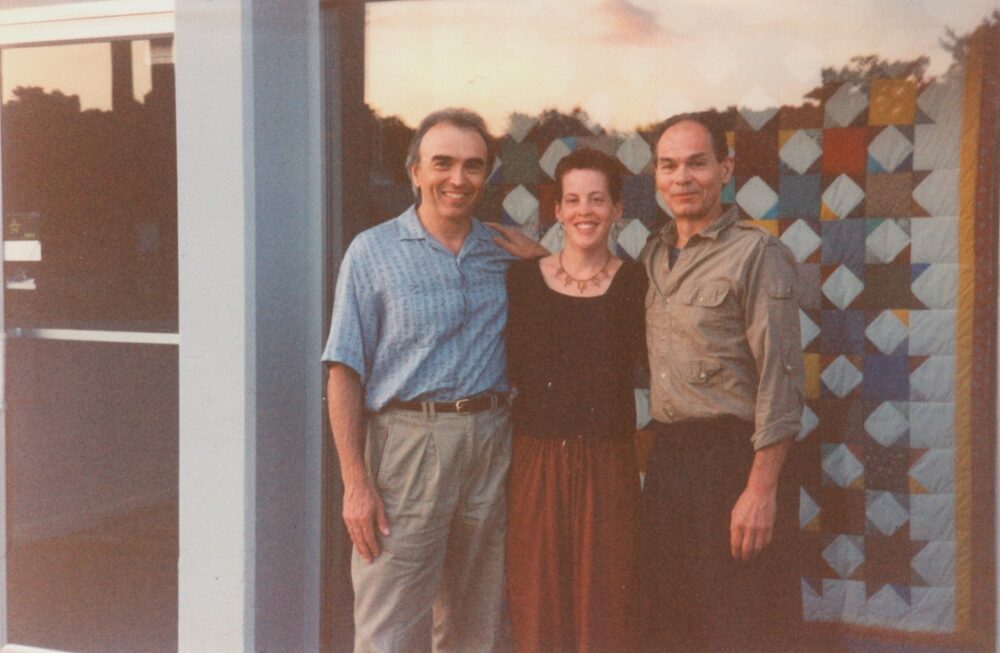

In memory of Chloe, a precious, sassy calico

I guess this is my favorite photo of Chloe (my longtime blog portrait photo) because it’s of us together in good times, and she flirts with the camera with that white-tipped tail of hers.

Once she’s gone, through the tears, your mind rewinds right back to the beginning.

It was almost love at first sight. I had been doing some online match.com searching for some time, but I had never picked a female out of an online lineup before. I saw her face on a small picture and wasn’t totally sure. It was mostly black, so when I picked her I whimsically dubbed her my “soul sista.”

But there was also a large white spot on her right side next to her nose, what I came to think of as her beauty mark. It helped to tip me off she was a calico, with plenty of golden-orange and brown, some delightful white highlights and a big white breast.

I had buried my last cat Maggie, who died in my home, not a long time previously. So, across the whole Milwaukee-area Human Society website this one had grabbed me. I got right into my car and drove from my Riverwest home up to the Ozaukee Couty Humane Society on Highway 33.

When I got there, I called Chloe’s name and she immediately emerged from her little hovel and came up and peered at me through the glass. Yep, the black face and the white spot and she was a wonderfully colored girl.

Calico Chloe transfixed by a butterfly.

She had just turned six and was spayed and microchipped, so she seemed healthy though I knew no more about her background. She was friendly and social right away, and when I got her home she took to her new digs without much adjustment. Behavior patterns emerged quickly. She relished sitting on my lap and loved to sit or sprawl on my desk under my lamp showing off her plush white belly as I wrote, and even added her two-cents worth to my text with a few choice paw taps here and there.
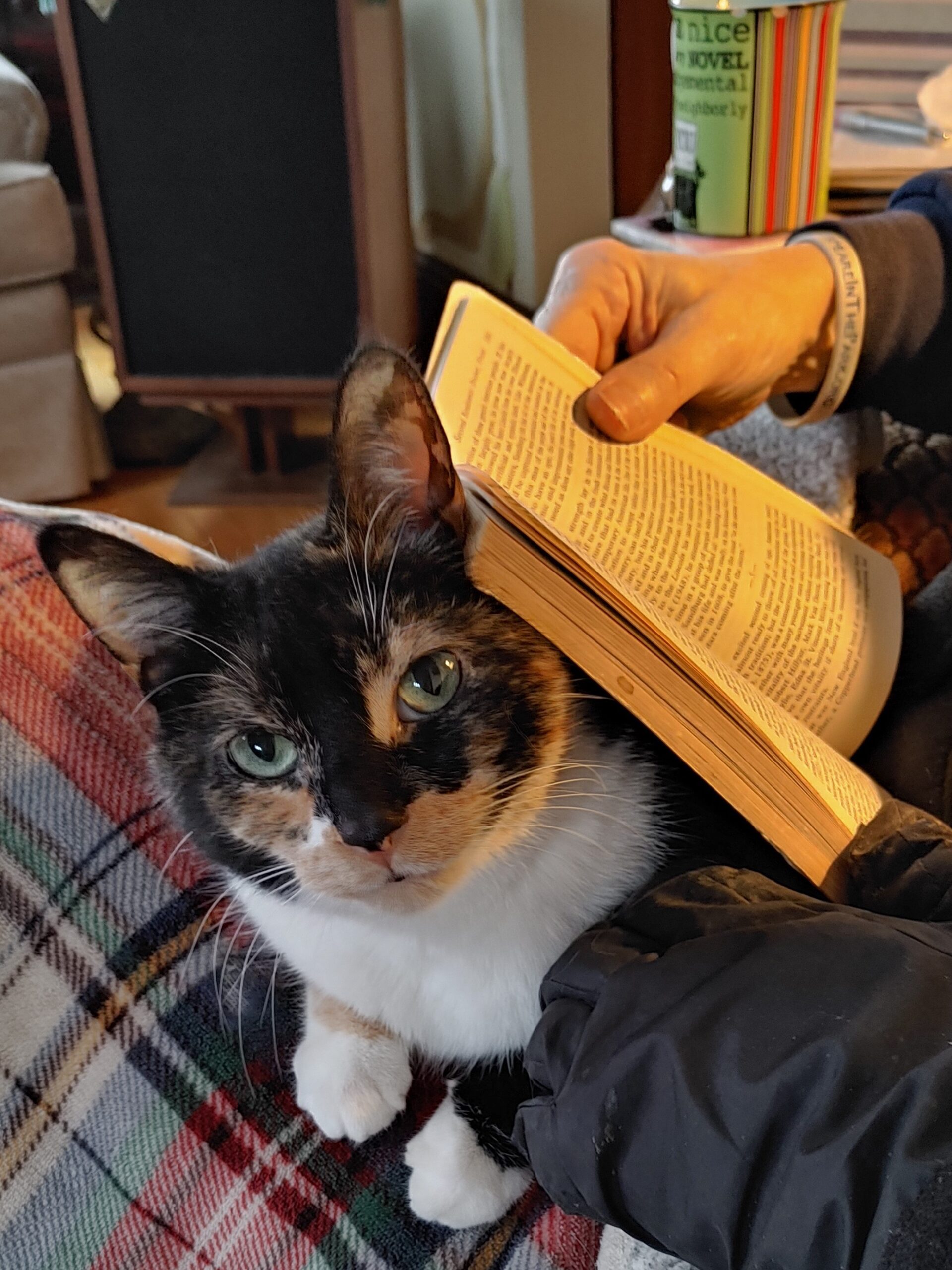
Chloe the adorable literary lap cat

And right around four each afternoon Chloe appeared and vocally reminded me it was time for her dinner.

She very quickly became queen of my humble upper flat castle, and as it was summer she also loved leading me out to the small front balcony. She was soon jumping atop the railing and haughtily tip-toeing along it, which didn’t unnerve me too much — if she fell forward there were still two feet of roof and a gutter for her to land on. But such latitude only emboldened Miss Chloe.

The way the balcony was cut into the roof, before too long she decided to hop up onto the roof and next thing you know she had disappeared around the living room gable corner. I was a bit concerned and expected her to come back after a little snooping round.

Well, I didn’t see her again until she emerged from the other corner. Sure enough she had found her way up and around the back of the gable which really reached to about two feet below the apex of the roof.

At first, I had wired off, a bit absurdly, the two cat-sized openings at the bottom corners of the front balcony railing. But it was such easy access for her and I was hardly going to ban this roof-romper from the balcony I sat on, so I just prayed for the best and learned to trust the fates a bit with this intrepid young lady.

I thought I’d try to follow her up one day, so I crawled out over the railing and peered around the corner. I’m a former amateur mountaineer from many years ago and have done guided climbs in The Tetons. But now my left hand was lamed by a permanent auto immune neuropathy -– I’m now a one-handed typist — so grabbing the gable roof for security with that hand felt dicey so I ventured no further.

Pretty soon I was getting reports from neighbors who’d spotted that calico parading around the roof, sitting and licking herself when the wind ruffled her and tight-roping a bit on the roof apex and around the heater chimney.

Ah, life was good for this sun-bathing dame.

In time she aged and retired from her high-wire attic antics, as if nothing had ever happened.
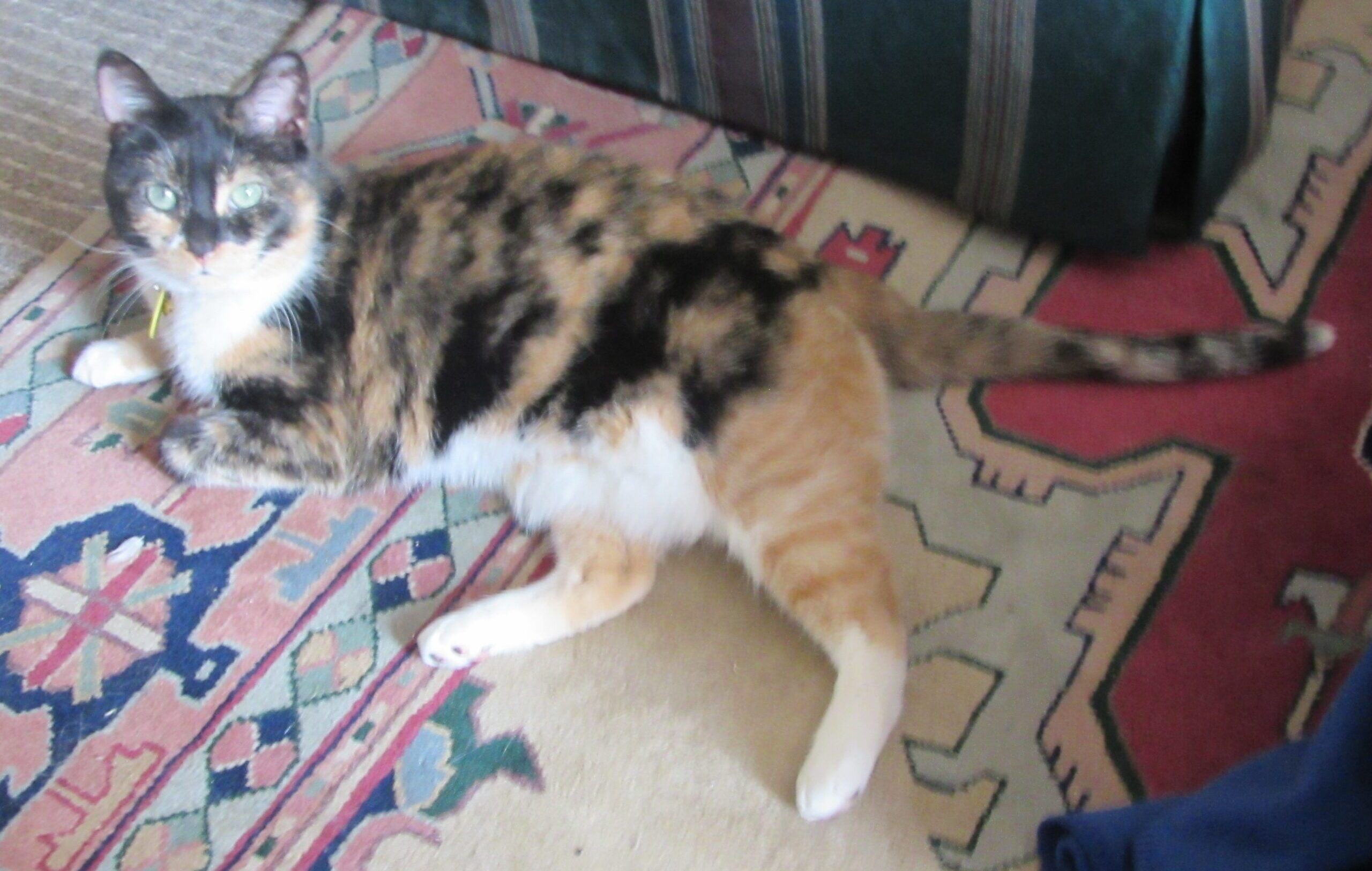
Chloe the lovely queen of the abode

Life remained good for the dame for some years, she greeted human visitors with graceful amiability, was never tempted to stray outside downstairs, though ventures into the basement always proved evident when she sauntered up with dust balls in her whiskers.

Yeah, things were quite good until the fateful day when my gal pal Ann moved in with me, when my landlords offered their own more spacious upper flat next door, as they were moving to Mukwanago. It included a roomy space for my book and CD-lined office and a third bedroom that offered Ann some office space but mainly became a cat feeding and litter room.

The catch for Chloe was that Ann’s two male cat were moving in, too. I had always had a female cat living as my sole feline resident. Ann anticipated trouble having dealt with various cats living together.

Dog and cat owners often compare notes and, yes, dogs behave reliably for always needing to ingratiate their owners/feeders. With a cat, he may rub against your leg seductively at chow time, but you just never know what’s in that box-of-chocolate brain and when or how it might pop open.

Big black Taj was a handful, an always rambunctious and sometimes outrageous escape artist we had to constantly guard against when closing the kitchen door which led to the basement.

Now that Taj was moving in, along with a far more meek “brother” named Ravi, all bets were off for the new furry threesome. Chloe soon had hackles and hair raised by Taj’s oafish efforts at playful interaction. He’d didn’t really know how to deal with a female.

Actually he got sick not too long later and passed away, very sadly for Ann and Ravi who’d grown up with him and soon missed his old play pal.

Now rather lost was Ravi — a bit of a Whimpey in a Popeye cartoon…He’d gladly pay you Tuesday for a hamburger bit today, but only if you gave it to him the quietly enough to not send him running away.

So life simplified for the feline who’d always been the imperious queen of the household with only imaginary subjects. Cat politics hanged drastically. The queen would mess with Ravi, hissing and pawing at him. She was declawed up front when I got her, so she was mostly hot air but the dumb guy cats never seemed to think so.

Then came the Great Ambush in the Tunnel Trick. Ann had brought into the house a long soft cloth tunnel for cats to walk through and play in, as it had a fuzzy ball dangling in the middle of it. It was situated in the dining room pointing towards the center hallway to the kitchen, bedrooms and bath. Chloe got a bright idea, knowing Ravi was just enough of a doofus.

So, she positioned herself at the back end of the tunnel when Ravi was wandering innocently in the center hallway. If he paused the too long, he was dead meat for her.

She spied him through the tunnel, raised her butt up in the air and wiggled it, then shot through like a bullet and in a blink of an eye was on top of poor unsuspecting Ravi, like a vulture on fresh carrion.

Ravi had actually a fair amount of wrestling experience with Taj, so he held his own for the few seconds of Chloe terror.

Cat politics changed yet again when Ann got the bright idea to find a new male buddy for beleaguered Ravi. Problem was, Eddie was a cat kitten who quickly grew into a bit type A-ish personality. “Ish” because he was basically a fraidy cat who spent hours under the bed in fear of any potential visitors or sudden sounds and even me when she was gone — to where I nicknamed his black butt Dracula. That’s just like a bully, really a coward. He would harangue the other two cats plenty as he ballooned into a 14-pound fatso monstrosity and they began to shrink in old age, and Chloe drastically in her last couple of years.

So, I could tell more stories and comedy did abound at times. But this coincided with Chloe’s gradual and finally precipitous decline, mainly from a hyperthyroid condition. As this reflection is really for her, it’s not right to linger long on this era. She loved to chase her tail in the bathtub.

She loved to play with a ball-in-a-circle game and got quite ambidextrous with it before things went bad. As she grew more skeletal she was also ravenously hungry — a Holocaust survivor in her first hours of freedom. Alas, because of that her upchucking gained in frequency and volume and finally her other bodily expressions grew more outside-the-box, but not in any hip way.

I religiously applied transdermal medicine to her ear daily but things grew inevitable for my quite cleanly housemate, increasingly put upon by the messes. Yet Chloe still enjoyed sitting and purring in my lap, to the very last day. I cancelled two euthanasia appointments but a few months later, not the third one.
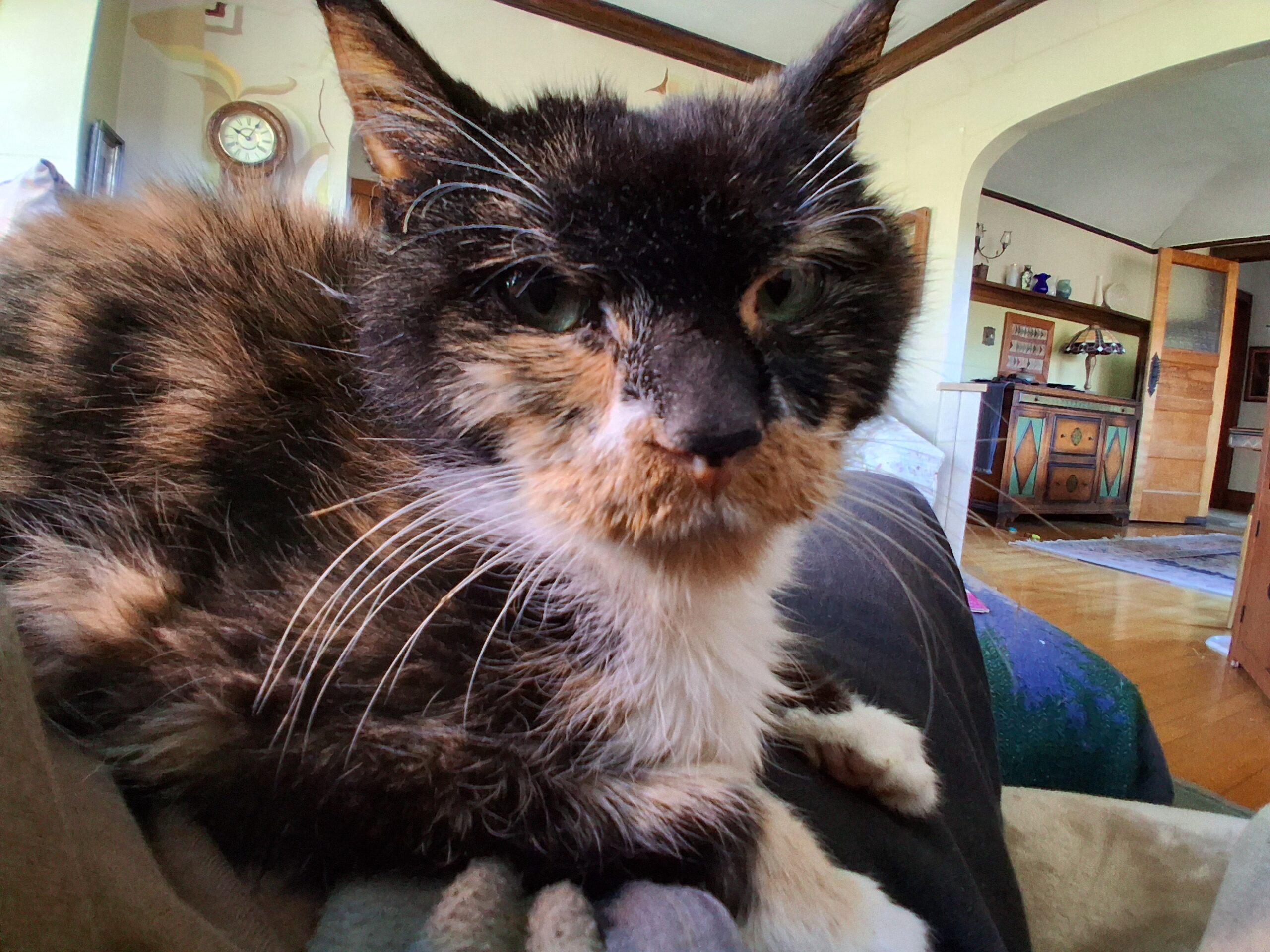
Chloe’s very last portrait, from my lap.

I’m still lonely and heart aching a couple of weeks later. She also signifies plenty to me, as an aging, childless man. I even miss Chloe bugging me for food, jumping up on me at the crack of dawn to tell me to get my rear in gear. In the semi-darkness, the big white beauty mark on her black face seemed to glow in the dark. Even Ann commented on this.

But it’s May and hope does still spring. Big-fat Eddie has plopped down on my lap a couple times since. And I always have really liked Ravi and even relate to him a bit. After all, we both snore.

_____________
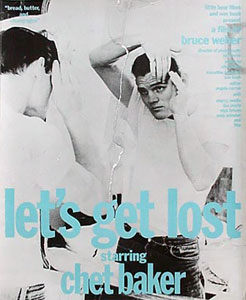


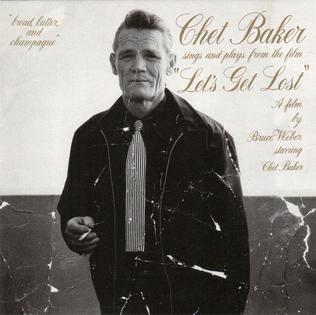
Acclaimed documentary on Chet Baker plays Thursday at Jazz Gallery CFA


poster for Let’s Get Lost, Bruce Weber’s Academy Award-nominated documentary film about Chet Baker


“Let’s Get Lost,” Bruce Weber’s Academy Award-nominated documentary film about Chet Baker

6:30 p.m. Thursday, May 21st, Jazz Gallery Center for the Arts, 936 E. Center St. Milwaukee.

The Chuck LaPaglia Jazz Film Series

Trumpeter Joel Lehman quintet will perform music of Baker after the film.

Suggested donation $15 ($10, students)

https://jazzgallerycenterforarts.org/

_____________

Chet Baker was often compared stylistically to Miles Davis as trumpeters who helped define the cool school of jazz. That’s worth revisiting: Each plied us with the limpid beaty and sly tenderness of their horn. As the lead performer on the iconic recording The Birth of the Cool, Miles probably correctly gets credit as initiator of the style.

A big difference in persona can affect interpretation. As a romantic, Miles was always a tough customer, an amateur boxer, who once recorded an album dedicated to the pioneering black heavyweight champion Jack Johnson (However, his whispery voice resulted from an improperly healed throat operation, not a street fight).

By contrast, Baker almost always conveyed degrees of vulnerability and wistfulness, rather than toughness. He was a lyrically inventive trumpeter but what stood out was his singing, rare among musicians known first as instrumentalists.

His tenor voice sounded like an injured dove inhabiting a man’s frame. In his youth, he also had lean square-jawed good looks comparable to James Dean. In his last years, after a life ravaged by drugs, he was the proverbial picture of Dorian Grey, but without the demonic aura.

In August of 1981, Baker played at the Milwaukee Jazz Gallery, and now that venue’s current incarnation, The Jazz Gallery Center for the Arts, will present Let’s Get Lost, Bruce Weber’s 1988 Academy Award-nominated documentary film about the unforgettable jazz trumpeter and singer, at 6:30 p.m. Thursday, May 21.

Immediately following, trumpeter Joel Lehman’s quartet will perform music by and associated with Baker.

Soundtrack to Burce Weber’s film on Chet Baker, “Let’s Get Lost.”

A Wikipedia listing includes this on the film: “By juxtaposing these two decades, Weber presents a sharp contrast between the younger, handsome Baker — the statuesque idol who resembled a mix of James Dean and Jack Kerouac — to what he became, “a seamy looking drugstore cowboy-cum-derelict”, as J. Hoberman put it in his Village Voice review.” 1

The Icelandic singer-songwriter and actor Bjork, is unstinting in her praise of Baker: “He’s the only singer I’ve ever been able to identify with. I love the fact he’s so expressive, so overemotional. It’s classic stuff; it makes me soft in my knees… He was so into it: like, ‘Fuck those notes I’m singing, and fuck those songs I’m singing – what I want is the emotion.’ That’s how I feel about it too.”

Let’s Get Lost also received a 93% Rotten Tomatoes rating.

I was fortunate to document Baker’s 1981 performance here for The Milwaukee Journal. My phone interview feature with Baker (August 7) and review of his Jazz Gallery concert (August 12) are included chronologically in The Milwaukee Jazz Gallery 1978-1984 anthology, reprinted in 2016, but now hard to find, possibily at the JGCA. The Milwaukee Public Library owns a copy. 3

So, I include scanned copies of both documents here.

This event continues the valuable film and performance series named for the Milwaukee Jazz Gallery founder Chuck LaPaglia and expertly curated by a JGCA board member Ron Aplin.

This writer’s 1981 phone interview with Chet Baker for The Milwaukee Journal:

20260519_140012_0001

20260519_140012_0002

This writer’s 1981 review of Chet Baker at The Milwaukee Jazz Gallery:

20260519_140012_0003

________

  1.  Hoberman, J (April 25, 1989). “Self-Destructive Beauties”. The Village Voice.
  2.  Aston, Martin (October 1993). “Björk Guðmundsdóttir’s Record Collection”. Q.
  1. https://www.goodreads.com/en/book/show/32682861-milwaukee-jazz-gallery-1978-1984

Time to save New Deal public art threatened by Trump’s wrecking ball

The Wilbur J. Cohen Federal Building was completed between the years 1939-1940, by architect Charles Z. Klauder. Architectural style is Stripped Classicism. Originally constructed as and called the Social Security Building, it was renamed in 1988 for Wilbur Joseph Cohen (1913-1987), a government official and public affairs educator. Art.

As an art major undergrad, my aesthetics were shaped by modernist values, leaning towards degrees of surrealist abstraction (read Joan Miro, Arshile Gorky and Jackson Pollock). But as readers of my blog know, my full inclinations (“common and uncommon culture”) are hardly exclusionary or purely abstract.

So, Judith Shulevitz’s essay in The Atlantic’s May 2026 issue struck a chord and blows against the ever-gilding empire of Donald Trump. She focusses on the Wilbur J. Cohen Federal Building, the current home of the Social Security Board, and other already hollowed-out agencies like the Department of Health and Human Services, and
The Voice of America. The massive Art Deco and Egyptian Revival building in DC is on the administration’s “accelerated disposition” list, a euphemism for demolition. Whither Social Security? Probably nowhere but severely damaged, but God only knows.

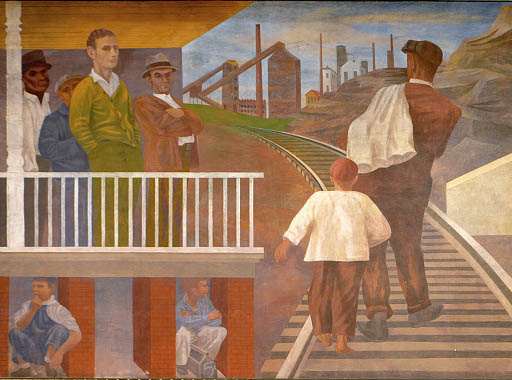
The mural artwork still visible there — commissioned by the Franklin Roosevelt administration to help shepherd Americans out of the Great Depression — spoke in proletarian terms but hardly lumpen, nor was it nostalgic “make America great again” gloss.

It proved that artful imagery could speak to people as powerfully as any words or verbal rhetoric — it transcended the limits of literacy. One can see how new immigrants might seize the day and become workers toward citizenship. The vision was big-shouldered forward-ho, even as it showed how hard that road could be. This remained the land of individual freedom but governed society now had a big role to play. And this was no racist lily-white wash, as persons of many colors inhabit the murals by Ben Shahn, Seymour Fogel and Phillip Guston. Nor were these smiling or overly proud faces.

Shulevitz writes: “Perhaps the air of gravitas evident in all the building’s murals, and the ambivalence hinted at in Guston’s and Fogel’s, reflects the anxieties of the time. While Shahn was working (during World War II), people came up to him and said that what he was painting was what they were fighting for.”

She also notes this art drew from Soviet-style Socialist Realism but also from the more expansive imagery of “Regionalism — think Grant Wood and Thomas Hart Benton – which leaned toward heartland nativism.” Again, this aesthetic and value system was inherently American, suggesting how socialist programs could adapt to and enhance capitalist progress.

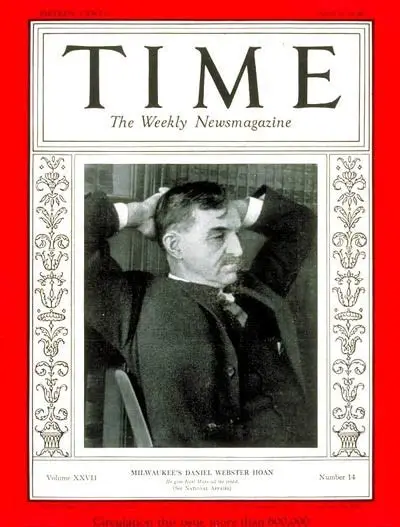
Socialist Milwaukee Mayor Daniel Hoan on the cover of TIME, April 6, 1936. TIME USA LLC

This also coincided with Milwaukee mayors demonstrating how their so-called “sewer socialism” could work at local metropolitan levels. Mayor Daniel Hoan made the cover of TIME magazine by 1936. The word socialism had so much more applied meaning to real life than the reflexive recoiling from it typical of so many misinformed people in this era of facile online fearmongering and contagious xenophobia.

Some derided such art as propaganda and kitsch for the masses. But, as Shahn wrote in a 1968 oral history, “Propoganda is a noble word. It means you believe something very strongly and you want other people to believe it, to propagate your faith.”

Idealistic for sure, but apt to the moment and the place. His most notable narrative murals in the Cohen building, titled “The Meaning of Social Security,” (see detail of Shahn mural at top) are two-part — one depicting the plight of people without such security, from huddled children and mothers, to thread-bare fathers and sons facing a curving railroad track into an uncertain future. The second part, post-Social Security Act of 1935, shows men constructing new skyscrapers with blazing welding guns and muscular youths leaping for a basketball.

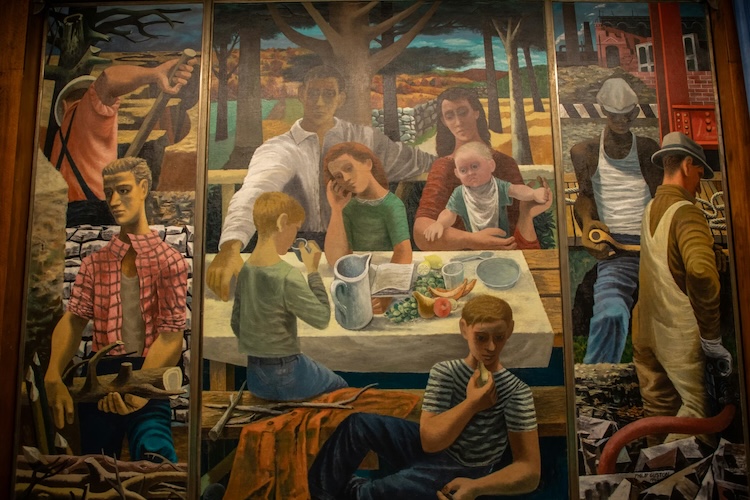
Philip Guston’s Social Security Building mural “Reconstruction and the Well-Being of the Family,” handmadepiece.com

The chiaroscuro, textures and architecture of these works — note Guston’s triptych, “Reconstruction and the Well-Being of the Family,” evoking the Last Supper and Madonna and Child, — “has the aura of an altarpiece,” also lending a storytelling atmosphere, challenging and charging the imagination.

Perhaps this signifies something to hold sacred in the American ethos, “to remind future generations of what patriotism looked like.”

Wrecking balls, by contrast, can reduce history to rubble with a single, imperious order, for the sake of the powerful and narcissistic.

Here is Shulevitz’s essay:

https://www.theatlantic.com/magazine/2026/05/new-deal-art-wilbur-cohen-building-murals/686581/ 

__________________

Grammy-winning trumpeter Brian Lynch outdoes himself


Torch Bearers, by Brian Lynch


The Israel/Palestine quagmire of tragedy comes home in essay by Jodi Melamed

Salah Sarsour.  OIP.webp

The genocide that resulted from the horrid tragedy of the Israel/Palestine conflict remains the greatest moral dilemma extant, despite the current madness of King Donald’s war on Iran. And the dilemma came home to Milwaukee when — in an opinion piece by Jodi Melamed in the Sunday May 3rd Milwaukee Journal Sentinel Ideas Lab section — she reiterated the situation of Salah Sarsour, president of The Islamic Society of Milwaukee.

Sarsour was recently targeted and kidnapped by ICE for his advocacy of the Palestinian people, according to a resolution passed April 21 by the Common Council to demand his immediate release.

“As Jews who know our history, we have seen the playbook before,” Melamed writes. “Disappearing the most beloved member of our community to terrorize us and fragment us is familiar to us. It was the strategy of the Gestapo in Nazi Germany and by the Russian Tzar in the Eastern European Pale of Settlement. No one should fear the knock on the door, the unconstitutional detention.”

Jodi Melamed, "The Open Secret of Racial Capitalist Violence" | Fall ...

Marquette Professor Jodi Melamed is a passionate lecturer and social activist. You Tube

I’ll let Melamed detail Sarsour’s importance to the community in her piece linked below. She co-founded the Milwaukee Chapter of Jewish Voices for Peace in 2014, and remains a member-leader.

Melamed and Sarsour have worked together on the Palestinian cause, she says. They exemplify the wisdom and courage of our local Jewish leaders in solidarity with Islamic fellows to fight the tragedy of Benjamin Netanyahu’s criminally grotesque overkill of 70,000-plus Palestinian people in response to the October 7 attack on Israel by Hamas, and to counter the sinister misinformation that feeds Trump’s current “anti-semitism” campaign. History already casts a shadow of profound shame and criminal accountability on contemporary Israeli leadership. As for the Israeli people, considering the history of The Holocaust…

Salah Sarsour, president of the Islamic Society of Milwaukee. OIP

Her piece initially jumped out at me because I happen to know her personally. I took a 20th Century American Literature course from her at Marquette University while doing work towards a PhD (which I did not complete).

Melamed was perhaps my favorite of the professors I encountered in a year and a half at MU. I was deeply impressed by her passion for ideas and writing that contribute to social justice and an empowered sense of international pluralism and community.

I had no idea of her activism and leadership at the time. But it all makes sense now. Dr. Melamed got us students up to speed on the work of important recent writers like Judith Butler and Gloria Anzaldua, and contemporary feminism’s role in today’s society and politics. I always left her class slightly buzzing. She was also a fair and rigorous critic of my own essays for her class, yet always in a supportive spirit.

Hers is also the kind of quality university education under attack by the Trump administration. Melamed’s essay here also underscores the very real personal fear she feels as a prominent figure in the Palestinian cause with the fate of Sarsour still in limbo.

I’m proud to report my congressional Rep. Gwen Moore visited Sarsour in the Clay County Detention Center in Indiana on April 24. Melamed urges other leaders supporting him to do the same.

This is about an important and beloved Milwaukee community leader languishing as a prisoner of unconstitutional state-sponsored terrorism. What has our nation become?

Here’s a link to Melamed’s essay:

https://www.jsonline.com/story/opinion/contributors/2026/04/25/ice-arrest-milwaukee-muslim-leader-palestine-antisemitism/89720092007/

_____________________