Acclaimed documentary on Chet Baker plays Thursday at Jazz Gallery CFA


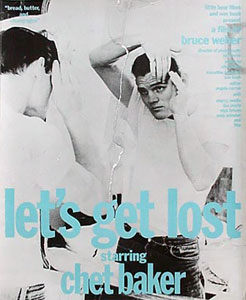
poster for Let’s Get Lost, Bruce Weber’s Academy Award-nominated documentary film about Chet Baker


“Let’s Get Lost,” Bruce Weber’s Academy Award-nominated documentary film about Chet Baker

6:30 p.m. Thursday, May 21st, Jazz Gallery Center for the Arts, 936 E. Center St. Milwaukee.

The Chuck LaPaglia Jazz Film Series

Trumpeter Joel Lehman quintet will perform music of Baker after the film.

Suggested donation $15 ($10, students)

https://jazzgallerycenterforarts.org/

_____________

Chet Baker was often compared stylistically to Miles Davis as trumpeters who helped define the cool school of jazz. That’s worth revisiting: Each plied us with the limpid beaty and sly tenderness of their horn. As the lead performer on the iconic recording The Birth of the Cool, Miles probably correctly gets credit as initiator of the style.

A big difference in persona can affect interpretation. As a romantic, Miles was always a tough customer, an amateur boxer, who once recorded an album dedicated to the pioneering black heavyweight champion Jack Johnson (However, his whispery voice resulted from an improperly healed throat operation, not a street fight).

By contrast, Baker almost always conveyed degrees of vulnerability and wistfulness, rather than toughness. He was a lyrically inventive trumpeter but what stood out was his singing, rare among musicians known first as instrumentalists.

His tenor voice sounded like an injured dove inhabiting a man’s frame. In his youth, he also had lean square-jawed good looks comparable to James Dean. In his last years, after a life ravaged by drugs, he was the proverbial picture of Dorian Grey, but without the demonic aura.

In August of 1981, Baker played at the Milwaukee Jazz Gallery, and now that venue’s current incarnation, The Jazz Gallery Center for the Arts, will present Let’s Get Lost, Bruce Weber’s 1988 Academy Award-nominated documentary film about the unforgettable jazz trumpeter and singer, at 6:30 p.m. Thursday, May 21.

Immediately following, trumpeter Joel Lehman’s quartet will perform music by and associated with Baker.
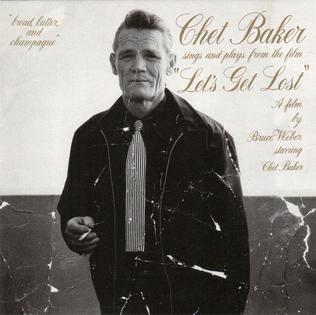
Soundtrack to Burce Weber’s film on Chet Baker, “Let’s Get Lost.”

A Wikipedia listing includes this on the film: “By juxtaposing these two decades, Weber presents a sharp contrast between the younger, handsome Baker — the statuesque idol who resembled a mix of James Dean and Jack Kerouac — to what he became, “a seamy looking drugstore cowboy-cum-derelict”, as J. Hoberman put it in his Village Voice review.” 1

The Icelandic singer-songwriter and actor Bjork, is unstinting in her praise of Baker: “He’s the only singer I’ve ever been able to identify with. I love the fact he’s so expressive, so overemotional. It’s classic stuff; it makes me soft in my knees… He was so into it: like, ‘Fuck those notes I’m singing, and fuck those songs I’m singing – what I want is the emotion.’ That’s how I feel about it too.”

Let’s Get Lost also received a 93% Rotten Tomatoes rating.

I was fortunate to document Baker’s 1981 performance here for The Milwaukee Journal. My phone interview feature with Baker (August 7) and review of his Jazz Gallery concert (August 12) are included chronologically in The Milwaukee Jazz Gallery 1978-1984 anthology, reprinted in 2016, but now hard to find, possibily at the JGCA. The Milwaukee Public Library owns a copy. 3

So, I include scanned copies of both documents here.

This event continues the valuable film and performance series named for the Milwaukee Jazz Gallery founder Chuck LaPaglia and expertly curated by a JGCA board member Ron Aplin.

This writer’s 1981 phone interview with Chet Baker for The Milwaukee Journal:

20260519_140012_0001

20260519_140012_0002

This writer’s 1981 review of Chet Baker at The Milwaukee Jazz Gallery:

20260519_140012_0003

________

  1.  Hoberman, J (April 25, 1989). “Self-Destructive Beauties”. The Village Voice.
  2.  Aston, Martin (October 1993). “Björk Guðmundsdóttir’s Record Collection”. Q.
  1. https://www.goodreads.com/en/book/show/32682861-milwaukee-jazz-gallery-1978-1984

Milwaukee Jazz Orchestra: Something New in a Grand Old Tradition

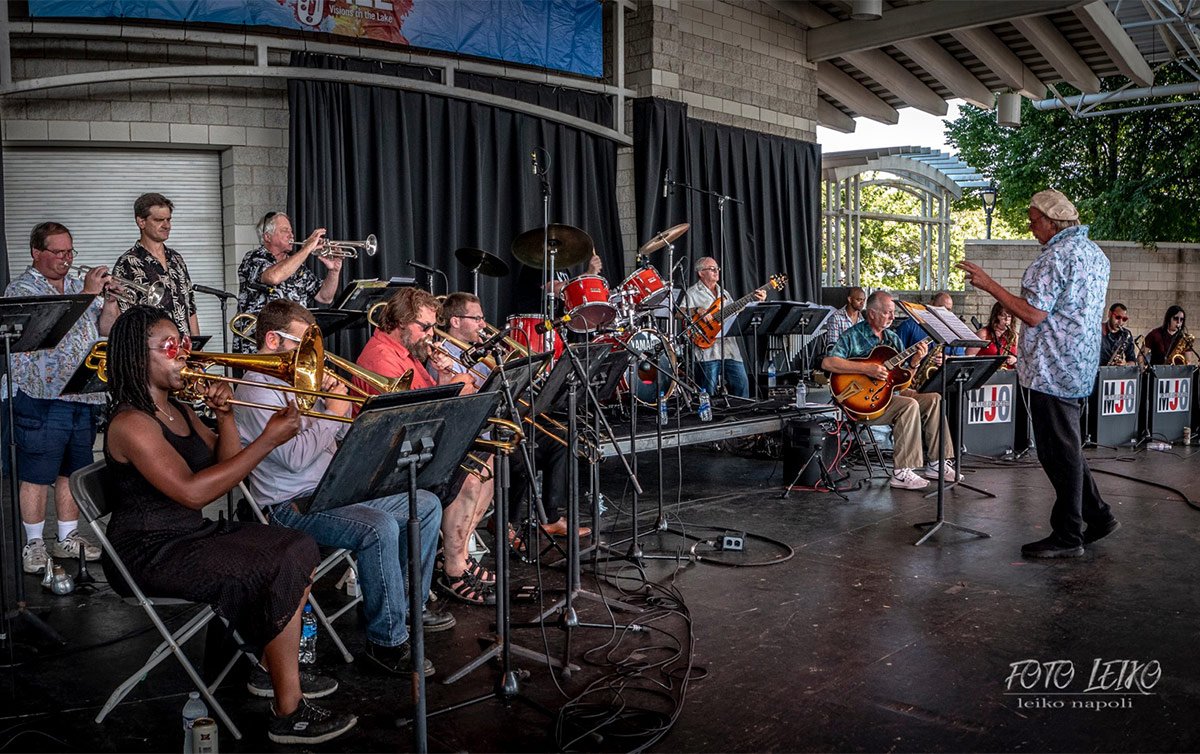
Saxophonist-bandleader Curt Hanrahan ( standing, far right) conducts the Milwaukee Jazz Orchestra. Photo by Leiko Napoli

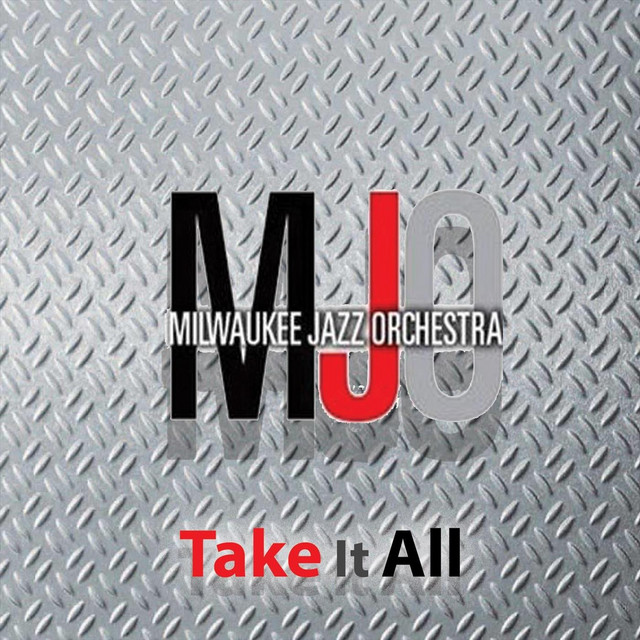
The Milwaukee Jazz Orchestra will perform an album-release concert for Take it All at 6 p.m. Sunday Aug. 21 at the Racine Theater Guild, 2519 Northwestern Ave., Racine. For advance tickets, visit: MJO tickets

Is the jazz big band a relic of the swing era? Well, there’s still power in numbers, and wider musical vistas to explore. Despite inherent costliness, the art form has remained vital and evolving with such distinctive ensembles as The Maria Schneider Orchestra, The Lincoln Center Jazz Orchestra, The Mingus Big Band, Darcy James Argue’s Secret Society, John Beasley’s MONK’estra and The Vanguard Orchestra. The Brian Lynch Big Band won a Grammy award in 2020, led by the Milwaukee-raised trumpeter-composer-band leader.

Add the Milwaukee Jazz Orchestra to that list, with their auspicious second album, Take it All. It reveals a full plumbing of orchestral resources with both advanced contemporary aesthetics and catchy grooves aplenty. The MJO hardly emerged out of the blue. For 12 years, orchestra leader Curt Hanrahan led the UW-Milwaukee Jazz Ensemble, and the annual Woody Herman Jazz Festival, before retiring in 2017.

At the core of the new orchestra’s personnel is the synchronistic 30-plus-year-old jazz fusion band OPUS (which will open the Racine concert for the MJO). Between Hanrahan and his brother, drummer/co-bandleader Warren Hanrahan, they’ve performed with numerous big bands of the past, including Arturo Sandoval, Glenn Miller, Tommy and Jimmy Dorsey, Frank Sinatra Jr., Harry Connick Jr., Lawrence Welk and Woody Herman’s band led by Frank Tiberi.

“I love all big bands and have observed, listened and learned from many of them but my main influence has always been the benevolent Woody Herman,” Hanrahan says. “The Milwaukee native was on the road for close to 50 years with various bands and ‘Herds’ and produced some of the most iconic and legendary jazz musicians, composers/arrangers that this American art form has to offer. Our jazz festivals are modeled after his Woody Herman/Sister Fabian scholarship and educational programs that began in the mid to late sixties.”

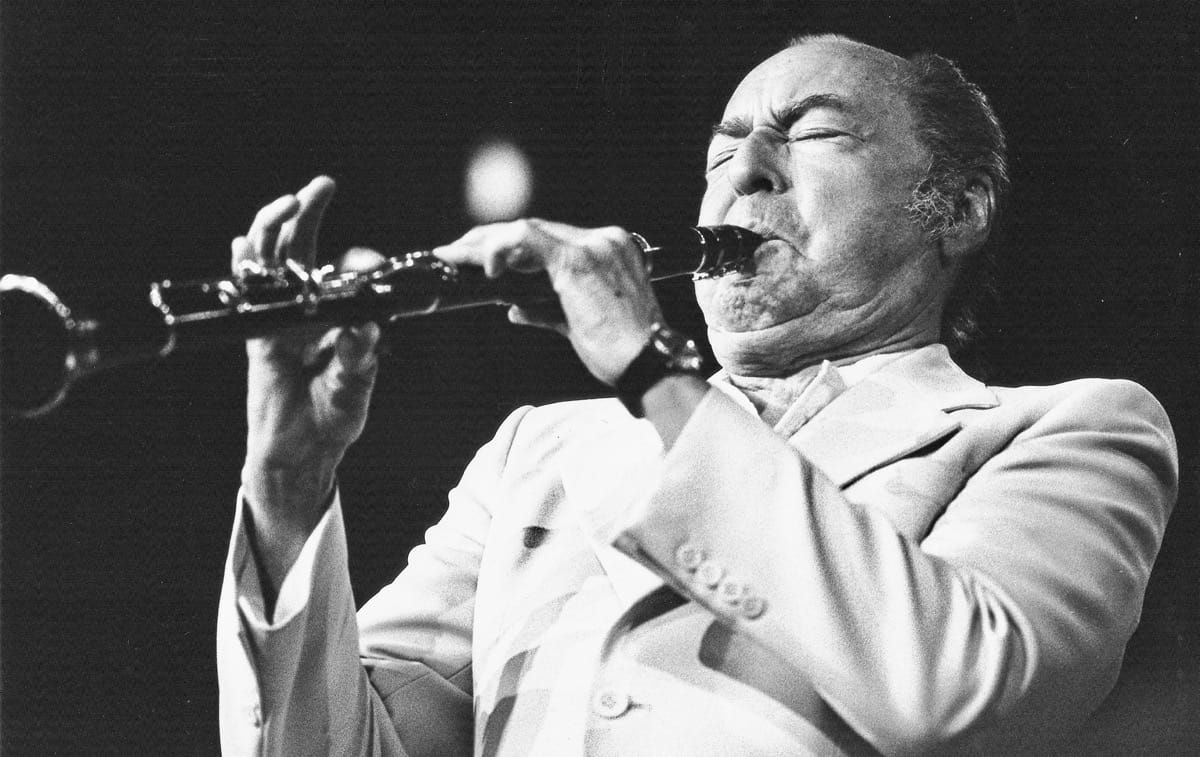
Milwaukee-born clarinetist-saxophonist Woody Herman. Courtesy Jazz Journal

Perhaps there’s hometown bias in Hanrahan’s affection for Herman’s “Thundering Herds,” but that big-band leader always forged bridges between swing orchestras and modern jazz. Jazz historian Ted Gioia writes, “Herman’s evolution from sweet music to traditional jazz to modern jazz is almost unprecedented in the history of music. For Woody Herman is best understood…as a catalyst. His talent lay in enabling – spurring those around him to their deepest creative currents, inspiring them, letting them ‘loose’.” Herman’s second Herd debuted the “Four Brothers” band, with a section of three tenor saxophones and one baritone, which provided a template for what would soon be called cool jazz.

Album cover courtesy Spotify 

Accordingly, The MJO projects through a forward-looking lense, with arrangements that facilitate rather than burden soloists and ensemble flair. The title tune “Take It All” opens with short phrases building suspense, then layers into dissonant yet alluring harmonies with a complex series of snapping ensemble accents. Tenor saxophonist Kyle Seifert delivers a measured solo rumination until the second chorus’s rising intensity driven by the big ensemble. Trumpeter David Katz provides deft, warm counterpoint, a la Thad Jones, to a sumptuous climax.

The second tune, “We All Love Eddie Harris,” reflects saxophonist Harris’s penchant for a cool but funky vamp that allows sassy rhythmic licks from Seifert, and quotes liberally from Harris’s swaggering, interval-skipping jazz classic “Freedom Jazz Dance.”

Ensuing material ranges from a tricky Oscar Peterson adaptation of the vintage finger-snapper “Sweet Georgia Brown” to “Covidity,” a Hanrahan piece reflecting the “angst of the pandemic era,” yet inspired by Elvin Jones’s Live at the Lighthouse album, a blazing hallmark of post-Coltrane jazz.

“Souljourner” closes the album with a transporting swirl of woodwinds detouring into a gritty jazz-fusion guitar solo from Steve Lewandowski. The MJO demonstrates how bigger is better when the outcome embraces a panoply of compelling moods and stylistic effects, allowing the listener to “take it all” in.

For information on the MJO, visit: https://www.mjojazz.com/

________________

This article was previously published in The Shepherd Express: MJO article