
The Wilbur J. Cohen Federal Building was completed between the years 1939-1940, by architect Charles Z. Klauder. Architectural style is Stripped Classicism. Originally constructed as and called the Social Security Building, it was renamed in 1988 for Wilbur Joseph Cohen (1913-1987), a government official and public affairs educator. Art.
As an art major undergrad, my aesthetics were shaped by modernist values, leaning towards degrees of surrealist abstraction (read Joan Miro, Arshile Gorky and Jackson Pollock). But as readers of my blog know, my full inclinations (“common and uncommon culture”) are hardly exclusionary or purely abstract.
So, Judith Shulevitz’s essay in The Atlantic’s May 2026 issue struck a chord and blows against the ever-gilding empire of Donald Trump. She focusses on the Wilbur J. Cohen Federal Building, the current home of the Social Security Board, and other already hollowed-out agencies like the Department of Health and Human Services, and
The Voice of America. The massive Art Deco and Egyptian Revival building in DC is on the administration’s “accelerated disposition” list, a euphemism for demolition. Whither Social Security? Probably nowhere but severely damaged, but God only knows.
The mural artwork still visible there — commissioned by the Franklin Roosevelt administration to help shepherd Americans out of the Great Depression — spoke in proletarian terms but hardly lumpen, nor was it nostalgic “make America great again” gloss.
It proved that artful imagery could speak to people as powerfully as any words or verbal rhetoric — it transcended the limits of literacy. One can see how new immigrants might seize the day and become workers toward citizenship. The vision was big-shouldered forward-ho, even as it showed how hard that road could be. This remained the land of individual freedom but governed society now had a big role to play. And this was no racist lily-white wash, as persons of many colors inhabit the murals by Ben Shahn, Seymour Fogel and Phillip Guston. Nor were these smiling or overly proud faces.
Shulevitz writes: “Perhaps the air of gravitas evident in all the building’s murals, and the ambivalence hinted at in Guston’s and Fogel’s, reflects the anxieties of the time. While Shahn was working (during World War II), people came up to him and said that what he was painting was what they were fighting for.”
She also notes this art drew from Soviet-style Socialist Realism but also from the more expansive imagery of “Regionalism — think Grant Wood and Thomas Hart Benton – which leaned toward heartland nativism.” Again, this aesthetic and value system was inherently American, suggesting how socialist programs could adapt to and enhance capitalist progress.
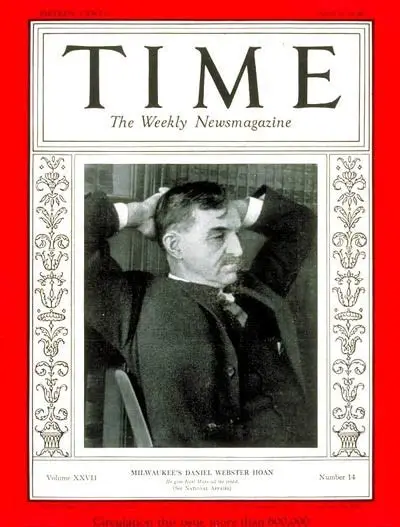
Socialist Milwaukee Mayor Daniel Hoan on the cover of TIME, April 6, 1936. TIME USA LLC
This also coincided with Milwaukee mayors demonstrating how their so-called “sewer socialism” could work at local metropolitan levels. Mayor Daniel Hoan made the cover of TIME magazine by 1936. The word socialism had so much more applied meaning to real life than the reflexive recoiling from it typical of so many misinformed people in this era of facile online fearmongering and contagious xenophobia.
Some derided such art as propaganda and kitsch for the masses. But, as Shahn wrote in a 1968 oral history, “Propoganda is a noble word. It means you believe something very strongly and you want other people to believe it, to propagate your faith.”
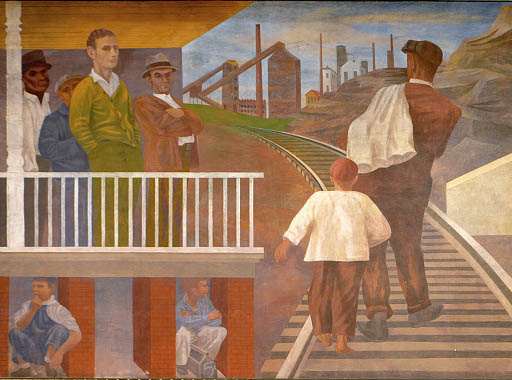
Idealistic for sure, but apt to the moment and the place. His most notable narrative murals in the Cohen building, titled “The Meaning of Social Security,” (see detail of Shahn mural at top) are two-part — one depicting the plight of people without such security, from huddled children and mothers, to thread-bare fathers and sons facing a curving railroad track into an uncertain future. The second part, post-Social Security Act of 1935, shows men constructing new skyscrapers with blazing welding guns and muscular youths leaping for a basketball.
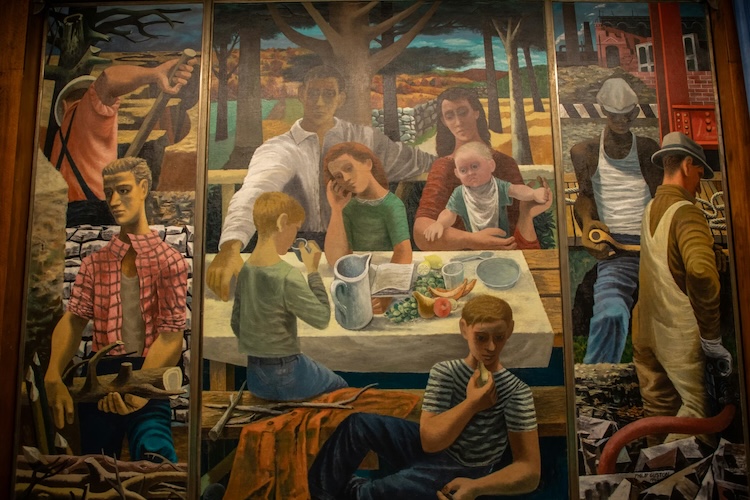
Philip Guston’s Social Security Building mural “Reconstruction and the Well-Being of the Family,” handmadepiece.com
The chiaroscuro, textures and architecture of these works — note Guston’s triptych, “Reconstruction and the Well-Being of the Family,” evoking the Last Supper and Madonna and Child, — “has the aura of an altarpiece,” also lending a storytelling atmosphere, challenging and charging the imagination.
Perhaps this signifies something to hold sacred in the American ethos, “to remind future generations of what patriotism looked like.”
Wrecking balls, by contrast, can reduce history to rubble with a single, imperious order, for the sake of the powerful and narcissistic.
Here is Shulevitz’s essay:
https://www.theatlantic.com/magazine/2026/05/new-deal-art-wilbur-cohen-building-murals/686581/
__________________