J6anuar0Syn968 29 5soiat 1l51dg77:432 AMl
Shared with Facebook Public


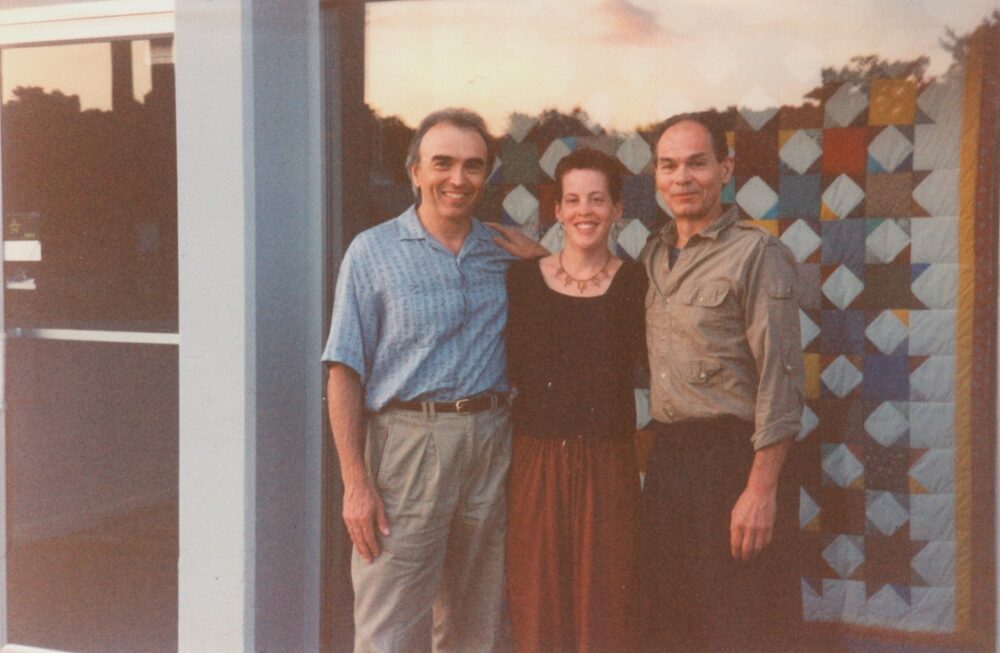
Wendy and Marvin Hill. Courtesy Wendy Carroll Hill
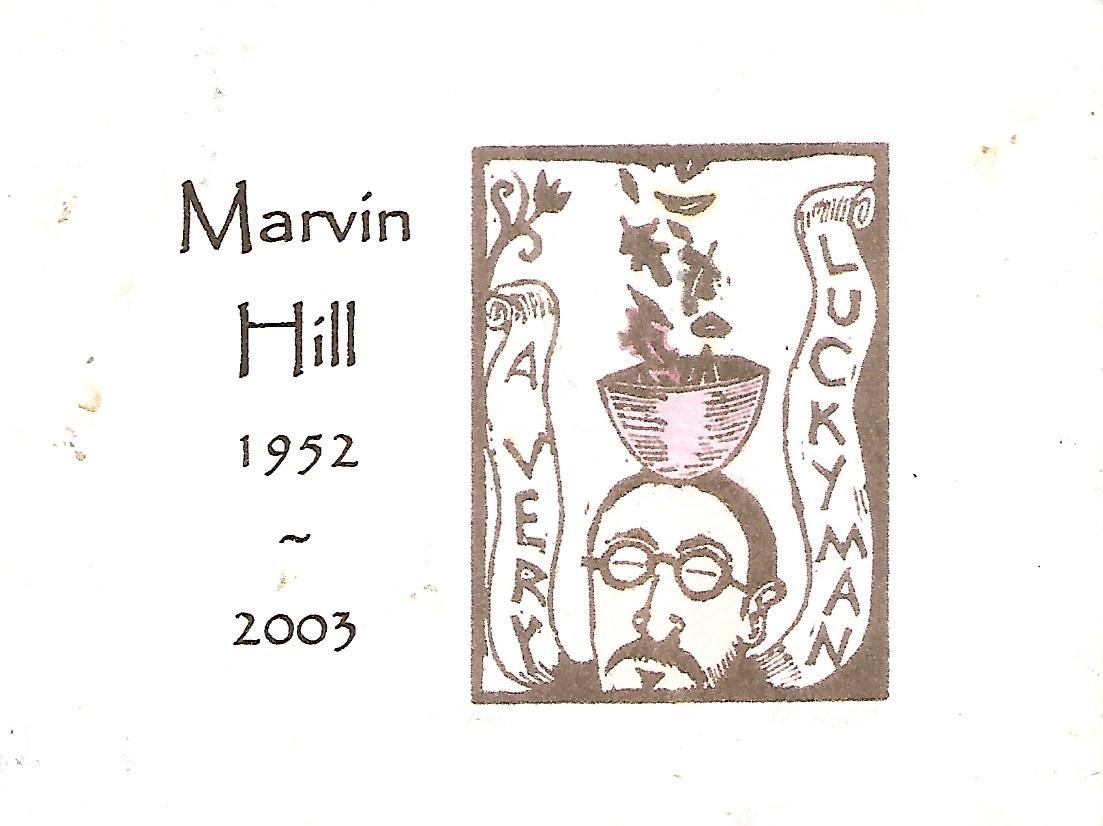
He’s been gone since 2003, but Marvin Hill is hardly forgotten. My home brims with his wondrous and witty linoleum-block prints. And just as his memorial postcard (see below) was graced with his self-description as “a very lucky man,” I feel blessed as well, with his art and for having known him. I don’t know when exactly Marvin made that self-portrait, but I suspect it was near the end of his life. He seemed like the sort who appreciated his time on this planet, and knew that he had left a rich legacy, filled with hundreds of pathways into his imagination, each adventure returned as a sharply-honed visual story of wonder, humor and mystery.

He died on this day, December Second, in 2003, of non-Hodgkin’s lymphoma, at 51. His widow, Wendy Hill, who did most of the hand-coloring for his prints, sent out the above postcard in June of 2005, to announce a Marvin Hill booth at Art Fair On the Square. As if nothing had changed, except that angelic tribute to Marvin’s life, talent and spirit. .
He was a sweet, but droll man, with a vibrant creative fire. I once visited his rural studio, slightly pungent with the smell of printer’s ink, and it seemed alive with a slightly cock-eyed aura of artistic affirmation. His artwork was popular, yet idiosyncratic and personal, never pandering. He was always one of the most interesting artists at any art fair he exhibited at, and he was duly feted when chosen as The Featured Artist, for the 1999 Art Fair on the Square in Madison. He designed the official T-shirt for that year’s fair, which he autographed for me and I still have it. Hill exhibited widely at fairs and galleries, and won national awards for his work. 1
Though he once lived on the same street in Milwaukee I now live on, he and Wendy ended up in Johnson Creek, halfway between Madison and Milwaukee, and Madison seemed his strongest market.
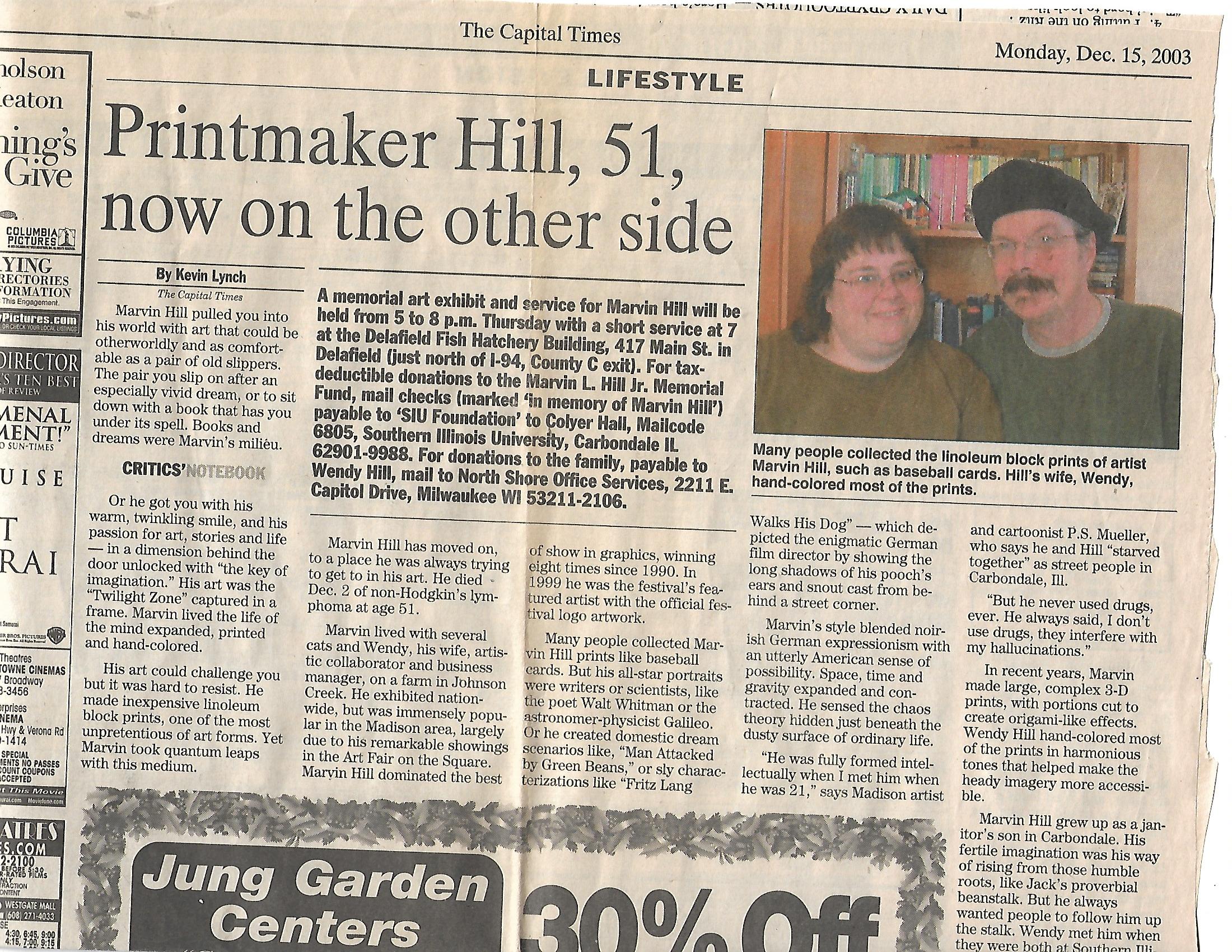
I wrote an appreciation of him when he died, for The Capital Times in Madison, and I’ll share some of my thoughts from that time:
“Marvin Hill pulled you into his world with art that could be otherworldly, or as comfortable as a pair of old slippers. The pair you slip on after an especially vivid dream, or to sit down with the book that has you under its spell. Books and dreams were Marvin’s milieu.
Or he got you with his warm, twinkling smile, and his passion for art, stories and life – in a dimension behind the door unlocked with ‘the key of imagination.’ His art was “The Twilight Zone” captured in a frame. Marvin lived the life of the mind, expanded, printed and hand colored.
His art could challenge you but it was hard to resist. He made inexpensive linoleum block prints, one of the most unpretentious of art forms. Yet Marvin took quantum leaps with this medium….
“Marvin’s style blended noir-ish German Expressionism with an utterly American sense of possibility. Space, time and gravity expanded and contracted. He sensed the chaos theory hidden just beneath the dusty surface of ordinary life.”
“‘He was fully formed intellectually when I met him when he was 21’, says Madison artist and cartoonist P.S. Mueller, who says he and Hill ‘starved together’ as street people in Carbondale, Illinois.
.” ‘But he never used drugs, ever. He always said, ‘I don’t use drugs, they interfere with my hallucinations.’ ” 2
That’s how funny and delightfully outre the guy could be.
Now, I will share some images of Marvin Hill art, with commentary.
He only made one print of my personal favorite among those I own (see his edition designation, “1/1” or “one of one” beside the title). This (and three Hill “artist’s proofs” I own — a test print marked “A/P” he sold inexpensively and may or may not have run an edition of) also confirmed to me a closeness in our aesthetic and literary sensibilities. They were sort of personal favorites that he made for himself, yet still offered to for sale. So they the A/P’s too might be one-of-a-kind Marvin Hills.
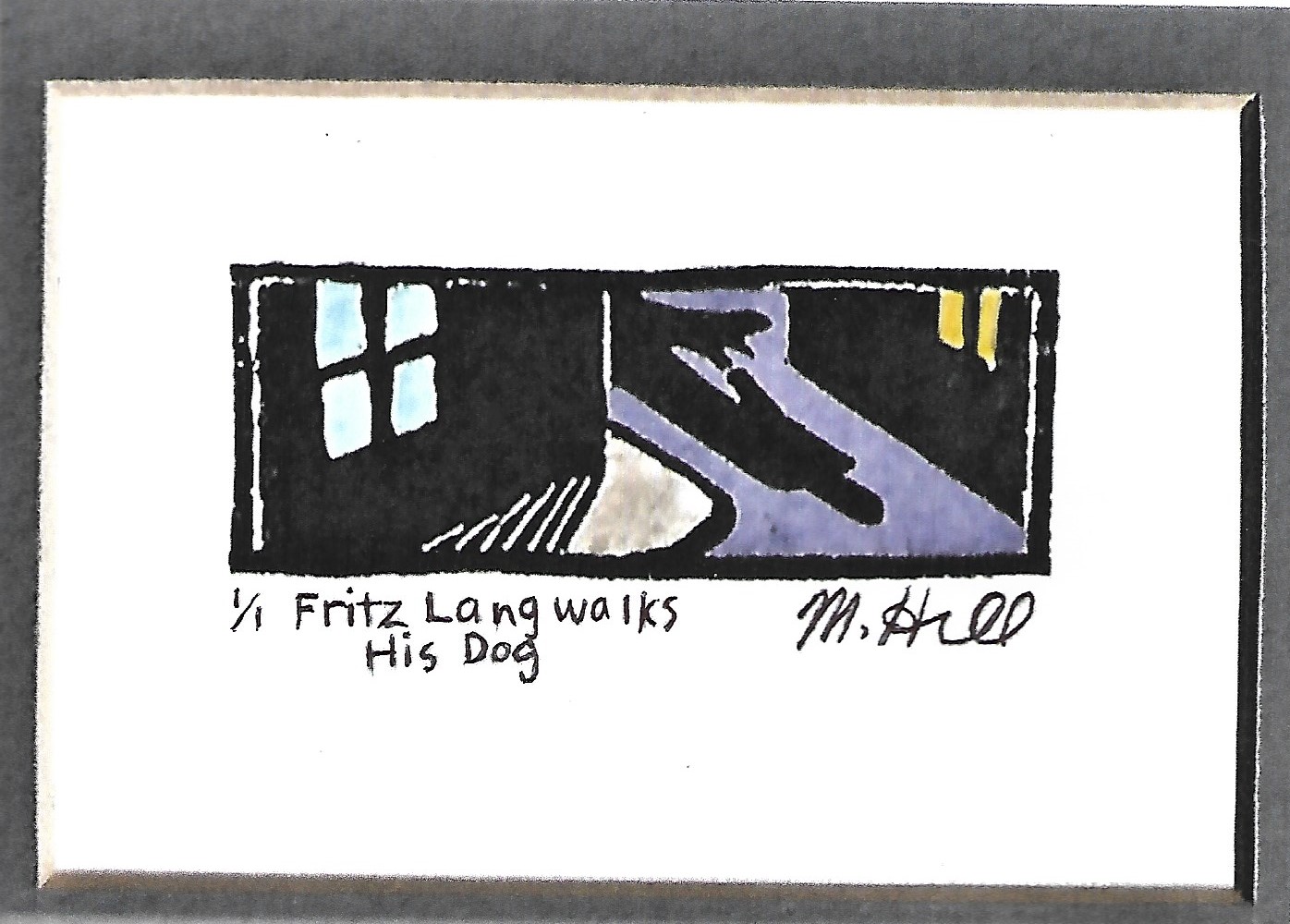
My favorite among these is also the smallest single image I ever saw him produce. It is titled “Fritz Lang walks His Dog” and I post an enlarged version for you to appreciate. Now, shrink it in your mind: The actual image is only 3/4 of an inch by 2 and 2/5th inches!

The enlargement allows you to see the image, but remember, enlarging also roughens its craftmanship. Hill wasn’t obsessive about razor-sharp technique, but his chops constantly served his quirky genius in perfect simpatico, perhaps like the great jazz trumpeter Miles Davis, at times a bit scraggly, but that enhanced the art’s peculiar, funky beauty.
The squinty size of “Fritz Lang” is a “big” part of the piece’s brilliance. It’s like a secret portal into his imaginative world, and into how his conception and style manifested themselves. The idea of movie director Lang and his dog recalls an Alfred Hitchcock movie cameo, though this is more sly, as we see only only the projected shadows of Lang and his dog. It also carries an ominousness, as Lang’s most seminal film is M with Peter Lorre as a serial killer preying on children in Berlin in London. The 1931 film, part of the German Expressionist art movement, is pretty much the prototype for all film noir. 3. Hitchcock arguably predates M with his 1926 fog-bound silent film The Lodger, about a London serial killer, both films likely inspired by Jack The Ripper’s legend.
But Peter Lorre’s creepy breakout performance, enhanced by his weird nasal-breathing speaking style and demonic laugh, helped give Lang’s “talkie” greater notoriety, for its shock value and aura of paranoia — and stylistically, with his more incisive cinematographic intersecting of light and shadow. Knowing all that, Marvin Hill uses his noir-ish wit to humanize the German director, while maintaining his mystique.
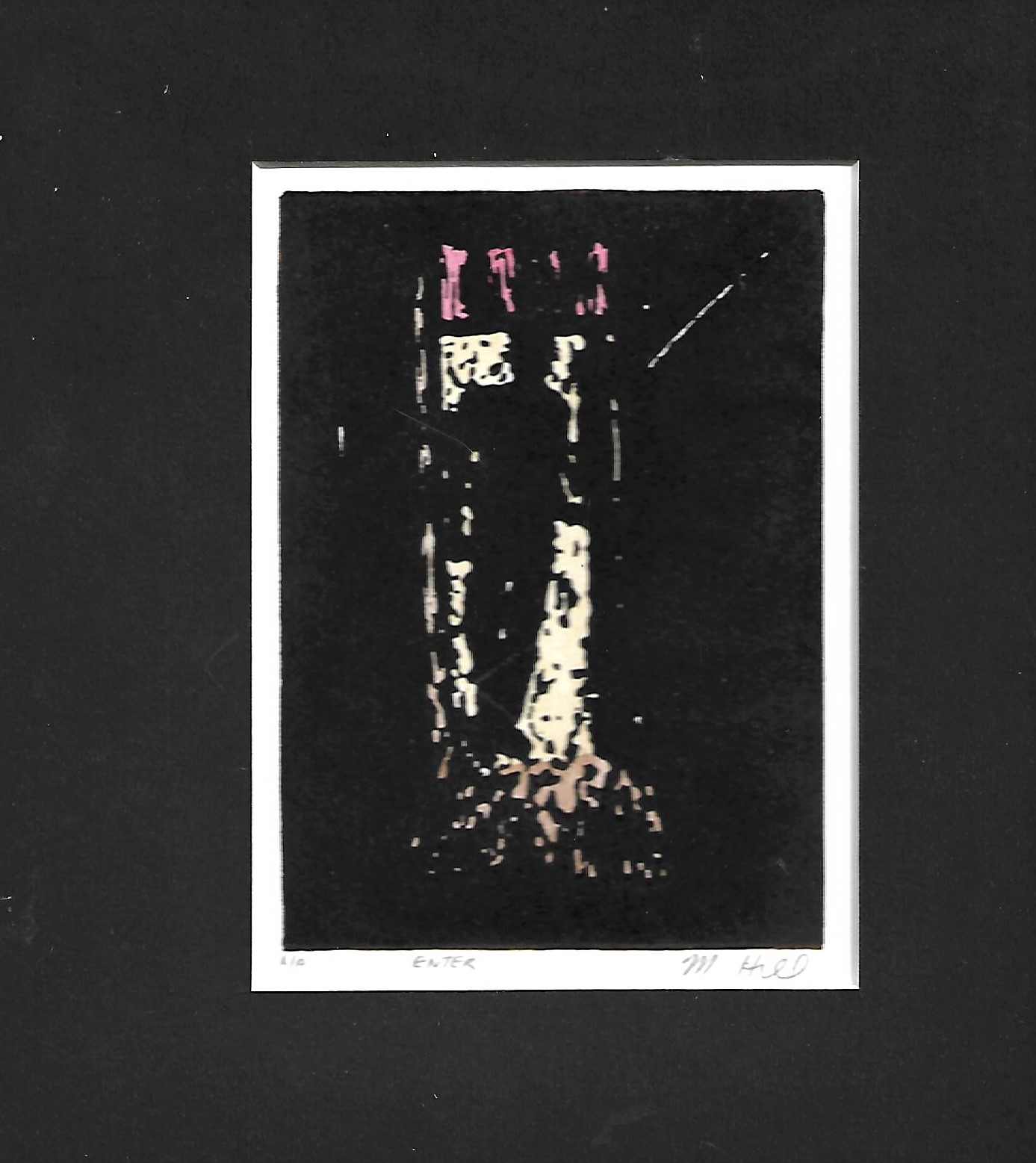
Another noir-ish Hill piece which was an “artist’s proof” shows how subtle his craft can be. It’s titled “Enter” (below).

“Enter,” Marvin Hill. Hand-colored linoleum block print (artist’s proof)
The figure entering the dark room is engulfed in a sort of ectoplasmic atmosphere, an effect unusual for knife-executed block-cut prints. It’s unclear whether the figure is the vulnerable one, entering the dark enclosure, or the threatening one, entrapping a frightened person hiding within. The psychological ambiguity intensifies its power. I have positioned it as as a sort of “welcome” for guests to my home, or now, to my office.
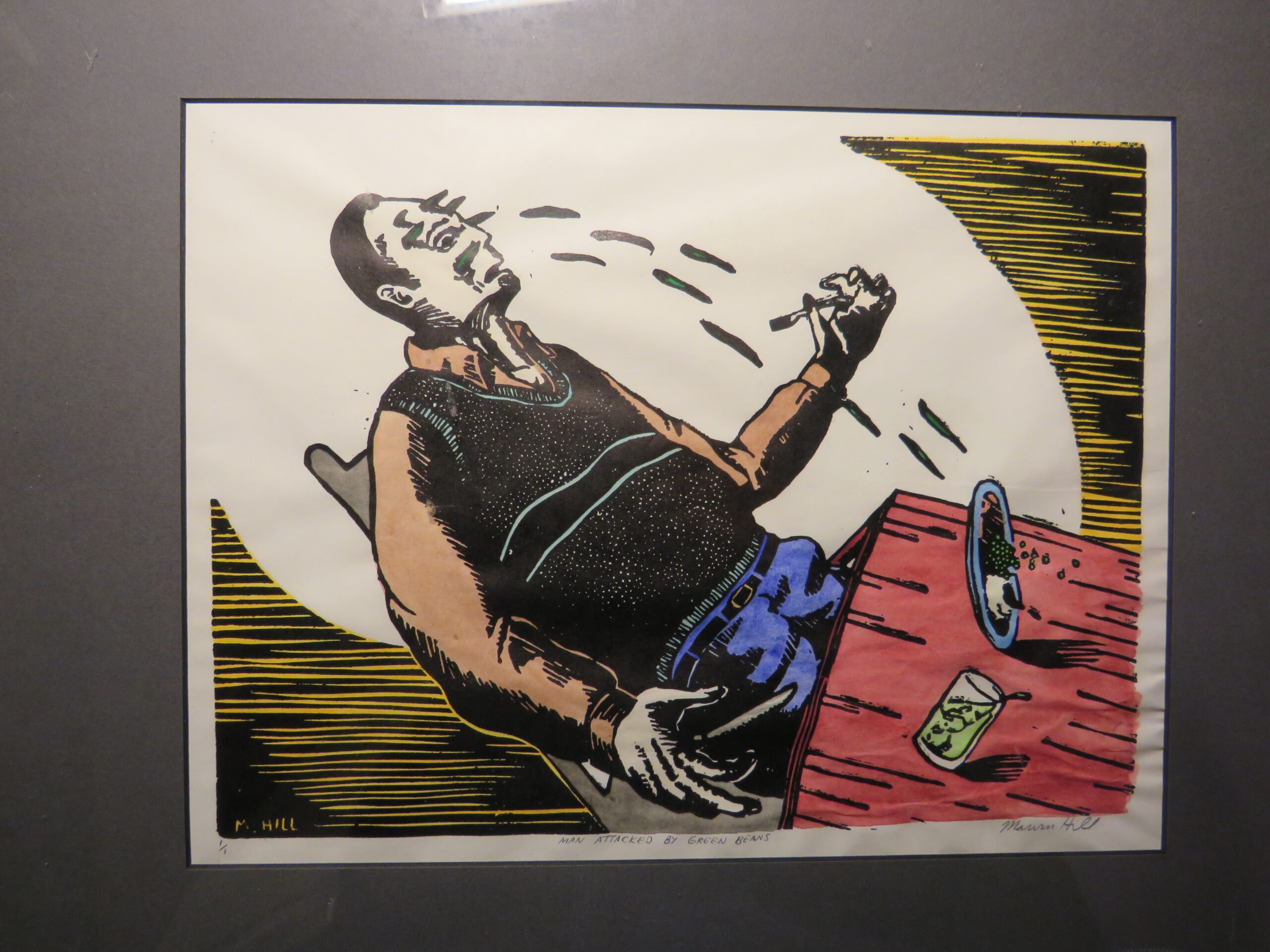
A brighter, rather comical Hill print nevertheless retains his surrealistic weirdness. Some have characterized it as “a bit goofy,” true enough, but it held a place of honor in my divorcee bachelor-flat kitchen for many years.

Marvin Hill, “Man Attacked by Green Beans,” hand-colored linoleum block print (artist’s proof).
I love the animation of “Man Attacked by Green Beans,” everything is flying askew (not unlike

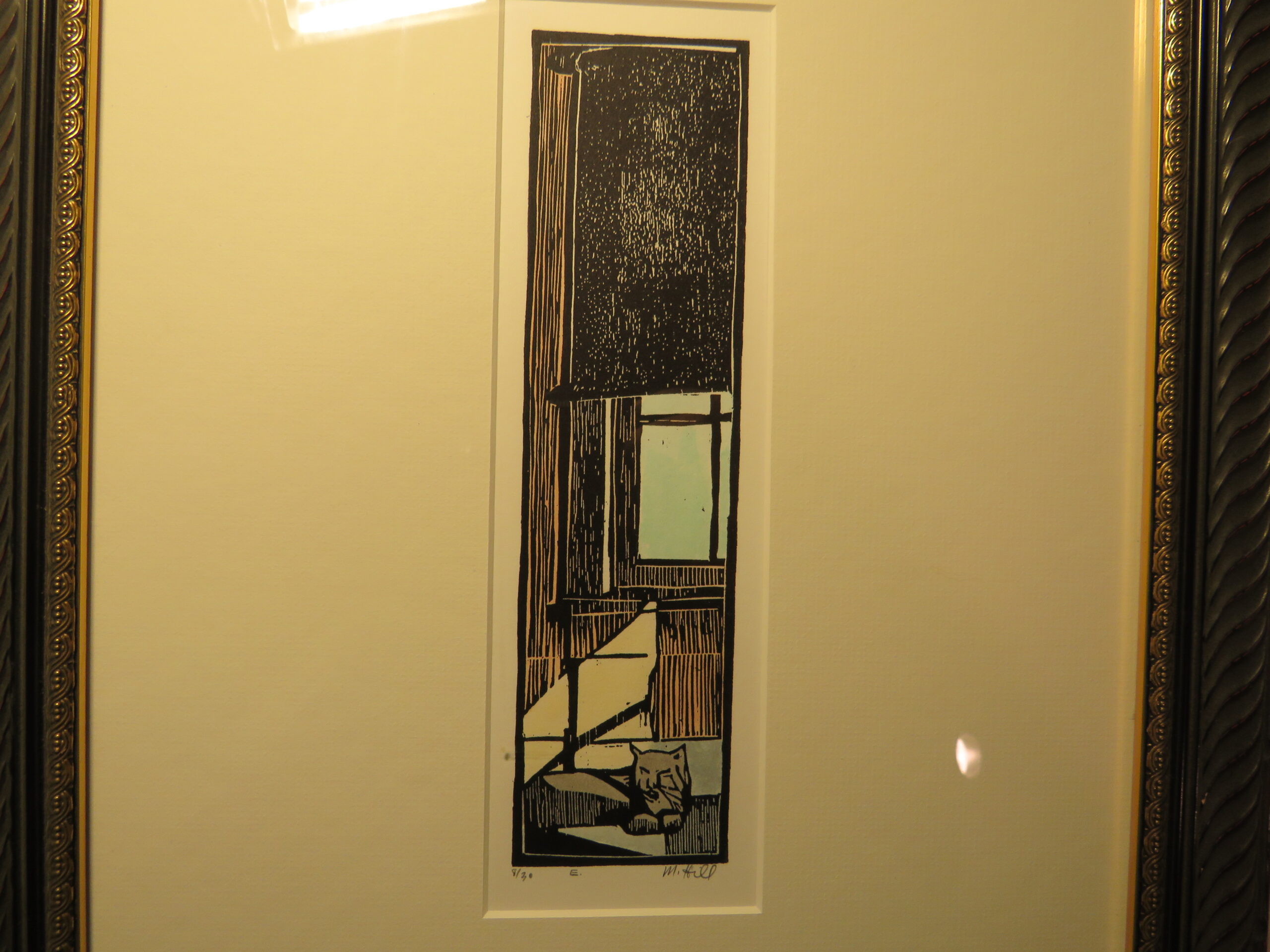
Marvin could also celebrate serenity and domesticity, as in this elegantly framed (but still inexpensive) print, below, simply titled “e.”, as in the name of the sleeping feline in portrait.

Marvin Hill, “e.”, hand-colored linoleum block print.
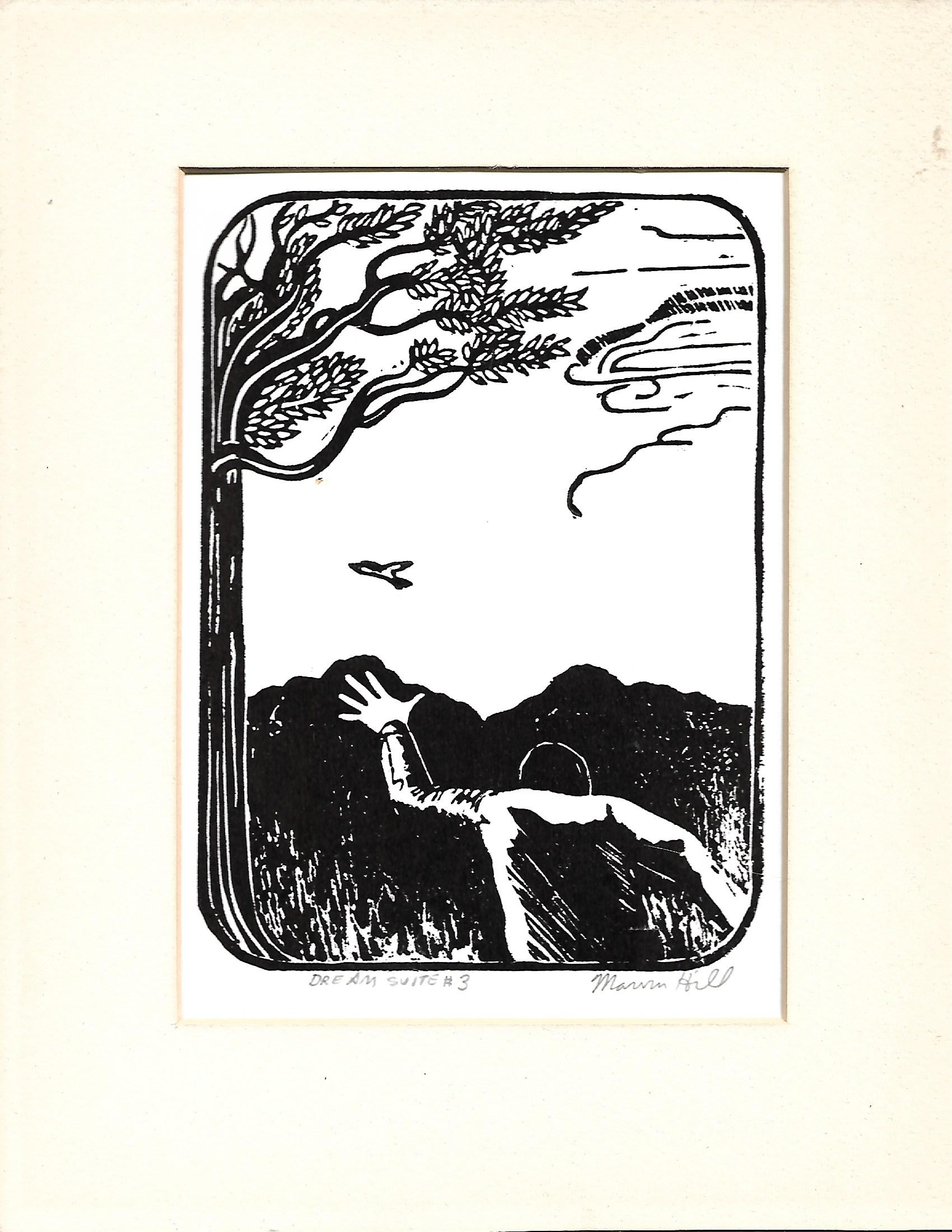
Next, the Deco-styed print (below) takes us into Hill’s dream realm, and suggests his striving to connect or follow nature, to transcend the limits of gravity-bound humanity. It feels like a late-period Hill, though I think it may be the first of his I purchased, before Wendy began hand-coloring his images. His sense of time was elastic, reaching into the fates of futurity as well as backward, with symbolic ease, and wonder.

Marvin Hill, “Dream Suite # 3,” linoleum block print.

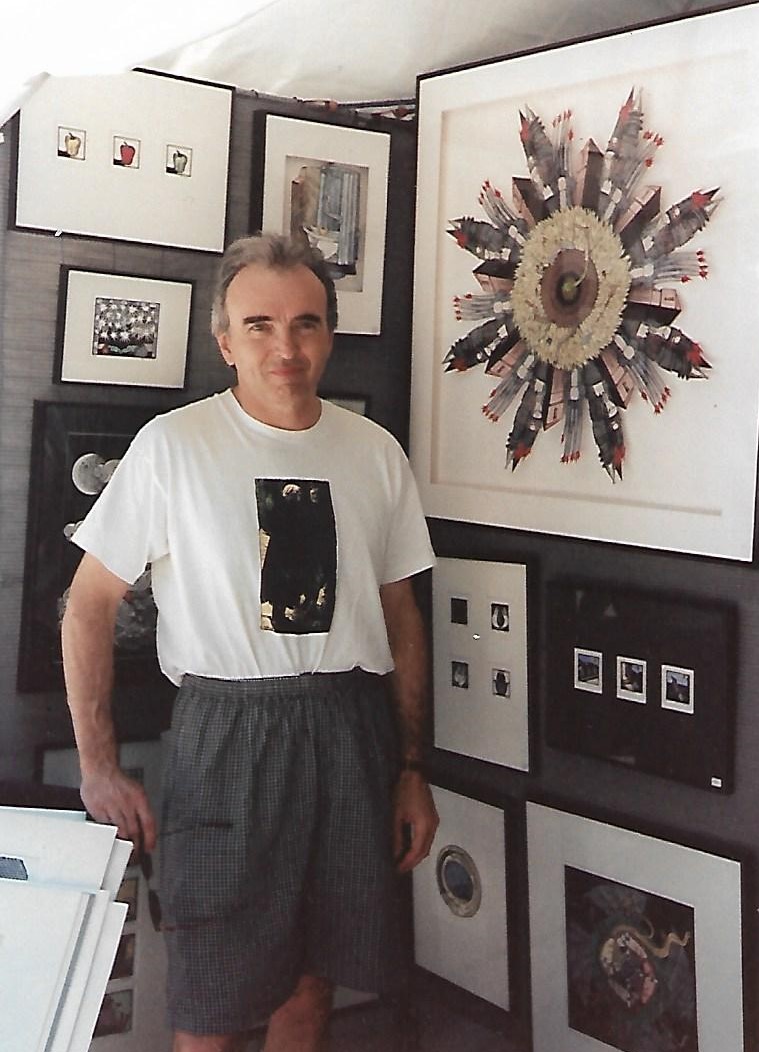
Photo of Kevin Lynch at Marvin Hill art booth at Art Fair on the Square, in Madison, by Beth Bartoszek Lynch.
This photo (above) was taken in summer of 2005, at the first posthumous booth of Marvin Hill art at Art Fair on the Square, maintained by his widow, Wendy Carroll Hill. It shows some of his small work and some of the more ambitious work he achieved late in his life, like the stunning, large mandala-like three-dimensional print, to the right of your blogger, in this photo. The several evident circular images, to me, suggest Marvin’s expression of a holistic experience of the world, his coming to grips with where his journey beyond might take him, not into nothingness, really, but to part of a circle (reincarnation?) that will be unbroken, bye and bye, one can hope.
Yet another marvelous Hill image, which my ex-wife and I bought together, and which she now possesses, depicts a shaman in a small shack high in the mountains. It might allude to the end of his life, or beyond. His corporeal end, to any outside observer, and to Wendy, was impossibly sad. He he lost the use of his hands and arms — an artist still at the peak of his powers, which at times seemed visionary, in his humble way. There are more sad details I won’t get into here. I will recount some of Wendy’s narrative, from my 2003 Capital Times obit appreciation:
“He couldn’t take care of himself, he couldn’t walk, but he was still so positive. One day, he looked out the window and said, ‘It’s all good.’
“I said, ‘It’s all good? It sucks! ‘
” He said, ‘No, I want to know what’s going to happen, what’s on the other side.’ ” 4
Fortunately for Wendy, Hill’s work has steadily sold online in recent years, and a goodly but diminishing amount remains available online, including more ambitious works. 5 One uses the above bird-seeking “Dream Suite” image as one of multiple motifs, each dominated by a blackbird in the dazzling 3-D montage titled “Jack’s Message Dream Suite.”
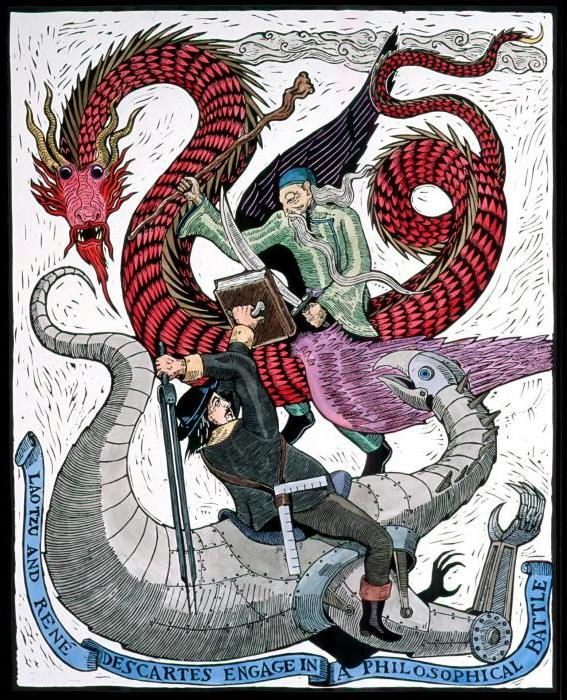
Another, “Lao Tzu and Rene Descartes Engage in a Philosophical Battle,” articulates his self-expressed intellectual hunger and spiritual curiosity (image below). It’s telling that Hill positions the ancient Chinese philosopher in the dominant dueling position. Descartes, riding a mechanical dragon, uses a book “shield” and wields a giant pointed circumference compass; while Lao, atop a “real” dragon, counters with a traditional saber and a walking stick. Mathematician, metaphysician, and philosopher Descartes is, of course, best known as the Western paragon of rationalist philosophy as a demarcation of reality. Though his historicity as a real person is debated, Lao is credited as the founder of Taoism and reputed author of the philosophical text Tao Te Ching.
By contrast to Western rationalism’s prioritizing the brain’s reasoning powers, Taoism embraces an inquiry into primary sources, the un-apprehended aspects, or vast realms of existence, that may help form our cosmos, our world and affect our lives. Accordingly Tao signifies “the source and ideal of all existence: it is unseen, but not transcendent, immensely powerful yet supremely humble, being the root of all things. People have desires and free will (and thus are able to alter their own nature). Many act ‘unnaturally’ upsetting the natural balance of the Tao. The Tao Te Ching intends to lead students to a ‘return’ to their natural state, in harmony with Tao.] Language and conventional wisdom are critically assessed. Taoism views them as inherently biased and artificial, widely using paradoxes to sharpen the point. ” 6

Marvin Hill, “Lao Tzu and Rene Descartes Engage in a Philosophical Battle.” Linoleum-cut block print. Courtesy www.marvinhill.com
Surveying Hill’s oeuvre, one senses his Taoistic leanings, an intense awareness of forces beyond the empirical. Another ambitious print, is even more surreal than “Man Attacked by Green Beans.” Titled “Nonattachment,” wherein gravity has evidently abandoned a man in his home, and he and his possessions all float freely. Is this evoking a strange scientific phenomenon, or an underlying truth of contingency regarding reason, and even ownership? Were Marvin’s humble and drug-free “hallucinations” also possibly insights? Given his ever-leavening humor, he was a serious reader, and a pan-cultural, pluralistic thinker, clearly interested in the dialectical (and in paradox), and beyond.
I think Marvin Hill’s equilibrium helped focus his insights. He seemed to know how far to go with his dreams. As D.H. Lawrence wrote: “The Holy Ghost (the winged soul within us) bid us never be too deadly in our earnestness, always to laugh in time, at ourselves and everything, Particularly our sublimities. Everything has its hour of ridicule – everything.” 6 Marvin could always laughed in time, like, say, pianist Victor Borge, a musical comedian with exquisite timing. A prime Hill illustration of perfect comic timing is the piece titled “Does Awakening Come All at Once?” The image is of a bespectacled man (le artiste?) getting a blueberry pie splat in the face. Or, there’s the tart irreverence of “Thoreau is Driven from the Garden by Unruly Nature,” the ironic title delivering plenty.
And then, the affliction arose and eroded him. Sorrow welled, though not Marvin’s, until his knife and wit lay still, for the last time, December 2, 2003.
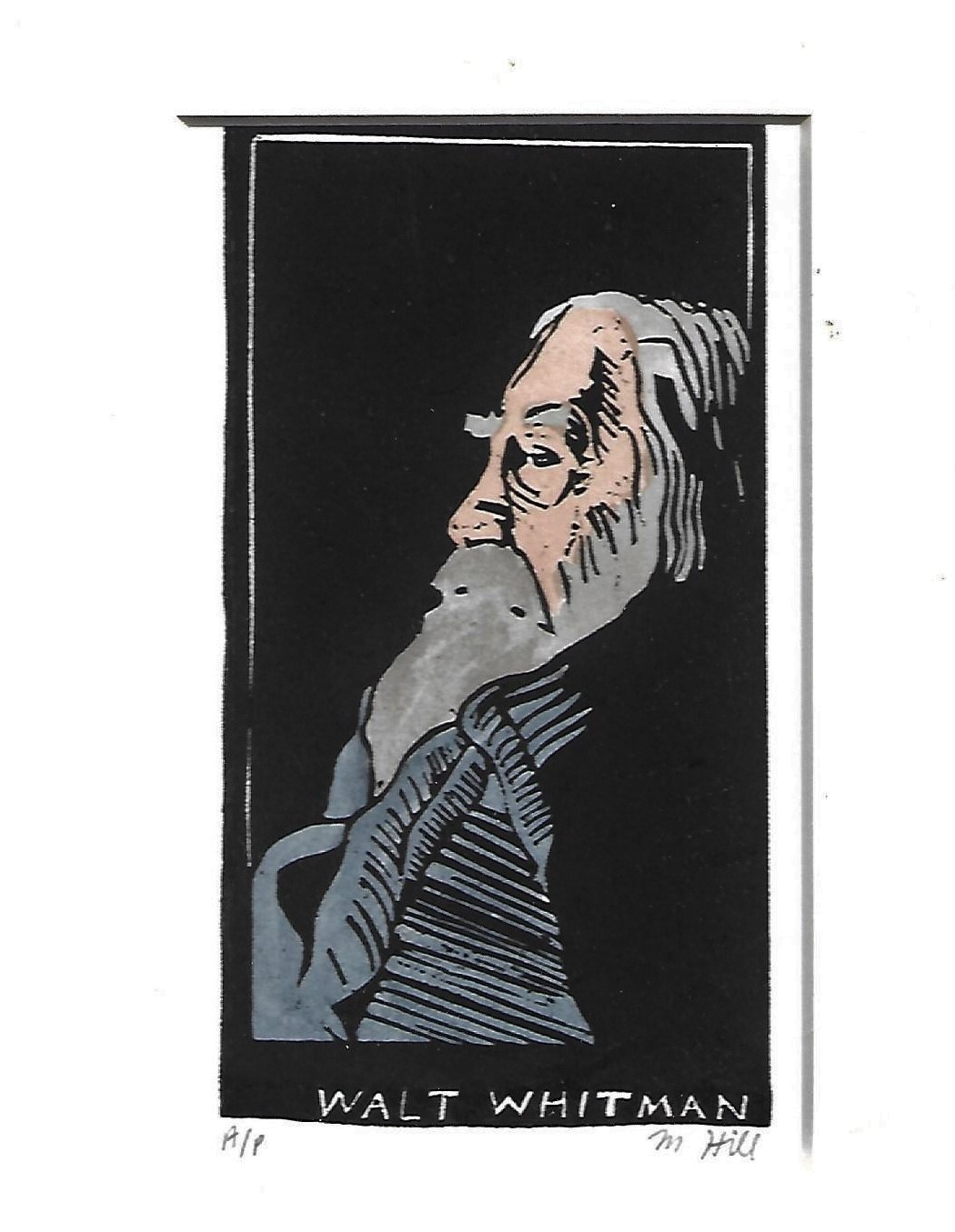
Finally, another Hill “artist’s proof” (below) would become a posthumous gift from him to me (actually sent to me by Wendy, in gratitude for my patronage and coverage of Marvin) – a portrait of the great American poet Walt Whitman, clearly in the autumn of his life. Marvin knew just how to visually honor the mighty, innovative, and quintessentially American poet, also known for his massive capacity for compassion, as a dedicated Civil War nurse. Hill depicts Whitman’s head, well, as if upon a hill. Whitman here seems like granite, or one more great face, to be carved into Mount Rushmore, alongside other American giants, including his contemporary Abraham Lincoln, whom Whitman honored in magnificent verse, better than any other poet.
I didn’t consciously intend this, but “Walt Whitman” sits in my office, atop a bookshelf, the highest location of any artwork I own.

_______________
1 Art Fair on the Square, held each Independence Day Weekend, is sponsored by The Madison Museum of Contemporary Art, and is one of the state’s most rigorously-juried outdoor art fairs, along with Milwaukee’s Lakefront Festival of the Arts.
2. Even given Mueller’s story about he and Hill as classic “starving artists,” Hill had earned an MFA in printmaking from Drake University.
3. Among other many great Fritz Lang (primarily) films noirs: include: “Metropolis (silent),” “You Only Live Once,” “Ministry of Fear,” “Scarlet Street,” “Clash By Night,” “The Big Heat,” “and “Beyond a Reasonable Doubt.”
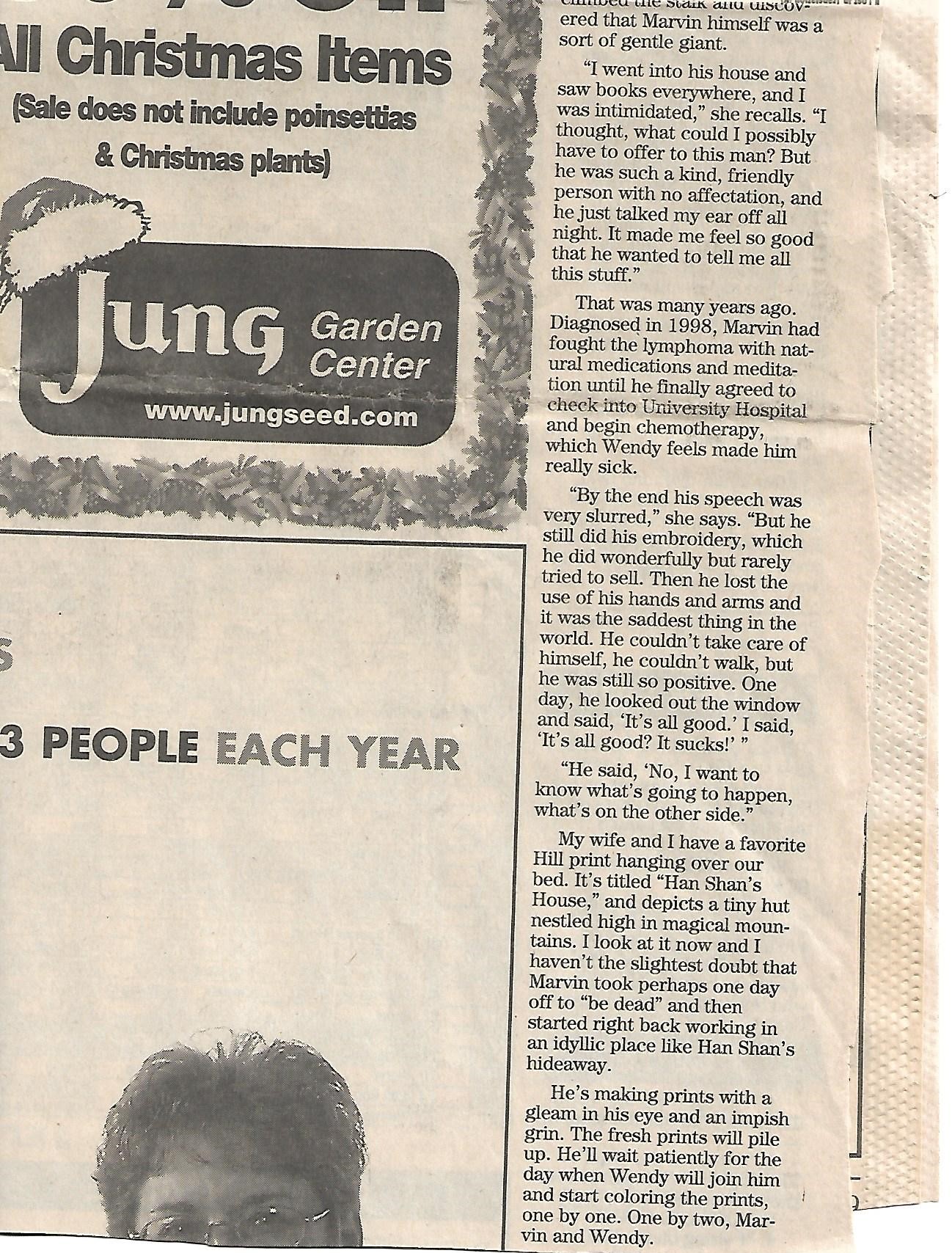
4. Here’s a scan of my 2003 newspaper appreciation of Marvin Hill. You might save or download it to a picture file to magnify and read it better.


5. The Marvin Hill website: http://www.marvinhill.com
6.. https://en.wikipedia.org/wiki/Laozi
7. D.H. Lawrence, Studies in Classic American Literature, Penguin, 1923,1977, 79

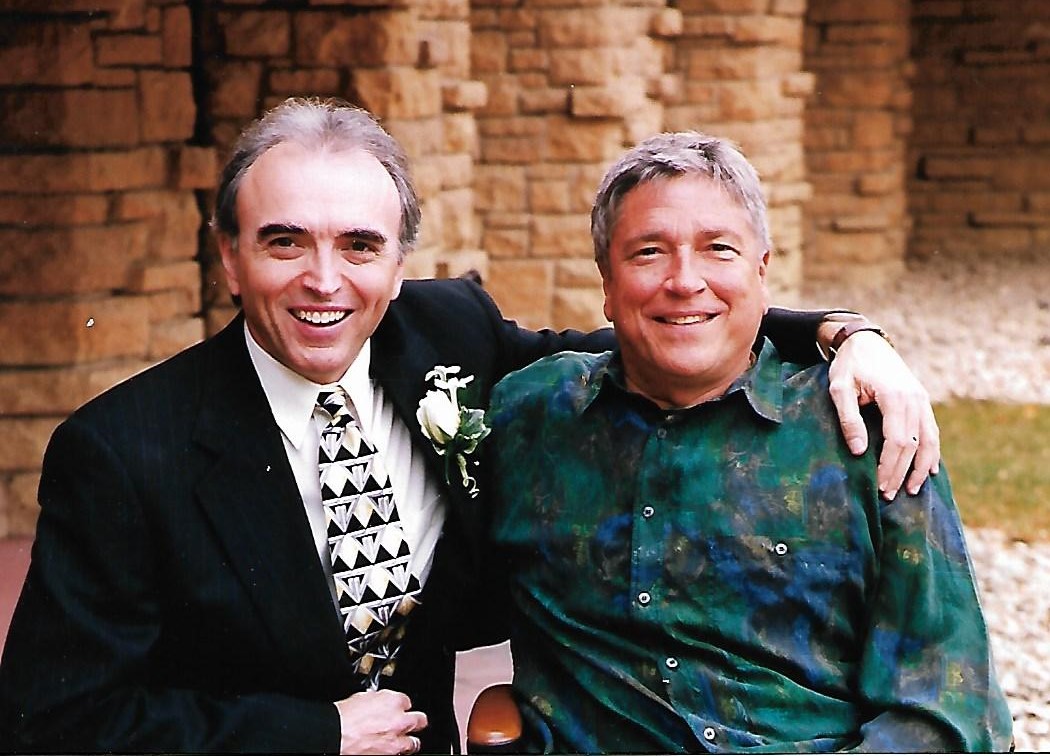
Jim Glynn served as best man for my second wedding to Beth Bartoszek, in Madison Wisconsin, at the Unitarian Meeting House, designed by Frank Lloyd Wright. Photo by wedding photograper. All other photos by Kevin Lynch
Without the power of his legs, Jim Glynn often seemed to soar through life on wings of passion, love, charisma, and a gift for serenity. He was perhaps the most extraordinary man I’ve ever known to call a friend.
I’m honoring him on the anniversary of his death, October 18, 2004. Coincidentally, I myself became disabled that same year, but in my upper limbs, with a severe neuropathy that continues today.
So, it wasn’t until the year he died that I could perhaps begin to fully relate to the challenges that he overcame with rare and inspiring grace. But it’s always different when you are no longer ambulatory. Jim never simply fell back on the use of a wheelchair, as he regularly used crutches for decades, bolstered by the strong athletic upper body that he kept in superb shape as a swimmer and arm-powered cyclist. “He was a marathon swimmer,” said Harvey Taylor, the poet and singer-songwriter with a truly amphibious relationship with Jim. They swam in the Racine quarry together hundreds of times. “He was a magnificent athlete.”
I too swam with Jim in that quarry, which he seemed to especially value for the serenity that its glasslike water surface signified. 1 And yet he often also swam across Elkhart Lake, which can get feisty and treacherous.

Jim gets ready to take a swim in the Racine quarry, a favorite refuge of his.
Harvey may have been Jim’s best friend, but I held him as dearly a friend as any person I’ve ever known. He was the best man at my second wedding. Jim and I bonded over our love of music, with tastes that were similarly wide-ranging. I met him when I was working as album buyer at Radio Doctor’s “Soul Shop” at Third and North Avenue, in Milwaukee, back in the mid-1970s. 2
Only the hippest white music lovers frequented the soul shop, in the “downtown” of Milwaukee’s inner city. Jim knew and loved jazz — our greatest shared passion — as a connoisseur, but without pretension. He also craved classical music, from baroque to contemporary, and had a supremely selective taste for the best of all American vernacular musics, as well as emerging world musics.

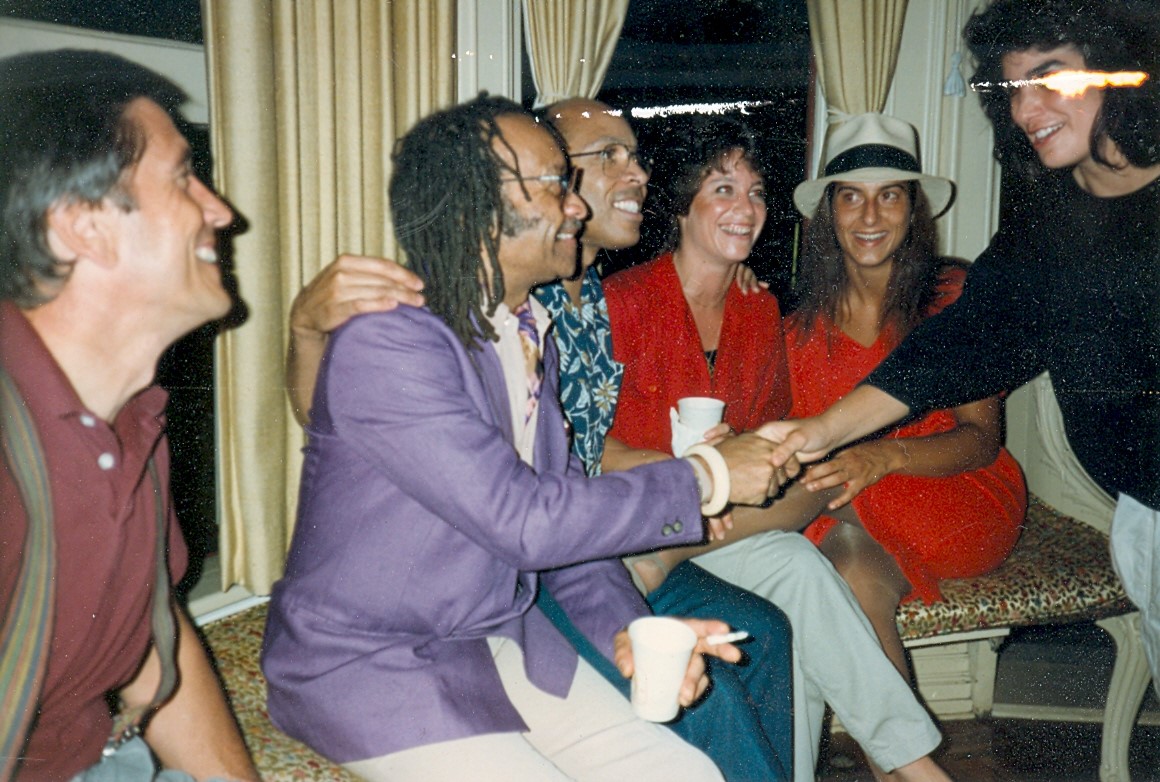
An avid fan of many musics, including avant-garde Jazz, Jim Glynn (left) joins a reception at the Wisconsin Conservatory of Music for the renowned jazz pianist Cecil Taylor (center in sport jacket) along with Cecil’s longtime friend and collaborator Ken Miller, with hand around Taylor.
And despite his apparent physical limits, Jim often seemed capable of morphing into multiples of himself. He showed up at most every notable music event in town. After attending maybe three events in one evening, he’d say, “Well, we did it all, tonight.”
What did I learn from him? One thing is this. More than I, he also gravitated to the sort of musically unadorned kinds of music that emerge from Eastern classical music partly because, perhaps once he became paraplegic, he became a hand drummer like the great Indian tabla players. I’m talking about so-called New Age or what mutual musician friend Mitar Covic called “bliss music.” The harmonic simplicity of “New Age” can be traced somewhat to the modal music of John Coltrane, as well as Eastern classical music. But I felt the new music often insipidly exploited those modalities without their profundities and passion, at best turning potential beauty into prettiness.
Now perhaps I can see more Jim’s perspective, throughout his decades of disabled suffering. He always strove for healing, replenishing and enlightened serenity in life, and that included artistic vibrations. Amid contemporary life’s onslaught of stresses and ugliness, his search for musical beauty and rhythmic vitality, which some of the NA musicians achieve, is something I can still learn and benefit from. It ties in to Zen disciplines and meditational practices, the latter which I have partaken off since college, but with no consistency.


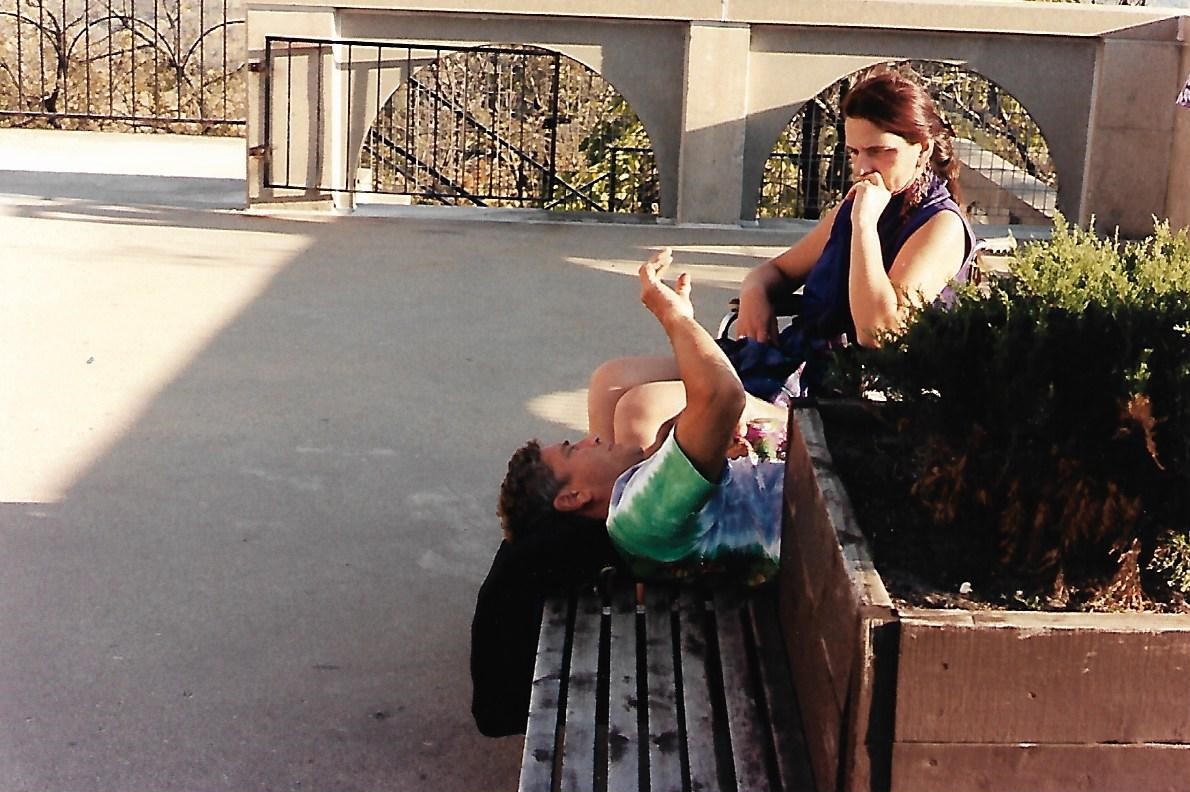
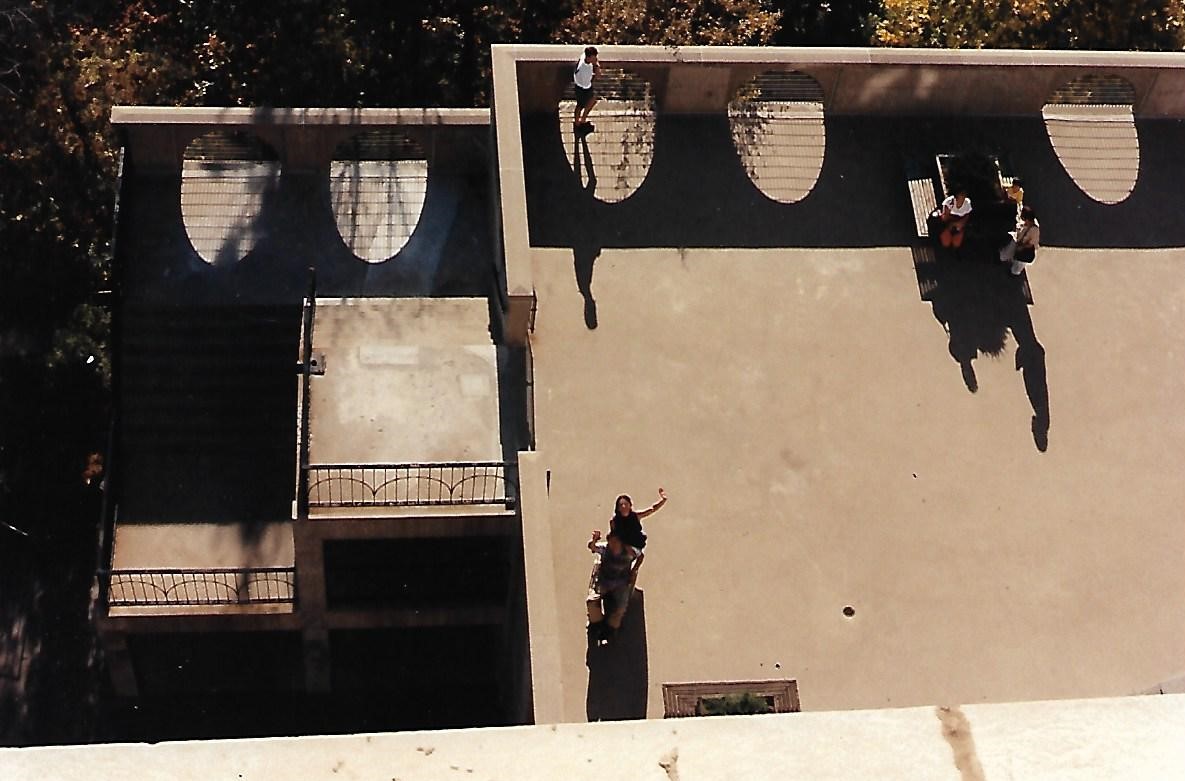
Jim may be imparting a tidbit of wisdom to girlfriend Yovanka Dajkovic in this scene (top photo) from Holy Hill in Wisconsin’s Kettle Moraine. In the lower photo, the two of them wave picturesquely from below the great cathedral’s tall steeples.
Jim might have been a “guru” of sorts, though I never realized that at the time. But the man’s rare, aura, his alluring friendliness frequently suggested a tacit invitation to most anyone into his life, to do what he often did with his best friends: Hang, talk, listen and do little jam sessions with a few hand drums and some of his flute playing thrown in. The meditative quality of a Jim Glynn hang-out was often generously enhanced with marijuana. Yet, in later years, he bemoaned the diminishing experience that blended music, camaraderie and marijuana had provided. “I really miss the transcendent experience of a great high,” he said, something that, for whatever reasons, changing times stole from him. Perhaps we had less sense of discovery and revelation after hearing so much music, as well as the oft-discussed damaged idealism and and fading visions of our generation.

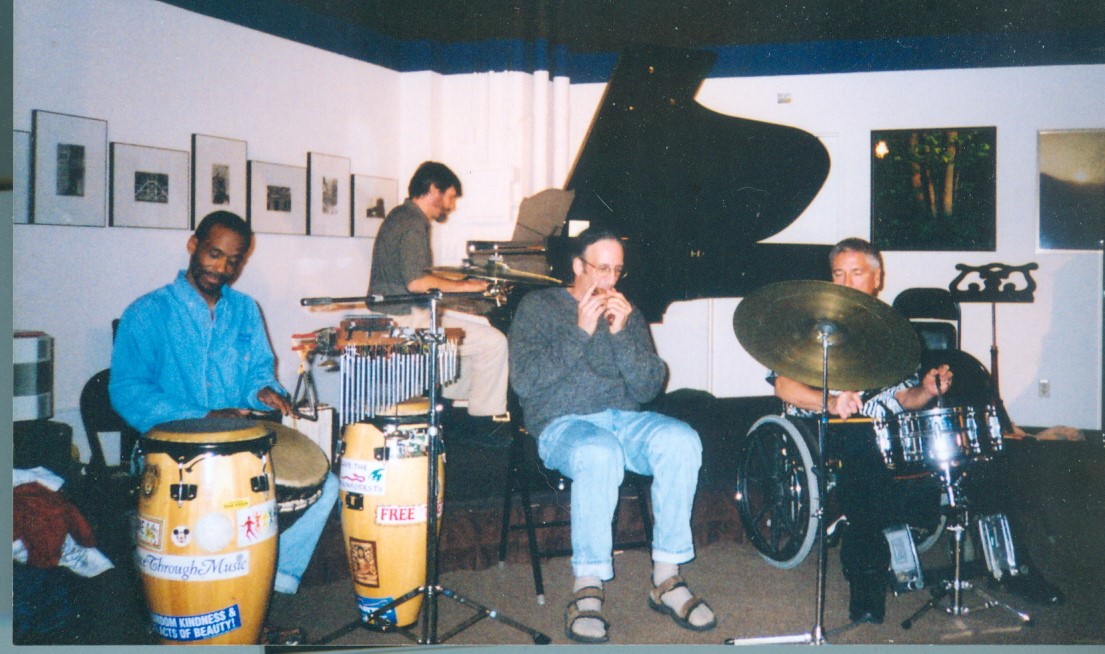
The last photo I took of Jim, (playing drums, at far right) at a farewell party for him before he moved from Milwaukee to Portland, Oregon. The other players include (L-R) percussionist Tony Finlayson, pianist Steve Tilton, and harmonica player Steve Cohen (of the blues band Leroy Airmaster). .
But the fact that he could attain such transcendent moments long after he lost the use of his legs speaks volumes for the man’s spiritual capacities. That’s something that people seemed to intuitively sense from him, as he was one of the most effortlessly charismatic people I’ve ever known. It’s as if he made something of his seated posture, implicitly inviting many a stranger into an imaginary crib. So he befriended people time and again, and quickly called them “brother” or “sister,” often before he really even knew their name.
A good-looking Irishman with a low, naturally-seductive voice, an easy smile and a sly wit, Jim was something of a ladies man. Any number of women over the years eagerly befriended and romanced him, while activating their caretaking instinct. Perhaps his best and most loyal woman friend was Pat Graue, who ended up honoring his wish that his ashes be strewn in Sedona, Arizona — with its mysteriously looming rock formations, like permanent sentinels of ghosts — which he considered the most Nirvana-like place in America.
The other end of Nirvana on earth was the hellish day, during the Vietnam War, when his Army jeep swerved in the French Alps, to avoid a blocking car. Flung from the vehicle, Jim fell hundreds of feet, but somehow survived, though this leg functions did not.
For me, he is now a quietly great figure who built up a strong and loyal following of listeners on his mind-expandingly eclectic music programs on WUWM and WMSE radio. And this greatness he wore with the grace of a bird’s wing. The quote of Harvey Taylor above is from Amy Rabideau Silvers’ superb obituary on Jim in The Milwaukee Journal-Sentinel upon his death. Reading it again, I’m amazed at the humility of the man, despite all that he added up to, which seems now the essence of cool. Some of the most remarkable aspects of his life detailed in Silvers obituary were revelations to me, even though I thought I knew Jim intimately for over three decades.
For example, while in the service he worked in Army intelligence, including the Cold War’s most famous espionage event. He tracked U-2 spy plane flights by pilot Francis Gary Powers, including the one in which Powers was shot down and captured by the Soviet Union in 1960.
And despite our shared love of jazz, he never told me that long ago, as a fully functioning drummer before his accident, he had played with Louis Armstrong, Miles Davis, Johnny Cash, and the Everly Brothers when they would visit Wisconsin.
On that October day in 2004, my mother called to tell me Jim was dying. I was living in Madison and jumped on a Badger Bus to meet my folks (also great friends of Jim’s) at the Milwaukee bus station. When I got there, they told me he was gone. Harvey had been there with him. I melted into tears.
Jim bequeathed his huge CD collection to me. I couldn’t practically accept it, as my own collection was nearly as big already. But the gesture deeply moved me. After being cherry-picked by me and a couple friends and WMSE disk jockeys, the recordings were donated to that radio station by his sister .
Something of a philosopher, Jim also helped counsel paraplegic veterans in Milwaukee, Chicago, and Washington D.C. in how to “take a fall and get back up” as his brother Steve Glynn explained to Silvers. That included, “you can still have an active sex life.”
I’m sure he delivered that assurance with an offhanded air akin to Paul Newman’s title character in “Cool Hand Luke,” with “that old Luke smile.” Like Luke, Jim Glynn lived in a sort of prison, but he could break away from that trap with the same kind of uncanny ease.
(One of three post parts on Jim Glynn)
_____
1 Our Racine Quarry swimming inspired a poem I wrote in about 1985. I would never had such an experience of nature, and nature interrupted, but for my friendship with Jim Glynn.

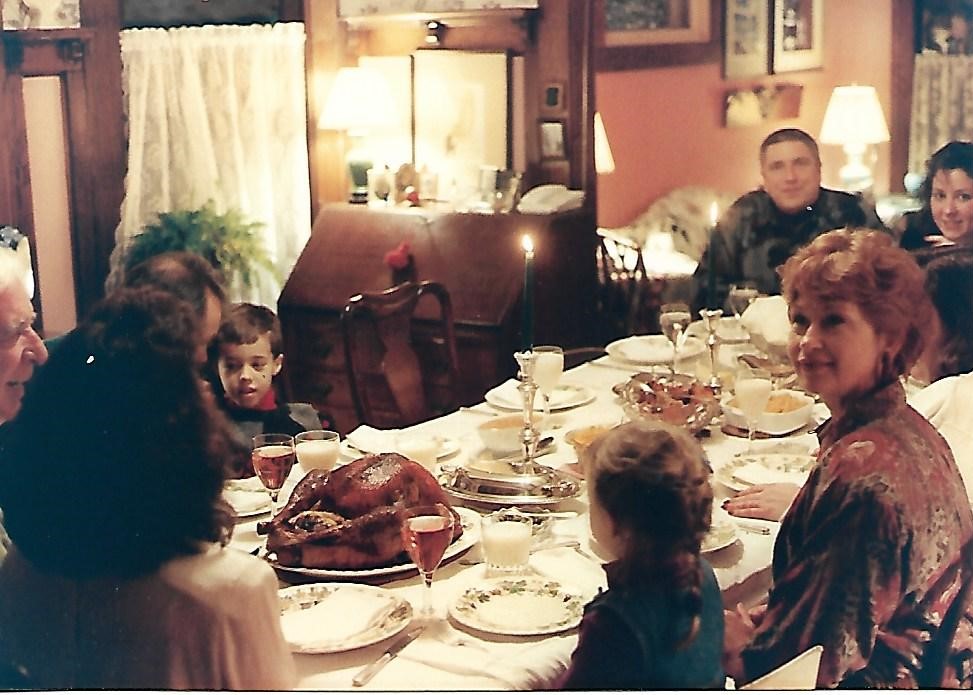
2. Jim actually knew two of my six sisters before he met me. He became a great Lynch family friend — my parents were big jazz and classical music fans — and attended a number of our family’s Thanksgiving meals. In the photo below, he’s seen with his girlfriend Pat Graue in the foreground. (Pictured, L-R, Norm Lynch, Nancy Aldrich, Erik Aldrich, The Turkey of Honor, Lauren Aldrich, Jim Glynn, Pat Graue, and Anne Lynch).
(Pat Graue now goes by the name Zoe Daniels)


Composer-arranger-bandleader Maria Schneider won two Grammy Awards for her album “Data Lords.” Courtesy the artsdesk.com
All praise Maria Schneider and her larger-than-life, intrepid orchestra! She just won two Grammy Awards for best instrumental composition (“Sputnik”) and best large ensemble recording, for Data Lords. Like a goddess sprouting heavy new wings, Schneider brilliantly ventured far beyond her comfort zone of nature-inspired jazz impressionism, in the Gil Evans tradition: Schneider Grammy announcement
Despite her clear and proud roots, Data Lords affirms her genius as a true original and her prominent place in jazz history. I never actually reviewed this album partly because I’ve given her so much blog and newspaper play over the years and I reviewed in-depth a live concert she performed while unveiling some of Data Lords material, before the album’s release.

Data Lords album cover
I chose Data Lords as my No. 2 album of the year in the NPR jazz critics poll largely because, to me, my top choice, Gregg August’s Dialogues on Race, was too urgently relevant in light of last year’s world-wide racial-justice protests. August’s large ensemble album also carried massive musical weight on its own.
But Schneider’s every statement now virtually demands critical attention, not unlike John Coltrane and Miles Davis, avatars of the post-bop era. Data Lords revealed the fire, indignation and backbone of the music’s leading composer-arranger, fully wielding her past mastery of scoring for jazz orchestra, like a woman warrior leading troops. And, yes, Delacroix’s famous romantic painting “Liberty Leading the People,” comes to mind. And no album had more great music in 2020 than hers. As an artist who records on a self-created label (ArtistShare) and distributes independently, 1 she’s not only a self-made artist but extremely attuned to the role of “data lords,” the gigantic online media companies (Google, Twitter, Facebook, YouTube, etc.) that play a grossly outsize role in how we pursue and receive information on the Internet, and spend our money on cultural products or activity. In other words, Schneider asserts that they virtually lord over our lives because so many of us are now dominated by our involvement in online media.
The Grammy-winning composition “Sputnik” is part of the “protest” side of this two-CD recording, yet it retains the depth of textured and spiritual beauty that trademark her best work, while evoking a profound sense of angst and desolation. By nominally invoking a famous space travel vehicle, it suggests that we may need to travel to new realms far from “home” to regain truth, self-determination, sanity, freedom and societal-coherence – not overseen by the data lords. Here too, an allusion to the Underground Railroad and slavery hovers in the stratosphere. I suggest this not to equate the two, but to honor the cultural pervasiveness of that darkest chapter in this nation’s history.
Such elevated praise might indicate that this is The Maria Schneider Show with musician munchkins. But she chooses her world-class players with Ellingtonian acumen (here, among others, Donny McCaslin, Rich Perry, Steve Wilson, Scott Robinson, Ryan Keberle, Gary Versace, Ben Monder, and the late Frank Kimbrough) and gives them many extended spotlights, which helps expand this to two discs, and there’s hardly a moment of seeming filler.
And Schneider rewards listeners for the facing the sometimes-dissonant challenges of the first CD, “The Digital World,” by reminding us of what she is fighting for, in “Our Natural World,” the gloriously beautiful second disc. Another implication, in these juxtaposed titles, is that data lords’ dominance affects our overall priorities and collective consciousness, perhaps to the detriment of addressing climate change, and the perils to the natural world.
Great art like Schneider’s does its extraordinary work on its own terms, while reaching out to us, to some degree. The cultural covenant is completed when we respond as we will, which that art itself is not responsible for, and yet which reflects its sometimes-uncanny powers of evocation, provocation, and communication.
____________
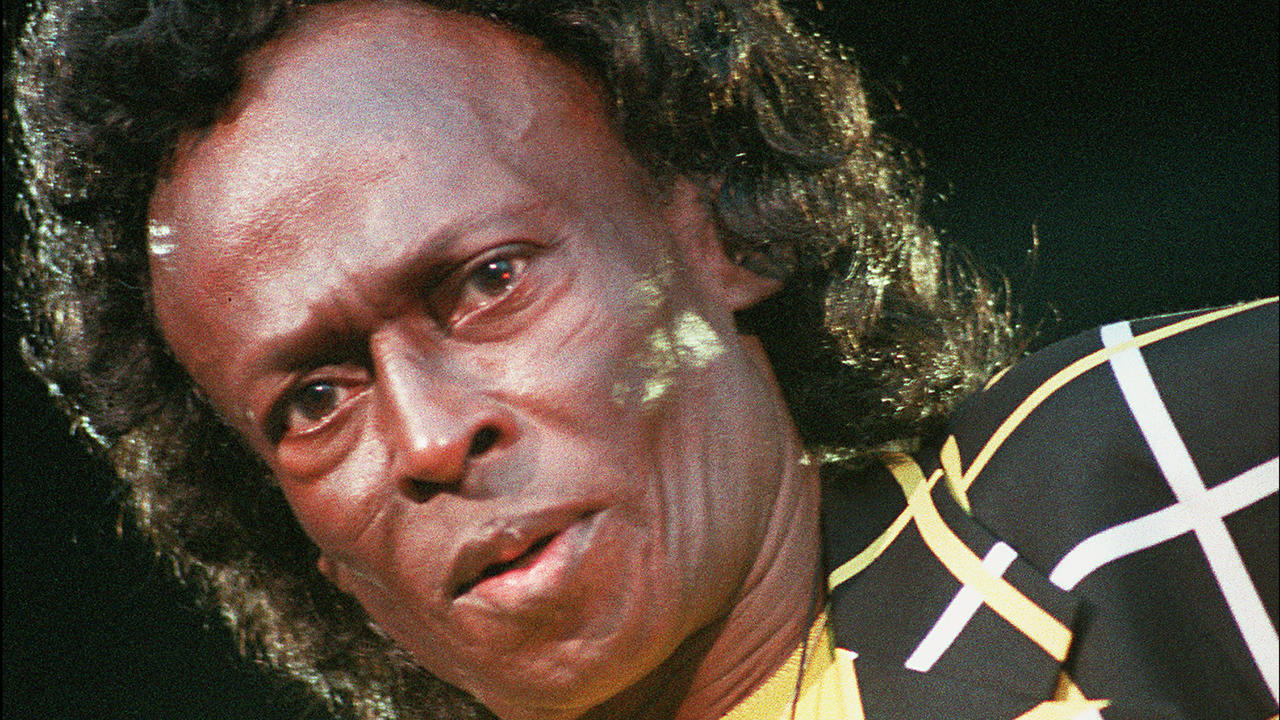
Portrait of US jazz trumpet player Miles Davis taken 06 July 1991 in Paris.
Portrait du trompettiste de jazz Miles Davis pris lors d’un concert le 06 juillet 1991 à la Halle de la Villette à Paris. (Photo credit PATRICK HERTZOG/AFP/GettyImages)
Why care?
Miles Davis dwells at, and helped create, the root thrust of many music vernaculars of the 20th century — from vintage bop with Bird, to purring like a breeze-cooled cat in Birth of the Cool, to kicking in the blues ‘n’ back beat of workin’, walkin’ hard-bop with Trane, to modal jazz trance with Kind of Blue, to cutting-edge modern slash with his second great quintet, to polyrhythmic Afro-fusion with Bitches Brew, to deep street funk and proto-hip-hop ‘tude with On the Corner. And he always gave us the essence of personal style, as an expression of American individuality and romance. Whew.
Well, that’s by way of introduction to this radio story. Thanks to 88.9 Radio Milwaukee’s Glenn Kleiman and trumpeter Jamie Breiwick for including me in this fine feature. http://radiomilwaukee.org/discover-music/still-care-miles-davis/
The feature, with interviews of Breiwick and me is hooked on Don Cheadle’s highly-anticipated biographical film about Miles Davis Miles Ahead, and “A Tribute to Miles Davis,” (a supper club edition) a live concert event at Company Brewing, 735 E. Center St, Milwaukee, at 9:30 p.m. on April 15. The event is organized by and features saxophonist Jay Anderson along with trumpeter Russ Johnson, pianist Mark Davis, bassist Ethan Bender, and drummer Mitch Shiner. This is an excellent ensemble event, featuring music by and associated with Miles, not to be missed: https://www.facebook.com/events/1671208159798613/
Also, here is a link to my review of the 1983 Miles Davis concert in Milwaukee, for The Milwaukee Journal:https://news.google.com/newspapers?nid=1499&dat=19830218&id=XWgaAAAAIBAJ&sjid=4ykEAAAAIBAJ&pg=4166,4949562&hl=en