Jazz education is swinging hard across Milwaukee and America


Brian L

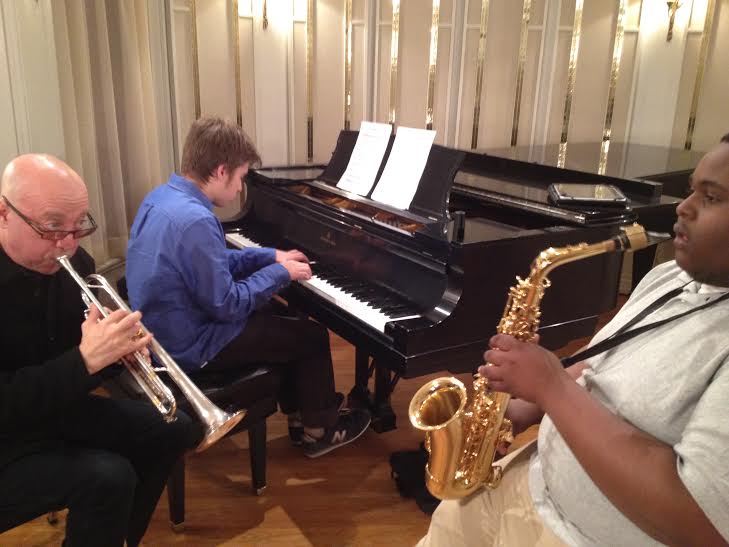
Artist-in-residence and Grammy-winning trumpeter Brian Lynch (left) works with the Wisconsin Conservatory Music Jazz Institute’s award-winning students saxophonist Lenard Simpson and student pianist Peter Garofalo.

Jazz ain’t the music that made Milwaukee famous. However, like beer, the music’s innate effervescence is part of this city’s cultural DNA. Improv and swing are rising locally, and reflect the creative brewing of musicians – like sax and brass players – who literally blow life into their instruments.

I’ve been extremely impressed by the young-musician generation since returning to Milwaukee, two decades after extensively covering the jazz scene here.

“A difference today is a very strong crop of young players in town,” says trumpeter Jamie Breiwick.

For a serious art form, jazz education is essential for performers and to cultivate audiences, unlike more innately popular folk- or mass media-based arts. Education  creates musician’s work, as it has for decades with an art form that commingles sophistication and soulful grittiness. Down Beat magazine extensive annual October jazz education guide provides a documentation of the art form’s ongoing growth at the roots of youth nationwide, and is considered so important that Jazz Times has begun offering an annual jazz guide as well.

UWM jazz

UW-Milwaukee offers a bachelor’s degree in jazz studies, begun in 1990. Photo courtesy of The Peck School of the Arts.

UW-Milwaukee’s jazz studies degree program, begun in the wake of the city’s 1980s jazz revival, is directed by noted veteran reed player Curt Hanrahan, and signifies the music’s growth and demand, as does the ambitious Jazz Institute at the Wisconsin Conservatory of Music, which holds concerts, summer camps and annual residencies by Milwaukee-born trumpeter Brian Lynch, a Grammy-winning former Jazz Messenger with Art Blakey. Plus, The West End Conservatory opened on Vliet Street a few years ago with a strong faculty of young professional jazz musicians.

A highlight of the jazz education year will be the second annual Music Education Day at Summerfest on Wednesday, September 17 (with a free lunch) featuring nationally known clinicians, including New Orleans drummer-bandleader Adonis Rose, who leads his own quintet and has worked with Wynton Marsalis, Terence Blanchard, Nicholas Payton and other jazz luminaries. Jazz Institute director Mark Davis will also lead a group. Last year’s event drew 600 school-age music students.

The Conservatory’s accredited jazz degree program, launched in 1971, crucially sparked that era’s early 1980’s jazz renaissance. The Jazz Institute, underwritten by the Batterman Foundation, also selects top high school players for scholarships in private lessons, theory classes and concerts. In addition to the Prospect Avenue Conservatory home, The Institute now also has branch locations in Fox Point and Brookfield.

For the third consecutive year, the program’s Batterman Ensemble placed as a finalist in the International Charles Mingus Jazz Competition, and in 2013 won the competition’s “Mingus Spirit” award and the group’s trumpeter Travis Drow won an outstanding soloist award. The current ensemble took first place for best high school ensemble in 2014 at the Eau Claire Jazz Festival. In 2012, the Batterman’s 17-year-old saxophonist Lenard Simpson won the Mingus event’s “outstanding soloist.”

conservatory band

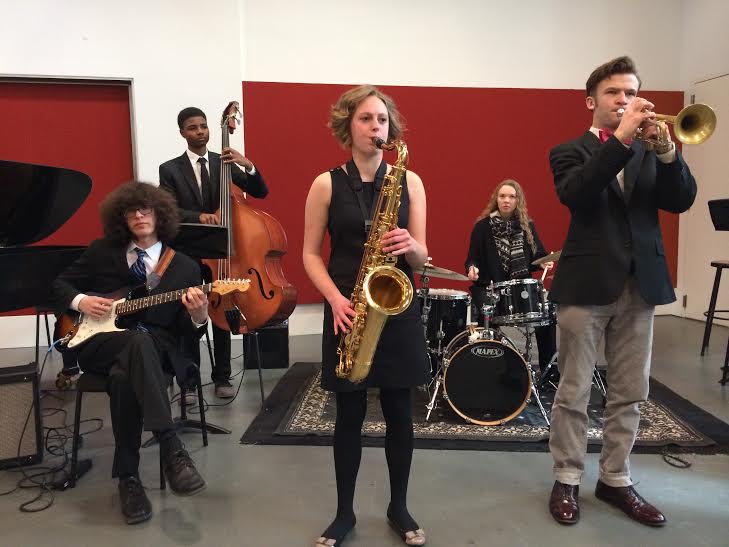
The Jazz Institute’s Batterman Ensemble recently won the award for best jazz high school Jazz Ensemble at the Eau Claire Jazz Festival. The ensemble includes (L-R) Jordan Rattner on guitar, Gervis Myles on bass, Amy Clapp on tenor sax, Hannah Johnson on drums and Travis Drow on trumpet.

This sounds like a dynamic art form in town, yet an old saw endures: “Jazz is dying.” “Compared to what? For the last story about that, we had a joke: All the jazz musicians were unavailable for comment,” responds the Conservatory’s pianist Davis.

“All the musicians I know are constantly working,” concurs Breiwick, also a professor at the UWM program.

“You really need to work at it, but it pays off,” adds Jeff Hamann, the city’s “first-call” bassist, a Conservatory instructor and house bassist in Michael Feldman’s nationally-syndicated radio program “Whad D’ya Know?” “My peers seem to keep busy.” However, Hamann has noticed less work for some veteran players. “Everyone’s path to success is a little different.”

“The value of jazz education is that you can play just about any type of music with it,” Davis says. And yet, he adds, “some music programs are dwindling, especially in the inner city.” But WCM and other higher-ed programs provide scholarships — and the Conservatory faculty ensemble, We Six, does residencies and performances — at these schools.

“Milwaukee seems on a real upswing, with numerous incredible Conservatory-trained high school and college players coming up: Lenard Simpson, trumpeter Alec Aldred, guitarist Tommy Antonic, saxophonist Robert Larry (from UWM) and percussionist Jake Richter — now on full scholarship to Indiana University.”

“Their success comes from education, the jazz community and musicians acting as mentors, if only through their playing. Guys like Jamie Breiwick. Last night, Jordan Rattner, a great high school guitarist and trumpeter Cody Longreen sat in with us. You can’t just teach jazz in classroom. You gotta be out in the real world,” Davis says.

“You hear criticisms that academia creates musical clones, who all sound the same. I think it’s a reaction to more jazz education and less playing opportunities.”

Jazz still fights against American anti-intellectualism, and it lacks the funding base classical music enjoys. Yet jazz persists.

“You have to learn how to hear those harmonies to really understand it,” Davis concludes. “Most jazz musicians recognize the need to give something back, to educate people to create an audience for tomorrow. Most people I taught 20 years ago are adults and hopefully it’s part of their culture.”

We Six Concert Season Will Tribute the Late Horace Silver, and a Classic Wayne Shorter Album
we six
We Six 
The Wisconsin Conservatory of Music’s faculty jazz ensemble We Six is probably Southeast Wisconsin’s premier straight-ahead jazz ensemble. The group includes Eric Jacobson, trumpet; Eric Schoor, tenor sax, Paul Silbergleit, guitar, Mark Davis, piano; Jeff Hamann, bass; and Dave Bayles, drums.
The 2014-15 We Six concert season will honor the passing of the great hard-bop pianist, composer and bandleader Horace Silver, as well as a concert that will reproduce all the music from Wayne Shorter’s 1964 Blue Note album Speak No Evil, one the most brilliant and influential recordings of modern jazz. This season also includes a concert of original compositions by the ensemble’s members.

The Music of Horace Silver — October 9, 2014. We Six performs “Nica’s Dream,” “Strollin’,” “Señor Blues,” and other classics by this highly influential composer and pianist.

“Speak No Evil” — November 13, 2014. To commemorate the 50th anniversary of Wayne Shorter’s iconic album Speak No Evil, We Six performs “Witch Hunt,” “Fee-Fi-Fo-Fum,” “Infant Eyes,” and other selections.

All Our Own — March 19, 2015. An annual showcase, this concert features new original compositions and arrangements by members of We Six.

Sounds of Brazil — April 16, 2015. We Six draws upon the musical traditions of Brazil, performing works by Antonio Carlos Jobim, Ivan Lins, Luiz Bonfá, and others.

______________

Unless otherwise noted, all photos are courtesy of the Wisconsin Conservatory of Music Jazz Institute.

A shorter version of this article was published in The Shepherd Express.


Here’s my list of “Books that Mattered the Most to Me.”

  • sontag
  • My friend Stuart Levitan prompted this list by posting his Facebook list of “Books that mattered the most to me.” I gather such lists are a viral trend right now on the Internet, so a blogger, if anything, can be trendy.
  • However, I hope my list of BTMTMTM (also on FB) stands the test of time, much longer than any list-making fashion. For me, they already have.
  • Feel free to comment on my list or post your own list. And think about checking out these books. I’d also be happy to comment on specific books on my list, by request.
  • BTMTMTM, in the order they came to mind. Note the slashes for separate books by the same author:
    Moby-Dick/ Tales, Poems and Other Writings (Ed. John Bryant) – Melville 
    The Idiot — Dostoevsky
    American Renaissance: Art and Expression in the Age of Emerson and Whitman – F.O. Matthiessen
    Dubliners — James Joyce
    The TrialFranz Kafka
    Cloudsplitter / Continental Drift — Russell Banks
    Lyrics 1962-1985 — Bob Dylan
    News of the Universe: Poems of Twofold Consciousness — Ed. Robert Bly 
    Humboldt’s Gift — Saul Bellow 
    On God: An Uncommon Conversation — Norman Mailer and Michael Lennon
    Mystery Train/The Old Weird America – Greil Marcus
    The Arts Without Mystery – Denis Donoghue
    Devil Sent the Rain: Music and Writing in Desperate America – Tom Piazza
    Thanks to Stu for mentioning Dave Maraniss’ excellent and important book about the Vietnam War, They Marched into Sunlight on his list. While reading “They Marched” in January of 2004, I was afflicted with my auto-immune neuropathy. Note (in scan below) how my p. 143 and ensuing notations are written left-handed, cuz my right hand was in hell. It forced me to stop. I must finish it, soon.

    Kevin Lynch's photo.
    I’d also want to add Zen and the Art of Motorcycle Maintenance by Robert Persig, Leaves of Grass by Walt Whitman, Daniel Martin by John Fowles and Independence Day by Richard Ford, and two by the superb literary critic Ihab Hassan: Selves at Risk & Radical Innocence.
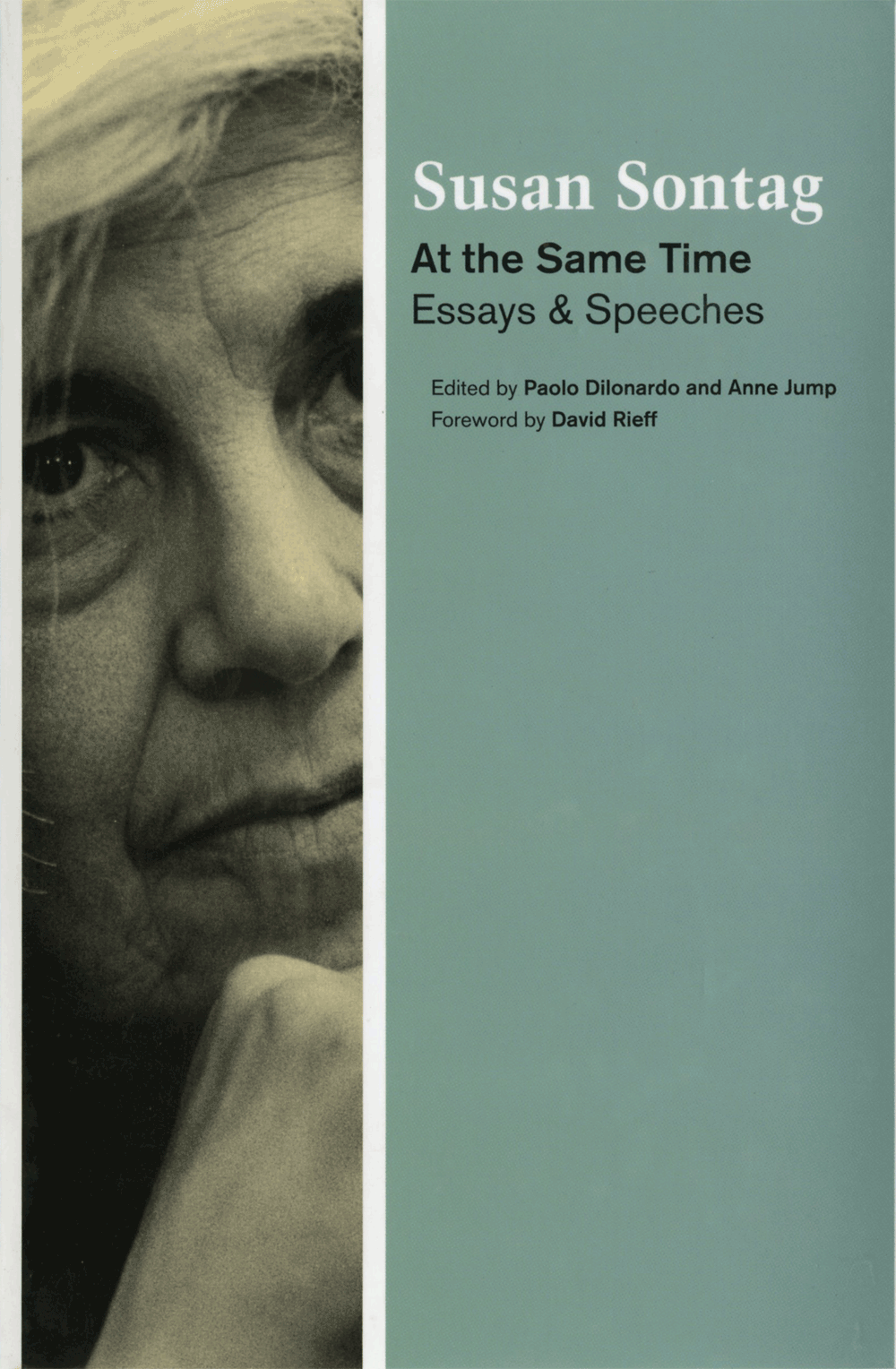
  • Finally, I would include Susan Sontag’s essay collection, At the Same Time: Essays and Speeches, published in 2007, three years after her death.
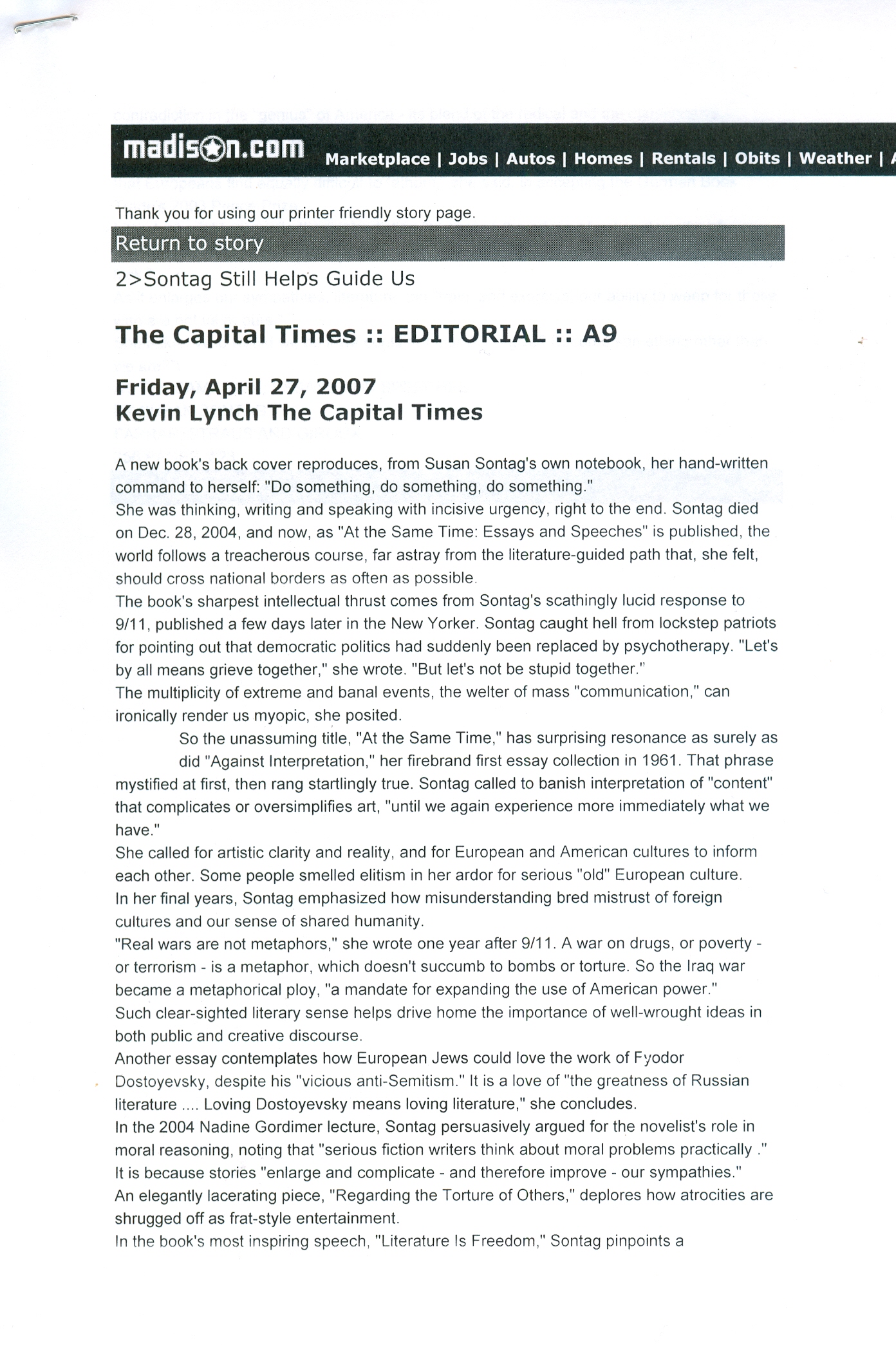
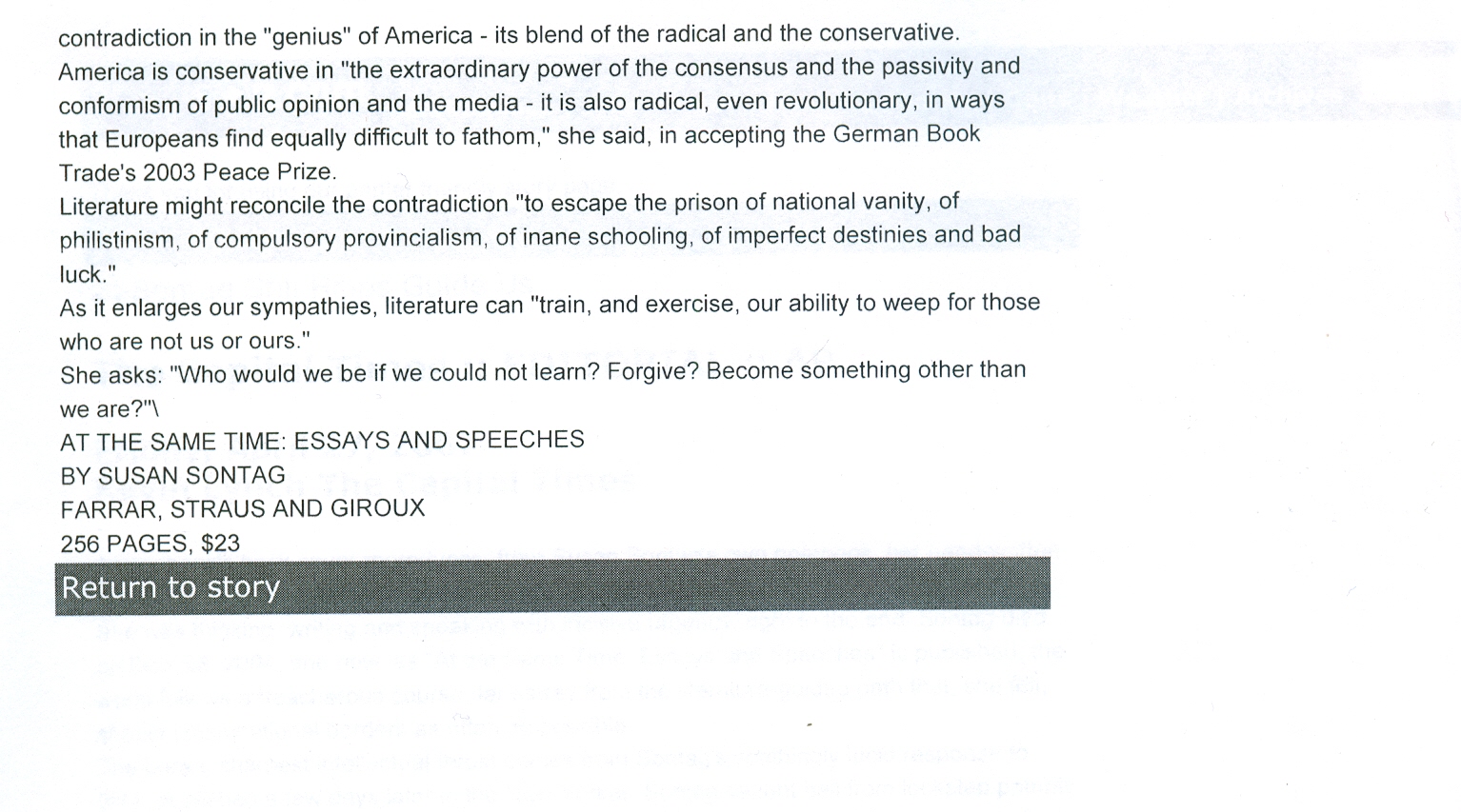
    Because it’s the most recent book on my list that I happened to write a review of, here’s my review of At the Same Time. I believe the book is available in paperback now from Penguin.
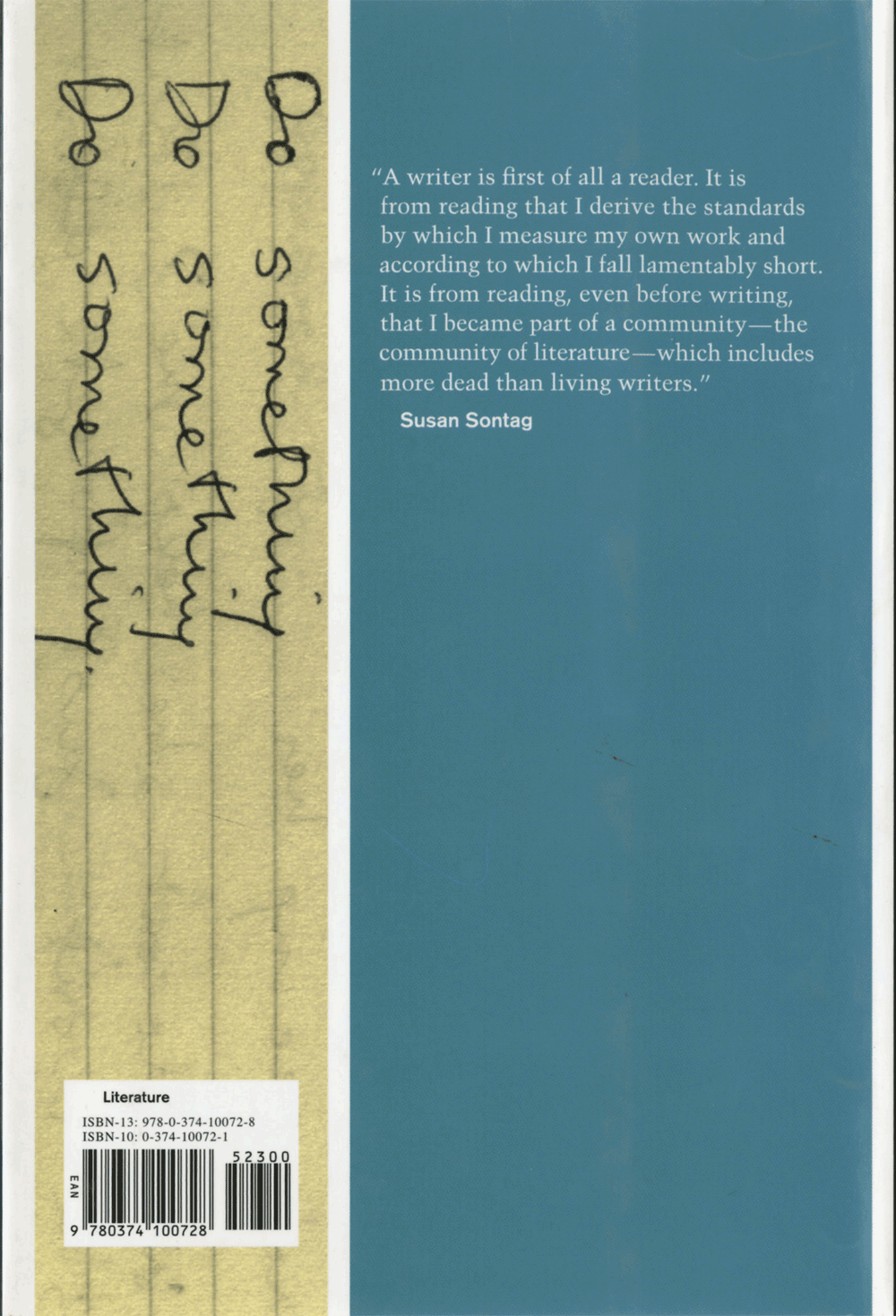
    Regarding Sontag’s interesting quote on the back of her book (see below), I believe my “community of writers,” as listed here, includes slightly more dead than living writers.
    scan0372
    scan0373
    (Below) The back cover of the hardcover edition of Sontag’s At the Same Time.
    sontag 2

Two days left to see Kandinsky, a great thinker and a greater artist

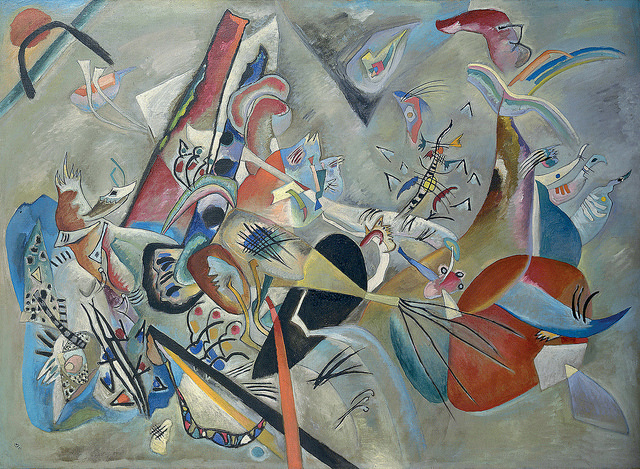
k5 In Gray, 1919

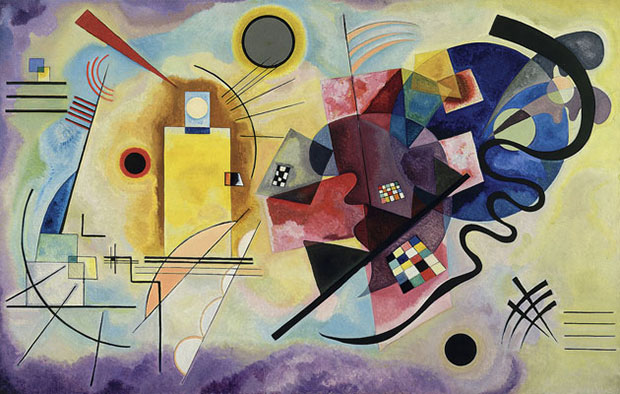
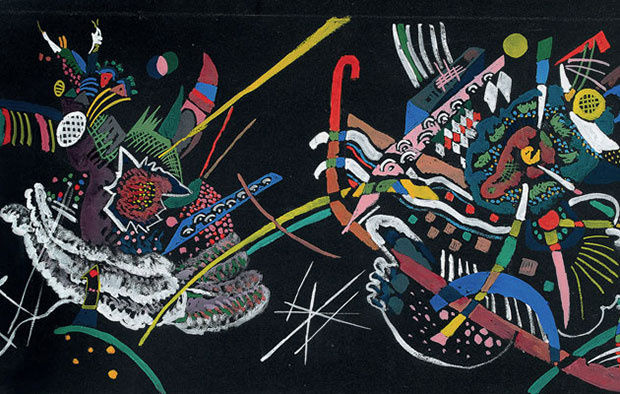
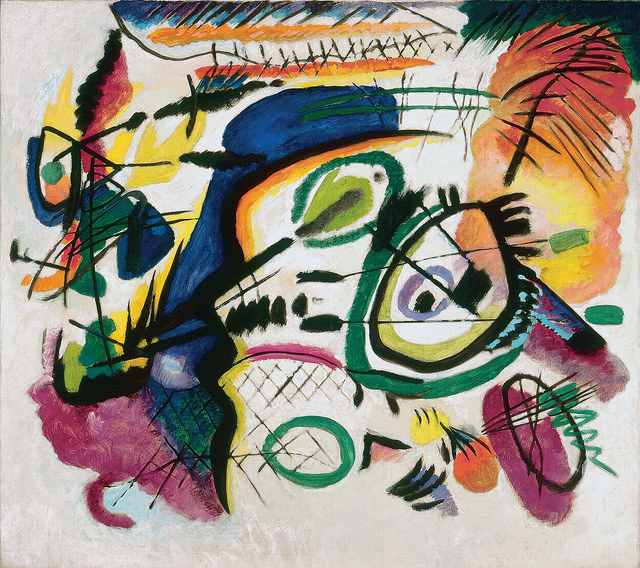
Because I have too much other writing to do today, I’m merely going to give you this little image essay of the fabulous Vassily Kandinsky exhibit at the Milwaukee Art Museum, running through Monday, September 1. This is a great way to spend some of the Labor Day weekend, especially if the weather continues as it is right now. Don’t miss it, maybe the best art show of the year, at least in the Milwaukee area. A friend of mine who walked into this show saying, “I don’t really understand abstract art,” raved about it continually throughout, and that says as much as anything I can say.

The paintings are not presented here in chronological order. One suggestion or two: Enjoy the representational paintings as such, but then try to look at them as abstracts, to appreciate their compositional, sensual, and even spiritual qualities.

Consider also that Kandinsky did his work before, during and after World War I. Kandinsky said that war stress and imagery can be detected, including cannons and barbed wire fences. During the war, he was exiled to Russia and suffered great privation there. He also wrote a short book, a sort of ruminative aesthetic manifesto titled “Concerning the Spiritual in Art.”

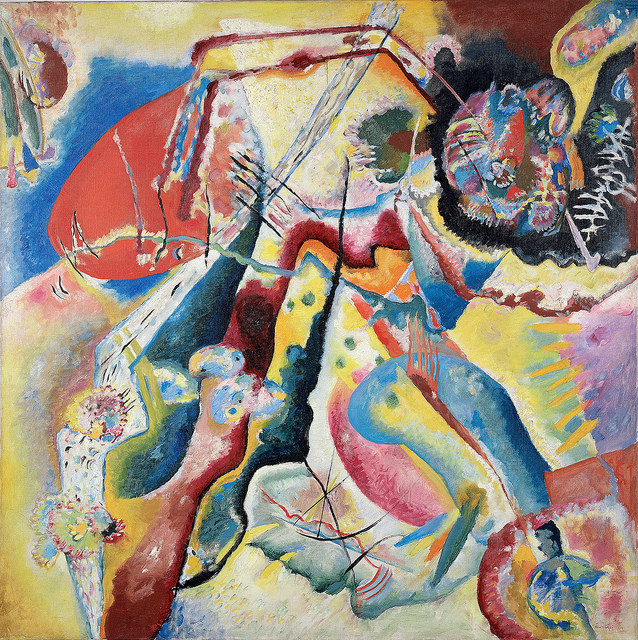
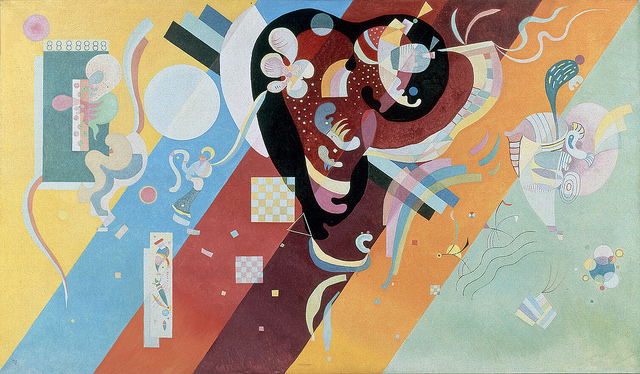
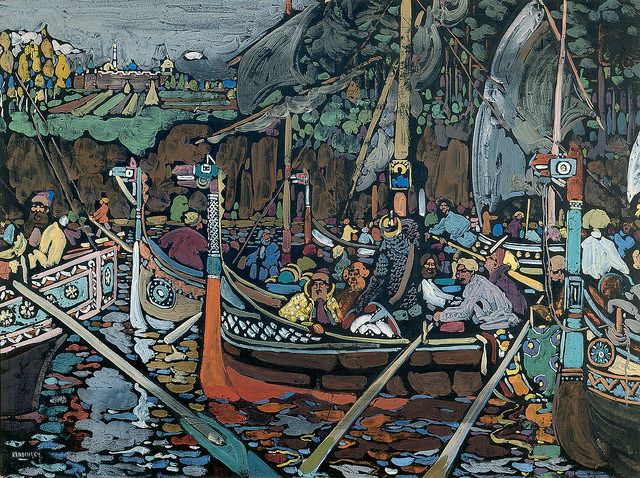
Unless otherwise noted, all the artwork is oil on canvas.kandinsky-2 Yellow-Red-Blue   kandinsky-3 Panel design for the “Juryfreie” exhibition, Wall A (Entwurf für das Wandbild in der Juryfreien Kunstschau: Wand A), 1922 Goauche on canvas13584059265_3bdee49c67_z Fragment 1 for Composition VII   Composition IX    Old Town II 13584092934_c1c6768a63_z Old Town II

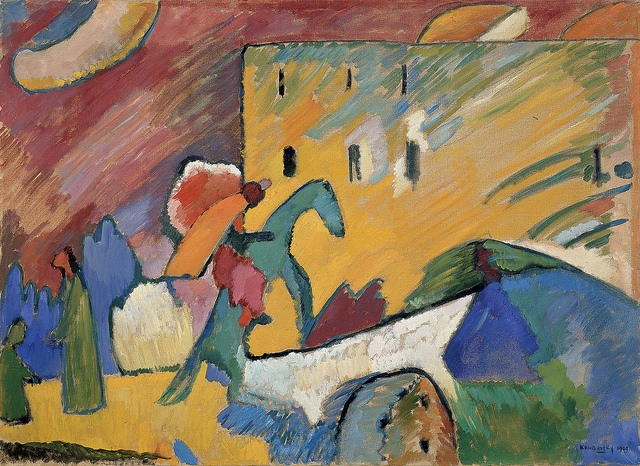
13569549583_29c81c1839_z  Painting with a red mark 1914  13569550793_39741cf0fa_z Improvisation III

13569486485_2343284ed0_z

Composition IX

13570124994_1141df931a_z

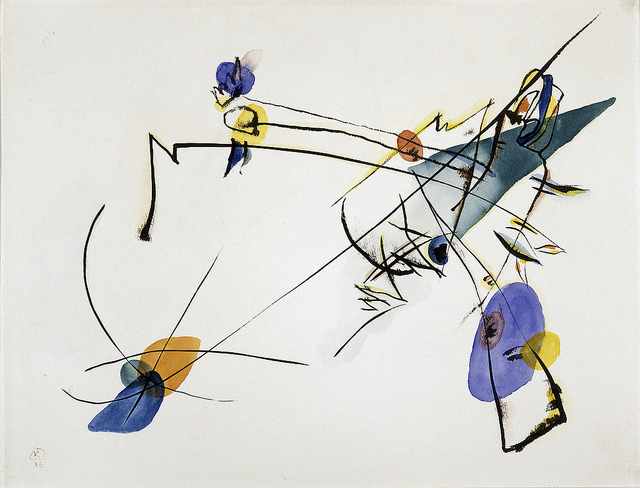
Simple 1916 Watercolor and india ink

13569547613_796e6b426b_z

Song (Leid) 1906


My book “Voices in the River: The Jazz Message to Democracy” gets a pre-published airing


voices 1

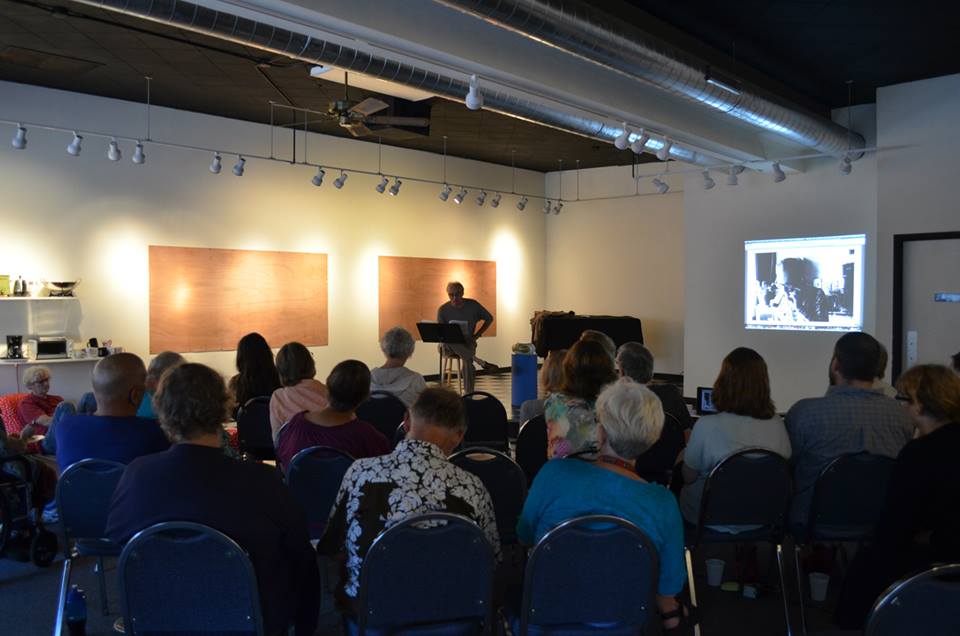
This was the setting for my August 24th presentation and reading for my forthcoming (hopefully soon) book Voices in the River: The Jazz Message to Democracy at the Jazz Gallery Center for the Arts in Milwaukee. The illustration on the wall at the right above is a photo of Chuck LaPaglia, the founder and owner of the original Milwaukee Jazz Gallery. After changing the course of jazz history in Milwaukee, LaPaglia went on to become the talent booker at Yoshi’s in Oakland, which would become one of the greatest jazz clubs in the United States.

voices 2

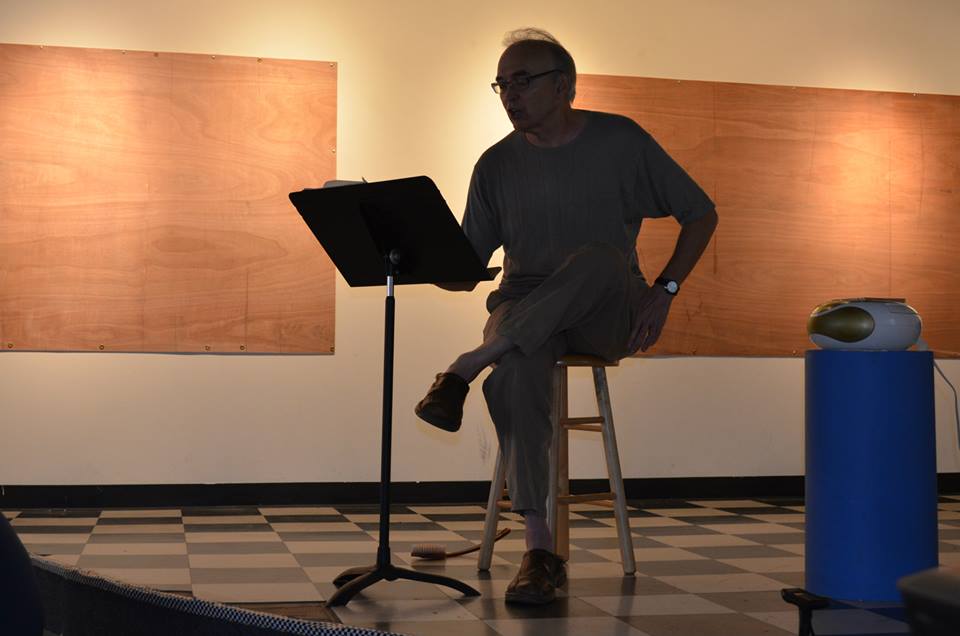
I used a music stand for a podium and among my props were a bathroom back scrub brush (for an anecdote about a very clean Sonny Stitt), a Hal Leonard Jazz Fake Book, and a boombox.

voices 3

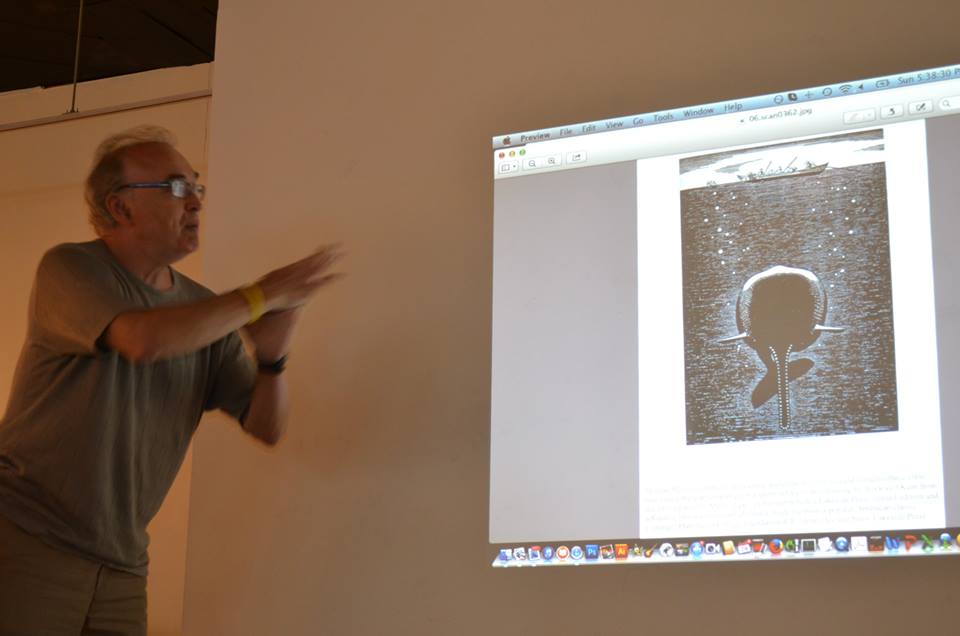
Among the visuals was this wonderful image by Rockwell Kent which was part of the 1930 illustrated edition of Moby-Dick, which popularized Melville’s great work in the 20th century.
I briefly spoke of how Melville is one of the precursors of many writers my book discusses who understand the jazz and democracy relationship. In Moby-Dick, the whaling ship The Pequod, and its remarkably multi-cultural crew, serve as a striking metaphor for America as a melting-pot democracy.

voices 5

I was blessed with a remarkably attentive, literate and responsive audience. It didn’t hurt that they had been fortified with a delicious array of food from the potluck provided by a variety of attendees, mostly from the Riverwest neighborhood.

voices 6

Among the attendees was Bill Schaefgen (above), the gifted Milwaukee trombonist-composer and bandleader, most notably of the group What on Earth?  I played a recording by the group and also described their music in part of the reading from my book’s second chapter, titled “The Milwaukee How-Long Blues: An Unlikely Jazz Scene Flourishes.” The band blended “a controlled spaciness, mock defiance and post-bop freedom with both traditional jazz forms and structural ideas drawn from contemporary classical music.” We also took a moment to allow Bill to tell us about the genesis of “Flow,” the tune of his that we played.

voices 4

Young visitors to the Jazz Gallery’s Habeas Lounge Riverwest had fun with the bean bag chairs.

______________

All photos by Linda Pollack/Habeas Lounge.

Special thanks to visiting artist Linda Pollack, Mark Lawson, The Jazz Gallery Center for the Arts and the Riverwest Artists Association. Also thanks to all the contributors to the pre-presentation potluck. 

George Bernard Shaw scrutinizes human folly and romance in APT’s “The Doctor’s Dilemma”

DD rSir Ralph Bloomfield Bonnington (John Pribyl, foreground) in full blowhard form in “The Doctor’s Dilemma.”

SPRING GREEN — American Players Theatre’s Saturday production of The Doctors Dilemma saw playwright George Bernard Shaw let favorite archetypes tumble into a philosophical pecking order, where artists shone brighter than those with the means “to sometimes cure and sometimes kill.” Morally challenged MDs end up on the bottom with the bedpan.

They know “pain doesn’t come until after, when they get bill.” Merely the least buffoonish of the medicine men dabbles with “the doctor’s dilemma” — whether “to kill someone, so that another might live.” Shaw renders truth timelessly stark, wherein “40 out of 50 people are condemned to death.” So what does a doctor do to save the other 10?

Further, is an “artistic genius” worth saving over one of those lives?

While we chew on those fascinating quandaries, Shaw’s loopy gaggle of Irish characters help unfurl a seamy would-be romance. Despicable Dr.Colenso Ridgeon (Brian Mani) ponders euthanizing the stricken painter, Ralph Dubedat, while lusting for his red-headed wife Jennifer (Abbey Siegworth).

DD p

Long-time American Players Theatre favorite Paul Bentzen (right), adds his inimitable comic flair to Shaw in the final year of his career.

Among the other doctors adding to the chaotic fun are craggy Paul Bentzen, longtime APT comic foil, who’s retiring his lean-boned jocularity this year, and especially a foppish, blonde-mopped doctor named Sir Ralph Bloomfield Bonnington. “So many of my patients are better dead (than useful),” Bonnington shrugs. “My tastes are simple.”

Or “good wine, happy endings, touching gratitude, enchanting woman, gentle nature…”

He’s not the only one who conveys wit by letting his overactive mouth expose himself. It’s one of Shaw’s most winning ways but, in this play, might also have amounted to a bit of self-mockery, intended or not.

You can’t help liking Shaw’s moniker mongering. There’s also Dr. Blenkinsop (David Daniel), who provides some of the playwright’s most barbed social satire, as a physician too poor to afford his own treatment. Or Minnie Tinwell, a maid, who’s caught up in the unseemly steaminess.

DD 4Sir Colenso Ridgeon (Brian Mani) has eyes for Mrs. Jennifer Dubedat (Abbey Siegworth), the wife of one of his patients.

Despite Ridgeon’s amorous advances, Mrs. Dubedat is dedicated to her wispy, mortally-sick husband, whose corporeal remains seem 98% inspiration and 2% perspiration. What’s left of Dubedat (Samuel Taylor) seems hanging from a tube of paint.

However, ailing Dubedat, an “above it all” artist, is also a master money-grubber and a bigamist. Shaw finally frames things in existentially human terms.

However, the playwright couldn’t stop writing. Judging fate interceded where an editor didn’t — an audience member actually keeled over and a medical emergency stopped the play for nearly half an hour.

That merely slowed Shaw’s brilliant discourse, which should’ve ended with Dubedat’s death, an exquisite set piece by the company, a virtual Pieta on stage, pure spiritual pathos. “I think I’ll recover after all,” the artist murmurs. “I suddenly went to sleep.”

DD

Ralph and Mrs. Jennifer Dubedat in Ralph’s death scene.

That said, this superbly crafted production includes another stunning set piece, actually 48 of them – backstage panels of portrait paintings, ostensibly by Dubedat, of celebrated 19th century medical and cultural icons. These presences frame the dilemmas and shenanigans like so many witnesses to humanity’s folly, grace and endurance.

dd5

All photos by Carissa Dixon and copyright of American Players Theatre.

________

The Doctor’s Dilemma runs throughout October 3 at American Players Theatre’s “on the hill” theater, 5950 Golf Course Rd. Spring Green, Wisconsin. For information, call 608-588-2361 or visit www.americanplayers.org


A review: Charlie Haden and Keith Jarrett’s “Last Dance”

last dance

Keith Jarrett/Charlie Haden Last Dance (ECM)

What did they know when they titled the last recording released before Haden’s death on July 11? That his boyhood polio had returned, fatally as it turned out. Polio long ago robbed his young singing voice. So he became perhaps the most songful of bassists. That instrumental voice captures the nostalgia of “My Old Fame” with the gruff huskiness of a burly romantic , whispering the song in her imagined ear, or dancing in his dreams — an uncertain step or two, then finding his inner Astaire.

The rhythmic poise carries a resounding, muscular  tone — Haden dwelled in the bass fiddle’s natural depths, rather than trying to make it zip around like a guitar, as so many contemporary bassists try to.

So he became one of the best duets players ever, going back the quiet revelation of these musicians’ duets on Haden’s 1976 recording Closeness. Nobody listened or responded more closely than Charlie Haden. In this 2007 session, he fleshes out pianist Jarrett’s every lyrical turn of phrase with splendid harmony, or spare countermelody. Some striking substitute chords make the overplayed Round Midnight beam like a new moon.

Haden’s extended solo on “Where Can I Go Without You?” magnificently extends the melodic contours and the meaning of the song as if the rhetorical question had been deposited directly in the heart of the listener.

last dance 2

Pianist Keith Jarrett (left) and the bassist Charlie Haden, who died July 11, take a break during the sessions that produced “Last Dance.” Courtesy amazon.com 

Yet his epitaph might be another standard, “Everything Happens to Me.” Not as a solipsistic whine, this was a humble man. Rather, he was person who lived a full creative life, embracing all life’s wonders, cruelty and strangeness with his artful gifts and passion for justice, while battling the infidels of his body and spirit, to the end.

Haden could also swing and fast-walk the bass buoyantly, as on Bud Powell’s “Dance of the Infidels.” Last Dance’s uninvited infidel was polio,* and by the time it ends — with “Every Time We Say Goodbye” and then “Goodbye” — you know how he and Jarrett hate saying goodbye, and yet can’t stop saying it, and singing it.

last dance 3

A somewhat shorter version of this review was published first in the Shepherd Express.

* Haden died of post-polio syndrome. He had contracted polio as a child.

Some of this material was part of a CC obituary profile of Haden at https://kevernacular.com/?p=4420

It Must Work is holding a fundraiser for a new well for orphans without water in West Africa

it must work

Imagine you are an orphan in a West African village, today. You live in the orphanage because your parents died of AIDS, like countless other parents in Africa. One hundred degree heat beats on your brow, and you are thirsty. But you are also getting sick — from the only drinking water you have.

I may be stretching the perceived boundaries of Culture Currents for this posting. But this elasticity is justified: Culture Currents is interested in the uses of social media, which is now crucial for this effort at helping orphans survive in Africa. The effort began with an e-mail (see note with accompanying photo above). The sponsoring organization, It Must Work has gained support from a Facebook-driven non-governmental organization Electricians without Borders 1 for well-building plans and now is doing online and Facebook promotion for a fundraiser upcoming on August 6 at the Highland House, an excellent restaurant in the Milwaukee area which is donating money for each person attending the event (see below).

The Culture Currents blog is joining the effort and is always interested in the social and political aspects of contemporary media and communication, because they help define our contemporary culture — that is, the actions and expression that define who we are, and what we value, as a group of people and, more largely, as a common humanity (thus my blog’s sub-title).

So, this is a matter of imploring humanity to care about orphans in dire need. 

The orphanage’s relatively crude cistern is contaminated “from water runoff from roof gutters overhead and other impure sources,” explains Ed Valent, a Milwaukee educator and IMW board member.*  (see photograph at the bottom right, on the attached flyer.)

So building a well will be the practical solution to the water problem. “They are also trying to grow crops and have a fish farm,” Valent said. “But water is an ongoing problem, and it depends on the rain, which is seasonal. And the temperature there is always between 90 and 100 degrees.”

The effort is spearheaded by a remarkable Midwestern-born Peace Corp worker Rebecca Casper Harles, who worked at the orphanage in Benin, Africa. Here’s a message from Valent:

Hello,
I’m inviting you to join me for lunch or dinner or drinks at the Highland House on Wednesday, August 6. I’ll be there from 11:00 AM until closing time at 10:00 PM…. for a good cause, so you aren’t just getting an invitation, you’re getting a story too (see below and attached for more on the story).
The Highland House is a great Mequon restaurant and bar that has offered to contribute money for each customer who dines or drinks at Highland House on August 6 for our Build-A-Well-For-An Orphanage fund raiser. You’ve gotta read the story for more on that… but here’s more about Highland House:
Highland House is a family friendly, reasonably priced restaurant (managed by the son of my childhood friend, Frank Stemper)
Here’s their web site: Highland House.
Here’s their address: 12741 N Port Washington Rd, Mequon, WI 53092
Here are driving directions from Milwaukee:
I 43 North to Mequon Rd (exit 85), left on Mequon Rd to cross highway, right on Port Washington Rd for 2.9 miles. Highland House is on the left.

Now (if you’re still reading), here’s the story I promised:

The Water for Orphans Story: Several years ago, Rebecca (Casper) Harles came back from her Peace Corps assignment in Benin, Africa with a mission. While she was there, she befriended Mathieu Honzonon, who has an extraordinary story.
The small town where he grew up was coping with a heartbreaking result of Africa’s AIDS crisis: a large and growing number of orphans. Benin’s citizens rely on the generosity of neighbors to address family crises, but the scope of the problem was unprecedented. Mathieu began an orphanage for about 35 school aged children and set about the job of providing them with an food, shelter, an education and love.
The orphanage has always relied on a cistern system to supply all of its water. Recently, contamination in the cistern water has sickened both animals and children. The solution: a new well. The problem? No money. Fortunately, upon Rebecca’s return from Africa, she set up a non-profit to be able to continue supporting Peace Corps related work in West Africa. Her organization is called, “It Must Work”, the English translation of the name of the orphanage.
Mathieu has reached out for support from “Electricians Without Borders” for well plans and expertise and to “It Must Work” for funding. As a board member of It Must Work, I can attest to the legitimacy of this group. Since it’s beginning in 2009, 100% of every donation for the annual projects the group has undertaken has gone for the charitable work of the organization. All “fundraising” expenses have been paid by board members themselves.
 

A day or night out at Highland House sounds like a good time, but if you can’t join me on August 6, and you’re moved by the cause, the orphans and I would appreciate a donation. You can mail one to:

 
It Must Work c/o Paul Casper, Treasurer
1325 N. Van Buren St. #603
Milwaukee, WI 53202
For more about It Must Work, see: It Must Work’s Facebook Page (and like us while you’re there if you want to stay in the IMW loop).
Yours for the orphans,
Ed Valent

929 N. Astor St. #2207
Milwaukee, WI 53202
414-257-2448

Attachments area
Preview attachment Water4Orphansv3.pdf

Water4Orphansv3.pdf
___________
1 Electricians Without Borders FB page is https://www.facebook.com/ElectriciansWithoutBordersUsa
* Ed Valent and It Must Work founder Rebecca Casper Harles’ father Paul Casper, are old friends of mine, and fellow classmates from Marquette University High School.  For full disclosure, The Highland House restaurant hosting the fundraiser is managed by Frank Stemper Jr., the son of another fellow Marquette High classmate of ours, Dr. Frank Stemper. 


Recent Hauntings: Does American Democracy Stand a Ghost of a Chance?

scan0347

I took this photograph shortly after the small tin piano-shaped music box on top of the buffet shelf began playing its song, after several years of sitting silently. The music box formerly belonged to my deceased mother (who happens to be pictured beside the piano with my late father).


I’m a bit bewildered by small, spooky occurrences of late, that resonate with sentiment.

I’ve experienced three such happenings lately.

Now, feminist scholars of 19th century literature, especially written by women,

inform us that sentiment ain’t a bad thing, culturally speaking.

Uncle Tom’s Cabin was the feminine John Brown, they might argue.

Yes, I get that.

But a recent afternoon I was browsing through Tocqueville’s Democracy in America,

feeling burnt and wired, after a lousy night’s sleep.

Then, I hear a slight tinkling, teasing my brain.

I walk into the dining room…

I’ll be damned if it ain’t my late mother’s piano-shaped music box

that’s sat on the buffet silently for a couple of years.

Suddenly, it’s playing its tinny little heart out, a few feet away

from the cassette tape of my eulogy of father Norm’s funeral,

which appeared, out of nowhere, not long ago right on the bookshelf.

The piano’s melody is touching but sappy: “We’ve Only just Begun” by Paul Williams,

which…The Carpenters nailed together into a hit.

The piano’s song “began” a few years ago

when I first wound the tin piano up,

shortly after Sharon’s funeral. I let it play out —

or so I thought — then eventually set it down in the dining room.

Now I’m compelled to ponder Sharon’s affection for the melody, a sunny C major chord

which takes a striking modulation to seven successive minor chords

offset by one E Major 7. The minors help “sell” such sappy lines as “white lace and

promises…” The wide intervals of the phrases do as well.

So, Williams had a craftsman’s command of music.

And now the dippy lyrics nag at my brain

though I wanted to read more of what Tocqueville had to say

about “the people” informing the intelligentsia,

with his certain faith that American people

were fairly intelligent.

My own Tocquevillian faith in “the people” is tested regularly,

as much as my faith in a higher power,

but I seem to persist in such battered, residual beliefs,

still simmering in the petrie dish of my brain.

Rolling Stone lists “We’ve Only Just Begun”

as 405 among The 500 Greatest Songs of All Time.

And to be clear, the Paul Williams who wrote that song

is not the same one who started Crawdaddy magazine,

one of the really seminal rock critics.

If Paul Williams the critic were still alive, it would be interesting

for him to meet with Paul Williams, the soft-rock songwriter

and have them argue whether the song

deserves to be in the all-time top 500.

It’s a pop song. Often played at weddings.

These days I sometimes wish I was 30 years old

and could have Jeffrey Foucault sing his wedding song

“One for Sorrow” (two for joy they say) at my wedding.

It always lifts my spirit. And he writes a hell of a lyric.

But then, how different is Williams’ song than

some of the Tin Pan Alley Songs I’ve played on piano —

plenty romantic, and for Norm and Sharon’s wedding anniversary?

“My One and Only Love” and mom’s fave “Here’s That Rainy Day.”

I feel the heart tug and resist, or do I?

After all, The Carpenters sort of made my skin crawl.

Strange thing is, poltergeists don’t seem to. Not quite yet.

As long as they don’t start tossing furniture around the room

or de-alphabetize my CD library, or turn on an “Addams Family” video and, along with

Boris and Natasha, do a steamy tango with my startled cat (supple Chloe could at least handle the kicks, the boleo, the head snaps and the female’s deep backwards back bend. But I doubt she would dig it. And I’d be “Ghost Busters” spooked.)

But what of the weirdness of these occurrences?

Dad’s eulogy tape surfacing mysteriously a few weeks before mom’s piano plays,

out of the blue?

I shrug it off, sort off.

But still.

I’d like Tocqueville to be in the room with those two Paul Williams.

Tocqueville seemed to feel that “we” the people “had only just begun, to live.”

Ditch the “white lace,” expand the lovebirds’ first-person plural to

“We the people…” He wrote a 700-page political science masterpiece

based on America’s “promises.”

It would be a conversation with four writers, if I attended.

I’d prefer not to talk much.

I’d be a Kakfa-esque bug in the corner,

too ugly for anyone to acknowledge.

So, I keep following my psyche through my mid-afternoon Twilight Zones

but also keep thinking and writing because

Norm and Sharon would want me to, I’m sure.

Then, there’s my dead ex-wife Kathy, and the third creepy occurrence — which fit

her impish personality to a T (too complicated to explain here, having to do with a computer screensaver “joke.”)

I’ll just say Kathy, who died in 1999,

was bugging me to finish my long-postponed blog remembrance

of her — by her birthday, which I finally did.

So maybe that’s one spook silenced.

Maybe.

Unless I start pondering the “astrological psychic energy” of birthdays and anniversaries

and of “Occurences at Owl Creek Bridge”  yet to come.

_______

The Kathy Naab remembrance is posted here:https://kevernacular.com/?p=1547

  • An Occurence at Owl Creek Bridge is a haunting 1890 Civil War story short story by Ambrose Bierce, which was aired in 1964 on The Twilight Zone in a film adaptation. It was actually a black-and-white French film, rivière du hibou, directed by Robert Enrico, and won awards for best short subject at the 1962 Cannes film festival and 1963 Academy Awards.
  • The Bierce story’s subtitle is “A Dead Man’s Dream.” I just hope I don’t have a dead man’s dream tonight, or anytime soon. Dad, you can hang onto your dreams, until further notice. Are you listening? Um, hello?
  • Suddenly, I feel like Hamlet, the brooding, haunted Dane…
  • Now what should I do? What’s this? I just heard a small voice somewhere, whispering, “Psst. Hey dude. Your money or your life.”
  • To quote Jack Benny (not Hamlet), “I’m thinking, I’m thinking.”
  • p.s. OK, I made up that last “ghostly” quote. As for any of the rest of this blog, (to quote a contemporary “philosopher”) “I did not make that up.”
  • http://en.wikipedia.org/wiki/An_Occurrence_at_Owl_Creek_Bridge
  • HERE “IS AN OCCURRENCE AT OWL CREEK BRIDGE” ON YOU TUBE:https://www.youtube.com/watch?v=DocXC-kobmU

Charlie Haden’s bass sang around the world, and back, to The Shenandoah

charlie-haden

Courtesy bluenote.com

Blogger’s note: On Aug. 7, I will add to this posting a more complete review of Charlie Haden’s last released recording “Last Dance,” when it is published by The Shepherd Express. 

On the new ECM CD, Last Dance with pianist Keith Jarrett, Charlie Haden’s extended bass solo on “Where Can I Go Without You?” magnificently extends the melodic contours and the meaning of the song, as if he has deposited the questionnaires directly in the heart of the listener.

Yet his epitaph might be another standard, “Everything Happens to Me.” Not as a solipsistic whine, this was a humble man. Rather, this musician lived a remarkably full creative existence, embracing all life’s wonders, cruelty and strangeness with his artful gifts and passion for justice, while battling the infidels of his body and spirit, to the end.

“I want to take people away from the ugliness and sadness around us every day and bring beautiful, deep music to as many people as I can,” Haden said in a 2013 Interview with the Associated Press shortly before receiving his lifetime achievement Grammy Award. Eventually his body, debilitated by post-polio syndrome, took his music and life from him.

Born on August 6, 1937 in Shenandoah, Iowa — Charlie Haden died at age 76, on July 11, shortly after the CD’s release. This great bassist, composer, educator and bandleader has a vast and wide-ranging recorded output (see selected discography below), from powerfully rhetorical, politically acute large-group records to duets, where you hear the man most intimately, which is why I am starting this appreciation with a consideration of his duet recordings with several different pianists.

jarretthaden-5d741c44b983e75312f3012927abf0c886703899-s6-c30

Keith Jarrett and Charlie Haden recording the sessions that produced “Last Dance” and “Jasmine.” Courtesy npr.com

Besides Jarrett, Haden also recorded excellent duet albums with pianists Denny Zeitlin and Hank Jones, actually two superb recordings with the latter — of spirituals, hymns and folk songs, which reveal some of his roots as a boy singer in the popular country radio act The Haden Family.

But Haden’s most artfully beautiful duet album was Night and the City with the master of New York piano jazz, Kenny Barron. Haden the role player understood restraint and understatement, and knew, with a pianist of bounteous pianistic and harmonic resources like Barron, the bassist can slip a bit further into the background. Yet Haden remains the recording’s deep-breathing presence, the knowing inner voice perhaps weighing the difference between the dark and light angels within each human, for this is a musical symbiosis of two sensibilities as one whole.

Haden’s “Waltz for Ruth” from Night and the City: https://www.youtube.com/watch?v=3gbhHA_nrEY

The CD’s cover image, Georgia O’Keeffe’s famous 1927 painting “Radiator Building – New York” is the perfect visual analog to Haden’s heartland-to-big city career arc. O’Keefe, a Sun Prairie, Wisconsin native, became the student and spouse of New York sophisticate art photographer Alfred Stieglitz, who understood her genius, here interpreting the ultimate urban setting.

Charlie Haden 1996 Night And The City

The cover of “Night and the City” with Georgia O’Keeffe’s painting of the Radiator Building in New York. Courtesy blue-train.es

The painting’s architectural starkness parallels Haden’s stripped-down structural strength, the dancing wisp of smoke suggests his lyricism, and the lights reaching to the heavens, his spirituality. The music echoes not only O’Keeffe but also the poem quoted in the liner notes, Mark Strand’s “Night Piece,” which itself pays homage to Charles Dickens:

…And people moved like a ghostly traffic from home to work

and home,

and the poor in their tenements speak to their gods

and the rich do not hear them, every sound is merged,

this moonlit night, into a distant humming, as if

the city, finally, were singing itself to sleep.

Haden produced the album with his wife Ruth Cameron, who co-produced most of his later work. You get a muted sense of Haden’s gifts for album concepts and socially-consciousness expression. There was a bracing, highly political side to Haden, most evident in the recordings he made periodically with his Liberation Music Orchestra with pianist-arranger-composer Carla Bley.

The first album, Liberation Music Orchestra from 1969, lends pointed purpose to the maelstrom of musical creativity, and social and political unrest that remarkable decade produced.

Charlie Haden LMO

The first Liberation Music Orchestra album in 1969 set a standard for political jazz in a pan-cultural cast. Courtesy public-embarrassment-blues.blogspot.com

The Liberation Music Orchestra’s last recording, Not in Our Name, recorded in the summer of 2004, is a protest against the Iraq war, among other travesties of justice. The album also introduced many in the music world to the brilliant young Puerto Rican alto saxophonist Miguel Zenon, who may have no peer today on his instrument.

Not in Our Name superbly blends originals and folk-derived pieces by Bley, and various Americana: a sardonically harmonized “America the Beautiful,” part of a medley including a majestically soaring, trumpet-borne, “Lift Every Voice and Sing,” and a quote from Haden’s old bandleader Ornette Coleman’s powerfully searching tone poem Skies of America. There’s alsoAmazing Grace,” and “Goin’ Home” (the folk song used in Dvorak’s “New World” Symphony).

The album closes with their interpretation of Samuel Barber’s Adagio for Strings. The original material may not match that of the first Liberation Music Orchestra album, one of the great recordings of the modern jazz era, and perhaps this Adagio inevitably, with 12 musicians, couldn’t quite equal the luminous, searing orchestral beauty of Barber’s masterpiece, as scored for strings.

But few artistic statements in recent memory have shown a surer artistic and critical grip on the America of the present, without forsaking, trivializing or glibly diminishing it.

“People sometimes ask, does it make any difference to make a recording like this?” Haden and Bley wrote in their liner notes to Not in Our Name. “What is important is that we choose to express our concerns, when the circumstances warranted and our natural mode of expression is music.”

Haden knew that music has the vibrational power to move people unlike any other art form. He used that power wisely. He toured worldwide until his body began to break down.

Perhaps one of the first documented clues to this tireless creative musician’s deteriorating condition arose in an interview he did for Jazz Times in May 2011. Writer Don Heckman wrote:

“At the moment, seated in an Italian restaurant near his home in northwest suburb of Los Angeles, it’s a coffee he’s drinking that’s bothering him. He’s been coughing since he took the first sip. ‘Coffee!’ He mutters. ‘I keep drinking it, and I keep coughing,’ And then in his typically whimsical fashion, he laughs at the inadvertent pun.”

Respiratory problems are among the symptoms of post-polio syndrome. Heckman aptly characterizes Haden as a Renaissance man, and the interview ends with the journalist asking Haden if he thinks Renaissance men are born or made.

“Well, my parents were like that, too, and I’ve always, from the beginning, wanted to play different music from different parts of the world,” Haden replied. “And then, as I was exposed to the problems of society as I was growing up — racism, Vietnam — that affected me, too. But I think the simple answer is this: who you are and what you do comes from what’s inside you.”

A humble man of vision and ambition, who knew who he was, and what he became, and how to share that with world. In his speech given when he received a Lifetime Achievement Grammy award, you sense vulnerability in his crumbling stature and unsteady voice. Yet he always seem to know where he was going with or without anyone else.

His career had a magnificent sense of purpose, perhaps no more overtly is when he formed the Liberation Music Orchestra, one of the most powerful and eloquent ensembles ever dedicated to the idea of freedom. His eloquent solo on “Song for Che,” from the first Liberation Music Orchestra album from 1969, will burn through the ages as surely as the memory of Che Guevera, the man it commemorated.

Haden’s “Song for Che” preformed with Ornette Coleman: https://www.youtube.com/watch?v=Fmoj_vdk_5U

I saw him play twice in Madison, once years ago with Keith Jarrett’s American Quartet with Dewey Redman and Paul Motian, a concert of lyrical and acerbic urgency. The second time was with his Quartet West, a project which explored his noirish, romantic side. The great Joe Lovano was to be special guest but needed to cancel, so an old West Coast compadre, Gary Foster, flew in for the gig.

Foster’s a fine post-bop/post-cool school player, but the concert didn’t fully persuade without Lovano, who can do romantic on tenor sax as well as anybody (see Lovano’s Celebrating Sinatra album). Some fans longed to hear a fiery Liberation Music Orchestra-type concert, but it’s good to remember that Charlie was also a romantic, which was part of his LMO idealism, but also his natural lyricism. And jazz concerts by definition always risk not fully working because they’re all partly improvised.

Regardless, Haden played magisterially, in the center of the stage, behind see-through studio-type acoustic baffles, always supremely attuned to his songful tone quality.


haden bass

Courtesy charliehadenmusic.com 

At his strongest, Haden sounds like a man carving his bass notes into an ancient oak tree.

Now people are commemorating him, singing songs for him, as he was once able to do with his family’s country music repertoire. The Haden Family was a popular Midwestern radio act when he was a boy and known as “Cowboy Charlie,”  on the verge of being a star singer. Polio struck, robbing his singing voice.

He switched to bass and became interested in jazz after hearing Charlie Parker perform with Jazz at the Philharmonic. He headed to Los Angeles to study music and began performing with such local musicians as pianist Hampton Hawes and saxophonist Art Pepper before meeting iconoclastic saxophonist Ornette Coleman.

ornette

Charlie Haden on bass in the early 1960s, with Don Cherry on pocket trumpet, Ornette Coleman on plastic alto saxophone and Ed Blackwell on drums. Courtesy dailykos.com.

“Ramblin'” by Ornette Coleman with Charlie Haden: https://www.youtube.com/watch?v=kqwdRBWvPs0

Almost a lifetime later, Haden’s soft tenor voice gives a stunning rendition of “Wayfaring Traveler” on his Quartet West album The Art of the Song from 1999. You hear a man who’s willing or compelled to wander and yet, as he did as bassist in the “free” jazz of Coleman’s pioneering quartet, he always seemed to know where he was headed. That was a secret of his success as an intrepid improviser. “Wayfaring Traveler” is actually a spiritual.

Haden founded the jazz studies program at the California Institute of the Arts in 1982, and emphasized the spirituality of improvisation. So he was always on his way home, at least in spirit. He died in Los Angeles, with his musical family beside him, says ECM label publicist Tina Pelikan, who announced his death.

Rambling Boy from 2008 is a gorgeous, moving and fascinating document and, in effect, a modern-day Haden Family album, with a gaggle of guest roots-music stars – a measure of the respect he’s earned across musical vernaculars and

in the jazz, country, folk, classical and world music realms. This is Charlie the global rambler finally coming full circle.

You hear Haden, wife Ruth Cameron, the piquant harmonies of their triplet daughters Rachel, Petra and Tanya, their son Josh and son-in-law, actor Jack Black — and Elvis Costello, Rosanne Cash, Vince Gill, Jerry Douglas, Dan Tyminski, Bruce Hornsby, Ricky Skaggs, Pat Metheny and others.

“My roots have never left me … because the very first memory I have is my mom singing and me singing with her,” Haden said in a 2009 interview. The CD includes Haden’s first recorded performance – an excerpt from a 1939 Haden Family radio show on which 22-month-old Cowboy Charlie yodels on a gospel tune, already with an innate feel for phrasing.

Haden family

A vintage photo of the original Haden Family with “Cowboy” Charlie Haden in center, (wearing a vest). Courtesy newswbt.com

Amid the bigger names, Haden’s unheralded son Josh offers “Spiritual,” a stunningly confessional supplication to Jesus: “I don’t want to die alone.”

The last song on Rambling Boy is Haden himself singing “Oh Shenandoah,” like a prodigal ghost. He returned, longing to hear Shenandoah, again, that rolling river.

The Shenandoah will always sing, for Charlie Haden. Night, and the city, singing itself to sleep, will as well.

____________________

Editorial assistance by Harvey Taylor, Michael Goldberg, Howard Landsman, Gary Alderman and Steve Braunginn.

A selected Charlie Haden discography:

With Ornette Coleman: The Shape of Jazz to Come, Change of the Century, This Is Our Music, Atlantic, early 1960s recordings; Beauty Is A Rare Thing (box-set reissue) Rhino/Atlantic, 1993; Crisis, Impulse! 1972, The Complete Science Fiction Sessions, with Bobby Bradford, Jim Hall, Cedar Walton, Ashla Puthli,  and others, recorded 1971, Columbia, 2000.

With The Keith Jarrett Quartet: Death and the Flower, Impulse! 1977; Survivor’s Suite, ECM 1977

With Rickie Lee Jones: Pop-Pop, Geffen,  1991

With Abbey Lincoln: You Gotta Pay the Band, Verve, 1991

With Joe Lovano: Universal Language Blue Note 1992

With John McLaughlin: My Goal’s Beyond, Douglas 1970

With Helen Merrill: You and the Night and the Music, 1998 

With Pat Metheny: Song X, with Ornette Coleman, Jack DeJohnette, Geffen 1986

With Old and New Dreams: Old and New Dreams, with Don Cherry, Dewey Redman and Ed Blackwell, Black Saint (Italian) 1977; and Old and New Dreams ECM 1979 (re-issued in 2005 as Lonely Woman on Universal.)

___

Charlie Haden:

Charlie Haden’s Liberation Music Orchestra, with Carla Bley, Don Cherry, Dewey Redman, Gato Barbieri and others. Impulse! 1969

Closeness (Duets), with Keith Jarrett, Ornette Coleman, Alice Coltrane, Paul Motian, recorded 1976. Jazz Heritage

Time Remembers One Time Once, duets with (pianist) Denny Zeitlin, ECM 1979

Silence, with Chet Baker, Enrico Pieranunzi, Billy Higgins, Soul Note (Italian) 1987 (six months before Baker’s death)

Etudes with Paul Motian, featuring pianist Geri Allen, Soul Note (Italian) 1988

Dream Keeper, Liberation Music Orchestra, with Joe Lovano, Branford Marsalis, Ken McIntyre, Tom Harrell and others, Blue Note, 1991

Haunted Heart, Charlie Haden Quartet West, Verve 1992

Night and the City, duets with pianist Kenny Barron, Verve, 1994

Steal Away: Spirituals, Hymns and Folk Songs, duets with pianist Hank Jones, 1995

Beyond the Missouri Sky (Short Stories) with Pat Metheny, Verve, 1996

The Art of the Song, Quartet West, with Shirley Horn, Verve 1999

Not in Our Name, Liberation Music Orchestra, with Carla Bley, Miguel Zenon, Curtis Fowlkes and others, Verve 2005

charlie haden cover

Rambling Boy, Charlie Haden Family & Friends, with Elvis Costello, Rosanne Cash, Jerry Douglas, Dan Tyminski, Bruce Hornsby, Ricky Skaggs, etc. Decca 2008

Jasmine, duets with Keith Jarrett ECM 2010

Sophisticated Ladies, Quartet West, with Cassandra Wilson, Diana Krall, Norah Jones, Renée Fleming and others, Decca Emarcy (import) 2010

Come Sunday, duets with Hank Jones (Jones’ last recording) Verve 2012

Last Dance, duets with Keith Jarrett, ECM 2014

___

“Rambling Boy” CD cover courtesy mike-oldfield.com 

Wisconsin gave John Steuart Curry a home. He gave back the state’s idea as image

curry Wisconsin Farm Scene

John Steuart Curry’s “Wisconsin Farm Scene,” oil on canvas, 97 by 89 inches, 1941. Lent by The Chazen Museum of Art, Madison.

John Steuart Curry’s relationship with his native state of Kansas was as troubled as a convulsing tornado, and the raging soul of John Brown. Curry became famous when he gave that state indelible public images.

His paintings of their swirling escalators to Oz and the anarchistic, slave-liberating Brown, and of fundamentalist baptismal dousings in a wood barrel, embarrassed early Kansas critics likely hoping his fame might help boost the state’s nation image in the newly modern and chic 1920s.

But Curry painted “the American scene,” with the same rough-hewn, real-life observational sensibility of Thomas Hart Benton and more craftsman-like Grant Wood. They would become renowned as the three major Midwestern regionalist artists,  comparable to another new American storytelling art form, the more urban “Ash Can School” artists, who preceded them  by a decade or so.

While Kansas worried about flying witches and other cultural blights, Wisconsin and in its visionary Big Ten university lay poised, deep in its rolling hills and forests, to woo the man to help artistically express its ideals, a man who created a new art largely independent of modern European influences.

Wisconsin made all the right moves, as is evident in the artwork and underlying story of John Steuart Curry at Home in Wisconsin, the new exhibit at the Museum of Wisconsin Art in West Bend, which is running through September 14.

This show title is slyly docile, domestic as a curled-up cat. But more’s afoot at this ambitious flagship for Wisconsin art. MOWA made a good move itself, when it re-defined part of its mission to exhibit not only native Wisconsinite artists like photographer Edward L. Curtis, but also artists, like Curry, who “lived in the state for a period of time and had a transformative experience here,” as MOWA executive director Laurie Winter explains.

An impressive show in Madison at the Elvehjem Museum of Art (now, The Chazen Museum) in 1998 traced Curry’s impact in defining the Midwest from the standpoint of the era’s natural and societal turmoil. The MOWA exhibit provides Wisconsinites with a fuller sense of a crucial if more internal story – of outreach-style rural education and collective state-side war efforts. But the cumuli-graced air he painted was also sometimes filled with UW flying footballs and a big buzzing vibration called “The Wisconsin Idea”, which helped the painter transform into a state citizen and ambassador for his adopted state in the progressive sense the idea espoused.

In November 1936, Curry was the first artist featured in the new LIFE magazine which would help “America’s foremost painter of cyclones and circuses” move squarely in the middle of American consciousness.

John Steuart Curry portrait

Curry, the nation’s first artist-in-residence at a university, poses in front of “Madison Landscape,” a painting familiar to Madisonians for having hung previously in The Madison Civic Center lobby, and currently part of the collection of the Madison Museum of Contemporary Art. 1941 photograph courtesy of UW Archives.

Wisconsin’s savvy talent scout was Chris L. Christiansen, Dean of the College of Agriculture, who lured Curry to Wisconsin in a telegram on display here, and hired him for $4,000 a year as the nation’s first “artist in residence’ at a university. By then, fame had virtually compelled Curry to move to the East Coast, but he was never comfortable in the high modernist climate there, and he longed to return to the Midwest.  Unsurprisingly, Kansas sent no zephyr whispers his way and, by 1939, the state became immortalized as the ultimate tornado state, when Dorothy murmured “Toto, I’ve a feeling we’re not in Kansas anymore.”

Nor was Curry who, though possessing the least draftsman skills among the three big Regionalists, had a big-sky state vision that understood the power and meaning of the brawling and sprawling American landscape. As the often-acerbic Benton himself wrote of Curry’s famous “Wisconsin Landscape”: “(It is) a strange picture. It is at first sight slightly repellent.” But Benton’s second thought was, “this damn thing is a masterpiece of some sort.” 1 The painting, property of The Metropolitan Museum of Art and not in this show, is surely Curry’s masterpiece.

Benton sensed how Curry’s Kansas eye fell hard for Wisconsin’s far shapelier curves, and the work reflected the way UW-driven Wisconsin Idea was modernizing the farmscape, striving to bring modern technology and know-how in synchronicity with extraordinary natural resources.

MOWA curator and director of collections Graeme Reid explains that the UW’s art and art history departments were in the mix for getting Curry as their department star. But Oskar Hagen, head of the school’s department of art history and criticism, anticipated the political “bickering” that would likely ensue among the culture-vulture departments. So he let Ag have Curry, and the whole university and state ultimately benefited from his prominence.

The shy but affable Curry embraced his state ambassador role here and, like the other American scene painters, was also well attuned to symbolic resonance of their work, drawing connections “from Capitol domes to silo domes,” as Reid puts it.

curry View of Madison with Rainbow

“View of Madison with Rainbow,” 1937, oil on canvas, lent by the Kiechel Fine Art Collection.

This is more than simple realism; clearly something vast and even heroic radiates from the verdant potency of the three great landscapes seen at MOWA shoulder to big shoulder — “Wisconsin Farm Scene,” “Madison Landscape” and “Landscape with Grouse” — all painted in 1941, for the First National Bank as a sort of triptych. Together for the first time in decades, Reid says, they convey the sweep and grandeur of “God’s country” in the deep wheat fields and swelling hills and skies that seem to float among the tree canvases like a big-as-the-sky entity.

curry Landscape with Grouse

“Landscape with Grouse,” oil on canvas, 1941, lent by the Milwaukee Art Museum, gift of The First Wisconsin Corporation and The First Wisconsin National Bank of Madison

Curry’s technical mastery of the big landscape seems to increase with each ensuing section that he did, as if he was bringing it all slowly into focus for us. The underbellies of the clouds increasingly glow golden, reflecting the sun-drenched wheat and haystacks below. He illustrates how the UW Ag department has taught area farmers to till across the grain of a hill to minimize runoff erosion which, in rainy growing seasons, steadily produced a sort of inversion of the biblical Red Sea flood, dispersing valuable fields into decimated catastrophe which contributed to the 1930s Dust Bowl.

And Curry’s fairly breathtaking view of Madison shows the capital city, a virtual “city on a hill” as New England Puritan pioneer John Winthrop once idealized, on its verdant isthmus. The the rainbow and cathedral-like clouds seem like the rising revelations of a new way of living, working and thinking about the relationship between a forward-looking government and university and an increasingly educated citizenry — courageous European immigrants and their offspring — and the state’s vast natural resources and industry. The Wisconsin Idea gestating.

curry Our Good Earth

Curry painted a somewhat aggrandized portrait of an iconic Wisconsin farmer in “Our Good Earth” in 1941, as part of Wisconsin’s World War II-era public relations effort. Lent by the Chazen Museum of Art, UW-Madison, College of Agricultural and Life Sciences, gift of US Treasury Department.

Then, when Curry zoomed in from his sky view his gift for symbolic image gave the state a full makeover that proved iconic with the majestic “Our Good Earth.” A photograph of Curry painting it reveals his model as a gawky hayseed farmer whom Curry transformed into a square-jawed, musclebound symbol of America’s impervious sense of “manifest destiny” which, in 1941, signified a defiance of the fascist Axis of the world war. But here and in other works Curry’s palette renders his humans as at one with the landscape and environment. The golden-hued children in “Our Good Earth” seem almost like rootsy cherubs growing right out the soil.

The notion is akin to the ideals of human and environmental harmony espoused by other progressive Wisconsin cultural leaders of Curry’s era, like architect Frank Lloyd Wright and naturalist and environmentalist philosopher Aldo Leopold, who was also a pioneer at The UW-Madison in conservation and forestry.

“What is the meaning of John Steuart Curry, Thomas Hart Benton and Grant Wood?” Leopold once wrote. “They are showing us drama in the red barn, the stark silo, the team heaving over the hill, the country store, black against the sunset. All I’m saying is that there is also drama in every bush, if you can see it. When enough men know this…we shall then have no need of the word conservation, for we shall have the thing itself.” 2

curry paintring mural

John Steuart Curry (at the top of the scaffolding) and an assistant work on his 1942 mural “Wisconsin Agriculture Leads to Victory.” The mural is not in the MOWA exhibit because “it is MIA,” says curator Graeme Reid. Its whereabouts has been unknown for a number of years. 

Indeed, Curry allegorizes the conservationist’s universal impulse in another drama, the mural “Youth Helps Rebuild a World.” A group of rural Americans march towards something an oracle-like farmer points to: the smoky haze of a desolate, bombed-out city, in the far-right portion of the mural. Yet this work from 1946 implicitly acknowledges that this political and environmental tragedy could be the Allies-bombed Dresden, or even Hiroshima, profoundly tempering whatever jingoism one might initially detect.

curry Youth Helps Rebuild a World

Curry’s sprawling (308 by 95 inches) mural “Youth Helps Rebuild a World” from 1946 conveys Wisconsin’s progressive spirit of socially-conscious activism. Lent by the collection of the Helen W. Schultz Revocable Trust.

The young woman in the mural curiously wears a skirt far shorter than 1940s fashion. UW-Madison art historian James Dennis sees a pattern in Curry’s depiction of women. This contrasted with Benton, who often sensually objectified his female subjects.

Curry’s paintings “transgressed any fixed art historical label in their woman imagery,” Dennis has written. So a young woman like this “left traditional academic forms of allegorization behind, the first requirement of (her) modern independence.”

Dennis adds that, beyond 19th-century conventions of migrating womanhood, Curry created “a contemporary ‘girl-woman’ to whom he assigned his most crucial social causes.” 3

Curry died in 1946 of a heart attack at age 49, right after finishing “Youth Helps Build a New World,” with the help of assistant Bob Hodgell, in time to see the mural’s installation at The Wisconsin State Fair.

The show’s paintings and drawings of UW football action seem lighter fare, but they convey the powerful communal spirit that college football engendered. Back then, it had become much easier for the children of rural farmers and outlying city dwellers to get education from the UW, which would develop one of the nation’s leading multi-campus extension systems, a crown jewel of “The Wisconsin Idea.”

curry An All American

Curry, an athlete himself, exulted in the school’s sports fever. Harry Stuhldreher, one of Knute Rockne’s legendary “Four Horsemen” of Notre Dame, coached the Badgers, and the receiver catching the football in “An All-American” (1941) — is David Shriner, a two-time UW All-American who, though drafted by the Detroit Lions, would join the Marines and die fighting at Okinawa.

A large question hovers implicitly in this show: How well do the state’s current citizens, educators and political leaders live up to the ideas and ideals that forged Wisconsin’s modern identity?

One wonders what visionaries like Curry, UW Ag department’s Chris Christiansen, and Wisconsin Sen. Robert LaFollette would think of current Wisconsin Gov. Scott Walker’s efforts to dismantle the internationally respected UW and its extension system, in the name of “freedom.” Charles Pierce, political blogger for Esquire magazine, examines Walker’s political machinations in a recent post, and re-defines The Wisconsin Idea quite well, without the bias of a Wisconsin native.
Pierce writes:

“The Wisconsin Idea was a manifestation of the creative process of making a self-governing political commonwealth that had its beginnings with the Mayflower Compact and that had been, in fits and starts, the main engine of American political and social progress for the entire life of the country. Specifically, the Wisconsin Idea was a manifestation of that process that arose in response to the vast centrifugal forces of corporate power and organized money operating within the government during the previous Gilded Age.

“The Wisconsin Idea produced improvements in agriculture and medicine through the university’s laboratories. The Wisconsin Idea produced improvements in government because it produced people like its greatest political advocate, Robert LaFollette, and his successors in Madison after LaFollette moved on to the Senate.”
4

Curry publicly embodied the creative process of the idea, which Pierce describes. In a post-modern culture morphing into a pluralist, multi-cultural, global and inter-connected world, there’s plenty of flashier, more exotic, and more cutting-edge art around, compared to Curry’s. His work, clearly is a product of its historic moment and place.

Yet the significance of the pioneering regionalist artists seems to grow in time, partly because pluralism is a fertile culture, less restrictive, and elitist, than post-modernism and much of modernism arguably was.

I’ll never forget UW-Milwaukee English Professor Ihab Hassan, the great literary critic who helped define post-modernism, say to our graduate English seminar in 1985, “We are all pluralists now.” Hassan seemed amazed by how fast the times were changing, even then.

The phenomenal growth of so-called American “roots musics” is kindred to Curry’s kind of art. And is the underlying idea of Curry’s art passe? Wisconsin’s progressive ideal is far from moribund. 5

Though only mildly modernist, Curry’s artwork has a straight-talking, “big-shouldered” heartland strength, akin to that which poet Carl Sandburg famously attributed to Chicago, Wisconsin’s big, noisy, dynamic neighbor.

And even before he ever got to Wisconsin, Curry understood and captured the historic, radical, and transformative import of abolitionist John Brown. Though not part of this show, his John Brown images are central to Curry’s legacy. He titled his incendiary mural of Brown, in the Kansas Statehouse, “Tragic Prelude.” The apt title allows the controversy and potency of John Brown’s legacy to resound through time, on its own terms.

In 1859, Herman Melville described Brown as “the meteor of the war,” in his superb poem “The Portent.” 6.

Curry shows us the meteor, ablaze.

John_Steuart_Curry_Tragic_Prelud_1937_1942

“Tragic Prelude,” a mural portion by John Steuart Curry, in the Kansas Statehouse. Courtesy pixgood.com

Curry saw Brown as “a living symbol of mankind’s need to fight oppression,” wrote art critic Theodore Wolff, who knew the artist. 7 Also, Curry’s scenes of destruction from the 1929 Kaw River flood had produced wrenching images such as “Mississippi Noah” (1935), a black father imploring the merciless heavens, with his family and cat huddled on their cabin’s roof. Did Wall Street investors have it worse in 1929? And by the evidence of the photo below, today’s college students at Kansas University have embraced the vivid power of a Kansas artist, who died before their births, deemed too crude for wanna-be modernist Kansas critics.

ku curry

Kansas University students brandish a modified reproduction of John Steuart Curry’s famous mural of John Brown at a KU sporting event. Courtesy www2.kusports.com

Yes, it’s a fast world. Still, as time passes, Curry’s tornadoes and firebrands — and his brawny Wisconsin landscapes and pulsing, progressive scenes — seem to stand taller, in the wind, in the stately clouds, and in the long light of history.

All reproductions courtesy MOWA, except as noted. For information, visit: http://www.wisconsinart.org.

_________________

A shorter version of this review was published in OnMilwaukee.com.

1 Thomas Hart Benton, “Wisconsin Landscape” an essay on Curry, in Demcourier, April 1941, 13

2 Aldo Leopold, “The Farmer as a Conservationist,” 1939 http://books.google.com/books?id=6HLo7ltlKP0C&pg=PA273&lpg=PA273&dq=Aldo+Leopold+John+Steuart+Curry&source=bl&ots=MrULoJSg6_&sig=xY8ea6Yn2Ld5m3YmCdM-=-] Q2tET4&hl=en&sa=X&ei=lnm9U5WmEIqNyATJr4LACw&ved=0CB0Q6AEwAA#v=onepage&q=Aldo%20Leopold%20John%20Steuart%2

3 James M. Dennis, Renegade Regionalists: The Modern Independence of Grant Wood, Thomas Hart Benton, and John Steuart Curry, University of Wisconsin Press, 1998, 245

4 Author and journalist Charles Pierce is Esquire magazine’s chief political blogger, and contributes to ESPN and NPR. A Massachusetts native, Pierce graduated from St. John’s High School in Shrewsbury, Massachusetts and from Marquette University in Milwaukee, with a journalism major in 1975. So his perspective may be informed by both classic New England political values and Wisconsin’s progressive tradition. http://www.esquire.com/blogs/politics/The_Death_Of_The_Wisconsin_Idea?src=spr_TWITTER&spr_id=1456_140346841

5 Wisconsin’s progressive ideals regained international visibility with the massive populist protests and recall election against Gov. Walker’s draconian budget cuts and cronyism policies which undid, among other things, some of the work of a truly popular three-term Republican governor, Warren Knowles, who believed in another aspect of “The Wisconsin Idea”: “That it was possible to reduce political pressures on the governing process by putting professionals in charge of determining whether the books balanced,” writes John Nichols, in Uprising: How Wisconsin Renewed the Politics of Protest, from Madison to Wall Street, Nation Books, 2012, 74. To date, Walker’s flagship job creating agency WEDC has produced a documentable 5,840 jobs, ninth best out of 10 Midwestern states, barely a percentage point higher than Illinois, which Walker’s belittles for its job creation horrors. Yet he just hired an Illinois audit firm to investigate Wisconsin’s job creation. Who’s in charge here, doing what? http://www.progressive.org/news/2014/06/187732/how-many-jobs-has-walkers-wedc-created

Yet he just hired an Illinois audit firm to investigate Wisconsin’s job creation. Who’s in charge here, doing what?http://democurmudgeon.blogspot.com/2013/08/wisconsin-hires-illinois-auditor-to.html

Another excellent example of the state’s ongoing tradition is the annual political chautauqua Fighting Bob Fest, named for Robert LaFollette, which features an array of prominent progressive leaders, writers and activists. In recent years, the event has drawn upwards of 10,000 people. The festival will be held this year on September 13, at its original site in Baraboo, at The Sauk County Fairgrounds. For more information, visit

http://www.fightingbobfest.org.

6. “The Portent” is the opening poem of Melville’s under-appreciated work of poetic experience and evocation of the Civil War, Battle Pieces, and Aspects of the War. Prometheus Books, 2001, 11

7. Theodore Wolff, “John Steuart Curry: A Critical Assessment,” essay from John Steuart Curry: Inventing the Middle West,  Hudson Hills Press, 1998, 87

Continue reading