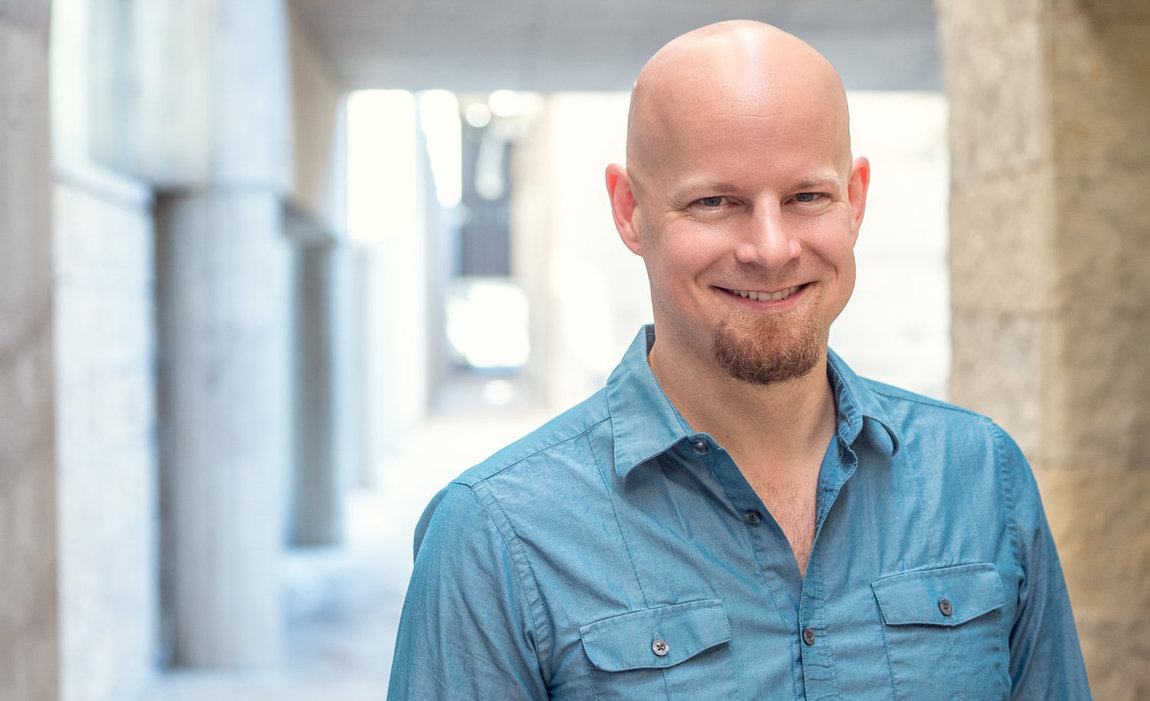
The great bassist Eddie Gomez, of Bill Evans Trio fame, will be a highlight of Jazz Appreciation Month in Milwaukee, when his trio plays at the Jazz Estate on Thursday, April 26. Courtesy WMKY
Thursday, April 26, The Jazz Estate – The great virtuoso bassist Eddie Gomez, renowned as the linchpin of the longest-running Bill Evans Trio, brings a piano trio to Milwaukee, with Stefan Karlsson on piano and Rodrigo Villanueva on drums. The two-time Grammy winning Gomez has worked with Miles Davis, Dizzy Gillespie, Chick Corea, Gerry Mulligan and numerous others jazz and pop music artists, as well as venturing boldly into classical music realms, a musical range beyond most musicians.
It was an “aha” moment when I pulled the big, dark LP box out of a library clearance sale bin. It was the final “modern jazz” segment of The Smithsonian Collection of Classic Jazz. I’d read about it, but had recently been downsized out of a nearly 20-year staff arts reporter job at The Capital Times, and my financial future was uncertain. So this was a small blessing, as the box set cost me a mere three dollars.
I knew the whole set was as close as any single collection of recorded jazz history could be, partly because the great critic and author Martin Williams headed the jazz and “American Culture Program” at the Smithsonian Institution in Washington D.C.. There, in 1973, he compiled and wrote liner notes for The Smithsonian Collection of Classic Jazz. 1His album notes for a subsequent collection, The Smithsonian Collection of Big-Band Jazz, earned Williams a Grammy Award. But many jazz buffs knew him from his books of criticism Where’s the Melody? and especially The Jazz Tradition.
The Smithsonian’s boxed jazz history set (see footnote) may be the most readily available byproduct of the organization’s contribution to the art form, which includes a vast treasures of historical holdings in Washington D.C. at The National Museum of American History, such as the invaluable Duke Ellington collection. This includes Ellington’s sound recordings, original music manuscripts and published sheet music, hand-written notes, correspondence, business records, photographs, scrapbooks, news clippings, concert programs, posters, books and other items.
Since 2001, the Smithsonian Institution has sponsored Jazz Appreciation Month in April. That leads to my real purpose – pointing out how much top-notch live jazz is happening in Milwaukee in the second half of Jazz Appreciation Month. A a sign of the significant progress in gender equality and opportunity in jazz is that two of these bands are led by women. Here’s your thumbnail JAM guide:
CANCELLED Tonight, Saturday, April 14, 8 p.m. The Jazz Estate – Jazz singer Steve Marche-Torme (the son of Mel Torme) is a superb vocal stylist in his own right and will make his debut at an intimate Milwaukee club. MARCHE-TORME HAD TO CANCEL THIS GIG, DUE TO ICY ROADS IN NORTHERN WISCONSIN, the Estate reports. The event has been rescheduled for June 9, at at 8 p.m. Tonight the bassist Jim Paolo’s Quartet will fill in, with saxophonist Eric Schoor, pianist Mark Davis, and drummer Dave Bayles. For those who purchased tickets, the tickets will be automatically moved to the June 9th event. Anyone who purchased tickets can get in tonight’s show for 1/2 price, they’ll have a list at the door.
Sunday April 15, 8:30 p.m., The Jazz Estate – Post-bop flutist-composer Jamie Baum leads her New York quintet, a rare chance to hear a flutist leading a band. Baum, a 2014 Guggenheim Fellow, gives her instrument the full range of modern jazz possibility. She’s been nominated by the Jazz Journalists Association for “Flutist of Year“ eight times and placed in DownBeat polls annually since 1998.
Thursday April 19, 8 p.m., The Jazz Gallery Center for the Arts – Try some left-of-center improv collaboration between Minnesota pianist Matt Blair and jazz/improv-leaning Milwaukee string quartet (which includes a bassist) The Tontine Ensemble.
Friday, April 20, 8 p.m. The Jazz Estate – Promoting her brilliant new album Heart Tonic is up-and-coming progressive jazz alto saxophonist and composer Caroline Davis from Chicago. This is heady but accessible music built with Davis’ highly distinctive composing style, and the album’s single cover, of Wayne Shorter’s “Penelope,” suggests the rare strata of her compositional acumen.
Alto saxophonist and composer Caroline Davis will play at The Jazz Estate on April 20. Courtesy carolinedavis.org.
Sunday, April 22, Turner Hall – Big-name jazz artists John Scofield and Joe Lovano will lead their quartet Past/Present. Scofield is among the most celebrated and versatile guitarists in jazz, and Lovano probably jostles with Sonny Rollins and Wayne Shorter as the music’s preeminent tenor saxophonist. Tenor Saxophonist Joe Lovano and Guitarist John Scofield bring their Past/Present Quartet to Turner Hall on Sunday April 22. Courtesy pabsttheater.org
____________
1. The Smithsonian Collection of Classic Jazz has been updated and re-released as Jazz: The Smithsonian Collection, a 6-CD,111-track set, pictured here:
Milwaukee blues musician Steve Cohen (left) holds a letter written by his grandfather, an American soldier, to document his witnessing of a Nazi death camp at Buchenwald in 1945. Cohen found the letter in the possessions of his uncle Neil Cohen (right). Courtesy Milwaukee Journal-Sentinel
This is The Blues.
This is the blues in the most profound sense of the art form. Its implicit state of mind and spirit is born of the black experience, the black genocide that was slavery. Yet, by extension, this sensibility is shared by all of humanity that is oppressed by forces from within or without. That is the music’s universality.
This is the blues, as expressed in a 12-page handwritten letter that Al Cohen, a Jewish-American Army soldier wrote in 1945 to his mother back home, after he entered and witnessed the carnage and genocide of the Holocaust in the Nazi concentration camp at Buchenwald.
This is the blues that Steve Cohen understands in the core of his being, partly because that soldier was his uncle. There’s a deep strain of Jewish klezmer music’s mournful penetrating microtonalities in Cohen’s understanding of the music. That lineage and history contributes to what has made him among the greatest blues musicians that Milwaukee has produced since the blues revival of the ’60s.
Some readers of this blog, oriented to American music vernaculars, would specifically know Steve as the central figure of the longtime Chicago-style blues band Leroy Airmaster. But he’s also a blues scholar and, in recent years, has deeply delved into and performed the roots of the blues, that is, country blues from Charley Patton, Son House and Robert Johnson forward, especially as he has become a more accomplished singer and guitarist, along with his virtuoso harmonica playing.
Further, many blog readers and online media consumers don’t read daily newspapers much these days. So you may have missed the feature in a recent Milwaukee Journal-Sentinel about Cohen’s uncle. Steve’s familiar face in a photo (above) made sure I saw the story and it’s a good one.
But the core of it, Al Cohen’s remarkable and disturbing historical letter, was glossed in Stingl’s relatively brief column. Steve Cohen had recently discovered the letter among his uncle Neil Cohen’s papers. When his uncle Al Cohen saw the horrors of Buchenwald he wrote the letter to his mother and insisted that she share it as much as possible, so that people would understand the tragic inhumanity of the Nazi Holocaust. The stuff of “never again.”
American soldier Al Cohen, who wrote the letter describing the Nazi death camp in Buchenwald. Courtesy the Cohen family
Apparently Al’s mother was reticent about sharing the letter, which includes graphic, troubling details, and it never saw much readership beyond her.
It’s fortuitous that it has come to light and can be shared now, because anti-Semitism and neo-Naziism, and racially-motivated hate crimes and hate speech, seem to be on the rise, as well as the strange phenomenon of Holocaust denial.
This important letter is a primary historical source, as researchers say, something that provides greater understanding of larger truths that we can build from, for a better society.
That is why Culture Currents believes it is important to share it as well online. After Stingl’s the article, The Journal-Sentinel received a strong clamor from people who wanted the letter published in full. The newspaper belatedly transcribed and posted a copy of the letter online.
But here it is for Culture Currents readers, courtesy of the Journal-Sentinel and Steve Cohen. Here’s page one of Al Cohen actual letter, then the full transcription:
The first page of Al Cohen’s 1945 letter to his mother.
Here is the complete transcription of Cohen’s letter describing the Nazis’ Buchenwald death camp:
April 26, 1945
PLEASE PASS THIS LETTER AROUND, MOTHER, LET OTHER PEOPLE SEE IT.
Dear Mother,
I am sorry that I can’t write more often but I’ve been working for a long
time. We have been in Germany for almost a month and I’m glad to say that
what parts of it I have seen are smashed to the earth.
A few days after Buchenwald, the notorious concentration camp, was
liberated, I got an opportunity to visit it. You can never realize what it
was like. Approaching it, I saw people dressed in striped pajamas – like
clothing walking around. They were thin as skeletons, weak and quiet, just
walking around aimlessly. The place was surrounded by barbed wire fences
and overlooked by towers where guards used to stand. The enclosure was
very large and for the main part filled with wooden barracks. Across the
street were S.S. barracks and factories. As I entered, my attention was
attracted to a pillory (?) in which inmates were locked and beaten by SS
men with clubs and a tin whip. There were other things that Nazis had
constructed to torture people in the country too.
The next place I visited was the oven room. Entering the basement, I saw
the room where as many as 80 people at a time were hung by their hands
from pegs high on the wall and beaten to death with big wooden clubs. When
they were dead or almost so, they were taken down and loaded on an
elevator, then hoisted up to the ground floor where they were shoved into
ovens and cremated – dead or alive. There were still partially burned
bodies in the ovens.
Walking outside, my attention was drawn to a huge wagon in an inner square, filled with corpses. They were skinny shrunken bodies with big staring eyes and open mouths. It was so horrible that I was not bothered by it at all – it seemed too unreal. Believe me though, I
have seen with my own eyes what sights I describe. Some of the boys took
pictures of this and I’ll send some home at my first chance.
Every once in a while, some of the inmates would bring in a pushcart full
of bodies from the woods where the S.S. troops had taken them and shot
them. These corpses were dumped on a pile with others which were later
taken away to be buried. They were heaped together like a pile of leaves.
The hospital was a dirty grimy building and it was the smelliest place in
the whole camp. This was probably caused by the dirty bed clothes and the
dead and dying people. It was hard to tell the difference; they both had
purple skin. The main cause of death was malnutrition. There were barracks
after barracks filled with people who were slowly dying from that cause,
whom it was impossible to serve. The inmates were beaten down, broken-spirited people. Til the time when the Nazis had to leave there were 51,000 killed in the camp and there
was a high monument with that number on it in the center of the courtyard,
which had been placed there by the Nazis to commemorate their murderous
achievement.
I spoke to some Polish boys of a group of boys my age. They were placed in
a concentration camp at the age of seventeen and were there for five
years. They told me that the only thing that concerned the Nazis was how
to kill the people fast enough. One of the methods they used at first was
to inject chlorine or a strong acid either into the heart or veins with a
large hypodermic. This killed them instantly but it was not efficient for
large numbers of people so new methods were evolved. They were herded into
a large barracks, 800 at a time, and all the doors and windows sealed off.
SS men stood guard – a week later all the people in the barracks were
dead. The Kommandant’s wife was an ugly woman but it meant 25 lashes for
any men who looked at her. Her hobby was making lamps and knick-knacks of
parts of humans.
The food at the camp was not fit for human beings. It was dirty looking
soup and coarse-grained bread. In one barracks of living-dead men there
was a collection of rotten potato peelings which the prisoners were saving
to supplement their meal. I had brought them K rations and cigarettes from
stuff I had accumulated and they went for those things as if they were the
most wonderful things in the world to eat. The joy of seeing that I had
done some little thing to help them was worth all the discomforts and
disappointments I have found in the Army.
One old man walked up to me and stood there staring at me with a
holy-looking smile of gratitude on his face. He quietly thanked me for the
things they had gotten. I told him “I knew how it was – my name is Cohen.”
He said again, quietly, “When you came in the door I could tell that.” I
never felt prouder.
The Polish boys told me that often the people in the camp were starved
badly. One day there was a wagon load of a hundred corpses standing in the
yard waiting to be taken to the crematorium. When the driver came out to
take his wagon away, there were only 80 bodies remaining in the cart and
there were prisoners standing around eating arms, shanks and other human
parts. This scene was witnessed by these Polish boys – it is not just some
thing they overheard being rumored. For all I know, they may have
participated themselves.
The Nazis used to fill little pails with ashes from the furnaces and sold
them to the relatives of the murdered. Usually they were not even the
ashes of the person they were said to be.
We are deep into Germany now and capturing prisoners quite often. Just
this afternoon at lunch there were captured in front of our mess hall.
Things are more difficult now that there is nothing to worry about. I’m
scared and a scared man is always careful.
Thanks very much for the package.
This letter is long so I’ll close it with lots of love,
In this YouTube video, Cecil Taylor, at 80, performs solo at the Perugia Jazz Festival in Italy, 2009. The ensuing 1984 video is also well worth experiencing, including his poetry recitation and dancing.
The news pains my heart like a plunged lance with a thousand blue-noted edges. Those are the sorts of notes that Cecil Taylor wielded in any given performance over his incomparable career. My second impulse is to not believe that he has passed at 89.
That’s because, if ever a musician broke through the “mask” that Ahab decried of Moby Dick’s inscrutable forehead –to understand the mysteries on the other side – it was Cecil. His energy and organic realm of soul and structure allowed him to deeply penetrate music and possibility, but also to build a fortress with wings — a weird image, yes, but he was at once of this earth and ever rising and falling, a Prometheus who would never simply acquiesce to physical death.
Writer Howard Mandel reported his passing to the other side, with his concise appreciation, expanded on in the major segment of his book Miles, Ornette, Cecil, an essential study of jazz modernism at its most personal and embracing. Elder pianists as diverse as Erroll Garner and Thelonious Monk were big Cecil Taylor fans. Yet perhaps the great belle lettrist of jazz journalism, Whitney Balliett, said it best, as Mandel quotes him: “…Cecil Taylor wants you to feel what he feels, to move at his speed, to look where he looks, always inward. His music asks more than other music, but it gives more than it asks.”
Keep that desire in mind as you listen to Cecil or watch him on a video. His desire to connect was as overt as the most pandering Kenny Gs of the world. And yet, for the profusions of the dippy saxophonist that might ostensibly connect him to Taylor, they’re worlds apart. If you have the open-mindedness to enter Cecil’s world, you’ll feel it and likely be moved, perhaps in unexpected ways. So it’s unsurprising that The World of Cecil Taylor was the title of his earliest albums.
On that recording, he came out swinging in his own way, yet he moved deeply in the jazz tradition. Listen to him trading fours with drummer Dennis Charles on “Air,” the first tune on The World of Cecil Taylor – the sharp, swift interplay sounds like Muhammad Ali in his prime, shadow-boxing with himself. As annotator Martin Williams notes of the album’s second interpretation of a jazz standard (preceding “Lazy Afternoon”): “Cecil transforms ‘This Nearly was Mine’ into a blue aria. Richard Rodgers wrote the melody for Pinza to sing, and I find it most moving. In this track, Cecil’s ideas and his playing demonstrate strikingly his ability to sing an interpretation.” 1
Speaking of arias and the “brooding air” of another tune on World, I’m sure Taylor would allow my “air” analogy some breathing room. His whirl-over-the-keyboard approach and attack – for its frequent harmonic density and deep, bluesy eloquence – seemed like he was clearing space for the very evident dancer in him to pax de deux with his huge piano. Another album that emerged from the World sessions was titled simply Air. A solo piano recording in mid-career he titled Air Above Mountains (Buildings Within).
One of Cecil Taylor’s evocative, poetic and apt album titles and covers. Courtesy djstrangeblood.com
The titles are always significant in Cecil’s music, always poetic, evocative and personal. I risk venturing into literary interpretation because Cecil was a poet of the highest order.
Consider a few more album titles simply worth savoring: first, the fulsome single word – indent, Regalia, Conquistador!; Gallia, Melancholy, Trance, Complicite, Remembrance, Garden 1 and Garden 2.
…To the more descriptive: Cell Walk for Celeste; Spring of Two Blue-J’s; Silent Tongues; Dark to Themselves; Unit Structures, New York City R&B , Jumpin’ Punkins; Winged Serpents (Sliding Quadrants); Double Holy House; Leaf, Palm, Hand; and For Olim (named for an Aztec term for the motion of a volcano).
…To his grandest titular haikus: Nefertiti, The Beautiful One Has Come; Fly! Fly! Fly! Fly! Fly!; It is in the Brewing, Luminous; and the brilliant rhythm and momentum of One Too Many Salty Swift and Not Goodbye.
To a word person like me, my breath slips away just to contemplate these titles. This was because Cecil was fascinating to talk to and listen to, nearly as much as his piano playing could “lift the bandstand,” as Monk once put it, and carry the listener to breathtaking heights of vertiginous magnificence. You hung on for dear life to this winged titan of piano creativity and blues power, flying in the face of the fiercest winds. 1
To put Cecil Taylor the poet in literary context, I refer you to the superb anthology Moment’s Notice: Jazz in Poetry & Prose, edited by Art Lange and Nathaniel Mackey (Coffee House Press, 1993). It includes only one of Cecil’s poems, “Garden” (for which he titled two aforementioned albums), but the poem covers a long gust of pages. You see in this book how he fits in to the quietly sumptuous realm of jazz and letters, which dwells largely in silent tongues, unless one opens such a book and reads, and aloud.
Yet to speak personally, I had an opportunity to interview Cecil in 1986 in his home in the Fort Greene neighborhood of Brooklyn, an encounter facilitated by our mutual friend Ken Miller, a Milwaukee modern dancer who was the first person to ever dance with the Cecil Taylor Unit, in the early 1970s, when he was a music faculty member at the UW-Madison. 2
My interview is in the November, 1986 issue of Down Beat magazine, and during the conversation Taylor sat on a rug cross-legged in a Buddah-like posture beside his nine-foot grand practice piano. Utterly gracious, he expounded and reflected, thoughtfully, expansively. He shared with me some of his visions of music, culture and life. The article was titled “Cecil Taylor: The Poetics of Living.”
As per his desire to “give more than he asks,” Cecil purposely situated is mighty grand piano in the bay window of his Brooklyn brownstone, so passersby could readily hear him playing and practicing.
Despite his music’s extreme originality – a fusion of 20th century “classical” music and technique with aspects of African music and jazz from Waller and Ellington onward, and Taylor’s rigorous practicing regimes – he was the opposite of an ivory-tower dweller. He was a very social being.
The day I interviewed him, he invited me to a party the next day. This was a first, among all musicians I’ve ever interviewed over 35 years. I accepted, and found myself strolling with Cecil through a Brooklyn neighborhood until we got to the apartment of the party, where Cecil dove in and engaged with several partygoers in bracing and animated conversation (as the photos below indicate).
The personal rhythm and musicality of Cecil Taylor is evident in these shots of him at a Brooklyn party. Photos by Kevin Lynch
The following year, Cecil agreed to fly to Milwaukee – merely to visit his friends and admirers there, with no concert paycheck to be had. He came to my Riverwest flat for a dinner prepared by my spouse Kathy Naab Lynch. I was honored when, entering the house, he immediately gravitated to an abstract bronze sculpture of mine titled “Free Space Relief,” a phrase which might describe a Taylor composition.
Cecil Taylor (center) at a Milwaukee reception in his honor, greeting an admirer, Karen, the spouse of VIolent Femmes drummer Victor DeLorenzo. Also in the photo, at left, is Jim Glynn and, to Cecil’s left, our mutual friend Ken Miller.
The next day, he attended a reception in his honor at the Wisconsin Conservatory of Music, which Cecil soaked up gratefully. Photographs that Ken Miller took of Cecil in his room at Milwaukee’s Pfister Hotel graced the cover of Down Beat containing my article, as well as the cover of Taylor’s ensuing solo album For Olim.
My favorite portrait of Cecil Taylor was this one, taken by our mutual friend Ken Miller, for my Down Beat interview feature on Taylor. Courtesy downbeat.com
He died in his long-time Fort Greene brownstone. I imagine Cecil trying to practice that day, perhaps even expiring at the keyboard. Born at the crux of The Great Depression a few months earlier than my late father Norm Lynch, Cecil possessed a comparable personal warmth. That came from his generous physical heart, guts and brain. One of Taylor’s finest comments on the notion of “free jazz” is from the liner of Fly! Fly! Fly! Fly! Fly!: “There is no music without order — if that music comes from a man’s innards. But that order is not necessarily related to any single criterion of what order should be as imposed from the outside. This is not a question, then, of ‘freedom’ as opposed to ‘non-freedom’ but rather is it a question of recognizing ideas and expressions of order.”
My final word is left to Cecil Taylor the poet, from “Garden,” his long, bountiful poem from the Moment’s Notice collection:
Possess’d lil’ Stevie by holy rock remains stand standing Wonder (too)! Heritage – echoes – silence – moving – Universe manners hip food gatherin a be seen gregarious slip’ en slidin’ getting entities hallowed thy will be done
foraging among crabs long tongued ancient snapp’d but regard is weight hipness lighten’d Ray Robinson steered, fandancin’ out orbiting (no game) sludge knowing out, in, sideways tall, possibility axis & fall Muhammad Ali like Amma, arboreal corpuscle twine harmonium them 2 legs (Dinosaurs) that’s got each (fine graining) his natural (from Jack Johnson portent know, see, the Barring –
– apart from – over reiging
head, scalp or hand Domed)
of colored goings doings love our way his own Johnson then Robinson War Clay now (‘them-thar lookin’ fidgetin’ wonderin’ how – admiration to – ball breakin’) Johnson – Robinson – Armstrong – Louis – Ali inscription held fertile glories passed magnificence back & forth on & on…
copyright: Coffee House Press, 1993
____________________
Taylor’s enveloping interpretation of the Richard Rodgers’ song gives lie to the ignorant comment of one online commenter on a recent YouTube of Taylor performing, that “he doesn’t know how to play the piano,” and has perpetuated a “scam” for decades. On his 1956 album Jazz Advance Taylor ingeniously covered tunes by Monk, Ellington, Cole Porter and the standard “Sweet and Lovely.” That Taylor, an honorary doctorate graduate of the New England Conservatory, still suffers such indignity even upon death at 89, smells of the winds of ignorant reaction I alluded to above, which often blew in his face, and which seem especially polluting in the Age of Trump. As with too many original jazz artists, Taylor’s largest and most supportive audiences were in Europe, and perhaps Japan.
Cecil Taylor was also pivotal to my arts journalism career. In 1977, amid a winter deep-freeze, I drove to Toronto with Milwaukee guitarist Jack Grassel and drummer Dave Ruetz, to solo piano concerts by Taylor. He performed two three-hour non-stop concerts, at 3 and 7 p.m. — in sum, the greatest solo music performance I’ve witnessed, perhaps the greatest performance of any kind. There, I also met Bill Smith, editor of CODA, the Canadian jazz magazine, and he accepted my proposal for a record review of then-emerging saxophonist David Murray, and published it, and my jazz journalism found its footing.
Never again! (#Never again). Sing it out high and loud to the heavens.
“Come senators, congressmen/ Please heed the call/ Don’t stand in the doorway/ Don’t block up the hall… There’s a battle outside/and its ragin’. / It’ll soon shake your windows/ and rattle your walls/ For the times they are a changin’.” – Bob Dylan
Two baby boomer-age women, among thousands, marched down State Street to the fiery cadences of one of Dylan’s greatest protest songs emitting from a portable player one held. The other woman brandished a harmonica to play along. It was one of many ingenious ways in which people put on a March to Save our Lives from the bloodstained peril of a nation with more guns than people.
It reminded me of how potent Dylan’s song remains. Concurrently, in Washington D.C., reportedly 800,000 gathered in the largest single protest in the nation’s history. And a highlight of that event was soul singer Jennifer Hudson singing “The Times They Are a Changin'” along with a gospel choir and the talented drama club and choir of Marjorie Stoneman Douglas high school in Florida, where the assault-style gun killing of 17 of their classmates has spurred an amazing movement for sane, common sense gun reform.
Hudson cranked the song up to a fever and impassioned pitch – gun death and violence has ravaged her own life. So Dylan’s great anthem met one of its greatest interpreters, 55 years after he wrote and recorded it.
As for the young speakers, they said plenty. But what struck me was how well they made the connection between mass shootings and the countless shootings and death in individual incidents that may or may not make any news, but continue with numbing regularity for the communities afflicted. So the death of Dontre Hamilton, a mentally troubled Milwaukee black man awoken from his sleep in Red Arrow Park — and killed with a volley of police bullets after a brief struggle with an officer — was addressed several times.
A connective point is that, along with institutional racism, the profusion of guns in America makes police officers exceedingly paranoid, even though their subjective “feared for my life” rationale is way too easy to corrupt their rationale, after the fact. That easy way out for a cop slaughtering an unarmed black man or boy is part of the institutional racism, of course. But the tons of guns completes the tragic circle.
For my part, here’s a photo essay on Milwaukee’s march, one of 80 across the country Saturday, with many more protests marches around the world in solidarity with America’s gun dilemma.
A huge and fiery crowd engulfs the Milwaukee County Courthouse; well, at least up to its ankles.
A senior citizen with a walker climbed up the hill to the courthouse, and let ’em know what she feels about America’s outlandish indulgence for guns — the worst kind of guns, that kill masses of people, senselessly, needlessly. Yes, she’s pissed off.
Another marcher who would not be denied was a woman with a broken ankle.
An infant was used as a prop, but it was starkly effective as a protest.
A big march crowd on State Street, stretching from 9th Street all the way to Water Street, seemed to have no end.
The destination for the march was Red Arrow Park across from City Hall, a popular gathering place but also infamously the scene of a police gun killing of an unarmed black man, Dontre Hamilton.
Judge Rebecca Dallet (right) joined the protest and did a little in-the-crowd campaigning for her bid for a state Supreme Court seat, in the April 3 election.
The proud father of a six-month-old girl (below in the buggy) wants her to grow up without needing to fear for her life when she goes to school.
Even the Statue of Liberty showed up, and up, and up, and up.
The crowd listens to an impassioned, spontaneous speech for gun control, with an emphasis on “love,” by a man in the crowd near the podium.
Here is the man who had plenty to say, despite not being among the invited speakers.
These two high school student speakers wore their hearts n their sleeves, and are part of a new generation of activists who, we hope, makes a transformative difference in gun control.
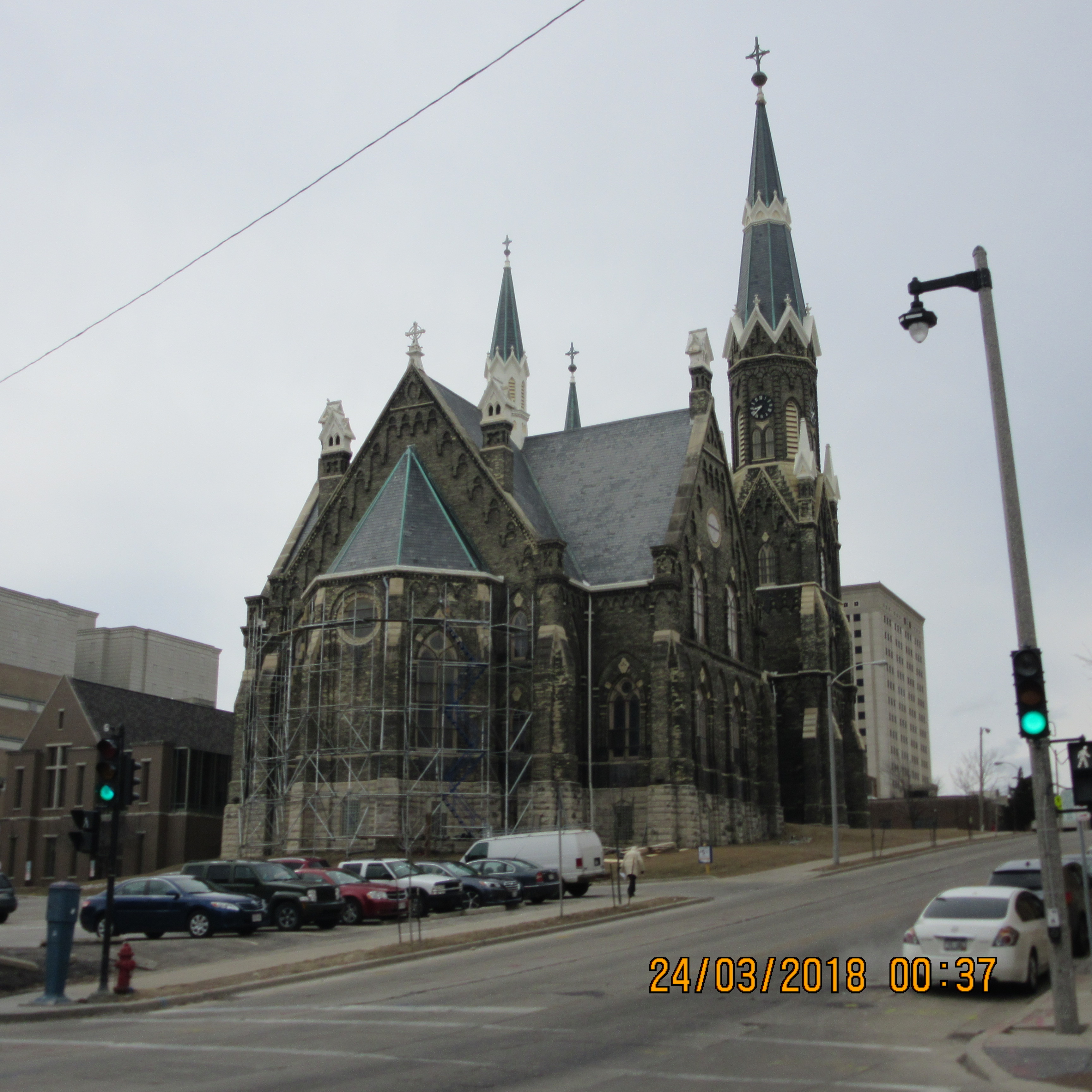
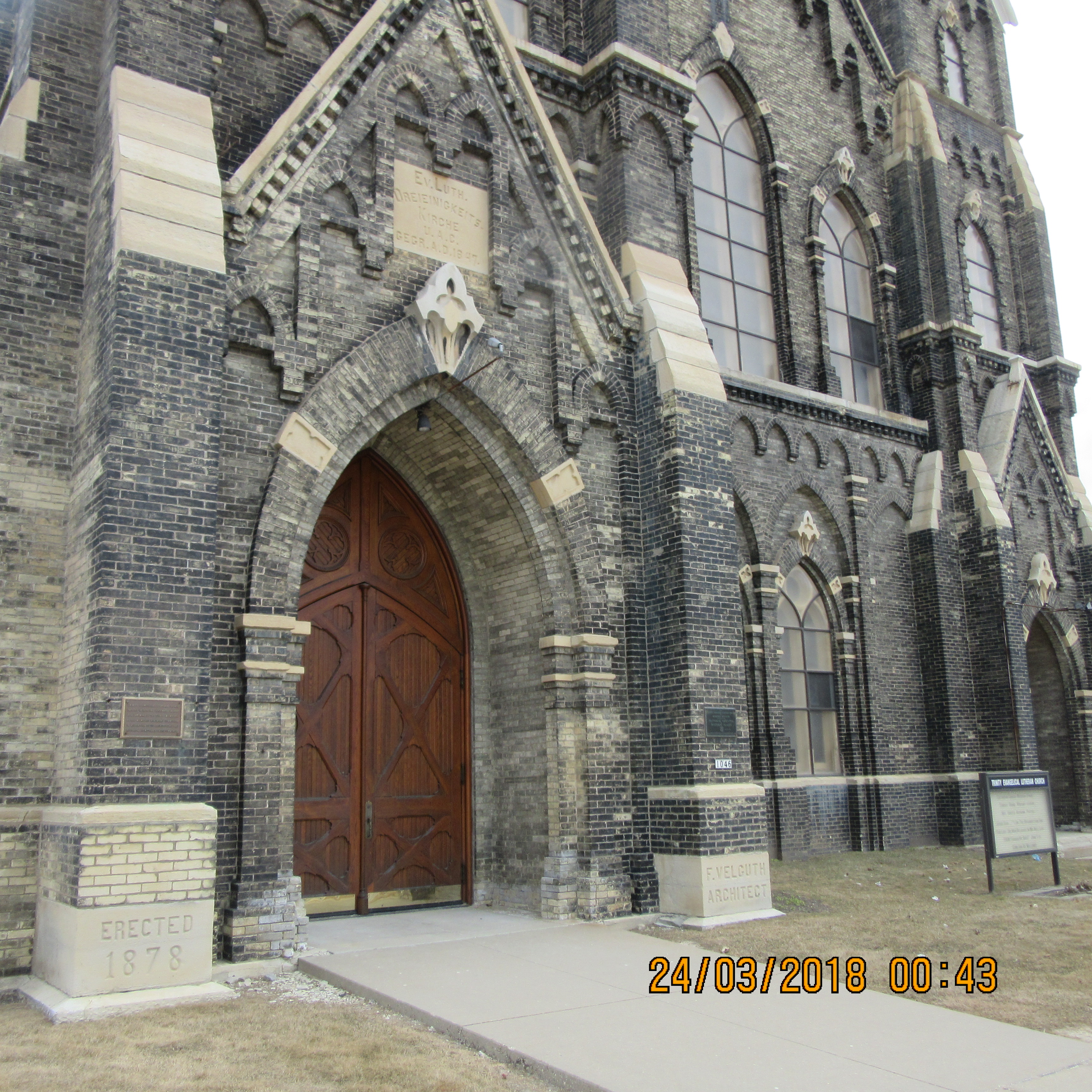
On my way back from the march, I noticed the stately old Trinity Evangelical Lutheran Church, described on its website as a” conservative, caring” congregation. It was built in 1878 of cream city brick, which is deteriorating, but the back side is undergoing restoration work. As with my first photo at top, of the flags and “never again” sign, and we often look to the heavens for answers. What does this conservative congregation care about? One hopes, life and sanity over guns.
Anybody who loves, or wants to hear more of, the music that Blue Note records presented through the mid-1960s – as bold extensions of hard bop and more avant-garde freedoms – should pay heed of an event happening at 8 p.m. this Saturday at The Jazz Estate on Murray Avenue in Milwaukee ($13 cover).
A strong and fearless quintet will perform live music from one of saxophonist-composer Joe Henderson’s greatest albums, In N’ Out, recorded on April 10, 1964.
The Jazz Estate’s curator/booker, trumpeter Eric Jacobson,will lead the band. He’s among the region’s two or three best trumpeters, and is chair of brass and woodwinds department in The Wisconsin Conservatory of Music’s jazz studies program. Jacobson has curated Record Session, which has presented live an impressive list of music from classic recordings, by ensembles he puts together for several years at The Estate. It’s a fascinating project for any jazz fan who came of age in the 1960s, or has since discovered the decade’s music, a period rich in classic jazz modernism and innovation.
Trumpeter Eric Jacobson, who organizes the Record Session series at the Jazz Estate, will lead a quintet Saturday performing compositions from Joe Henderson’s 1964 album “In ‘N Out” and other classic albums of his. Courtesy Eric Jacobson facebook page.
The band also includes saxophonist Jason Goldsmith, pianist Mike Kubicki, bassist Jeff Hamann, and drummer Todd Howell. Goldsmith has a big task obviously, but is a highly accomplished musician who teaches saxophone at the West End Conservatory, and has performed with leading jazz musicians, including Ernie Watts, Ed Shaughnessy, James Moody and Slide Hampton.
Jacobson has not revealed the exact playlist but indicated that material from In ‘N Out will be a jumping-off point for a survey of Henderson compositions from various other albums, including Page One, Mode for Joe, Inner Urge and Power to the People. Those were all Blue Note albums. except for the last one, recorded on Milestone as the 1960s cultural Revolution gained power. 1
Here’s a brief Facebook teaser video for the event from Jacobson:
A ghost will shadow the bandstand. Henderson actually performed at The Jazz Estate some years ago, when I was not living in Milwaukee, unfortunately. Although he could play with startling and moving passion, his intelligence always guided his horn’s voice, even at quicksilver tempos. You could really hear the man thinking when he improvised, as logical as it was sometimes startling, ear grabbing and, not infrequently, beautiful.
Joe Henderson, in 1996, as a mature master of modern saxophone and jazz composition. Courtesy janperssoncollection.dk
As In ‘N Out is at the nominal inspiration for this project, I’d like to give you my take on it, as a Blue Note and Joe Henderson classic.
First, as a visual artist, I must note the album cover itself (see top), one of the best examples of Blue Note’s striking, even arresting, trademark graphic art style. Here we see Henderson’s head comprising the dot of the “i” in the title. And the graphic merges the idea of “in” and “out” with a brilliant downward sweep of the second letter of “in”. It conveys superbly, with the arrows, the churning, forward-pushing energy and sharp intellect of this music. As a total image, the album cover title asserts its own sort of muscular beauty. (Graphic artist Reid Miles knew this was a winner, as he signed the design. Look closely for it.) 2
But before a comment on the music specifically, I’ll say that it’s generally understood that the title referred to the musicians striving for a blend of both “inside” playing, which largely adheres to a tune’s chord changes, and playing “outside,” or in a manner free from characteristic bop type changes. The latter realm is something that pianist McCoy Tyner especially facilitates, along with the extraordinarily gifted bassist Richard Davis. Tyner by then had mastered the modal style of jazz that is regular bandleader John Coltrane played.
Modal jazz is influenced by Indian classical music and Coltrane especially used it to flying free of sometimes-constricting complexities of modern jazz changes, which he himself exemplified in his classic tune “Giant Steps.” This recording’s drummer Elvin Jones, also an innovative bandmate of Coltrane’s, frees up the music rhythmically, with his uncanny polyrhythmic style, while still maintaining powerful and swinging tempos.
Now, as for that extraordinary title tune which begins in the album. The head of “In ‘N Out” starts with an off-kilter but captivating phrase, almost as if Henderson is hovering at the fork in the road between going in or out. It then bursts (out/into) a very fast bebopish line that has the intervallic and harmonic nuances that were distinctive and peculiar to Joe Henderson.
The ensuing soloists absolutely burn – Henderson on tenor, pianist McCoy Tyner at the peak of his powers with a cascading solo rippling with his own harmonic innovation of fourth intervals. Trumpeter Kenny Dorham, a naturally lyrical player, slows the tempo for a few moments, then jumps into the speeding vehicle himself, and finally Henderson returns for a very witty closing solo. The tune is breathtaking and whizzes by at 10 minutes and 22 seconds.
It is as if the whole band has taken both forks in the road, in and out, touching down on each and yet flying over them with ever-expanding wings.
I won’t really review the whole album as such, but I will say concisely that the ensuing “Punjab” is also an intriguing tune, but a more spacious and lyrical side of Joe Henderson, which continues on the third tune, “Serenity.” The album shifts to a few hard bop-ish pieces, “Short Story” and “Brown’s Town” both ingenious in her own ways and composed by the date’s trumpeter Kenny Dorham, a greatly under-appreciated musician of the post-bop/hard bop era. “Short Story” is a descending line with a few stately extensions and twists, just like a good short story. And Dorham himself proceeds with an extremely musical and compelling solo.
I’ll conclude by noting that, in ways, this remains an underappreciated album. A few years ago, I chose the SFJAZZ Center in San Francisco as a destination for a desire to take a westward road trip. Specifically we made the big drive to hear the SFJAZZ Collective perform a couple of concerts which would become a recording of Joe Henderson compositions (and originals). Curiously, this world-class ensemble did not perform oe record any of this album’s tunes, though I didn’t hear their third evening of Henderson music, and he was a fairly prolific composer.
Late in his career, Henderson recorded several magisterial albums for Verve records which gained him great popularity and acclaim, as arguably our greatest living tenor saxophonist. He died at 64 on June 30th of 2001 in San Francisco, his home during most of his career, of heart failure, after a long battle with emphysema.
So for me, and I hope many others, Saturday will be a rare opportunity to hear superb Joe Henderson music live, pretty close to the way he recorded it.
The ghost will be listening too, and hopefully nodding with a smile of approval.
_______________
Eric Jacobson, a highly accomplished but honest musician, says that the band will do all the compositions from In ‘N Out, except the title tune which, he says, they didn’t have time enough to rehearse. As my description of the tune might suggest, it is a technical as well as artistic challenge to master. “But there’s so many great tunes of Joe’s that I want to play, so it’ll be a fun night,” Jacobson says.
The album cover design compromises function for form in one respect. Pianist McCoy Tyner’s name is reduced to an “etc.” because Reid Miles didn’t have enough room in this layout for his name. Great as he was already, Tyner still had the smallest reputation amongst these musicians. His breakout Blue Note album as a leader, The Real McCoy – with Joe Henderson and Elvin Jones as sidemen – wouldn’t be released until April, 1967, three years later.
Even without his mask, T’Challa (Chadwick Boseman as The Black Panther) retains his superpowers by wearing a magical necklace. Courtesy www.frontera.info.com
The Marcus Theater ticket taker – a pudgy, full-grown whiteman with an adolescent’s gawky enthusiasm – seemed to have hot-wired Black Panther into his skull, and could hardly stay seated on his stool. He blurted out a single run-on-sentence- thumbs-way-up review of it, and told us to stay after the closing credits for a postlude. I almost expected him to follow us in, plop down, gobble our popcorn, and blab a scene-by-scene spoiling of the movie and, while it played, show us how to order Black Panther paraphernalia online with his smart phone.
Thankfully he didn’t, so I was merely bemused, which primed me, and probably helped my receptivity. You see, I came to Black Panther as in inverted sort of viewer, one who only periodically partakes of action super-hero movies, and resistant to the sense-gorging proliferation of digital special-effects, most of which for me, despite their frequent razzle-dazzle, go down like artificially manufactured food, with injected nutrition, if it’s there at all.
Give me the vintage and hard-to-imagine magic and romance of the original 1933 King Kong, and the mighty ebb-and-flow of the 1956 Moby-Dick, for big special effects, or the chilling subtleties of the original Dracula with Bela Lugosi, for supernature. Such films exercise the imagination, instead of overwhelming it with effects, and still seem somehow more akin to nature, and supernature, as I sense and imagine monsters, vampires and dinosaurs might be if around today (look again, wary reader). If that makes me hopelessly old and unhip in some eyes, so be it. At least I have a distinct point of view that doesn’t simply reel with every gigantic screen explosion of easy, digital intoxication.
As for Black Panther, it’s a lot more than a gargantuan carton of force-fed digital popcorn exploding in your mouth and ears, tasting and sounding like hard-edged cardboard. There’s plenty of nutrition, intellectually and spiritually, which deftly sustains its two-and-a-half hours as much as the action counterpoints the often-reflective and introspective dialogue.
The only superhero movies I’ve bothered to attend in theaters in recent times have been a couple of Christopher Nolan’s abundantly dark Batman movies buoyed by, in The Dark Knight, the peculiar humor of the quintessential British character actor Michael Caine as Bruce Wayne’s busy-body butler Alfred Pennyworth, and Heath Ledger’s almost career-defining Joker, a strangely affecting, almost sympathetic original of a monstrosity, maybe the best arch-villain in movie history. However Tom Hardy’s intellectual, arrogant, sneering brute Bane, in The Dark Knight Rises, competes with The Joker.
Black Panther trafficks in plenty of shadows but is ultimately a self-questioning, affirmative, empowering saga and it earns that exalted position, just like the mythical African nation of Wakanda’s king T’Challa (Chadwick Boseman) earns his throne by facing several mano-a-mano challenges in primal duels with swords and shields. One could’ve easily imagined an African-American Batman, for the first truly epic black movie superhero, given the black motif of his style, which gives the darkest color a brooding nobility. But Nolan seems to have cornered that franchise with plenty of substance in its bulwark.
The movie Black Panther in full regalia. Courtesy imstnyyjfm-flywheel.netdna.ssi.com
Vintage “Black Panther” comic book cover. Courtesy coverbrowse.com
So writer director Ryan Coogler wisely fashioned a superhero with a grand composite of a vintage comic book hero *above) and the real-life African-American militant activist group, the Black Panthers, which itself draws from African mythology, excavated well here. Coogler, still only 31 years old, was born in Oakland, as were the real Black Panthers, and he surely has their complicated legacy deeply ingrained in him. But his fascination with this hero mythology grew from his boyhood immersion in the ground-breaking Black Panther, the black comic book superhero from Marvel Comics.
He also likely drew inspiration from noted author, social critic and essayist Ta-Nehisi Coates, who wrote an update of the superhero in comic book form.
The recent comic book written by noted author and social critic Ta-Nehisi Coates may have inspired the strong social and political consciousness in Ryan Coogler’s “Black Panther.” Courtesy sarjakuvakaupa.fi
Coogler crucially addresses the historical Panthers’ militant gun-toting side and their sometimes-impulsive violence, but this movie finally affirms redemptive, constructive, liberating Black Panther values, even reflecting the real-life group’s extensive, underpublicized, community-oriented work, which happened in Oakland and Chicago, among other cities. (For more on this subject, see my blog on the documentary photo book on the civil rights era in the north):
And Coogler quickly began winning me over by opening the movie in a basketball playground setting in 1970s Oakland. In fact, those city scenes are the film’s most convincing and moving for me, as they fully sketch out the modern roots of this hero, his challenges and sensibilities.
Yet, the sensibilities, style and the ethos reach back to motherland Africa. One of the film’s gratifying aspects is how we viewers, regardless of our own ethnicity, come to sense that this Africa is the mother lode of humanity, a historical fact, but also, Black Panther asserts, as a wellspring of humanity’s greatest achievements, especially in technology, medicine and architecture. That metaphor is richly evoked by Wakanda’s capital city standing beside a great body of water and atop a series of magnificent waterfalls. It’s on the edge of those deep cascades, standing in the water that rushes to the precipitous edge, that the would-be king must ritualistically face his duels with challengers to his throne.
Further, waters of the frozen kind will later engulf a pivotal plot turn, as the tale tinkers with doom, fate and hope. The backdrop, amid sunblessed African savannahs and rolling valleys, is the eloquently funky, retro-futuristic architecture of the land’s capital city, reminiscent of Blade Runner, but here expressive of a distinct Afro-aesthetic rather than dystopian decay.
So it’s not surprising that ultimately Coogler leads us back to tattered ol’ Oakland and the most pivotal scene of the movie’s plot – actually in the prologue – as well as the playground setting, where even a white-haired black dude on the cracked-concrete basketball court still can execute a spin move to a svelte drive to the basket. And when the high-tech-yet-brown-skinned Wakanda super-aircraft portals in and lands on the Oakland court, it’s like a gift from the gods to the playground youth. You sense that a young black street kid, with little resources but his/her own intellectual curiosity, talents and guts, can simply touch the ship like a giant talisman, and gain power to the journey to become a perhaps a techno-geek warrior, like a number of the Wakandans – most noticeably the women, in a nifty smashing of Silicon Valley-esque stereotypes.*
T’Challa’s sister Okoye (Danai Gurira) demonstrates that a magical natural resource found in Wakanda can be used for fighting as well as healing, in this battle scene from “Black Panther.”
The co-writer-director further bolsters his P.C. cred (the initials shouldn’t be just a pejorative co-opted by the reactionary Trump era), in his handling of huge rhinoceroses. The species, in the real world, is now grotesquely hunted for its horn, leaving massive dead carcasses behind to rot. The Wakandans raise them as pets and to ride as metal-armoured transport for battle. Coogler wittily reveals a tender side of the hulking creatures. One rhino ends up charging a fetching young woman but pulls up just short – to deliver her an affectionate, slightly sloppy lick on the cheek – right in the middle of a battle.
A large species of black rhinoceros, with his natural armor, is used as a pet and a saddled beast of burden in battle in “Black Panther.” Courtesy aeffonline.org
Also politically speaking, for me, Boseman’s young, newly-crowned Panther king evokes the 21-year-old Fred Hampton, who was murdered by a coalition of the FBI and Chicago police in 1969. Hampton radiated promise as the greatest real-life Panther leader, with charisma, eloquence, looks, intelligence and ability to transcend violence to assert black power In the sort of community oriented activism that T’Challa seems ready to lead his too-comfortably-remote nation towards.
The last point addresses Coogler’s message to any group of people insufficiently engaged in the struggles and suffering of fellow humankind. These extraordinary Africans have built a sort of utopia but the new king realizes, partly from the tragic mistakes his father made, that much more must be done by those so empowered. This moral conundrum deeply shadows the king’s consciousness.
So Coogler ain’t lettin’ anybody off the hook here, which is wise and admirable, especially in times in need of smart, inspirational power from somewhere, emergent leaders, among the people. Nor are the film’s most-conflicting characters simply black and white (and there is one significant Caucasian character in the movie, a CIA agent, who’s pulled into all the African intrigue and drama.) The king’s greatest challenger, the aforementioned EriK Killmonger (Michael B. Jordan), seems to harbor a deep, somewhat inchoate hatred. And yet the dreadlocked, street-jive talker has an intriguingly engaging personality under the macho chest puffing. Even T’Challa comes to understand that a complex soul lies within this man, who wants everything that he has.
Michael B. Jordan (left) as Erik Killmonger in “Black Panther,” is among the most fascinating superhero movie villains since Heath Ledger (left) as The Joker in “The Dark Knight.” Courtesy www3.pictures.zimbio.com
Ultimately Black Panther is a brilliantly conceived, executed and meaty high-tech show, with plenty of low-tech and humane values. The deftly-edited battle scenes flash by quickly and, even in the one-on-one macho challenges, there’s almost no bloodshed or gore to endure. I’m overjoyed that it’s a huge success despite that restraint. Perhaps we’ve (mostly) all had enough of real-life blood and gore that we don’t need much in our easily-abused “realistic” movie fare. Rather, the greatest power of the Wakandans’ genius for technology is mining a seemingly magical natural resource, for healing. The best natural healing often does seem magical.
Nor is the movie trampled by huge raging monsters, dinosaurs or sabertooth tigers. Wakandans strive, for the most part, to cultivate harmony with nature, as well as humanity.
For all that, and it’s often-dazzling and moving entertainment, Black Panther has got serious super-hero game, and scores from not only across the court, but on a super-rainbow arc from Wakanda to a bent Oakland playground’s hoop. SWISH!!!!
So, even the pudgy, white ticket-taker, all elbows and gut, scored in a bounce-around-the-rim layup.
____________
* Black Panther‘s very strong female roles include Angela Bassett as T’Challa’s mother Ramonda, Danai Gurira as his sister Okoye, and Lupita Nyong’o as his love interest Nakia. Reportedly, women have comprised a surprising 45% of the audience for the movie. The stellar cast also includes Daniel Kaluuya (Oscar-nominated star of the acclaimed movie Get Out) and Forest Whitaker.
Homer, Winslow; The Gale; 1883–1893; oil on canvas; 76.8 x 122.7 cm (30 1/4 x 48 5/16 in.); Worcester Art Museum, Museum Purchase, 1916.48
Coming Away: Winslow Homer & England
Milwaukee Art Museum, 700 N. Art Museum Dr. March 1 through May 20, 2018
By Kevin Lynch
Why did Winslow Homer – arguably the greatest 19th-century artist of the American experience – need to brave the Atlantic Ocean’s tempestuous waves and sail to England in 1881? He’d become increasingly famous for the most true-to-life paintings of the Civil War and early Reconstruction. And weren’t the British who we fought for our beloved, hard-earned independence?
Nobody knows for sure why he went. His artwork comprises almost all the documents we have of a private, reclusive man’s life. Some critics see him as a kind of Melvillian Ishmael, instinctively needing “to see the watery part of the world.” Homer was hardly traveling to court The Queen. After time in London, he gravitated to the humblest and hardiest, in a remote coastal fishing village, Cullercoats, near Newcastle.
Perhaps, after American dramas subsided, Homer needed new challenges and subjects and more self-edification of the larger world. The Milwaukee Art Museum’s new Homer exhibition, opening March 1, aims to show that he also found his long perspective, his biggest-picture vision, there among the rolled-up sleeves, flopping fish and dripping nets.
Among the revelations were the fisher women, who formed the backbone of a tough life, turning the men’s labors into sustenance and commerce. So Homer over the two-way voyage, came to profoundly understand the violent beauty of the sea, and the stoic humans braced against crashing waves and other elements.
Homer, “The Fisher Girl,” oil on canvas, 1894
His trip enhanced better understanding of his homeland, its people imbued, unlike the Brits, with “the American dream” and New World bounty. Homer began to strip away the “new Eden” myth of America that he, like most other artists, earlier partook of.
The trip was “transformative,” says Brandon Ruud, MAM curator of American Art, who conceived the exhibit with curator Elizabeth Athens of the Worchester Art Museum, where this extraordinarily promising exhibition will travel from. Ruud quotes a contemporary Boston critic, who praised Homer’s art for “giving the truth, coolly confident that the poetry would be found in that.” Realism bled into atmospherics. Ultimately the sea was Homer’s greatest subject, Ruud says. After returning, he moved to another remote location, Prout’s Neck, a tiny Maine peninsula with which the sea often has its wild ways. 1.
The show is book-ended by two great paintings from the 1881-82 Cullercoats period – MAM’s mythical, almost mystical “Hark! The Lark” (Homer’s personal favorite of his own paintings), and the brine-in-the-face drama “The Gale,” from Worchester’s collection – both depicting women.
Of course, the classic damsel-in-distress trope arises in some images, with this largely self-trained genius’s astonishing flair for drama. The exhibit includes the famous, breathtaking “The Lifeline.” A sailor rescues a near-drowned woman from a sinking ship. The two dangle over the snarling sea, transported along a British-invented pulley contraption called the breeches buoy. This iconic scene also radiates symbolism and strong erotic overtones. Their limbs entwine and a soaked dress hugs the contours of a woman bereft, or in rapture?
Homer, “The Life Line,” oil on canvas, 1884
And yet, far more often, Homer’s British and later work depicts strong women as courageous, in their ways, as men. In “The Gale,” a mother, with a terrified toddler peering from a papoose, braves the angry shore, hoping for some sign of her husband’s ship.
Ruud says Homer also spent time in London museums and libraries before venturing to Cullercoats. Inspired by the epic British painter J.M. W. Turner, Homer become a virtuoso of watercolor, pushing that medium into uncharted waters. Photographs of Greek Parthenon sculpture, scholars surmise, helped him further model heroic and mythical figures.
Homer, “Hark! The Lark.” oil on canvas, 1882
See the museum’s own “Hark! The Lark.” Three women, loaded with goods, stand on a hill, ostensibly listening to the bird’s cry. Yet this scene suggests far more, with closely-observed facial portraits – their eyes, dark and gaunt, stare aloft, but their stout bodies brace for something. They convey wary optimism as they gaze high across a distant horizon. Or is it some precipitous foreshadowing in the clouds, equally plausible in such transfixed faces?
Ruud concurs that these, and other Homer works of the period, amount to no less than a proto-feminism rising from this male American artist, right as the women’s suffrage movement gained power.
Homer, “The Cotton Pickers,” oil on canvas, 1876
Despite his evident love of America and especially its land and seascapes, Homer proved intensely aware of the nation’s contradictions in its professed ideals, such as sexism and racism. Homer’s “The Cotton Pickers” (above) revealed his social awareness of race issues. Like women, his not infrequent African-American subjects found positions of drama and social dignity. A classic example is his painting “The Gulf Stream” in which a ravenous shark threatens a black man alone out in a small boat that might just capsize. Despite his peril, one doesn’t sense the vigorous man is doomed. A blow-up copy of the photo below of Homer with “The Gulf Stream” canvas is on display at the exhibit (although the actual painting is not).
Photo of Winslow Homer with his painting “The Gulf Stream” is courtesy of Bowdoin College
Partly because of the vast preponderance oil painting in the history of art, it was especially exciting and dramatic to see an artist of Homer’s stature take on watercolor, a medium all too often relegated to Sunday afternoon dabblers. This show demonstrates, especially in a gorgeous work of the finest application, “Fisher Folk in a Dory,” how the medium most akin to water itself stirred Homer’s imagination by turns into tempests and Pacific zephyrs. Such range of moods coexisted within the cold, stormy realms of the North Sea.
Homer became a student of both color theory and watercolor practice as early as 1873 when he began to favor English paints and papers, perhaps another reason for his attraction to the great island. “His experimentation with English techniques, including the subtractive methods of blotting and scraping away color to reveal the white paper underneath, persisted through the ’70s and garnered positive attention from critics,” writes Martha Tedeschi, in her essay for the exhibit catalog. He also learned to apply darker watercolors first, to not obscure lighter ones. His palette thus embraced light’s panoply. A contemporary critic praised these as “pictures in the truest sense.”
What could be more idyllic, even in its hoisting energy, than this windswept sea, seen here with a fisher girl sitting high atop the stern, while the boys prepare the nets and fishing lines, and the breeze hastens a sailboat beyond. The play of pure white light and textured clouds fairly frolics in soft joyousness. Homer went even further by daring to forsake under-drawing and allowing pure, unpredictable water and even a dry brush as principal tools, drawing the scorn of the leading art critic John Ruskin who claimed the artist was “flinging a pot of paint” in the public’s face. 2
Homer, “Fisher Folk in a Dory,” watercolor on paper, 1881
This developed into a dispute which gained international attention and a court battle. But Homer we remained unbent and undeterred. He had discovered something deep and pregnant in this seemingly shallow artistic water. Though he paid great attention to arts critics and his press, he did not always acquiesce to them. His own eye and sensibility remained stronger and true, in his artistic universe. Almost always during this period, hearty humans remain a distinct counterpoint to the vast beyond of the elements he so magically evoked.
Yet finally, in some of Homer’s early 1890s images from the Maine peninsula, the humans recede into solitary figures, amid craggy rocks and swirling tempests. One senses vast loneliness welling inexorably. Like Melville, Homer strives to capture the encompassing indifference of Nature to human existence.
“Because this trip was so transformational his work become more meditative and abstract.” Rudd says. “At the same time, he still does some detailed work, as of old.” Homer’s later work presages the gritty realism of the Ash Can School, and even abstract expressionism, “so with the modern era dawning, Homer is wrestling with his legacy.”
John Sloan, “The Wake of the Ferry No. 2,” oil on canvas, 1907, The Phillips Collection, Washington, DC.”
It’s worth considering the renowned “Ash Can” artist John Sloan who, while mainly focusing on the innards of New York’s fast-growing and teeming metropolis, also understood the role the sea played in human fate and fortune. One of Sloan’s more celebrated New York works is “The Wake of the Ferry, No. 2” from 1907, which shares with Homer’s Cullercoats paintings a complex palette, and the weighted, eloquent form of a single female figure, as she gazes out upon steamboats chugging off to sea.
Time and actual artists have proved far more kind to Homer than the likes of John Ruskin, as his legacy has unfurled with increasing resonance, beauty and truth – the qualities most authentic artists pursue. The future will doubtless honor him. For today, we have Coming Away.
________
More information below:
Winslow Homer American, 1836–1910 Rocky Coast (Maine Coast), c. 1882–1900 Oil on canvas; 14 x 27 in. Wadsworth Atheneum Museum of Art The Ella Gallup Sumner and Mary Catlin Sumner Collection Fund. Endowed in memory of Leontine Terry Hatch by J.T.S. and D.C.S., 1945.1
All images courtesy of the Milwaukee Art Museum, unless otherwise indicated.
__________
A very relevant show to the Homer exhibit runs concurrently at the MAM, Turning to Turner, in the Godfrey American Art Wing, level II, gallery K230, through April 29. It offers prints by the famous English landscape painter J. M. W. Turner, which reflect what many celebrated as his “truth to nature.” His prints are paired with ones of leading 19th-century American artists, including Homer, who carefully studied Turner’s depictions of the natural world.
Also, the museum will offer several programs and events in conjunction with Coming Away.
Gallery talks,1:30 PM on Tuesdays:
March 6 and May 15 – with exhibit co-curator Brandon Ruud
April 7 – a group talk with Ruud and other curators exploring the exhibit from varying perspectives
May 1 – an exploration of 19th-century fashion depicted in the show’s works with costume scholar Deborah Mancoff.
Lectures, 6:15 PM Thursdays
April 5 – “Winslow Homer: International Man of Mystery,” with Sarah Burns, professor emeritus at Indiana University Bloomington.
May 3 – “Winslow Homer, Ben Shawn, and American Genre Painting” with John Fagg, lecturer in the Department of English literature, and director of the American and Canadian Studies Centre, University of Birmingham.
April 19 – Perspectives from Milwaukee writer and historian John Gurda, freshwater sciences scholar John Janssen, Milwaukee-based musician Chris Crane and New York-based artist and Milwaukee waterworks project pioneer Mary Miss.
___________
Brandon Ruud, “Hark! The Lark,” Coming Away: Winslow Homer & England, Yale UP, 2017, 43
Martha Tedeschi, “Pictures in the Truest Sense: A Reflection on Homer’s English Watercolors,” Coming Away: Winslow Homer & England, 73
Orchestra leader Maria Schneider demonstrates the nuance in her conducting technique which employs arms, hands and body English, but no baton. All photos by Kevin Lynch
ELMHURST, IL – Something ominous trails through the wind. Most everyone attuned to electronic media can feel it by now, if not wholly understand. It hovers at a crossroads in a busy city street, but for Maria Schneider it may feel like intrusion on a desolate but beautiful country road in Minnesota, not far from her hometown.
Same difference in the larger scheme, this is a state of mind and maybe of spirit. But after this concert, one senses Schneider’s crossroads stands near humanity’s choice between Robert Frost’s road less traveled and the one we seem headed on directly, into the mysteries and maelstrom of technology.
The technology engulfs us psychically among many other ways. And this woman, who has reached an artistic pinnacle using a traditional communicative technology – composing and arranging for her jazz orchestra – feels the dichotomy intensely. Now she’s shared her angst with her public.
In a way, the occasion allows us to see anew the choice – which way to travel. Schneider showed at this live concert Saturday that she remains the mistress of hill and dale, of The Thompson Fields near where she grew up.
She’s a conjurer of atmospheres as thick as pea soup and as palpable as the mist that swept steadily across the nocturnal landscape on this climactic evening of the 51st Elmhurst College Jazz Festival.
The pivotal work of the evening, she explained, is a recent and yet unrecorded commission. She calls the composition “Data Lords,” an oddly evocative title that brings to mind alien presences, perhaps like those in the Star Wars saga. Schneider has chosen to grapple with the huge technology media giants like Google, she says, which have transformed the way we live and communicate. The title references directly the exponential rise of artificial technology which may, before long, grow so powerful as to become more intelligent than humans. She’s taken considerable control with the independent record label ArtistShare. But she’s hardly alone in fearing, but for what exactly? We can’t know for sure right now.
I’d venture that the somewhat politically conservative “big band” genre is undergoing changes, certainly forged and liberated by Sun Ra among a few others. But more recently this impressionistic field-leaper may feel the dark, restless cloud of Darcy James Argue’s Secret Society, a jazz orchestra which, from its name on up, seems born for the age of Trump, with persuasively dark social themes that thunder across apocalyptic aural landscapes. This year Argue even overtook Schneider in the Down Beat Jazz Critics Poll for best jazz orchestra.
The times do seem to call for music that proves or inspires intense, extended contemplation and discussion, and Schneider’s Data Lords provides an appropriate couching for such concerns, and is hardly built for easy comfort.
We know her as a sonic magician in the tradition of Gil Evans and Duke Ellington and here she lets loose some reins because her control is always measured by a desire to allow her creative musicians to fly enough free, like those she evokes in celebrated pieces like “The Monarch and the Milkweed.” Her artistic reach can encompass much of nature and humanity.
One might even imagine her with a hopeful fancy. In announcing her exquisite piece “Home,” from her 2017 Grammy Award-winning album The Thompson Fields, she sounded like she’d uttered “Hope.” The tender concerto for tenor saxophonist Rich Perry and the orchestra glowed like a melding of healing and replenishment.
Rather then a top-down leadership, Schneider demonstrates a close creative symbiosis with all of her ensemble’s members.
And yet the concert provided abundant evidence that humanity is Schneider’s greatest concern – along with the faltering milieu of Nature, as source of such spiritual succor. First, there’s the fact that she creates music for the largest-populated ensemble of America’s indigenous art form, the jazz orchestra. So it is not only the sounds and extra-musical themes, but the living beings who produce them, that she tends to.
Accordionist and pianist Gary Versace, demonstrates the deep range of sonic possibility that composer-arranger Maria Schneider explores as a matter of course.
This was as evident in the fraught commission piece as any, as she allowed a kind of freedom for her players to rise up, commingle and explore together. She employed dissonance and collective improvising, but always controlled to some degree while repeatedly exhorting the orchestra to reach for bold, courageous outer limits.
She demonstrated her great artistry as a conductor, a craft of nuance and evocative power. Even on a damp February night, she wore her virtual trademark, a sleeveless blouse which seems to serve musical purpose in that her arms, like any conductor’s, crucially convey her artistry’s particular powers. The limbs, adorned only with passion, move as meaningfully as an airborne embrace.
Her personal connection to her musicians arose immediately in the opening piece, “A Potter’s Song,” an ode to Lori Frank, of whom she wrote in her Thompson Fields liner notes, as “our dear friend who played trumpet in the band since the making of our first recording in 1990. Lori was a fellow Midwesterner by birth, born in Nebraska. A person of tremendous integrity, talent, skill, humor, warmth, and tenderness, she’s deeply missed by all who knew, played, studied, or shared a ceramic studio with her.”
Note, in the lilting staccato of her extended description of Ms. Frank, an ardor that underlies the rhythms of Schneider’s radiant lyricism.
When she’s not conducting, Schneider remains closely attuned to the playing of each soloist, here trombonist Marshall Gilkes.
It’s also evident in concert that she’s intensely involved in appreciating her band members’ playing. When they solo with only the rhythm section, she refrains from conducting but remains vibrantly attracted, like a moth to the flame. She seems also to revel in the presence of the audience, as “so many smiling faces,” which might seem innocuous or even heart-string plucking. But Schneider risks such a moment with the adroitness of her music’s redeeming powers. Even if the utterance summons sentiment, it’s the finest-honed kind, worthy of a heart’s game sturdiness.
Similarly, in an act somewhat unusual for a “star” of this magnitude playing in a formal concert hall, Schneider offered, at the end, herself to her fans, to chat and sign autographs right at the foot of the stage, where a long line of admirers quickly accumulated.
Maria Schneider expressed deep appreciation to each soloist as well as to the large audience at Saturday’s climax to the Elmhurst Jazz Festival.
If this night’s music be food for thought as well as feast, I’m thankful for the wealth and bounty Schneider has wrought over several decades, as she’s climbed to her pinnacle. One senses, however, she’s hardly finished with searching out new peaks, that hill and dale will follow her far, more likely to sunlight than not.
Back cover of “The Collected Essays of Rich Mangelsdorff,” Dustbooks, 1977. Courtesy Harvey Taylor
“I love all men who dive. Any fish can swim near the surface, but it takes a great whale to go down stairs five miles or more…” – Herman Melville, in a letter to a friend, critic-editor Edward Duyckinck, March 3, 1849, three years before the publication of Moby-Dick.
Until I visited him in the hospital a few days ago, long-time Milwaukee arts journalist, essayist and poet Rich Mangelsdorff had faded somewhat in my memory, but not my consciousness. I think he would readily appreciate the distinction. Despite his comparative absence from the scene in recent years, part of my sense and critical understanding of the city’s cultural scene is formed by Mangelsdorff.
He wrote insightfully about the importance of “raised consciousness” in his substantial book Collected Essays of Rich Mangelsdorff published in 1977.
Mangelsdorff always cut an imposing intellectual as well as physical figure, as a tall, large-framed man with a high forehead and a fulsome black beard. He spoke deliberately and sometimes with pointed pungency. He doesn’t suffer fools gladly. Yet, as I describe him in my forthcoming book Voices in the River: The Jazz Message to Democracy, a high-pitched giggle incongruously emitted from his hulking frame, disarming some who might’ve been otherwise intimidated. This man’s character and personality intrigued and attracted me.
Today he remains – even lying in a hospital bed after surgery to diminish his serious bladder cancer – keenly attuned to the idea of comedy. As we talked, he brought up the acerbic, machine-gun-mouth social-critic comic Lenny Bruce. I’d asked him about what sort of perspective might have been lost from the days when he was writing his essays in the 1970s.
“So much of it has to do with the use of computers and smartphones.” Mangelsdorff said, referencing recent research showing how excessive use of smart phones may negatively impact cognitive and literacy abilities. Ironically, Rich now struggles to speak, due to medications and cancer’s ravages, but his brain remains vise-like. “But also, years ago we had somebody like Lenny Bruce,” he says. “He wouldn’t be listened to now, but I saw him at a Milwaukee club in April of 1966 or 1967, and one woman stood up and called him an asshole. Then there was Mort Sahl, who paved the way for Lenny Bruce and others.”
These comics fearlessly spoke truth to power, as harpooners of squirming hypocrites. Bruce fought the law and the law won – the battle, but not the war.
Front and back cover of Lenny Bruce album, “What I was Arrested For,” Douglas Records, 1971.
A brief Lenny Bruce bit from “What I was Arrested For,” which punctures conventions of perception based on skin color:
And here’s a more provocative and funny Bruce bit: “How to Relax Your Colored Friends at Parties” from the album Buyer Beware:
To me, Rich Mangelsdorff, even now, hooked to an oxygen respirator, is like a great, graying Buddha. Perhaps, the laughing Buddha, but also one who, back then, in his trademark black leather jacket, could as readily fall into meditative silence, sometimes stewing about injustice, corruption or unheard prophets.
As for the rise of Donald Trump, Mangelsdorff says those who voted for him and continue to support him reflect, aside from delusion, “a malignancy of spirit. People actually choose the path of division rather than the path of unity. People think that Hillary might’ve had an easier time, but I don’t know. It’s like we’re constantly dealing with an old, drunken, ranting white man.”
As for my aforementioned Mangelsdorff “consciousness” factor: He was my counterpart as jazz critic for The Milwaukee Sentinel in the 1980s, while I was covering jazz for The Milwaukee Journal. I often had the advantage of seeing Mangelsorff’s review of what I was writing about. The morning Sentinel’s first edition circulated The Journal newsroom to the few people still at work late at night, while I wrote my review, which would run in the afternoon.
I never mimicked his insights, but they helped refract my own perspective on what I had just experienced. You can see for yourself our parallel critical commentary in the journalism anthology Milwaukee Jazz Gallery 1978-1984, published in its second edition last year, and available at Boswell Books and Woodland Pattern, as well as online. Mangelsdorff had to shoot from the hip, with tough-minded, vivid accuracy.
I still picture him on his tight, morning newspaper deadline — a dark, furrowed brow, harrumphing softly to himself, as an insight or phrase came to mind.
But to see how he thinks about jazz, here’s an example from when he wasn’t on such a tough deadline. It’s from his book Selected Essays, and notice his unassumingly deft comparative plumbing of the creative webs that entwine jazz and poetry:
“I’d personally like to see more poets take off in that direction – not the jive it could easily degenerate into, or the slavish imitation of some favored ethnic rap, but rather, synthesis in the direction of something loosely brilliant, like Elvin Jones or Billy Higgins playing drums (and how many poets with big ears has jazz loosened up, speaking of latter-day influences?).” 1
Or check out this long, powerful riff by Mangelsdorff, which marks the dynamic immediacy of the era’s contemporary jazz andpresages the ascendance and profound impact of rap and hip-hop music in 1972:
“I’d always felt this gap between the means and language of poetry in the kind of swift, mental-energy exchanges that black people could get down on rapping in the street, that comics like Lenny Bruce communicate & that they’re spritzing back room precursors, by-passing explanational trappings, could communicate even more truly, that jazz musicians (and Coltrane, Ornette Coleman, Cecil Taylor, Shepp and the All-Star Blue Note lineups of Hancock, Davis, Williams, Hutcherson, Hubbard, et. al. were fueling my head like butane in those days) evidenced with grippingly articulate abandon and/or snake charming wiliness.” 2.
How many people of any stripe have seen such connections, taken these sorts of double-dip deep dives, back then?
Rich and I were mutually respectful competing journalistic colleagues, but also friends, especially as two of the closest compadres of the late but unforgettable Jim Glynn. Despite being paraplegic from a Jeep crash while serving in Europe during the Vietnam War, Glynn possessed uncanny dynamism and charisma, especially as a high-flying culture vulture, a vision of inspiration lifting his disabled body improbably along to the hippest or most important music event in town.
Mangelsdorff’s Selected Essays remain paramount in his still-underserved literary legacy. Read insightful literary criticism of the iconoclastic poet Charles Bukowski and others influenced by him, like Doug Blazek, T.L. Kryss and Bill Wantling. In another essay, he holds up to light the period’s best contemporary experimental fiction: “Its exterior is complex, even baffling, to anyone not sufficiently high to get into it. Yes, that’s what I said. Raised consciousness. That’s what she’s all about. Read people like Wildman, Chambers, Sukenick: they’re talking to a new and different fictive sensibility, even if, as was the case with Joyce and his Dublin (and Dubliners), it is one which has already generalized itself through our lives and times.” 3
Note his vernacular use of the female pronoun. Mangelsdorff sounded a unifying, if challenging, clarion for all sensate beings, right from his first-ever piece of criticism for Kaleidoscope, the pioneering alternative newspaper in Milwaukee in the 1960s:
“Serious rock (music) is a constant pushing forward of the shores of awareness, expanding the frontiers of sound and, as the liner notes to Jimi Hendrix’s album state: put(ting) the heads of…listeners into some novel positions,’ i.e. consciousness expansion…” 4
In that Kaleidoscope essay Mangelsdorff also underscores specifically the “psychedelic experience,” as an empowering medium which may yet provide incalculable potential for humanity. It’s easy to poo-poo such notions today, when we assume most of our power lies in a click under our finger, a mouse that potentially roars. That click can also sound like a solitary cricket — meandering, lost, easily manipulated. Surely we need fresh, diverse ways to tackle the intransigence of our political and social institutions. 4
Mangelsdorff’s writing still carries a load, as America grapples with marijuana legalization, with the herb’s great medical value, and reputation, anecdotally and deeply researched, for expanding consciousness, to frontiers far beyond the shores of reactionary stumbling blocks.
He long foreshadowed rock songwriters as Nobel winners, how various American artistic vernaculars generate “novel” intellectual and spiritual positions, which lead to enlightened action. Could we still imagine alt-music and culture growing against the craggy crevasses of “malignancy,” like a healing, marching cry along “the path of unity”? Might the culture yet form diverse yet converging paths, rising in rough-but-ready harmony, powered by a sum greater than their individual massed strengths?
Steve Cohen, the renowned blues-jazz harmonica-guitar virtuoso, is among many local musicians who hold this writer in high esteem. “When he was in full swing, I thought Rich was the best music critic in town,” Cohen says. “When my band Leroy Airmaster made an album, I wanted to him to do the liner notes and he did a great job. He would also visit my radio program on WMSE in the 1980s and offer his insights, which I thought were as great as any in the world.”
As Mangelsdorff sits now in his seventh floor hospital room, he can see the classic North Avenue light tower, standing over Lake Michigan’s vast horizon of darkly brooding clouds, like a sentinel. We talked for nearly two hours, so I suspect he was exhausted, although he was happy and urged me to come again.
North Avenue Water tower, Milwaukee. Courtesy cpd.typepad.com
I suspect he soon fell asleep, but I’d prefer to think such a mind – long immersed in cutting-edge literature and culture – might have rechanneled its consciousness, maybe alighted upon the great rhetorical pondering of Philip K. Dick: “Do androids dream of electric sheep?” That, of course, was the original title of the Dick novel that became the pioneering noir sci-fi film Blade Runner. The novel, published in 1968, is set in a post-apocalyptic San Francisco. Planet Earth, ravaged by nuclear global war, is invaded by android aliens who may – or may not – threaten human survival. Most animal species are endangered or extinct from extreme radiation poisoning, and owning an animal, an “electric sheep” is now a sign of status and empathy.
That attitude brings myriad intelligent species on a path closer to survival, like a new Noah’s ark at a wary dawn, where perhaps little remains of Milwaukee’s magnificent shore, but that sentinel tower on North Avenue.
Rich also would likely know that “The Sentinel” was the original name of Arthur C. Clarke’s story, upon which was born the mind-expanding film 2001: A Space Odyssey. No matter where Rich Mangelsdorff’s consciousness soon ends up, the arrow in his well-stocked quiver will aim for the stratosphere.
_________
1, Rich Mangelsdorff, “Towards Understanding How We Sound,” from The Selected Essays of Rich Mangelsdorff, Dustbooks Press, The “American Dust” Series,” Vol. 8, 1972, 13
2. Mangelsdorff, “I Still Think About Ole Magazine,” Selected Essays, 31
3. Mangelsdorff, “Consideration of Panache Magazine,” Selected Essays, 17
Fort Atkinson (WI) singer-songwriter Bill Camplin (right, or wrong) at the barn where he recorded “Reunion at Ebbott’s Barn.” Photo by Lee Matz, Milwaukee Independent http://www.milwaukeeindependent.com
Well, its roots music, so somebody could accuse me of having my head in the ground listening to this stuff, so it took me this long to post this “year end” list. No, I wasn’t down in the ostrich hole being a roots music whisperer (psst: we got kinds and sorts of “whisperers” these days, and some even make money off the claims. not me. keep this to yourself) This list was posted in timely fashion in December on the No Depression.com readers poll (I’m a ND contributor, but also a reader).
With that very whispery throat-clearing, let me get to it, before you fall asleep on the delete key, or get hypnotized
Looking over my best roots music of 2017 list, it remains quite evident how the look-to-the-past impulse still drives forward much vital music today, as evidenced most obviously by Old Crow Medicine Show‘s reworking of a Dylan masterpiece, jazz drummer Adam Nussbaum‘s delightfully quirky, percolating and lilting instrumental extrapolations on crusty old Leadbelly songs, and at least the nominal sentiments of Chuck Prophet‘s title song about Bobby Fuller (if you haven’t seen Prophet live, he’s a high-energy, hilarious gas). And my second-favorite album by Allison Moorer and sister Shelby Lynne, was a surprising collection – almost all covers of well-aged songs by two talented songwriters, thus acknowledging various favorites that have impacted their sensibilities, as well as the psyche-shaping traumas of early childhood the sisters shared.
In terms of more urgently contemporary songwriters, Steve Earle has been among the three or four best songwriters we have for a number of years, and his new album shows he’s hardly slowing down. Indeed, he still embracing his youthful outlaw attitude, even though his graying beard may touch his toes any day now.
For 2017, just beneath the Steve Earle singer-songwriting strata were Son Volt’s Jay Farrar (who still has the most oddly affecting male voice in roots music), enchanting song whisperer Kris Delmhorst(she really is a whisperer, making an art of the low dynamic), and Charlie Parr, who’s best known as a gritty country blues interpreter but displays songwriting chops of increasingly powerful emotive impact on Dog. Penny and Sparrow delivers soulful songwriting and warm, softly-prickling vocal harmonizing you can take an aural shower in.
But I’ll probably go back to The Tedeschi Trucks Band‘s live set as often as any of these, because I just love their collective power, color, passion, joy and sorrow, all of which can recharge your inner batteries very quickly. How much is that ability worth? Little wonder Live from the Fox Oakland was nominated for a Grammy for Best Contemporary Blues Album. This captured them at their best: flexing and stretching their artistic muscles on a stage with a crowd soaking it all up.
Tedeschi Trucks Band’s Grammy-nominated live album. Courtesy 45worlds.
Finally I’d like to give some slightly extended kudos (time to hit the annoying snooze button, or scroll down to the Top Ten list, if you prefer) to a couple of Wisconsin artists who deserve more visibility than they’ve received for their recorded and live efforts this year. One is old (and almost in the way) and always low in the weeds, Mudbutt Bill Camplin. The other is a young artist, Anthony Deutsch (Father Sky) who’s just breaking through the mud like a reedy-spined wild flower that simply won’t be denied all the sunshine and earth soul he can drink in.
Camplin (pictured at top, in my favorite roots-music artist photo of the year) proves on Reunion at Ebbott’s Barn he remains among the finest roots music vocal stylists anywhere. And only because he’s stayed put – running an appealingly fishy music venue, Café Carpe, on the Rock River (hope no Asian Carp are flopping out onto the rain garden!) in a small Wisconsin town (Fort Atkinson) – keeps him from wider recognition. He still improbably possesses one of the more ardently bracing voices you will hear, with a remarkable dynamic range from mid-high baritone to brilliant falsetto. Or he may simply be possessed, by a devil whupping on an angel.
Reunion is ostensibly a do-we-still-remember-these-songs get-together of the band that recorded Camplin’s tattered album Cardboard Box many years ago. It’s among the more distinctive albums in his impressive catalog. By this early point, Camplin’s own songwriting chops had become fully realized and “Long and Desperate Day,” and “Essence of Freedom,” remain in his playbook. Many of his songs stand up to anyone’s in quality, especially as he delivers them. “Northern Lights” is among the lesser-known Camplin originals here, a large-hearted beauty floating on a rich band pulse and the gleaming pearls of his arching falsetto, with a lovely melody the singer squeezes out like a juicy grape bursting from its skin. Another original, the album closer “Inspiration,” has comparable power and beauty. It fairly soars, and might just boot you out of your easy chair to try for something good or great, something waiting patiently to be freed from within, or wherever.
This band can also rumble and swing, in a bluesy groove, as in Camplin’s “Somebody’s Mood.”
Among the notable covers on Reunion are two rather mythical story-songs, “This Wheel’s on Fire” by The Band’s Rick Danko and Bob Dylan and Townes Van Zandt’s “Pancho and Lefty.” (“I don’t know what it means, but it sure the hell is evocative,” Camplin says of “Pancho.”)
By contrast, Camplin’s take on Leonard Cohen’s romantic reverie “Suzanne” seems like his own song, he brings out the rapt yearning implicit in Cohen’s poetry. It’s there in his still-radiant voice, subtle dynamics, and deftly open-spaced phrasing, as if he’s carving out his own places in the song’s memory. Here and elsewhere, longtime compatriot Jason Klagstad’s guitar remains a perfect complement, pointillistic and crystalline, with an expressive edge.
If Eric Burdon’s version of “House of the Rising Sun.”with The Animals remains a modern standard for this ancient classic, Camplin approaches it with a beneath-the-radar restraint but a proper sense of building dynamics, and takes-you-down-there storytelling. And he’s capable of the full-throated climax that can take this as high as the rising sun. Bob Knetzger’s dobro adds another vivid presence. “Mother tell your children, not to do what I have done.” In that moment, Camplin’s woeful narrator feels the pain of his profound mistake from his boots on up, and so do you.
Camplin’s covers amount to reinvigorated takes on familiar material that add another resonant layer to each song’s powerful vibrations down through cultural history.
***
The other Wisconsin artist who I felt sneaking up with the best was Father Sky, with the group’s eponymous album debut album. It’s the brainchild of young Milwaukee pianist and singer-songwriter Anthony Deutsch, a startling redolent talent. His style is is seemingly neither fish nor fowl, but it fits into roots music because he’s deeply influenced by great blues-gospel-jazz artists, especially Nina Simone. It’s fascinating to hear a white male singer whose primary influence is a black female singer, although Simone’s deep, whiskey-hued voice plausibly fits a male’s vocal range. Another connection I hear in Deutsch’s music is that of wonderful singer-songwriter pianist in the gospel and jazz idiom, Andy Bey.
(Footnotes beside titles in the list below provide links at the bottom to albums I reviewed for other publications and this blog, with the Steve Earle piece being a concert review.).
***
My Top Ten No Depression.com Best Roots Music Albums of 2017
Steve Earle (right) performing music from his album “So You Wanna Be an Outlaw” at the Minneapolis Zoo last summer. Photo by Kevin Lynch
1. Steve Earle – So You Wanna Be an Outlaw 1
2. Allison Moorer & Shelby Lynne – Not Dark Yet 2
3. Old Crow Medicine Show – 50 Years of Blonde on Blonde 3
4. Charlie Parr – Dog 4
5. Tedeschi Trucks Band – Live from the Fox Oakland
6. Chuck Prophet – Bobby Fuller Died For Your Sins
7. Kris Delmhorst – The Wild
8. Son Volt – Notes of Blue
9. (Tie) Bill Camplin – Reunion at Ebbott’s Barn (see review above), and Father Sky – Father Sky, 5
!0. (Tie) Adam Nussbaum – The Leadbelly Project, and Penny and Sparrow – Wendigo