Photos That Made History and Make You Remember

Why did this magazine jump out at me amid all the splashy come-on covers on the rack as I killed a few minutes in Walgreen’s recently? Perhaps because it was the classiest cover by far, with several images adorning it, including a pure Camelot shot of debonair John F. Kennedy, at a speech podium, pointing across a crowd, with wife Jackie gazing adoringly at him. Photo by Tony Baldasaro

Juxtaposed to this on the cover is an unforgettable shot of 11 skyscraper construction workers perched precariously on an I-beam, 800 feet above the streets of New York. Though often attributed to Lewis Hine, the famous photo is by Charles Ebbets, who took it on September 29, 1932 amid The Great Depression. The guys sit chatting, munching and lighting each other’s cigarettes at the 69th floor level of the RCA building site. A thick steel cable rises diagonally, crisscrossed in the distance by the faint parameters of Central Park, amid a foggy         Manhattan cityscape below. These details  superbly offset the row of relaxed and heedless laborers.

I mean, there you are, dangling your tootsies over 800 feet of thin air. It shows how extreme working conditions like this can become commonplace when men, who are facing harsh economic realities, may have no choice but to accommodate such improbable environments. It’s also so damn American, so devil may care, so fearlessly quotidian.

A third image on this cover shows New York firemen raising the flag amid the cathedral-like ruins of the twin towers on 9/11.

By now you understand why the magazine, published by TIME, is titled 100 Greatest Images: History’s Most Influential Photographs.

I’ve seen most of the images in this, which would seem to preclude my buying it. But once I sat down with it, those familiar images and the new ones simply compelled me to accept them into my possession. Confederate Dead at Hagerstown Road by Alexander Gardner reveals piles of bodies lying in awkward, mute configurations, as a dirt trail and a crude wooden fence stretch off into the distance. It’s in the tradition of the great Civil War photographer Matthew Brady, but was taken by a Confederate soldier.

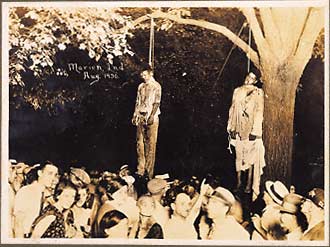
Another unforgettable shot places the underlying purpose of that war on center stage. You see The Lynching Of Shipp And Smith from 1932. Two young black men hang from a tree like Billie Holiday’s proverbial strange fruit, as white people in the foreground snicker and peer at the camera. One man, sporting a Hitler mustache, glares at you while pointing his finger up at the hanging victims, as if to say, “They deserved it, and so will any others of their kind.” Absolutely no one appears disturbed by the horrible carnage hanging above their heads. Photo (below) by Laurence Beiter 

Then there’s the still-astonishing image of the Hindenburg, crashing in 1937. The German zeppelin suddenly explodes spectacularly in Lakehurst New Jersey. If you’ve seen the film footage of this tragedy, which killed 35 passengers and crew, the blimp  completely collapses within seconds, reduced to a flattened pile of flames. It brings to mind such other imagination-stretching transportation fantasies such as The Titanic, and the peculiar fascination people have with such larger-than-life vehicles of extravagant  means.

One more example of that, a shot of the oddly bending smoke trail of the space shuttle The Challenger, as it explodes a mere 73 seconds after lift off in 1973, killing six astronauts and Christa McAuliffe, a  37-year-old schoolteacher chosen by NASA to represent space exploration’s educational value . I was watching this live on TV and didn’t really comprehend what I was seeing, until several minutes later when the telecast comments explained things as best they could at that inexplicable moment in history.

age and see Adolf Hitler in his full Nazi regalia, climbing a staircase, surrounded by swastika banners held by soldiers, with thousands in the background ready, for one of his vitrolic and bizarrely charismatic hate speeches.

Turn the page once more and find a photo of a great African-American sprinter Jesse Owens, standing on the podium after winning one of his four gold medals in the 1936 Olympics, which was infamous for Hitler propagandizing on the racial superiority of the so-called Aryan race. the chief Nazi propaganda henchman, Joseph Goebbels, commented, “Without these members of the black race – these auxiliary helpers – a German would’ve won the broad jump.” African-Americans equated to “auxiliary helpers,” a curious and surprisingly delicate euphemism.

What else caught my eye?

— Refugees crawling across a huge steel bridge like so many ants, slowly and laboriously striving for freedom. This is Communist Korea in 1950.

— The agony of Roger Bannister’s breathless stride at the finishing tape as he breaks the four-minute-mile barrier in 1954, the first person ever to do so.

—  Ronald Haeberle’s photo of the My Lai massacre in 1968, which recalls the recent massacre in Afghanistan. Once again, American military murder citizens in cold blood. Here, the sprawling bodies also recall the dead Confederates, but this is in grimy color.

— One of the most shocking pictures is titled A Vulture Stalks Starving Child by Kevin Carter, documenting the 1993 famine in Sudan. The title says it all: the bird of prey sits patiently watching a suffering little girl, who crouches helplessly with their bloated belly and oversized head resting on the dirt. Carter struggled with the reality of the moment —  the question of what he should properly be doing. Even though he chased the bird away after taking this shot, Carter became increasingly depressed, the magazine reports, and took his own life in 1994, only weeks after his picture was awarded the Pulitzer Prize. It’s on page 108.

— One of the most beautiful photographs documents tragedy on a large scale: Floodwaters Submerge New Orleans by Smiley Pool shows sprawling sepia tones engulfing the rooftops of numerous New Orleans homes from an aerial view. All you can see amid the muddy water are rooftops (like so many board pieces on a monopoly game board) and treetops.

Yet it’s a gorgeous visual configuration in its minimalist way. That’s just a sampling of this remarkable magazine. You’ll find plenty of famous shots you’d hope to find and more images of scenes and events you had heard about, but now will likely never forget, because of how these photos burn themselves into one’s consciousness.

TIME and again, remind you of what strange bedfellows horror and beauty make.

— Kevin Lynch


Night Thoughts of a Baffled Humanist: Marilynne Robinson


Novelist and essayist Marilynne Robinson seems as well grounded and as diligently penetrating as any cultural commentator right now. She’s courageous, unflinching and yet humble. We do well to heed her sober reflections and wisdom. I caught up with her long essay “Night Thoughts of a Baffled Humanist,” which was waiting patiently in my to-read pile, in the November 28, 2011 issue of The Nation.

I won’t do justice to her long and quite profound reflection but I do want to share some of it for your contemplation and, perhaps, spur to action.

She takes on the theme of a seemingly pervasive mentality of “austerity” and a recent kind of capitalism — shorn of most every sensibility but a severe economic rationalism.

“We have entered a period of rationalist purgation,” Robinson writes. “Rationalism and reason are antonyms: the first is fixed and incurious, the second, open and inductive. Rationalism is forever settling on one model of reality; reason tends toward an appraising of interesting things as they come.”

Robinson clearly comes down on the side of reason, and for engaging with things as they come, a humanist response to reading each situation’s apparent limits, but also its potential.

“Say that we are puffed warm breath in a very cold universe,” she poses metaphorically. “By this kind of reckoning we are either immeasurably significant, or were incalculably precious and interesting.  I tend toward the second view. Scarcity is said to create value, after all.”

But apparent economic scarcity need not choke off our humane instincts for the sake of “austerity.” Understand, Robinson is far from any sort of Pollyanna, as she’s proven in her wonderfully somber and elegiac domestic fiction Housekeeping, and Gilead, which won the Pulitzer Prize, and Home.

However she says belief in a bent toward “acting badly” has been taken to inhibit our potentiality for acting well, though why this should be true is not obvious.”

She recounts points in post-World War II history: Churchill’s “Iron Curtain speech,” which set the tone for chilling Cold War vigilance. Robinson notes that Stalin had a certain rationale for maintaining the Soviet empire, “that it was necessary for defense, is entirely analogous to Churchill’s rationale for maintaining a British Empire.”

Then of course, there’s America and The A-Bomb, and the ironic and troubling fact that “the American public learned about the atom bomb at the same moment the world learned about it.”

What price is national security? The question hung in the mushroom clouds over Japan and it hangs today.

“The dark ages may return, the Stone Age may return on the gleaming wings of science,” Churchill warned.

(Ah, technology. It remains deeply unsettling as we plunge headlong into a brave, inchoate and dynamic Cyber world. As a new blogger, I’m trying to embrace this medium for its fullest potential. But technology?) (Churchill memorial statue, right)

And then Robinson deftly segues to  the present, in Indiana Gov. Mitch Daniels recent speech, in which he gravely noted “We face an enemy, lethal to liberty, and even more implacable than those America has defeated before … I refer, course, to the debts our nation has amassed for itself for decades of indulgence.”

Yet, Robinson counters that there is also the factor were also having indulged in — too long and costly wars, and having indulged in taking up the novel burdens of security that present circumstance requires” including the accumulation of nuclear sites.

She gradually carries us back to when both the Soviet Union and the United States proposed a way of life that is claimed to maximize human happiness “with all the problems the notion involves, you come the place where it would be tonic to hear that old phrase: “The greatest good for the greatest number.”

Our sense of grounding in such values is an unspoken assumption, carried from the 19th century, that great culture proved the health, worth and integrity of a civilization…”

“Yet it seems to me, on the darkest nights, and sometimes in the clear light of day, that we are losing the ethos that has sustained what is most to be valued in our civilization.

“This despite the fact that the United States is a society structured around any number of institutions that are not, under this definition, capitalist. Suddenly anything public is “socialist,” therefore a deviancy, inevitably second rate and a corruption of, so to speak, the public virtue.”

Where is the real autonomy, the means to think and act as judgment and conscience dictate?

“The old and characteristic American ways do not fit well with the word capitalist, as neo-capitalists would understand it. They would like nothing more ideological consensus, varying among states and regions, about how best to “promote the general welfare.”

“Market economics – another name for a set of theories and assumptions also called capitalism – shown itself very ready to devour what we hold dear, the list can be taken include culture, education, environment in the sciences, as well as the peace and well-being of her fellow citizen .”

“I know Americans are supposed to believe in competition. I think is wasteful and undignified in most cases.

“Remember education is associated with prosperity, so there’s every reason to assume our shortfall can be monetized and reduced prosperity for our children or grandchildren which will be an onerous burden of debt dooming the poor souls to future yet more Greek. The alternative is to let ourselves be – that is, to let ourselves be the reflective, productive creatures we are, unconstrained and on worst. Eliminate the overwhelming cost of phantom wars and fools errands, and humankind might begin to balance its books.

“After all, it’s only debts are to itself.”

Perhaps I have left this all under interpreted, as an academic might say. Too many “run-on quotes.” So be it. I apologize to the offended.

But not to those who find value here. Robinson has so much to say. And we have so much to learn. And so much to live for, as a people, as a society, together. Do we starve ourselves for a balanced budget, whatever that means? Or do we give ourselves succor and a genuine future for our children, which has to do with more than just money? The answer seems obvious. Let’s try to imagine the means.

A few thoughts on “Take Five.”

Just thought I’d add this comment/Link from my FB page.Take Five (“Long” version)

Nice to hear a fresh and very swinging Desmond solo, the original is fully embedded in my brain. But do check out the longer version above (alas, no video) with the Joe Morello drum solo. The tempo’s slow and sultry, and Morello proves again that he may have been the most sublime jazz drum soloist of his time, which is saying something with Elvin Jones as a contemporary. Elvin’s still the greatest drummer of the era. The folks who don’t like Take Five are probably those who still resent Brubeck’s success. Get over it, and dig it. Life’s too short. Even my cat Maggie came over to listen to this one. The cat knows cool when she hears it.

BTW here’s a video version with a Morello solo (to compare), from Belgium in ’64. Belgium “Take Five” w/ video Here he’s less beholden to his original recorded solo but it’s still beautifully constructed.

Jeffrey Foucault: Songwriter on a Train to You

Gallery

This gallery contains 5 photos.

  Let me refer back to my first posting and give you an example of the new generation of singer-songwriter, and what makes him or her so special. I referred to Jeffrey Foucault’s 2006 album, Ghost Repeater, which just returned … Continue reading

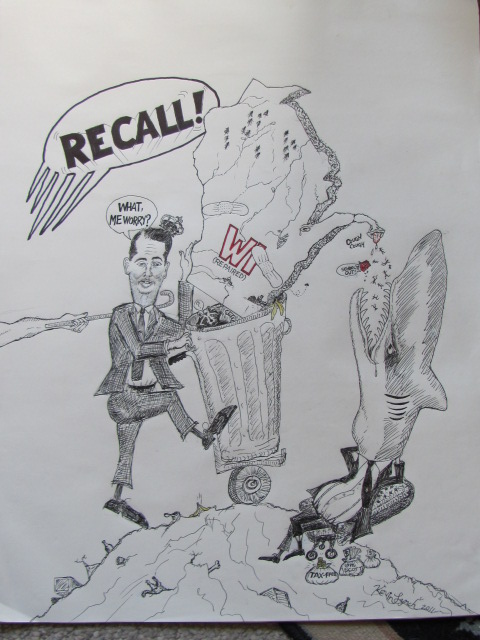
now vote to recall

Well, there is the matter of pledging to vote to recall Scott Walker. This is a big opportunity to do something right for Wisconsin. Sign a pledge to vote to recall

(Sign the pledge — below link.)

Show Wisconsin what you think.

Most of all, don’t be a fink.

http://us.mg204.mail.yahoo.com/dc/launch?.gx=1&.rand=1307855556&action=showLetter&umid=1_18468501_AGIIw0MAALt3T2v%2BIgGm1wepUxc&box=Inbox

I promise I’ll get back to culture tomorrow, and no more doggerel! – KL

Local labor movement struggles for job creation.

I’m mightily impressed by how my hometown has grown culturally in the 20 years since I’ve been gone, although the jazz scene really suffers in terms of supportive venues and especially press. But this town still has a long ways to go, politically and socially. A friend of mine, who is a sociologist, alerted me to the urgency of an upcoming election in which Eyon Biddle and Jose Perez are challenging long-time Common Council incumbents. I’m in no position to make an informed endorsement but moveon.org is backing them. I will refer you to this in-depth article on the germane issues, by my former Milwaukee Journal editor Dominique Paul Noth: http://www.milwaukeelabor.org/in_the_news/article.cfm?n_id=00238

Another list of ideas for action from Walter Mosley

If you want a list of more (and related) suggestions for democratic citizen action, check out this column by Walter Mosley. He’s best known as the author of several black detective book series, such as the Easy Rawlins books (“Devil with the Blue Dress”) but he also authored a wonderful series about an ex-con street philosopher named Socrates Fortlow (the first Fortlow book, “Always Outnumbered, Always Outgunned,” was also made into an excellent movie starring Laurence Fishburne [Morpheus in “The Matrix.”] ). And those who saw Mosley read in Milwaukee recently know he’s a funny and brilliant guy. He’s been writing political commentary for quite a while. http://www.thenation.com/article/165117/ten-things-you-can-do-sustain-occupy-movement

Also for a little musical inspiration, try this YouTube below of John Coltrane doing his beautiful dirge “Alabama,” in honor of the four young black girls killed in the Alabama fire Mosley alludes to at the top of his column.  If you don’t know, that’s McCoy Tyner on piano, and listen to the end to get the whole Martin Luther King Jr.-inspired effect the video caption refers to. Enjoy, remember, and act.  — KL

http://www.youtube.com/watch?v=cOjxBuwBUEE

If you can’t access these links, try my RESOURCES page.

Something to do, to be responsible for.

OK, you’ve read about “Margin Call” (last posting) and hopefully seen the movie. So you understand that the financial catastrophe wasn’t just about a bunch of evil greedy people, though there’s enough of those. But they’re all caught in the same system that we are. You probably saw the OWS sign “The system isn’t broken, it’s fixed.”

Veteran political observer and communications professor Todd Gitlin has some good ideas about how to extend the Occupy movements into areas of life that might make a difference. In the article I link below, he talks about direct action to stop the illicit foreclosures, auctions and evictions. He talks about “occupy student debt,” a way to help students out of their rigged financial holes.  He even suggests the savvy strategic move of winning the attention of corporate media. And remember, it all has to be done nonviolently, maintaining the high road. And then he says “support candidates pledge to push money out of politics ,to make taxes far more progressive, to regulate banks are more stringent” than the Dodd-Frank bill did. It’s about America taking back their country, which is a Tea Party phrase, but that idea can be pursued a lot more smartly and without the Tea Partiers’ moral hypocrisy (or at least confusion). Gitlin says  what Americans wait for is “plausible hope.” Yes, but why not be one of the Americans creating that hope instead of just waiting for it? — Kevin Lynch http://www.thenation.com/article/166822/more-protest-movement

Wall Street on the Edge: A Deadly Margin for Error

This posting is about a culture as far removed from roots or vernacular folk culture as one can imagine. But it is an “uncommon” yet ingrained upper-class culture we’ve been forced to come to grips with. Perhaps we can understand our roots culture, and its proper role, by examining its apparent opposite. Yes, I’m talking about Wall Street, the people who represent the reviled 1%. The film, Margin Call, now out on video, dramatizes how one brokerage firm nearly dissembles while grappling with the realization that all their mortgage-sale earnings will evaporate on the verge of the 2008 market catastrophe.

Jeremy Irons plays the cold-blooded CEO of a stock trading firm in “Margin Call”

What’s fascinating about the film is that it is about people more than cold economics. The excellent acting performances reveal how each market analyst, trader, middle-manager and even the CEO is personally affected by the situation. It starts with an analyst, played by Stanley Tucci, being fired as part of the first office purging in anticipation of tighter times. But nobody knows how suddenly bad things will get because Tucci holds the not-quite-understood secret in a flash drive, which he hands-off to his protégé as he is escorted out of the building, warning him, “Do something with this. But be careful.”

The younger analyst, who is the film’s everyman with a heart, soon figures out what Tucci had been groping towards, that the company holdings’ volatility rates will soon render its losses greater than the company’s entire worth. Tension ratchets up as this explosive information is passed up the chain of command, until the CEO — played pitch perfect by elegantly slimy Jeremy Irons — calls an emergency staff meeting in the middle of the night. Here’s where we see where people stand and how they are affected. Kevin Spacey is the office boss who realizes that the CEO is willing to sell off all these mortgage holdings even though he knows they are now essentially worthless — the ruse that destroyed the lives of countless ordinary Americans who put their faith in banks and the market.

But here’s where the movie gets interesting in surprising ways. Irons tell Demi Moore, one of the risk management analysts, that he needs “a head to feed to the traders” the next morning when everything is sold off and someone has to take the blame. He informs her that she is the sacrificial lamb — the only woman among the higher ups — perhaps symbolic of the patriarchal culture of Wall Street. To no avail, she reminds the boss that she had sent him several warning memos based on Tucci’s accumulating information, a while ago. “We all fucked up,” is Irons’ confidential share-the-blame concession to her.

We begin to see how human responses and decisions play out. Though a fictional film, it’s based on the actual experience of former Merrill Lynch trader Jeff Chandor, the father of the film’s writer and director, J.C. Chandor.

Aside from the drama and the stupendous damage such sell-offs produced, the film is compelling because it doesn’t judge the characters, as actor Zachary Quinto — who plays the young do-the-right-thing analyst  – comments in the “special features” commentary. I’ve begun to agree with Quinto. We see plenty of cold-heartedness but ultimately it is survivor’s behavior. They know what is at stake for the company. What about all the unsuspecting people will be hurt by this huge selloff? They are wonderfully signified by the cleaning woman who stands impassively with her cart in an elevator between Moore and a middle manager, who tersely discuss the fateful situation.

CEO Irons recites the dates of each of Wall Street’s market crashes and tells Kevin Spacey how American history repeats itself: “They’re just pieces of paper. It’s not wrong. We can’t help ourselves. We just make money and…there’ll always be the same percentage of winners and losers. Maybe there are more of us today but the percentages stay the same.”

Think what you will about this man’s self-serving historical analysis, and a harsh judgment may be in order because, after all, someone has to take some responsibility for all the greed and massive fraud we still suffer from.

But what most resonates in Irons’ speech is that phrase “We can’t help ourselves.” It implies several different things, depending on your interpretation. It may mean compulsive avarice, a craven lack of moral backbone. Certainly none of these people exhibit the sustained caring for vulnerable humanity shown by the lawyer-boss in Herman Melville’s classic story of Wall Street Bartleby the Scrivener. These contemporary Wall Streeters seem deeply acculturated to their abstracted manipulation of numbers, what one of them says “any crack head could do.”

But Irons’ phrase also can mean that these people — just like anyone affected by the market, which is probably all of us – is caught in a system. While brokers have bought into that system and are rewarded handsomely, the reptilian luxuries of free-market capitalism seem to, time and again, hoist us by our own petard, another implication of Irons’ speech.

One broker explains how readily he spends all his annual earnings — including $76,000 in hookers — so we see that, with their profligate lifestyles and the expense of living in New York, these people are paid just enough to keep coming back to work instead of walking away from this heinous high-stakes game.

You really may want to despise how the CEO administers the company ethos.  There are three rules in this business, he says: “Be first, be smarter, or cheat.”

But in his own way he takes his responsibility. “No one will ever trust you again,” Spacey warns him. “You let me deal with that,” Irons replies. Even this man agonizes, as he pounds his head against the wall in the company men’s room after Spacey tells him he won’t go along with the fraudulent sale. You sense, amid his growing desperation, that the CEO is suddenly faced with the cavernous hollowness of his position.

Ultimately the film portrays these people in relation to a bigger picture. Recurring scenes show these panicking characters peering down on sprawling Manhattan from high above. These beautifully wrought moments of contemplative vertigo suggest how the individual hangs suspended in a massive system of commerce that we have created and glorify and perpetuate — at least until the Occupy Wall Street movement began.  And here’s where our democratic folk culture rises and, one hopes, can make a difference. It has surely gained the attention of the powers that be.

Margin Call ends with Spacey’s character burying his dead dog in his front yard. He says he dug ditches before he became a stockbroker, but here he also symbolically buries his Wall Street life. The film is not bleakly apocalyptic; rather it seems to ask us to question the system that draws all these smart, talented people into it with the lure of lucre.

Whither social democracy? Economists note that many of the most financially secure advanced nations in the world have essentially socialistic systems. It’s hard to imagine “the land of the free” ever becoming socialistic but our under-regulated hyper-capitalism has gotten us into the mess we’re in. You see in these characters’ anguish a human questioning — that there must be a better way that we can learn from, ways to reduce all this built-in risk.

American ingenuity and resourcefulness is based on creativity but also learning. Learning implies open-mindedness to systems that may offer us wisdom, a chance to survive, and perhaps even thrive — as a society, not just as individuals in a Darwinian existence. If we survive only as individuals what are we left with? So what is our responsibility at this point in time? Watch this powerful movie and see what you think. Let me know.
— Kevin Lynch


Five Visionary Musicians Travel to the Apocalypse and Beyond

BY KEVIN LYNCH

Kayhan Kalhor and Brooklyn Rider carried Milwaukee to the nether edge of pan-cultural, time-tripping music-making in a recent concert at Alverno’s Pittman Theater. Now we know why Pitchfork.com raved about these guys, and nary a guitarist among them.

Let’s start with Brooklyn Rider, which is classy-cool, not overdoing the hipper-than-thou theatrics that Kronos Quartet sometimes indulges. But this quartet band ain’t four-corner square fuddy-duds. Each player (save the cellist, who still romances his instrument in a loin embrace) performs standing up, unlike traditional or even most other “hip” string quartets. They may not subject their axes to Pete Townshend arm wind-milling, but every once in a while you hear a full-throated ensemble power chord from their discretely amplified instruments.

But such a stunning harmonic attack is no brain-and-body crunch. It’s more a genuine heart palpitator, as in the second movement of the latest Philip Glass string quartet which opened the second half of their concert with a mewling, wailing, bird cry effect, a soulful sonic wave in time and space.

Kalhor, by contrast, does sit – but he doesn’t even use a chair. Foregoing bourgeois conveniences is part of the rigor and ritual of Eastern and, in this case, Middle Eastern music. (Check it out: Brooklyn Rider is collaborating with an Iranian master, undercutting stereotypes of Iran as a bunch of jihadist war mongers. The quartet and Kalhor met in cellist Yo-Yo Ma’s Silk Road Ensemble tour).

Intensely focused yet collectively attuned, Kalhor is a compact man, a virtuoso of a four-stringed instrument, the kamancheh, with a gourd-like voice box that, despite its smallness, cuts through the Western string ensemble sonority easily as a lead voice. At times it almost keened, but eloquently.

The concert ranged from “Atasgah,” inspired music by BRider violinist Colin Jacobson’s experiences in Iran (like most non-classical groups, they compose some of their own material) to music drawing from the classical tradition, specifically Beethoven. “Seven Steps” reimagined segments of the German romantic master’s genius into a contemporary mélange befitting, say, today’s Web-surfing sensibility.

But these riders were brave musical expedition guides bent on transporting listeners, after intermission. Again they balanced Western and Persian sources. The Glass quartet — music from the film Bent — characteristically doesn’t travel far harmonically but rather envelops the listener in its ardent sonic direction. Brooklyn Rider plays Glass music like second nature, lending all the sharp and supple dynamics that give the minimalist composer his expansively romantic  interest and enchantment. And in this ensemble’s harmonies — both power chords and supple aural massages — reminds the listener of the peerlessly quadrupled expressivity of the string quartet form.

It all led up to this unique quintet’s big “hit,” if you can say that of a half-hour long piece, Kalhor’s remarkable “Silent City.” BRider had recently spoken with the great Indian jazz pianist-composer Vijay Iyer (who’ll return to Alverno for a solo concert on March 10), and noted Iyer’s characterization of music as “necessitating an architectural space for things to happen.” That’s “Silent City” to a T, though it began with the T virtually obliterated.

Like the Glass, “City” is essentially but richly modal, rising at first like the meager embers of devastated urban ruins. Here the composer’s instrument creeps out tentatively amid the quartet’s vast, bleak setting of shifting microtonal textures, a slow emergence somewhat reminiscent of, say, Barber’s greatAdagio for Strings,” rescored as a tonally ambiguous soundtrack to Cormac McCarthy’s post-apocalyptic novel The Road. The group’s muted but intensifying pitches uncover a furtive, slightly frightening aura, suggesting a lone surviving consciousness — in the tentative voice of Kalhor’s kamancheh, with a memory haunted by spectral echoes. At one point, the piece begins growing almost like a random seed windblown to a fertile spot; a tree grows in scorched Brooklyn? Actually, Kalhor’s small, vertical instrument — with bulbous base, stalk-like neck and large pegs — resembles a growing plant.

The sonic sun gradually spreads, mournfully illuminating a morning of disabused innocence and pensively posing musical questions: What happened? What did we do to our world? Where do we go from here? The light births a new day and a now-insistent rhythmic sense of human industry. At this point, one sensed the concert had gradually achieved a touch of greatness — certainly a heady, breathtaking majesty to match the inextinguishable hope of a new era of life, amid desolation and death.*

The encore piece, bursting with joyously frenetic purpose, is titled “The Bird,” and depicted an intrepid winged creature “trying to fly to the sun,” Kalhor explained afterwards. In a post-technological world, Nature leads The Way.

_____________________________________


*The recorded version of “Silent City” is enhanced by a bassist and a bodhran percussionist. It would be interesting to hear this ambitious work played by an East-meets-West chamber orchestra.

BTW, BRider has one of the coolest artist websites (www.brooklynrider.com) I’ve seen, with homepage site tabs deftly integrated into a gloriously funky ink pen-and-watercolor cityscape portrait of Brooklyn, and an actual online art gallery.

Remember, blog comments are always welcome!