
Is Hillary for the working class and positive change for them, or not?

Hillary car

Hillary Clinton recently visited car wash workers in Queens, New York, who are represented by the RWDSU (Retail, Wholesale and Department Store Union). Courtesy rwdsu.info

Note: Culture Currents normally does not get quite this specifically political. But this is a very important election year, especially if we are to realize change in our government, our economic system and our way of life, for the better. So, in this post, CC is testing the culture currents of change.

Understand first of all, I am thrilled at the powerful movement that Bernie Sanders has spearheaded, and I’ve been a big fan of his for a long time, as a spokesman for the majority of Americans’ financial interest, and a critic of Wall Street and the corporate world’s domination of American economy.

Democratic presidential candidate Sen. Bernie Sanders, I-Vt., speaks at the Iowa Democratic Wing Ding at the Surf Ballroom Friday, Aug. 14, 2015, in Clear Lake, Iowa. (AP Photo/Charlie Riedel)

Democratic presidential candidate Sen. Bernie Sanders, I-Vt., speaks at the Iowa Democratic Wing Ding at the Surf Ballroom Friday, Aug. 14, 2015, in Clear Lake, Iowa. (AP Photo/Charlie Riedel)

Having said that, it appears certain that Hillary Clinton will win the nomination, though Sanders should continue as long as he has a mathematical chance to win the popular and delegate vote.

But if Sanders is aiming for a brokered convention, it will fracture and divide a potential consensus of supporters and voters who should be aligning to vote for the Democratic nominee to beat Trump.

President Donald Trump. Wrap your head around that. Yes, Bernie ranks ahead of Hillary vs. Trump in most polls. But he’s still not likely the nominee. If somehow he wins the nomination, then I feel confident he will beat Trump. Of course, that is a massively unlikely “if” at this point. And Hillary will win in November too, especially if disenfranchised workers and young people feel that she’s on their side, and understand that she must also work with at least a modicum of negotiation and compromise, which most successful politics entails (Republicans will never flop over and play dead to leftist demands.)

This leads me to a fairly historically informed argument by the noted liberal writer Thomas Frank in an interview with Financial Times. http://finance.yahoo.com/news/watch-hillary-clinton-revolt-brewing-101500894.html

Frank recounts how the Democratic Party has shifted its constituency response from its previous working-class base to that of middle-class liberals since the 1960s, and more recently, towards entrepreneurial power and the so-called “creative class.” This seems historically accurate in that young liberals sparked the leftward revolution of the ’60s and have driven much of Democratic Party direction of the  since.
And certainly Bill Clinton’s administration shifted gears toward the middle, and triangulated away from the poor and the working class, especially with his reform of welfare and tough-on-crime bills which resulted in our horrible black incarceration rates, a development he now admittedly regrets.

President Obama hasn’t done enough for the working poor and the dispossessed as one would’ve hoped, but he’s been fighting uphill against an obstructionist Congress his whole two terms. Chances are the Dems will take back the Senate and gain in the House, which will make things better for a Democratic president. And Hillary Clinton is a tough, smart and reasonable negotiator.
The problem I see now, however, with critics of Hillary Clinton is that they, including Frank, to often tend to conflate her with her husband in their arguments against her.

Thus, a significant amount of union people perceive her as anti-union, even though this is not the case. And many non-union workers assume she is against them and tend to support Trump, who feeds off their understandable feeling that nobody backs their interests. These contingents comprise much of the frustrated people creating the “revolt” the article refers too, a split between ardent Sanders and Trump supporters.

This is one reason why we need to work to bring the union movement back to something close to its former strength and respectability. I believe this intellectually but also because I have a lot to be thankful for from union membership. And I also know first-hand how vulnerable a worker, including journalists like myself, can be without union representation.

Like Clinton, some unions have hardly been paragons of virtue. Being comprised of humans, some have been subject to excess internal power-brokering, greed and self-interest. But they suffer, like Clinton does, from a very besmirched reputation from decades of right-wing and pro-corporate disinformation.

To the point of this election, let’s look at Hillary Clinton’s Senate voting record on jobs, the category in this comprehensive policy survey most relevant to working people.  http://www.ontheissues.org/Hillary_Clinton.htm#Jobs

For the most part, it shows how strong her support has been for issues that concern workers, both blue and white collar. Note also her high approval rating by the AFL-CIO and, in this election, the endorsement of her by a majority of labor unions.

Those who think that Hillary will preside like Bill Clinton did may presume that she’s stuck back in that era. She learned lessons from it, no doubt. But the truth is, she’s been extremely attuned to the present, which is why she has embraced her progressive ideals, even though she remained largely supportive of her husband as First Lady. Yet, unlike Bill Clinton, she would not compromise on the pioneering Clinton health bill, the prototype for the Affordable Care Act. The Clinton bill failed because she remained principled, she cared too much about the uninsured — mostly the working poor, minorities and the disenfranchised.

I think it is a perhaps-unconscious but sexist reflex to presume that Hillary is going to be Bill Clinton redux. She has always been her own woman, and obviously her relationship to women, and their issues, is probably 180° different than her husband’s, or at least 120°. So it makes a lot of sense that she will work hard to correct many of the excesses of Bill Clinton’s welfare reform, which has harmed poor black men and single women and their families for the most part. It figures she will do more to change the situation than any current candidate. Most African-Americans with a sense of history appear to know this, judging by their strong support of her.

hillary

Courtesy edition.com

So if that’s not fighting for working people, I don’t know what is. We used to associate the image of workers predominantly with men, who used to most typically be the primary Income provider of families. We know how much that has changed, but most pointedly by seeing how bad things remain for poor and working-poor women in forced (or misguided) single motherhood.

Remember, Hillary famously said, “It takes a village to raise a child.” She clearly wants to create an administration that fosters just such a village, metaphorically and literally.

And for those who still profoundly distrust her, due to some past associations and decisions, I remain among you, especially in foreign affairs, where she’s very experienced, but, I fear, still too hawkish. Prove us wrong on that, Madame Secretary. This era cries out for American prudence and restraint overseas, as Obama has largely exhibited.

Nevertheless, I’ve gained trust in Hillary Clinton partly because she is a calculating politician, and she hears and understands the angry winds of change, for which Bernie Sanders has spoken most powerfully and persistently. Regarding Hillary’s relative dishonesty, consider the recent comment of Nicolas Kristof, arguable America’s most respected journalist, though an avowed liberal:

When Gallup asks Americans to say the first word that comes to mind when they hear “Hillary Clinton,” the most common response can be summed up as “dishonest/liar/don’t trust her/poor character.” Another common category is “criminal/crooked/thief/belongs in jail.”

“All this is, I think, a mistaken narrative.

“One of the perils of journalism is the human brain’s penchant for sorting information into narratives. Even false narratives can take on a life of their own because there is always information arriving that can confirm a narrative.” Here’s Kristof’s column: http://www.nytimes.com/2016/04/24/opinion/sunday/is-hillary-clinton-dishonest.html

Given that tendency of journalism and the human mind, it’s unwise to ignore the Pulitzer Prize-winning Politico.com‘s recent fact-checking assessment of the truthfulness of statements by all the current presidential candidates. Hillary Clinton comes out as the most truthful, with Bernie Sanders a close second. http://www.dailynewsbin.com/news/fact-checkers-confirm-hillary-clinton-is-more-honest-than-any-of-her-2016-opponents/24196/

As MSNBC’s Chris Matthews commented Sunday, it’s up to Hillary to win the hearts of Americans. Against Trump, I’ll bet she succeeds.

And given the polarization between the two major parties, Hillary Clinton seems much better positioned and experienced to do something about positive change for the 99% as president. Assuming she’s the candidate, the Dems will need Sanders supporting her, along with great voices like Sen. Elizabeth Warren, to continue to fight for everyone who works for a living, or tries to, or hopes to.

And by that, I don’t mean people who play morally-decrepit games with numbers on Wall Street.


_____________

Bernie Sanders photo courtesy salon.com


Listening to the “deluxe edition” bonus disc of Tedeschi Trucks’ “Let Me Get By”


The cover of the box-set 2-disc deluxe edition of “Let Me Get By” mimics a vintage guitar amplifier. amazon.com

The bonus deluxe edition of the Tedeschi Trucks Band’s latest album Let Me Get By further demonstrates how you can turn a stylistic assessment of this remarkable band into a parlor game. Try pigeon-holing them — short of a six or seven-hyphen phrase —  and they’ll invariably squirm free, or break the bindings. That’s another of the metaphorical meanings of the album’s eloquently powerful cover image of a Mongolian eagle, flying free from his master’s binding.

The cover of their bonus disc is a photo portrait of the same eagle perched on the leather-sheathed hand of the ornately outfitted eagle hunter who, though unnamed, appears Mongolian himself, with his thickly fur-lined hat, and long coat reaching to the tops of his tall boots, which can ford deep snow drifts.

So it’s a pan-cultural nod to the Eastern influences that make this a group defy even the multi-various vernaculars of American roots music.

I said in my first blog review of the basic album Let Me Get By (here: https://kevernacular.com/?p=7331) we’ve never seen anything quite like this band before. I stand by that, however their precursors are three personnel-related groups — Derek and the Dominoes, Delaney and Bonnie, and Joe Cocker’s Mad Dogs and Englishmen. So Eric (“Derek”) Clapton is a visionary forefather. 1 Yet TTB has encompassed influences beyond what any of those groups ever did, by standing on their shoulders. Plus, they’re already longer lived than any of those, with no signs of slowing down.

All the styles, solos and 12 performers might sound messy in terms of musical structure and arrangements and, at times in the past it has been, but mainly in close listening as the power of their grooves usually carries along loose ends.

The success of the new album reflects the fact the band spent more time in the studio than in any recording project before, according to album annotator Ashley Kahn. It helps that their Swamp Raga Studios are in the Jacksonville, Florida home of Susan Tedeshi and spouse Derek Trucks, and that the group functions almost as an extended family.

The overall musical quality of the ensemble also seems upgraded since jazz bassist Tim LeFebvre came aboard last year. Lefebrve’s credits include jazzers Donny McCaslin, Wayne Krantz, Chuck Loeb, and jazz-contemporary classical’s Uri Ciane. Also he recorded  with the late David Bowie on his already now-celebrated last album Blackstar, which also includes McCaslin and several other top jazzers. LeFebvre co-wrote three songs on Let Me Get By, and actually flew between Bowie’s New York studio and Jacksonville during those albums’ overlapping dates. LeFebvre clearly facilitates the band’s inclusion of the 1971 Bowie  song “Oh! You Pretty Things,” which they cover on the deluxe album second disc, and which I’ll address below.

The fluency of several complex, stirring ensemble passages on both discs heightens the collective groove and may betray the arranging and playing skills of LeFebvre.

Along with three alternate takes of the new album’s songs and the Bowie cover, the deluxe-set disc includes a  quirky quintet studio instrumental “Satie Groove,”  and a three-song update on the band’s celebrated live-concert prowess — one song from the new album and two covers, recorded at New York’s Beacon Theater.

T

2

The first of the three alternate takes is a LMGB song I haven’t commented on previously: “Hear Me.” It opens like a long dusty trek, but it calls to a lover who may or may not be left behind forever. TTB seems very strong conveying that welter of feelings on the verge of break-up or post break-up, when life both shrinks and one imagines so much is possible, for better and worse.

Their lyrics’ deft rhetorical ambiguity allow such songs to resonate for many losses and failures in life. Reminding the loved one “we were one in a million years” speaks to the profundity, grandiosity and cavernous sense of loss in shattered romance. Here Derek Trucks shows his lyrical side, drawing from The Allmans’ singing guitar style of Dickey Betts, specifically his alternating oblique note bends, which mimic a pedal steel.

The live version of “In Every Heart” is slower more burdened and stripped down, but Trucks’ animated solo almost sounds like a conversation with his own heart, recalling Clapton’s buzzing blues style, perfected on Derek and the Dominoes classic album Layla.

Bowie’s “Oh, You Pretty Things,” fits this group’s POV, as a challenging but stirring appraisal of the human race that finally advises: Look at your children/ see their faces in the golden rays/ don’t kid yourself/ They’re the start of a coming race.

The “Just as Strange” alternate take is, surprisingly a 2 ½ minute instrumental jam on that LMGB song, with Trucks and the rhythm section and co-composer Doyle Bramhall II on bass.

Another short hornless instrumental, “Satie’s Groove,” rides Tim Lefebvre’s fat and funky bass guitar in a satisfying descending progression that may allude to piece by 18th century French composer Erik Satie, a sort of proto-minimalist. In fact, much of these first five bonus tracks may appeal to those who prefer an unadorned approach. For sure, they provide a little breathing room from the often heart-pulsing intensity of much of the basic Let Me Get By album.

But that also sets us up for the bonus disc’s last three cuts, live performances of TTB with all guns blazing and, on the last song, a great hired gun. These astonishingly potent performances from New York’s Beacon Theater make the deluxe edition worth the extra money, to me (this was no free reviewer’s copy)

By then, late in their odyssey-like 2015 tour, Susan Tedeschi’s voice had become somewhat raw, and here she sounds a lot like another influence, Janis Joplin. Her pained-tiger growl on these tracks conveys as much raw powerful and emotion as any singer working today. That’s especially remarkable because she never tries to stretch beyond her natural contralto range, unlike so many pop-rock-soul singers and would-be American Idol divas, to varying degrees of success.

I described “Laugh About It”  in the LMGB review post and this version has Tedeschi’s voice rough-riding the infectious but tricky guitar figure the song’s built on.

I’m glad they included their cover of “I Pity the Fool,” which I heard them do in Madison during that tour. It’s an old R&B song done memorably by Bobby “Blue” Bland and Paul Butterfield. This song of bitterness and pity — for the fool who falls for with the narrators ex-lover — shows that TTB can get down in the darkest of emotions, despite their generally uplifting music and lifestyle ethos.

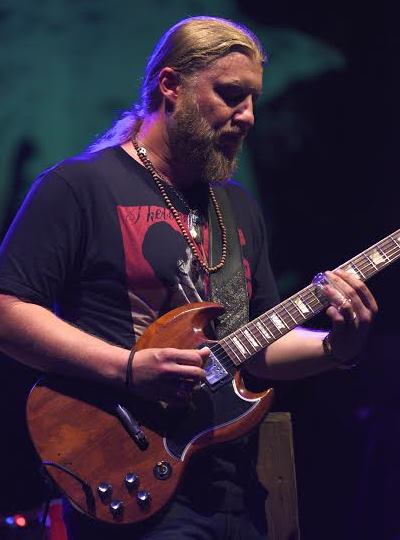
Derek Trucks (left) and David Hidalgo (right) of Los Lobos do some fancy jamming on “Keep on Growing” in this shot from the performance included in the deluxe edition of “Let Me Get By.” Photo by Dino Perrucci photography.blogspot.com.

The last song is another final statement as apt as “In Every Heart” is for the main LMGB album. That song is the exhilarating “Keep on Growing,” by Eric Clapton and Bobby Whitlock, from Derek and the Dominos’ classic Layla album.

Nominal message aside, the nine-plus-minute version really shows them hoisting the Southern jam band aesthetic to a fresh peak. Part of their current tour includes a number of dates with Los Lobos, and in 2015 that band’s superb lead guitarist David Hidalgo teamed up with Trucks on the song’s two-guitar jam, which bristles with riffing fire, contrapuntal wit and invention that compares to the Allman Brothers in their prime (Trucks was, of, course the Allman Brothers’ last lead guitarist). Characteristic of the Allmans’ longer jams, they slow down the tempo at one point, and then end in a whisper, so it becomes almost suite-like (which ultimately hearkens to the formal rock instrumental sense pioneered by Butterfield’s “East-West”).

Amusingly, from a video of the song performance, it’s evident that Hidalgo knew not much more than the song’s chord changes. And when he stepped to a mike to sing a few lyrics he’d picked up from the first chorus, Tedeschi turned and began mouthing lyrics to him, because who wouldn’t want Hildalgo’s marvelous tenor singing harmony? That is only partially successful, however when the two guitarists jam, Hidalgo’s eyes stay riveted on Trucks’ fretboard, and it works splendidly, a fine example of courageously performing on the fly. 2

I hope something like this happens when I see Los Lobos and Tedesci Trucks Band on the same concert bill this summer.

I’m not sure why Susan Tedeschi doesn’t try such improvisational interplay with her husband at times. She can play the rhythm guitar of a groove like the aforementioned, but perhaps she’s never done much plecteral jamming. Although hardly in Derek’s league technically, she’s a gritty blues guitar soloist, as she shows on “I Pity the Fool.”

The deluxe set also includes lots of cool pix and a brief insider comment on the bonus-disc selections by the band’s resident scribe Mike Mattison.

_____-

  1. I don’t know for a fact, but it’s a fair bet that Derek Trucks was named after the mythical Derek of the Dominoes.
  2. As the video of The Beacon Theater’s “Keep On Growing” is evidently a bootleg, and TTB doesn’t allow bootleg recording like most major concerts, I’m not re-posting it. But its not hard to find online.
  3. Back cover of deluxe LMGB box with song titles courtesy amazon.com

A message to a great actor: Jim DeVita in the one-man play “American Song”

Jim DeVita, as a devastated father of a dead son from a terrorist gun massacre, in the world premiere of Joanna Murray-Smith’s one-man play “American Song,” at the Milwaukee Repertory Theater. Photo courtesy jsonline.com

I decided to post the e-mail message below, which I sent to actor Jim DeVita today, even though the brilliant one-man play American Song, which he delivered the world premiere of at the Milwaukee Repertory Theater, has closed.

I managed to get to the end of the play’s run, but I still wanted to offer my appreciation to him, and for those who may have an opportunity to see the play, and to see DeVita perhaps performing American Song elsewhere, or in other roles with Milwaukee theater companies, or in his long-time position as a lead company actor for American Players Theatre in Spring Green, Wisconsin.
Anywhere you see him, you will probably understand why The New Yorker critic Terry Teachout called him “America’s greatest classical actor.”

But in this case, DeVita played the heart and stone-burdened Andy, in an overwhelmingly up-to-the-minute play by Joanna Marie-Smith, and directed by The Rep’s artistic director Mark Clements. 1

The play’s title references Walt Whitman’s Leaves of Grass, wherein the poet likens America to a song and its citizens as potentially a chorus, just as he celebrates American individualism, throughout the “Grass” collection, most famously in the poem “Song of Myself.”

The new play American Song, challenges Whitman’s optimism for an American populace singing in harmony. In fact, playwright Murray-Smith isolates one individual with almost cold-blooded scrutiny.

A father named Andy is hand-building a stone wall on his property while he struggles to come to grips with the harsh, devastating reality of his son’s recent death. The spectral back story is a terrorist gun massacre in the son’s school, which left nine people dead including his son and many injured, an all-too-familiar dirge of a song today. One wonders how Whitman would’ve responded to this numbing American refrain.

I will say no more about the story, only to add that the play’s scrutiny allows us to experience and feel the depth and array of feelings of this human being, an every man with warm blood and a lacerated heart.
In my message, I do try to express some appreciation of the power of the play and especially of DeVita’s astonishing performance.

Hey Jim,

I want you to know that my girlfriend Ann and I finally caught the last Sunday matinee performance of American Song. We were in the balcony in the middle. Both of us were greatly impressed by the play, and engrossed and moved by your performance.

Ann said that she felt on the verge of tears frequently. This is a tribute to you, and your uncanny ability — often in mid-set sentence — to shift into an emotionally charged tone. The audience senses, in the bat of an eyelash, the increased pressure and weight of that nuanced, yet charged, moment. The cumulative effect is draining yet quietly exhilarating.
Yet, the 90 minutes flew by with only you, and the text and stage direction, to sustain their flow and power.
I can think of very few actors who have such skills as yours, in this regard. You also commanded the narrative flow beautifully.
And I love the metaphor of you building the stone wall, it’s rhythm and symbolism, which is rich and open to interpretation.
For me, perhaps you are building a wall around your heart, to protect it. Of course, we never see you complete it because that is perhaps a lifelong project, at least internally, which adds to the play’s poignance and the footprints of personal history, your stone-hauling and pacing back and forth  — and talking to the sky in confounded wonder and anger.
The latter act evokes, for me, King Lear, before he loses it, and Melville’s “quarrel with God.” You recall, Melville also lost his oldest son, age 18, to a gun death, most likely suicide.
Thank you for an indelible experience,
Kevin Lynch
p.s,. Stay in touch regarding your performance and writing exploits, especially regarding Melville. Hi to Brenda.
_____________
1. Milwaukee Rep director Mark Clements approached playwright Joanna Murray-Scott about writing this play for the rep in 2012, “not too long before America and the world was shocked to its core by the fatal shootings of 20 children between the ages of six and seven, along with six other adult staff members, at the Sandy Hook elementary school in Connecticut., The director writes in his program notes to American song.”
Murray-Scott is an Australian playwright and novelist. Among her plays are Honour and Rapture, which both won the Victorian Premier’s literary award for best play.

Tedeschi Trucks articulates their full voice and vision on “Let Me Get By”

Susan Tedeschi’s soul-stirring voice soars and dips more majestically than ever, on an eagle’s wing. Listen to “Anyhow.” It’s a broken heart with tenacious muscles. Time after time, Derek Trucks’ slide guitar solos, searing and catchy, nail a song’s heart. Kofi Burbridge’s sinuously gleaming flute emerges periodically like a spectral angel. The band’s a glorious monster, like we’ve never quite experienced before. Yet there’s more, much more.

We’ve watched The Tedeschi Trucks Band grow before our eyes into the 12-musician offspring of the most blessed musical couple in American music. I’m hardly alone in thinking they’re the best performing band we have today. It’s also amazing how they become so great so fast, even while still coalescing. Their collective and individual talents have slashed through and absorbed thickets of influences, up the mountain to the roots-rock summit. Then, they reach out to pull you up with them. Their path betrays the sheer toil of inspired dedication, performing on the road for more than 200 days for the fifth straight year in 2015 — and they’re currently on another summer-long tour.

On Let Me Get By, their third studio recording,  they articulate overarching purpose and meaning more clearly than ever. That statement is quite evident on the basic album, as it should be. But it becomes more fully realized in the album’s two-disc deluxe edition, which includes eight bonus tracks, three of them live concert performances, and a David Bowie cover. I’ll address the bonus material in a second post, to try getting a handle on a great collective group finding its fullest self. Remember, TTB’s reputation remains foremost as a live band, despite their Grammy for their 2011 debut studio album Revelator.

Cover of the two CD deluxe box of “Let Me Get By.” amazon.com

The new album title and cover say something like “unchain your heart!” A Mongolian golden eagle has broken free from its master’s glove, and seems bound for new heights — bound for glory, as the band put it, on a great song from Revelator.

“’Let Me Get By’ actually refers to a lot of things,” says Trucks in their website profile, “like the band becoming more self-reliant than ever before—writing our own songs and producing our own music in our own studio. It’s about moving on to a new recording label (Fantasy/Concord) with a deal that gives us more freedom.

“It definitely took time for us to get here. I think the connections we have in this band and among the crew and extended family are the real reason why.”

His spouse and band co-leader, singer/guitarist Susan Tedeschi comments, “Derek hears everything from a big picture stance. Not just track-by-track but the album as a whole.”

Adds Trucks: It’s a bunch of different true stories meshed into one.”

So much feel-good P.R. talk? Listen closely, after you’ve felt the music, and judge for yourself. The road-tested communal feeling Trucks speaks of feeds into the band’s ethical worldview, which seems more clearly crystallized on Let Me Get By. Lyricist and background singer Mike Mattison’s emergence speaks plenty about the band’s step forward. He gets his first two lead-vocal spotlights on a TTB album (on “Crying Over You” and “Right On Time”), and his increasing mastery as a lyricist and songwriter is more central than ever to the band’s vision. Despite their prodigious musicianship and Trucks “guitar hero” status, they funnel those powers into the songs, and a sense that the collective sound fuels human aspirations.

Even vocalist Tedeschi, like her spouse, seems lacking in typical leader ego. She started a kind of joke about her joy and gratitude, Trucks says. “After shows, she started to say to everyone, ‘Thanks for letting me be in your band’ and we’d all laugh. Now we all say it.”

Joy and gratitude ooze from Let Me Get By, amid more complex emotions, and as qualities that might help heal and make a difference in a deeply injured earth and troubled society.

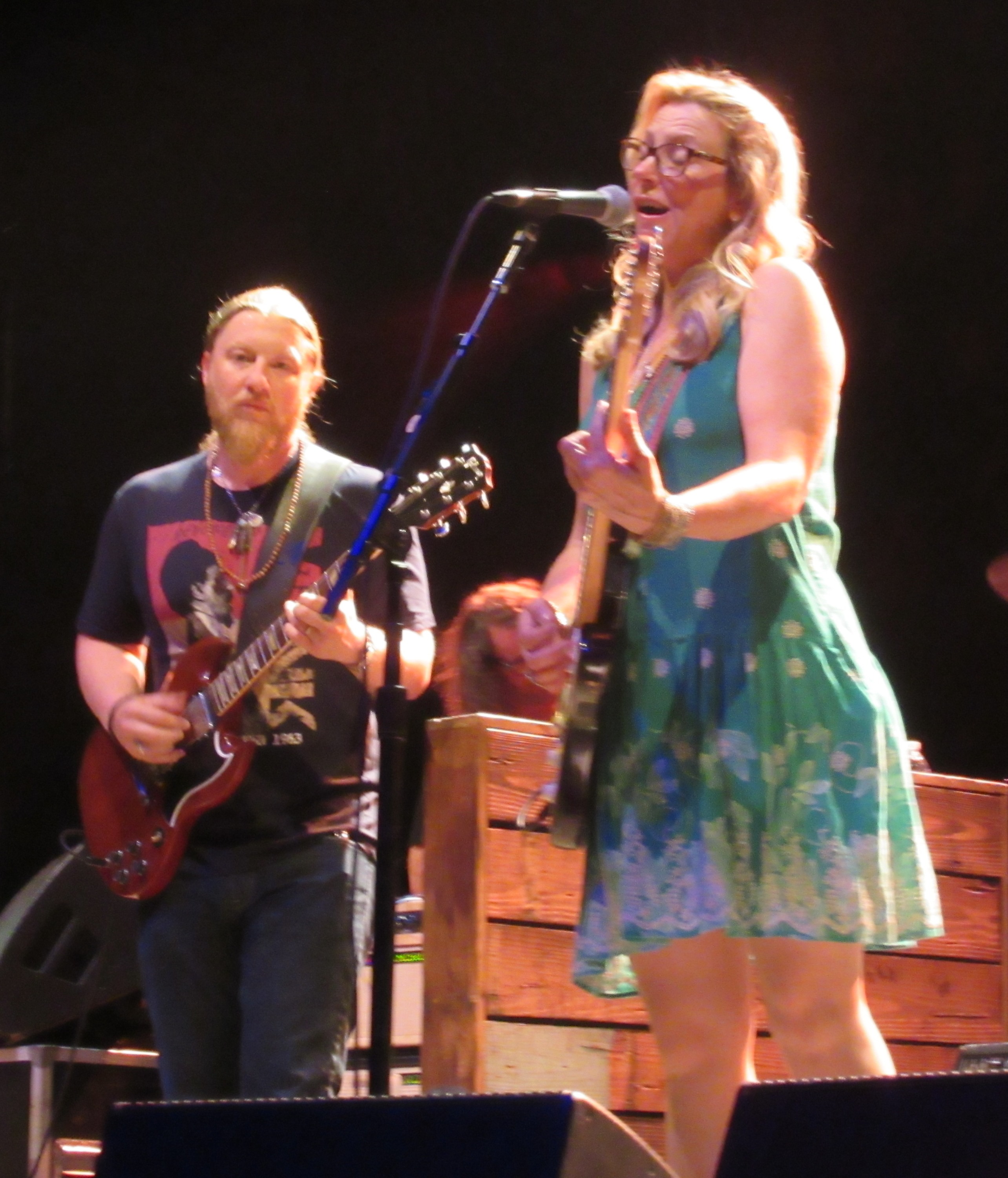
Derek Trucks and Susan Tedeschi at Red Rocks Amphitheater in 2015. Courtesy iwebradio.fm/Kell Yeah Photography

Hear the clarion call of Tedeschi bracing opening note of “Anyhow” signaling the “wreckage in my soul”: Running from a bitter taste/took a rest from all the chase/feeling something anchored in my soul./ played the game by all the/learning lessons no one gets to choose. The song continues about a personal relationship, but that first verse can speak to anyone in the economic 99% feeling betrayed by the game and its rules — the rigged system — whether you lean left or right. The song goes on to speak of cold-hearted desperation among the unemployed and even working poor, and invokes Biblical myth: “Cain and Abel lit the flame/we can never go that way again.” This clearly references brother-on-brother crime, whether it is inner-city shootings, police brutality/homicide, or white-collar financial betrayal.

Yet “Anyhow” is an absolute soul-stirrer — not a downer. And TTB doesn’t preach, they understand the philosophic pause and the medicine of laughter, in the ensuing “Laugh About It.” This band’s ethically-driven sort of communal political synergy resonates from the rapturous gospel choruses right into the groundswell roar of the Bernie Sanders political movement, a sense of empowerment and transformation.

_____________________________

Here is The Tedeschi Trucks Band in a NPR Tiny Desk Concert, performing “Just as Strange,” “Don’t Know What it Means,” and “Anyhow” from the album “Let Me Get By”:

http://www.npr.org/2016/03/24/471725403/tedeschi-trucks-band-tiny-desk-concert

______________________________________________

The instrumental break in “Laugh About It” shows how tight and rich their grooves and arrangements have become, with Truck’s guitar quick-stepping through horn and rhythm counter-punches. You can dance along to it or your music head can marvel. And Susan does laugh about it at the end.

“Don’t Know What It Means” shows this band reaching new heights in its pop appeal, in the power of call-and-response. The refrain glows with as much warm infectiousness as a vintage Sly and the Family Stone song, another collective-oriented stylistic precursor. That refrain melody descends like the slowing last yards of an exhilarating roller coaster ride, and the rhythmic hand-clapping helps turn that dynamic into a Juneteenth Day gospel-infused parade.

The lyric continues the previous song’s laugh-it-off wound-licking: If the story feels exactly like a dream/ don’t know what it means… And you can’t just turn the page and let it go/ things that you’ve been told/ deep down in your soul.”

Rather, it’s time to strategize: “Don’t make your move too early” or you may “surely lose your way.” And the shyster or con man may be poised to snooker the unwittingly earnest. Yet TTB believes self-empowerment perseveres: Now don’t look down in the dirt/ just to find out what you’re worth… To work hard and do it right/ learn to speak up and fight/ the truth is gonna beat them down the line.”

If that sounds preachy to some, it’s hardly fire-and-brimstone browbeating. Rather, it the sort of uplift that even the ostensibly angry American black writer James Baldwin articulated in the voice of his preacher father-figure in his transformative 1962 novel Another Country. The black minister’s own son had committed suicide, yet the father counselled his congregation, all grieving his own son’s death: “Don’t lose heart, dear ones, don’t let it make you bitter, try to understand. The world’s already bitter enough. We got to try to be better than the world ‘…Except for someone — a man weeping in the front row — there was silence all over the chapel…” 1

You find no comparable moments of low-key compassion on this recording, as this band has achieved on their brilliant story-song “Midnight in Harlem.” But the new “bunch of different true stories” now mesh into a bramble-strewn path rising toward sunlight.

“Learn to speak up and fight” can mean collective song as much as righteous chants. A group of remarkably persevering protest singers in Madison, WI have assembled every noon each weekday at The Capitol building for five years — over 1,300 consecutive weekdays — to sing. The Solidarity Sing Along sustains the spirit of the original massive protests of Gov. Scott Walker’s collective bargaining-busting, anti-education Act 10 “repair bill” — which has helped decimate and polarize my home state. The Sing Along’s 60-plus song repertoire ranges from Woody Guthrie’s “This Land is Your Land” to adapted country blues classics and a Ramones song, to originals by participants. The Act 10 bill and its 100,000 protesters helped inspire Occupy Wall Street and now the Bernie Sanders “revolution.” 2

TTB’s solidarity stresses human commonality, via a collective gathering of cultural tribes, from Tedeschi’s ex-gospel choir singer-cum-blues mama roots to Trucks’ voraciously wide-ranging “big picture stance.” Trucks rose from country-blues bottleneck guitar to Allman Brothers’ band trademarks – gutsy singing, swampy blues, pealing guitar riffs for modal flights. And his Coltrane/Shankar micro-tonalities help summon this band’s patented “swamp ragas.” That simmering instrumental vocabulary facilitates exquisitely meditative introductions or segues, which help embrace a more worldly cultural vision.

Flutist-keyboardist Kofi Burbridge highlights “Swamp Raga for Holzapfel, Flute and Harmonium” on “Let Me Get By.” Courtesy Wikipedia.com

And all the band members seem attuned to the wellsprings of the blues, ‘60s-‘70s gospel and R& B, free and funk-jazz, and modern pop-rock, epitomized, of course, by the Beatles.

Which leads me to album’s next song, the slightly tipsy rollick of “Right on Time,” Mattison’s vocal seems to channel John Lennon’s gentle side, “What is it that you lack? What is it that you seek?” Then, the gently bouncing harmonized refrain: “Does a smile come alive when you share the wine..?” and a “Hey!” refrain, with woozy dance-hall horns. The whole effect, the George Martin-esque arrangement, could’ve fit right into Magical Mystery Tour or even The White Album. Heresy? So sue me.

Lyricist and backup singer Mike Mattison of Tedeschi Trucks Band gets two lead vocal spotlights on “Let Me Get By.” Courtesy pghintune.wordpress.com 

For blues-rock buffs who fear they’re getting too cute, the title song is another full-throated empowerment barn burner. “Let me get by/cuz time won’t wait!” And then, they pause again, for a reality check. “Just as Strange,” co-written by Doyle Bramhall II, is a stripped-down Robert Johnson-like wail about abject craving for sex or drugs, as pure  bedevilment.

Mattison’s fervent lead vocal on “Crying Over You” with the deliciously cheesy line “I caught you snooping ‘round swimming pool” segues to a lovely, haunting swamp-raga. The album’s last few songs tread in lost-romance/relationship territory, but very convincingly.

However, the final song (of the non-deluxe album), “In Every Heart,” resounds like a thematic recapitulation, blending reality and inspiration. Mellifluous horn harmonies, the ever-ready background singers, and an easy, reflective groove cue Tedeschi’s voice, honoring a warm primary influence, Bonnie Raitt. Yet “Heart” is TTB’s own statement: “In every heart there’s a name/under the perfume and the blame.” It’s about coming to terms with your true identity and your “story,” admittedly no easy task. “In every heart, there’s a song/ turning the pages… In every song, there’s a psalm/ coming to find you to sing along.”

With a surrogate family like the Tedeschi Trucks gang, one need not be alone. They deliver the power of the song. Perhaps some existentialists will call that mere sop. Me, I’d rather not stand in the rain of my spiritual solitude.

PART 2. I’ll consider the deluxe bonus disc of Let Me Get By and that 2-disc total package in another post, coming shortly.

______________________

  1. James Baldwin, Another Country, Vintage International, 1993, 121

2. Scott Walker, who survived a re-call election driven by the Act 10 protests, later declared, “If I can take on 100,000 protesters, I can do the same across the world,” in reference to defeating the terrorist group ISIS. The spurious analogy may have marked the beginning of the end of Walker’s short-lived presidential nomination bid. Meanwhile, he’s back in Wisconsin working his same far-right agenda and the singers continue, as they say, “until Wisconsin gets better,” as one of their mottos declares.The Solidarity Sing Along is open to anyone each weekday starting at noon at the Capitol. Their Facebook page: https://www.facebook.com/SolidaritySingAlong. At times, noted musicians have joined the participants, including Woody Guthrie’s famous son Arlo and Billy Bragg, who wrote music for and recorded unpublished Woody Guthrie lyrics in his Mermaid Avenue project with Wilco.

For the full story on the Wisconsin protests, see John Nichols’ book Uprising: How Wisconsin Renewed the Politics of Protest, from Madison to Wall Street.

“Let Me Get By” album cover at top, courtesy zumic.com

Why should we care about Miles Davis? New biopic, live tribute, local thoughts

Portrait of US jazz trumpet player Miles Davis taken 06 July 1991 in Paris. Portrait du trompettiste de jazz Miles Davis pris lors d'un concert le 06 juillet 1991 à la Halle de la Villette à Paris. (Photo credit should read PATRICK HERTZOG/AFP/GettyImages)

Portrait of US jazz trumpet player Miles Davis taken 06 July 1991 in Paris.
Portrait du trompettiste de jazz Miles Davis pris lors d’un concert le 06 juillet 1991 à la Halle de la Villette à Paris. (Photo credit PATRICK HERTZOG/AFP/GettyImages)

Why care?

Miles Davis dwells at, and helped create, the root thrust of many music vernaculars of the 20th century — from vintage bop with Bird, to purring like a breeze-cooled cat in Birth of the Cool, to kicking in the blues ‘n’ back beat of workin’, walkin’ hard-bop with Trane, to modal jazz trance with Kind of Blue, to cutting-edge modern slash with his second great quintet, to polyrhythmic Afro-fusion with Bitches Brew, to deep street funk and proto-hip-hop ‘tude with On the Corner. And he always gave us the essence of personal style, as an expression of American individuality and romance. Whew.

Well, that’s by way of introduction to this radio story. Thanks to 88.9 Radio Milwaukee’s Glenn Kleiman and trumpeter Jamie Breiwick for including me in this fine feature. http://radiomilwaukee.org/discover-music/still-care-miles-davis/

The feature, with interviews of Breiwick and me is hooked on Don Cheadle’s highly-anticipated biographical film about Miles Davis Miles Ahead, and “A Tribute to Miles Davis,” (a supper club edition) a live concert event at Company Brewing, 735 E. Center St, Milwaukee, at 9:30 p.m. on April 15. The event is organized by and features saxophonist Jay Anderson along with trumpeter Russ Johnson, pianist Mark Davis, bassist Ethan Bender, and drummer Mitch Shiner. This is an excellent ensemble event, featuring music by and associated with Miles, not to be missed: https://www.facebook.com/events/1671208159798613/

Also, here is a link to my review of the 1983 Miles Davis concert in Milwaukee, for The Milwaukee Journal:https://news.google.com/newspapers?nid=1499&dat=19830218&id=XWgaAAAAIBAJ&sjid=4ykEAAAAIBAJ&pg=4166,4949562&hl=en


Talking talk radio without much progress in Milwaukee…ah, but Chicago!

amy-un99

Democracy Now! reporter Amy Goodman holds a cell phone to her mike for her audience to Allan Nairn speaking to 500 people attending a demonstration for East Timor across from United Nations in New York, in September 2000. The moment illustrates how long Goodman has been on the forefront of progressive journalism. Nairn fell into in military custody in West Timor, after having been arrested in East Timor in 2000 “to prevent the denial of events by the US Mass Media whose owners supply the military and death squads their arms and instruments of mass murder,” according to the website that posted the photo. Goodman’s exposure of Nairn’s predicament helped eventually return him safely to the U.S. when Washington learned from her of the situation. Courtesy:http://www.usthefolks.com/Allan_Nairn.html www.usthefolks.com.

The Milwaukee Talk Radio Project Community is an organization worth supporting, especially if you are not dead-set on voting for Donald Trump or Ted Cruz in Wisconsin’s primary on April 5th.

As they point out fairly, without Milwaukee’s stifling conservative talk radio monopoly we’d have no Gov. Scott Walker. Without Rush Limbaugh’s long, strange trip of a reign on national airwaves — and the recent suicidal contortions of the Republican party — we might not have not have the current preconditions for Donald Trump’s increasingly scary racist, misogynistic,  authoritarian governmental dynamic. Trump recently added nuclear head-tipped saber-rattling against ISIS to his bully pulpit rhetoric. And still, his economically-desperate, lap-it-up faithful somehow believe in this “Superman” confidence man.

Where does that leave Milwaukee in the national political debate? Milwaukee radio does have WNOV’s local urban-orientation talk at 860 AM. Otherwise, Southeastern Wisconsin is lost in an airwaves wilderness where even our unspoiled trees lean right, as if meekly offering their necks up to chopping for a new development or Trump-esque resort. So if you care about fair and balanced discourse on your city’s local radio, do look into The Milwaukee Talk Radio Project Community, an activist support group working to bring progressive talk radio to Milwaukee: https://www.facebook.com/milwaukeeradioprogress/

However, you can stream Madison’s prog-talk radio WXXM 92.1 The Mic on you smart phones, tablet and computers. Try it if you haven’t. I have to plug one of that station’s very strong locally- oriented program with a national literary, cultural and musical scope. That is Stuart Levitan’s Books and Beats from 10 a.m. to noon Saturdays. Stu, a free-spirited lawyer-activist and a former labor-relations negotiator, consistently interviews authors of very substantial, interesting and topical books, and interviews many big-time musicians who come to the Madison area, with his vintage baby-boomer Dylan-to-Deadhead tastes on his sleeve. Full disclosure, he’s a former good neighbor of mine, and a cultural journalist colleague, so I’m slightly biased. But he’s also the author of the fascinating and extremely well-received Madison: An Illustrated Sesquicentennial History, Volume I, 1856–1931., So check out The Mic if you  haven’t here:  http://www.iheart.com/live/the-mic-921-2665/

But I don’t have a smart phone partly due to a manual physical disability, and I love to listen to talk radio while driving my car — then  I switch to a music station during commercials (like WMSE) on my reasonably good car speaker system — like millions still do nationwide. You can allegedly get a stream hook-up to The Mic on WKKV100.7 – HD 3 if you have an HD radio. Well, I have one in my house, and I can’t get it and I miss it, from having lived  in Madison for nearly 20 years. (What am I doing wrong, thoughts?)

Some of my moderate to right-leaning friends say some of my Facebook postings suggest “I lived in Madison for too long.” I’m not sure how different my politics would be had I not moved to Madison from Milwaukee in 1989 (then returning here in 2009). I sure am sympathetic to the plights and challenges of small business people, for sure.

But I’m also a union person, going back at least to my days at The Milwaukee Journal when our then-still fledging Newspaper Guild Local 51 crucially helped me get my part-time staff job back, with full nine-months back pay, after I was improperly dismissed. Well-known liberal Milwaukee columnist and pundit Joel McNally was the bracing steward for our Local 51 chapter at the time. Even though The Journal-Sentinel  in recent years has drastically downsized his staff, as have most newspapers around the country, the Milwaukee paper’s employee union remains, battling gamely for the rights of its members.1

That’s a lot of background throat-clearing to announce that, given Milwaukee’s dearth of balanced talk radio, my new favorite non-musical radio station is Chicago’s Progressive Talk.com WCPT 820 AM which I just discovered on the dial recently. 820 AM has an huge regional broadcast range from sunrise to sunset. FCC rules require them to drop their range in the evening. Among others, the station features progressive talk-can-be-slightly-madcap Stephanie Miller, Bill Press, the superbly incisive Thom Hartmann, and the award-winning (including The 2012 Gandhi Peace Award) invaluable reporter and author Amy Goodman for Democracy Now! (see photo above) with Juan Gonzales, which airs on over 800 stations nationwide, but not in historically-progressive but purple Wisconsin’s largest city.

I really fell for the Chicago station hard yesterday afternoon when a streaming listener, a middle-aged sounding woman from the state of Washington, called up to remind her fellow state voters that Washington state’s caucus is happening this Saturday and not to miss it! But after a bit of a detour comment which I can’t recall, the woman ended her call by musing this lovable mutt of a political non-sequitur: “You know, I think dogs are really in charge of us. After all, they have us following behind us wherever they go — picking up their poop.” Host Norman Goldman was so thrown — clearly caught without a “doggie bag” —  that he didn’t know how to respond. So the woman added in conclusion. “In my house, my cat is charge.”

As for me, that is pretty much true in my one-cat house with Queen Chloe, and of my girlfirend’s two-cat and two-dog house, until recently when her two geriatric canines sadly died in relatively quick succession. But the balance of political power in her house has evened somewhat, between the two male cats, one an alpha male, the other a classic scardy cat, but capable of guerrilla ambushes of the alpha.  Where my girlfriend stands is, well, kind of like John Kasich. And I suspect the Washington woman was groping for a political analogy herself.

I love that kind of live radio, with the droll real-life observations of what sounded like an ordinary middle-class woman, the kind whom I hope will make a big difference in the national election. She’d probably just come in from out of the cold Northwest rain with her poop-filled bag and her dog probably shook all its wet fur off — all over her legs.

The tone of the Chicago station is unpretentious, interesting and heartening, given that it’s the heart of the Midwest politically, culturally and otherwise. I heard some some pointed critique of Chicago Mayor Rahm Emmauel’s very shaky hold on fair, transparent  government and insufficiently diverse administration, and how Republican Illinois governor Bruce Rauner is starving that great blue working-class state with a shoestring budget that would’ve had Oliver Twist pleading for a shoelace for his hole-in-the-sole shoes, along with more food, please. Rauner sounds like one of those hole-in-the-soul GOP politicos, not unlike our own governor.

If my memory serves me from hearing The Mic consistently in the mid 2000s, I’ve sensed a subtle difference of tone and focus between the Chicago and Madison stations. WCPT seems to chew more on the nuts and bolts of “real politics” than The Mic in Madison, though the national commentary is somewhat comparable, especially considering that they share some of the same national talk show hosts as The Chicago station. There is at least a grain of truth to the cliché that Madison is “64 square miles surrounded by reality;” witness the Walker administration.

However, I still love the city, and I just returned to it last week for two wonderful cultural offerings, the very distinctive Harlem Renaissance Museum with Martel Chapman’s arrestingly delightful cubist-jazz portraits and scenes, and a fairly transporting concert by the Madison Symphony Orchestra, led by John DeMain, with guest pianist Emanuel Ax (see my previous post). The city also has a surprisingly vibrant and well-organized jazz scene.

Sometimes you just need another, perhaps fresh take on “reality” — and artistic culture frequently provides that. Nevertheless, we need more democratic airwaves, which actually belong to the people.

And regardless of the Chicago station’s presence — with somewhat spotty reception in Milwaukee — we still need our own station in Brewtown. We are no political outlier of The Windy City. Plus, they’re probably Cubs and Bears fans.

Milwaukee radio needs more democracy, to help to “Make Donald Drumph Again.”

_______

  1. The Newspaper Guild still has over 34,000 members in the US and Canada. For information on Local 51: http://www.milwaukeenewsguild.org/about-the-guild/


The rain, Harlemesque art, and Mahler


mso PIPES

Music director John DeMain conducts the Madison Symphony Orchestra in the stunning setting of Overture Hall in Madison. Courtesy isthmus.com

Rain…Rain…I don’t mind. Shine, the weather’s fine. I can show you that when it starts to rain, everything’s the same, I can show you, I can show you… It’s just a state of mind, can you hear me, can you hear me? — “Rain” by Lennon and McCartney

What a pleasure to be reminded how fortune smiles on Wisconsin with the blessing of two great symphony orchestras. There’s nothing like an orchestra working its big-canvas magic in person. In recent years I’ve reacquainted myself with the glories of the Milwaukee Symphony Orchestra.

On a rain-soaked day, sheets of rain, billows of rain, Ann Peterson and I drove to Madison to hear that city’s superb orchestra, but not before what has become a ritual, a stop at the Pine Cone Inn halfway between the cities in Johnsonville, to pick up a gluten-free monster cookie.
With slightly soggy crumbs nestled in laps, we rolled into Mad Town and stopped first at The Harlem Renaissance Museum on East Washington.

This place is  worth your time although, on a Sunday afternoon, also consider that a religious service is held in the back room, which is the way to enter. So if you make your way quietly to the front galley, you now see an exhibit of Cubist jazz art by the museum’s artist-in-residence Martel Chapman. The exhibit also includes a tribute to the great Harlem Renaissance writer Jean Toomer, a Wisconsin resident and one-time faculty member at the UW-Madison. On display were a selection of Toomer’s letters hand-written and typed to various people during important years of his career and they are illuminating and a bit historically transporting, although I wasn’t taking notes (apologies), so I can’t go into detail.

But Chapman’s art is a marvel. He has an uncanny ability to do conventional oil portraiture with great insight and style. But most of the pieces display his own trademark Cubist characterization of jazz and African-American cultural figures. Despite the almost futuristic stylization he’s capable of capturing the deep character of someone as profound as John Coltrane as he does in a portrait titled “Late Coltrane.” I  believe this is actually an interpretation of the famous black-and-white photograph of Coltrane for the album A Love Supreme.

Late_Trane_AG_thumb

“Late Coltrane,” John Coltrane as interpreted by Madison cubist artist Martel Chapman. Courtesy Martel Chapman

He does the same for white-haired sax icon Sonny Rollins and even superstar Black studies scholar-minister Cornel West. It’s almost as if the artist is torching a living person out of tubes of metal. Chapman’s not going for realism here, rather the essence of the artist, a remarkable achievement somewhat akin to a jazz player’s act of getting to the truth of the matter through a musical stylized abstraction.

Some of Chapman’s pieces comprise complete scenes more akin to Georges Braque’s early, somewhat painterly ” analytic cubism” such as the utterly delightful “Quartet ’58.” This painting interprets the Thelonious Monk Quartet with John Coltrane performing at The Five Spot Nightclub in New York in 1958. The luxuriously-faceted piece is a virtual whirlygig of animated expression spinning out from the fabulous figure of Monk himself whose splayed arms and legs hover around the keyboard like a hipster Gumby. 1

Monk 58

Martel Chapman’s “Quartet 58,” and interpretation of the Thelonious Monk Quartet with John Coltrane on saxophone. Courtesy Martel Chapman. 

For all these fine artistic moments, the afternoon’s main event was the Madison Symphony Orchestra. They rolled up their sleeves with a taste-whetting performance of Beethoven’s Coriolan Overture, Op. 62.
Then Emanuel Ax ambled on. The veteran, gray-maned and portly pianist has acquired a decidedly avuncular demeanor by now. But he sat down and showed that any uncle who can play a Beethoven concerto (No. 4) like this is worthy of inviting to dinner any old time. His playing absolutely sparkled and finely mirrored the orchestra’s rhythmic dancing through the melodies and sonic gusts rippling through deep meadows of sound.
Ax encored with an unannounced Debussy prelude, I believe, which unwound with strangely complex colors and arabesques.

Soon it was time for the centerpiece of the concert, Gustav Mahler’s Symphony 4 in G Major, one of the majestic pinnacles in the standard repertoire, and of late Romanticism.
I’ve always loved this work, as have many.  But it had been so long since I heard this orchestra after covering it for nearly 20 years. I somewhat forgot how fine and firm a grip DeMain has on such myriad details, dynamics and tempo, etc. and how superbly responsive the orchestra is.

They showed us what a ravishingly immersive creation the Mahler is, once again. It must be a supreme pleasure sit in the middle of that and participating in it. I’m still sappy enough of an Irishman to be moved to tears by it.

gustav-mahler-grandhotel-toblach-dobbiaco

Composer Gustav Mahler outside the Grand Hotel Toblach in the Alps. Courtesy grandhoteltoblach.com

So thank you for moving me, my old friends. It’s in the way that all the strange and wondrous colors and rhythms engulf the listener, like a fully-evoked world or lifetime of memories, and then the finely-wrought melodies and fanfares that swell up like water-drenched sirens. This all leads to that late, luminous cathedral-like chord rising to forever, not long before the soprano enters.

This is DeMain the Grammy-winning, Leonard Bernstein-mentored opera conductor synthesizing those skills into the orchestral domain for a rare sort of larger-than-the-moon musicality. He’s clearly spent all the time necessary for a reach for transcendence, having performed the whole Mahler symphonic cycle during the years pI lived in Madison. I would love to hear this band record a Mahler symphony.

demain conduct

A protege of Leonard Bernstein, DeMain has led the Madison orchestra for 22 years.

And such a celestial song in the finale, though guest soloist Alisa Jordheim, still doesn’t compare to the warm magnificence of Judith Raskin with George Szell and the old Cleveland recording. Ms. Jordheim had confessed to DeMain that she was suffering from a cold, which did not seem to affect her voice’s lovely timbre. But at moments she seemed to strain to project over the orchestra.

Still, it came to a marvelous end, like a winding scenic journey to a high vista.

And finally DeMain nudged the unaccompanied basses along to extend the symphony’s last very note, like an earth-whispering Ommmm.

Sublime. I could go on, but it would be just the German side of me getting a little oom-pah pushy.

So we headed home. And the rains came, again, stronger than ever.

______

  1. For news on the museum’s first year anniversary and future plans, check out Pat Simm’s Wisconsin State Journal article:http://host.madison.com/wsj/news/local/madison-s-harlem-renaissance-museum-celebrates-first-year-plans-for/article_a1f73372-1a82-52bc-b0dd-4f9caaee33dd.html


Pianist Mark Davis shows how to make jazz in a new method book

Mark Davis pianist author

Jazz pianist and author Mark Davis practicing at the Wisconsin Conservatory of Music where he directs the Jazz Institute. Photo by Kevin Lynch

In person, Mark Davis exudes warm, affable intelligence. At the piano he translates his personality, knowledge and talent into penetrating, fluent and swinging music. He’s the city’s premiere jazz pianist, director of the Wisconsin Conservatory’s Jazz Institute, and pianist with the school’s faculty jazz ensemble We Six, which can be heard on the recording Bird Say. He’s performed with jazz greats Jimmy Heath, Charles McPherson, Slide Hampton, and Frank Morgan, among others.

And now Davis is the author of Jazz Piano Method , published by Hal Leonard , which may become one of the most effective and efficient ways to learn jazz piano, short of taking lessons with a gifted musician and teacher like Davis. The book includes online access to 180 recorded examples of its practice exercises, each introduced and performed by Davis himself.

Mark Davis w book

Courtesy halleonard.com

What’s the genesis and motivation for this book?

I’d thought about this for years working with students of all different backgrounds and levels. There wasn’t  a perfect book to recommend my students that fit my way of teaching. So why not write my own book? In 2008, I began recording for Hal Leonard (the world’s largest music publisher) accompaniment tracks for various books including The Real Book (a primary jazz repertory book) with bassist Jeff Hamman and drummer Dave Bayless. But I really wanted to write the jazz piano method. Everybody teaches jazz differently. From pianist Barry Harris, I learned how interconnected teaching and playing are. I hope the book allows students a method to find their own way.

There is an inherent mystery to jazz in that it seems created out of the ether. But you give each note a purpose and get into why the music sounds and feels this way . For example, you point out that diatonic chords are ones that contain the same notes as other chords– which helps a student move through progressions musically and easily.

Jazz is not easy music play. You can get very comfortable with certain chord progressions and I hope the book gives people the fundamentals to give them a certain kind of freedom, so they can really take off.

Another example of useful theory you address are “shell voicings” and extensions.

My home base as a musician comes from the bebop approach, so shell voicings is a left-hand technique that bop pianist plays. But they also use, say, a tenth  interval (extension) but I show them how to get around that by breaking the chord up, as well as things like rootless voicings. Also, you can’t be jazz musician without understanding what came before. I’m using the bebop era as the starting point, rather than Herbie Hancock or Keith Jarrett.

But this can get them to Hancock or Jarrett. You emphasize learning directly from recordings. Also you address the idea of tension and release in the basic II-V-I chord progression. Doesn’t this help a student make an aesthetic choice, to make these decisions for expressive, dramatic or sonic effect?

Tension and release is an important factor in so much music, or even in movies or drama. If you just give a student a scale to improvise with you can point out the tools to see how tension and release occurs, which is the drama music. Otherwise it’s like going to a movie where nothing really happens.

In Chapter 5, you make a strong point that the rhythmic feel and the blues feel are the most important things, even more than the correct note or chord. Why is that so important?

Learning to play jazz is similar to learning a language. When a baby is learning to speak, before words they get the rhythm of language,  it sounds like talking but you don’t hear the words. Then the meaning starts to be filled in. Same in jazz, the more we learn, the more we can fill in, like language, the specific thoughts or ideas.


At the end, why do you characterize jazz piano as a never-ending journey and a quest?

In his 90s, Hank Jones said, you never fully master it. I find that students with careers outside of music can find a way to escape the day-to-day grind and of our own personal lives — escape inside music to a place where nothing really else matters. Charlie Parker didn’t want to go back to that other place. Maybe that’s why he was such a genius player. It’s the beauty you can find within music.

What I hope is that teachers will use this with students and now have the background using as a guide to teach jazz and they can pick up on these pocket topics and run with it in their own way. For example Brian Lynch is really excited about what his students are doing with it at the Frost School of music in Miami. I want to get this book into schools.

Among other jazz piano books, Davis notes, Jazz Piano by Mark Levine is an excellent book which I recommend. But it’s more of a reference loaded with information, where my book is a method, a pathway hopefully to come away with a much deeper understanding of music and approach for how they can continue to play it.

I don’t want to give them too much information because people can become overwhelmed by this music. I want them to enjoy learning how to play jazz.

Mark Davis and We Six will perform at 7:30 p.m. March 18 with guest artists Brian Lynch, a Grammy-winning trumpeter originally from Milwaukee, and Benny Golson, a renowned jazz saxophonist and composer, at Marquette University’s Weasler Auditorium, 1506 W. Wisconsin Ave.  Over a distinguished career, Golson has worked with, among others, Tadd Dameron, Art Blakey and the Jazz Messengers and the Art Farmer-Benny Golson Jazztet. Golson has written a number of jazz standards including “I Remember Clifford,” “Killer Joe” and “Whisper Not.” He’s also composed for TV shows including Ironside, M.A.S.H., and Mission Impossible. For information, visit www.wcmusic.org.

BennyGolson_500p

Benny Golson. Courtesy jazzpages.com

_______

This interview was originally published in The Shepherd Express in a slightly different form.

“Nature and the American Vision,” the birth of original American art on view in Milwaukee

_CatskillCreek_Cole

“Catskill Lake, N.Y.” By Thomas Cole, one of the co-founders of the Hudson River School.

Here’s my review of the extraordinary Milwaukee Art Museum exhibit Nature and the American Vision: The Hudson River School  in OnMilwaukee.com:http://onmilwaukee.com/ent/articles/mamhudsonriverschool.html

Here are a few extra images from the show that I comment on in the review, plus a few notes at the bottom.

Albert Bierstadt (American, 1830-1902)Donner Lake from the Summit, 1873Oil on canvas: 72 1/8 x 120 3/16 in. (183.2 x 305.3 cm)Gift of Archer Milton Huntington, 1909.16

Albert Bierstadt (American, 1830-1902)Donner Lake from the Summit, 1873Oil on canvas: 72 1/8 x 120 3/16 in. (183.2 x 305.3 cm)Gift of Archer Milton Huntington, 1909.16

Donner Pass

Here’s a photo of the still-imposing Donner Pass today, above Donner Lake, which I drove through in 2014. It is the highest point in the Sierra Nevada mountains.


Pioneers Donner Pass

This painting is not from the Milwaukee Art Museum’s “American Vision” exhibit. It is an artist’s rendering of 1846 Donner party battling the the blizzard they encountered in the rugged mountain pass that would be named for them. 

INiagara Falls Minot

“Niagara Falls” (1818) by Louisa Davis Minot is the earliest Hudson River School painting in the exhibit.

1858_1_CourseOfEmpire_Savage_Cole

Thomas Cole, “The Course of Empire — The Savage State.” 

1858_4_CourseOfEmpire_Destruction_Cole

Thomas Cole, “The Course of Empire — Destruction.”

___________

This review was originally published in OnMilwaukee.com

Here are a few notes about a somewhat comparable show you may have seen at MAM, Masterpieces of American Art, 1770-1920, work from the Detroit Institute of Arts.

1. That 2005 show was more diverse and diffuse but slightly less impressive over all than the Hudson River School show, especially with the new show’s celebrated “The Course of Empire” series by Thomas Cole. However, Masterpieces included two works that would enhance this show. There’s nothing quite as spectacular in this show as Hudson River School member Frederic Church’s “Cotopaxi” from that show. But then, there are no active volcanoes to render in North America (another brilliant South American mountain painting by Church, “Cayambe” (1858) is in the new show).

2. Also, Church’s “Niagara,” in that earlier show, is perhaps the most accomplished and definitive painting of the falls, as impressive as Louisa Davis Minot’s Niagara painting is in the new show.

3. Cole’s 1836 “Destruction” may have been a model for English Romantic painter John Martin’s 1851 “Destruction of Sodom and Gomorrah,” as the two painting compositions are remarkably similar:

John_Martin_-_Sodom_and_Gomorrah

Reproduction of Albert Bierstadt’s “Donner Lake from Summit” is courtesy www.hawthornehotelblog.com  All other images courtesy The Milwaukee Art Museum and The New York Historical Society, unless otherwise noted.

Ches Smith carves out his own resonant space in chamber jazz

smith-taborn-maneri

The Ches Smith Trio: Craig Taborn, piano; Mat Maneri, viola; Ches Smith, percussion. hallwalls.org.

Ches Smith The Bell (ECM)

Music of The Bell seems about the interplay of the subtlest of overtones, not unlike the layered harmonic convergences of multiple bells when played on a steeple. That’s a way of imaging and accessing this chamber jazz, which sometimes elides listener engagement with minimalist vamps and fragmented indirection. Underlying, more promisingly, is a sense of internal three-way dialogue.

ches cover

The title piece opens, casting a suspenseful aura. Vivid scenarios unfold — Mat Maneri’s musky viola often serpentine and mysterioso — and arrestingly on “I’ll See You on the Dark Side of the Earth.” A songful purposefulness arises in the latter part of “I Think.” That vigorously fraternal sparring leads to “Whacken Open Airwith a funky, push-pull tension that fully employs some of pianist Craig Taborn’s powers of dynamic attack and improvisational resource. “It’s Always Winter (Sometimes)” seems to tell an under-heated but sympathetic winter’s tale, with each player allowed enough to play to presume a character’s presence. In all, Taborn’s performance skills feel underused, but this is spatial art music. (Kevin Lynch)

Bell

___________

The Ches Smith ECM Trio performed on Feb. 23 at Bay View United Methodist Church, 2772 S. Kinnickinnic Ave., Milwaukee. 

This review was originally published in slightly modified form in The Shepherd Express.