
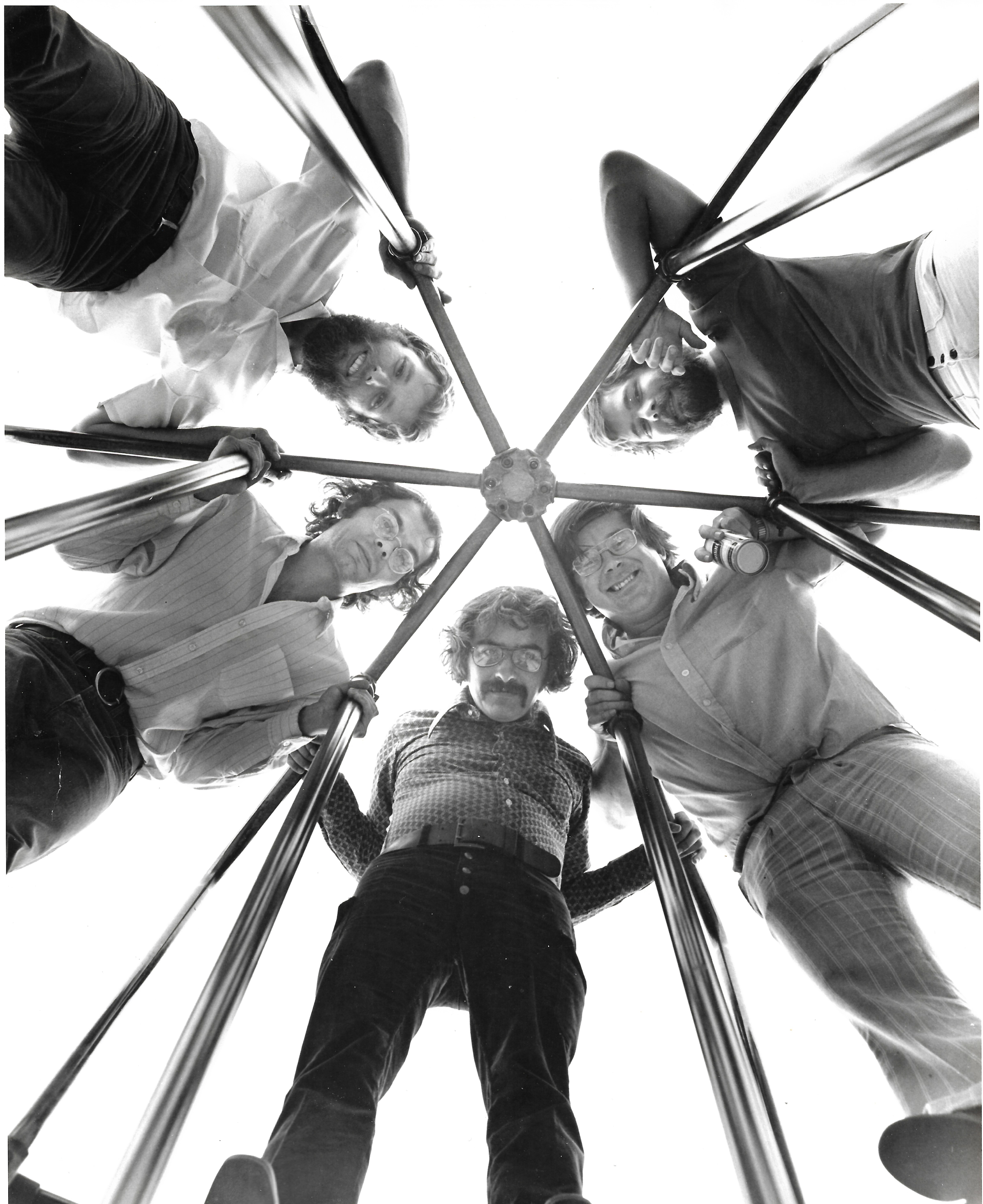
 Mitch Covic was a founding member of the extraordinary and adventurous Milwaukee band What On Earth. Original band members included (from top right) guitarist Jack Grassel, trombonist-composer Bill Schaefgen, pianist Leigh Cowen, bassist Mitch Covic and percussionist Andy LoDuca. Photo courtesy of Jack Grassel.
A story about proximity and distance, life and death. The relative nearness of you, times two. A pair of recent deaths in the upper Midwest jazz community render me, for one, inadequate to fully honor the quietly titanic Milwaukee jazz guitarist Manty Ellis. So many musicians and fans have already commented in honor of the man and the artist.
For sure, Ellis was the first guitarist I heard live who was a real original who emerged from the Wes Montgomery tradition. He had his own ideas, sense of time, space and swing. He was a true tonic of harmonic vibrancy: The chording, the punchy, percolating lines that spilled out of his guitar and then often stopped or shifted before you thought this was going anywhere predictable.
To his credit, he wasn’t really easy listening. At his best, he was bracing, a shot of musical bourbon.
And he also had his own guitar store for years and was instrumental in developing the Wisconsin Conservatory of Music’s award-winning jazz degree program. In 2025, the Jazz Foundation of America granted him the Jazz Fellowship Legacy Award. He hosted jam sessions at the Jazz Gallery Center for the Arts virtually until he died, at 93, on July 9.
Another Plane of Music
But having studied with pianists, I didn’t know Manty well. A more personal kind of loss had occurred the day before, on July 8, when bassist-composer Mitar Mitch Covic, 82, passed to another plane of music and art. Mitch was a colleague of Manty’s in the early years of that burgeoning WCM jazz program.
Due to the near-but far-proximity of Chicago, many readers may not know his name. The Milwaukee native once told me his dream job was to be a producer of classic recorded jazz archives like Michael Cuscuna, whose collection of re-issued Mosaic recordings are revered in the jazz world.
Covic could’ve done a comparable job if he had the chance. He is perhaps best known in the Milwaukee area as the man who in, effect, co-founded the Milwaukee Jazz Gallery with Chuck LaPaglia in 1978.
Few living musicians know how accomplished Covic was than guitarist Jack Grassel,. who worked with him extensively from 1970 until Covic moved to Chicago.
“Mitch was a smart, honest man with strong integrity,” Grassel recalls. “Wherever he went things he touched improved because of his presence. He thoroughly knew the history of jazz music. We spent a lot of time in the car traveling to far-away gigs talking and listening to fine music. He was a big fan of Charles Tolliver. We listened to a lot of Tolliver music together. especially the Music Incorporated album which was his favorite.”
In my July 1979 Milwaukee magazine feature on the Gallery, I refer to Covic as the “talent booker.” Chicago-native LaPaglia needed somebody hip to both national jazz and the Milwaukee jazz scene, like Mitch, to get it going.
Century Hall Days
But backing up, I refer to Covic as the “man behind the East Side Performers Workshop,” which he led at Century Hall, and “flourished for too-short a time at the pre-disco Century Hall.” It encompassed most of the performing arts. It was a classy, old historic building, with an elegant bar and good performance space. Covic was the perfect match for Century Hall as a knowledgeable, cosmopolitan arts maven.
Max Samson once wrote this recollection of Century Hall: “Milwaukee’s poets finally had a worthy venue (for poets) each Monday where they would be paid for their reading. Great Jazz jam sessions (led by Mitch) and dance concerts drew aficionados. Even the Milwaukee Ballet performed—ballet director Jean Paul Comelin referred to it as bringing ballet to the steelworkers, although I don’t believe there were any steelworkers. Certainly, if you liked ballet, being three feet away from the prima ballerina in a pax-de-deus was a thrill.
“We eventually formed our own theater company under the direction of Paul Sills, and presented Monkey, Arnold Weinstein’s adaptation of the ancient Chinese story of the monkey who steals the golden apples of eternal life from the gods—until Buddha teaches him humility.”
Covic acted in and composed original music for Monkey, in a cast that included soon-to-be-famous comedian Will Duerst.
Open Jam Sessions
Covic transplanted his Sunday afternoon open jam sessions to the Jazz Gallery upon leaving Century Hall. Chuck LaPaglia was inspired to open the Gallery by his memories of great Chicago jazz clubs like the Beehive and, as an amateur saxophonist, he had connections with ace Chicago players like multi-instrumentalist Ira Sullivan and vibist Carl Leukaufe to help build touring national jazz artist traffic, from Chicago.
Back to Covic the booker: His list of contracted artists was ambitious and substantial. Among those who soon played the gallery were guitarist Joe Pass, ex-Miles tenor saxophonist George Coleman and innovative alto saxophonist Lee Konitz. But this was a small sample of who ended up playing, among national names.
The big early jazz names booked included bop icons Dizzy Gillespie and Sonny Stitt, renowned vibist Milt Jackson, modern jazz vibist Bobby Hutcherson, trumpeter-singer Chet Baker, sax giant Dexter Gordon, iconic alto sax player Art Pepper and singer Betty Carter, among others. The Jazz Gallery also hosted some avant Chicago AACM acts, including pianist Muhal Richard Abrams, and saxophonist-conceptualist Anthony Braxton. 1
A key Milwaukee figure in establishing the MJG among local and national musicians was pianist-vibist Buddy Montgomery (brother of renowned guitarist Wes), with whom Covic played for a while.
Many Genres
Early Jazz Gallery acts included other genres like blues, hip folk music, off-beat comedy, benefits for community organizations, and theater, including the avant-garde Theater X (which produced much talent including renowned actor Willem Dafoe). Then-still fledgling now-famous folk-punk group The Violent Femmes played regularly at the MJG.
My Milwaukee magazine article also refers to the “the intergalactic shuttle service” of What on Earth? as one of the Milwaukee bands that paved the MJG’s way to distinction. Covic was the founding bassist in that avant-garde-ish quintet led through its duration by the late trombonist-composer Bill Schaefgen.
However, Grassel, also a founding member of the band — along with Covic, pianist Leigh Cowen and percussionist Andy LoDuca — insists that the band’s concept originated with Covic. “The What on Earth band was his idea,” he says. A key to the irreverently outward-bound group was the pianist Cowen who, though Bill Evans-influenced, was extremely exploratory yet innately lyrical. “Mitch loved Leigh Cowen’s playing,” Grassel says.
Sadly Leigh Cowen, who had moved to the Upper Peninsula a number of years ago, passed away in Chapel Fall, MI, at 83, on November 11, 2025. 2
A younger generation arrived with Milwaukee trumpeter Brian Lynch, now a multiple Grammy winner, and acclaimed pianist David Hazeltine. They got their early performance training at the Milwaukee Jazz Gallery, and in a band they called Cramer Street which played there frequently.
Lynch so impressed Art Blakey when the drummer played at the gallery that Blakey hired him for the last edition of the Jazz Messengers. The group Blakey brought to the Gallery included young virtuoso brothers Wynton and Branford Marsalis.
Unique Array of Talents
After the Jazz Gallery closed in 1984, LaPaglia parlayed his experience and connections, as talent booker for Yoshi’s in Oakland, the best jazz club in the West Coast during his tenure there.
Though he would probably have never said it, Covic’s unique array of talents probably needed a larger canvas than the Gallery and he moved to Chicago where he met his soon-to-be life partner and spouse: dancer, arts administrator and nature conservator Jacqui Ulrich, and soon made his mark on the Chicago cultural scene.
He opened “his own version of the Jazz Gallery called Cross Currents,” Ulrich says. “He played with great intensity and concentration,” comments Milwaukee pianist Steve Tilton, who was also “enthralled with the well-designed” Cross Currents venue in Chicago. Besides music, Covic staged theater and dance and specialized in accompanying poets on bass.
His distinctive style was perfect for this. (Like Manty Ellis) he wasn’t among the more recent generation of jazz string players who, perhaps influenced by Stanley Clarke and Jaco Pastorius, relied on ever-accelerating chops and pure digital velocity—impressive but the art was sometimes lost in the blur.
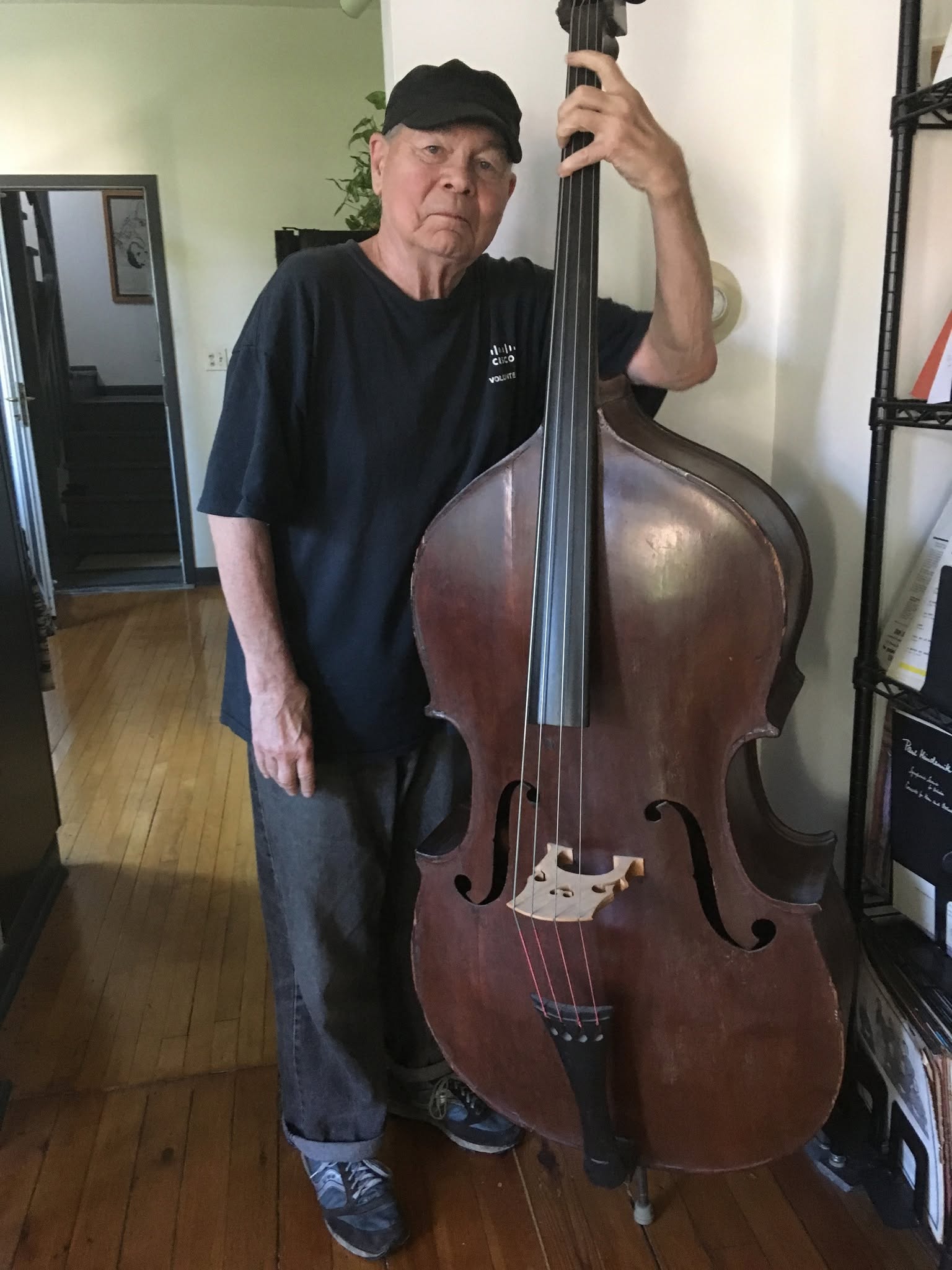
The unusual chord Mitar Mitch Covic is fingering, in this late photo, characterizes his deeply probing harmonic and poetic sense of lyricism. Photo courtesy of Jacqui Ulrich
Rather, Mitar Covic, who’d adopted his ethnic Serbian moniker by then, understood that every note and chord counted, as did every grace note.
He had a tendency to lean over and embrace the bass fiddle as he played, not unlike the great Charlie Haden, whose buoyant, soulful and deeply spacious bass playing his often recalled. This style exquisitely complemented poets, allowing them room to articulate, and for their thoughts to resonate like his deepest chords.
The longtime and beloved Milwaukee poet-singer-pianist Louisa Loveridge-Gallas began a musical relationship with Covic when he accompanied her reading from her first book of poetry at Century Hall decades ago. “He was very sensitive, he knew how to do space, move in and out (of your text), and he walked the bass beautifully,” she recalls. “He was elegant, gentle, and stern, an elite musician.” 3

Jazz Colossus
Covic served as music director for widely performing and published Chicago poet David Hernandez and Street Sounds, who played at Woodland Patten in Milwaukee several times.

Mitch Covic (right) and poet Mark Turcotte (left) Photo courtesy of Jacqui Ulrich
The bassist also worked extensively with acclaimed Chippewa poet Mark Turcotte, then a resident of Fish Creek, Wis., and currently the Illinois Poet Laureate. Mark and Mitar recorded the powerful CD album Road Noise.
Covic helped organize and run Neutral Turf, the poetry festival at Navy Pier and had involvements with the Latin Music Festival in the Chicago. He taught at the Chicago Center for Urban Life and Culture and the Associated Colleges of the Midwest Arts Program. As an arts advocate, he consulted with Illinois Arts Alliance, and the City of Chicago.
Covic also developed a series of solo bass concerts, Off the Deep End, a challenging and distinctive medium. “Mitar asked the audience to listen to the low end of the audio spectrum with his performances of bass and voice with Zahra Glenda Baker,” Ulrich says. Though I never witnessed these recitals in person, I can imagine his requisite courage, artistry and imagination. He mentioned, in one e-mail to me, a notably characteristic solo bass piece title, “Dirge for the Death of an Ideal.”
Perhaps some ideals have died, or died with Mitar, but I doubt it. Not long before his death, he urged me to read Aiden Levy’s 600-page-plus magnum opus, Saxophone Colossus: The Music and Life of Sonny Rollins, which he had just finished reading. I haven’t gotten to it yet. As it happens, Mitar outlived Sonny, who died May 25, by a few months.
In his modest but proud way, Mitar Mitch Covic—also a poet, educator, community organizer, archivist, opera lover and wine connoisseur—was his own sort of colossus and, in my mind, will remain standing as surely does the Colosseum in Rome.
___________
Screenshot
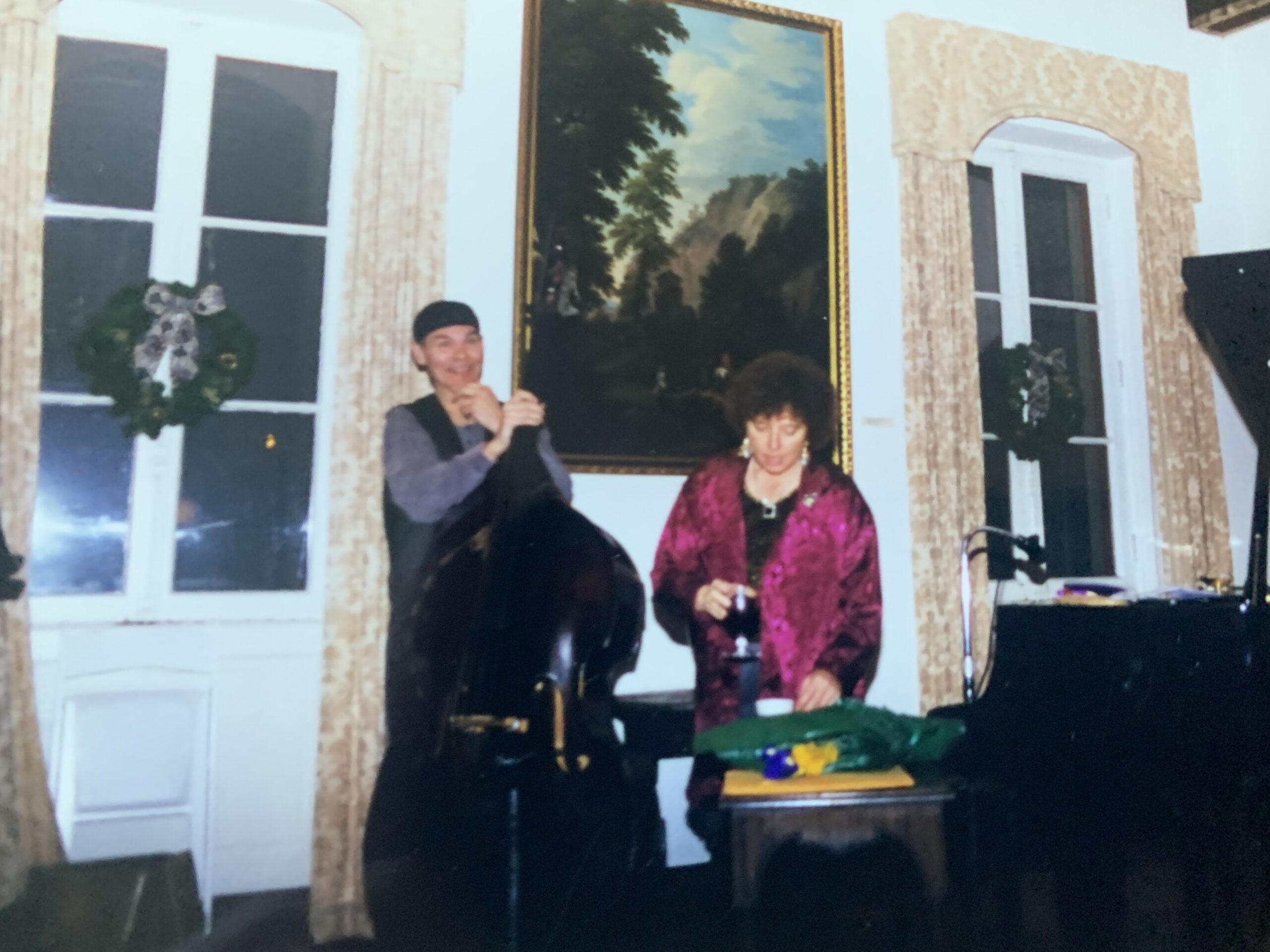
Mitch’s Milwaukee roots: Here’s bassist Mitch Covic (above) with Milwaukee poet-singer-pianist Louisa Loveridge-Gallas at Century Hall.
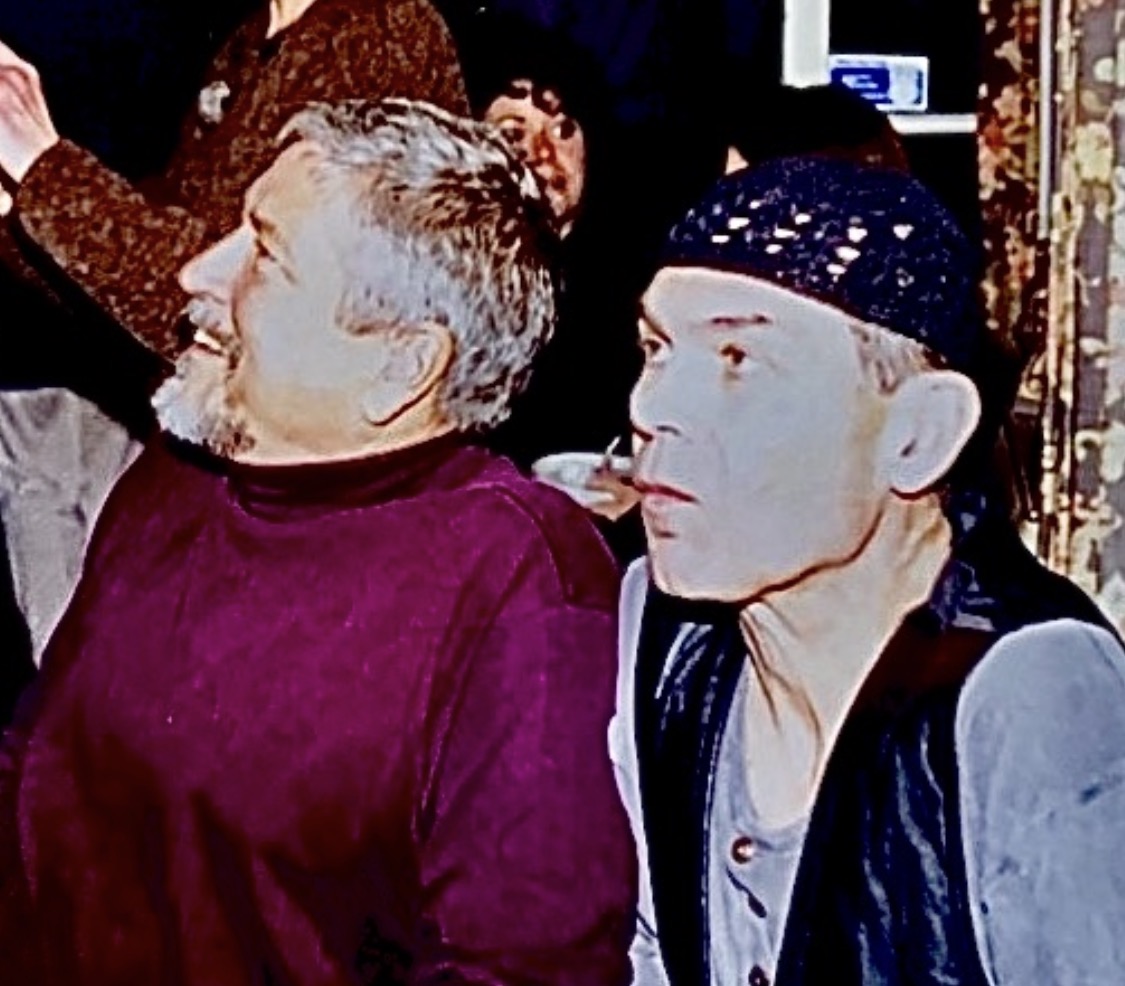
In the second photo, Mitch Covic (below, right) attends a reception with a longtime mutual friend of Covic and Culture Currents bloogger — Jim Glynn, musician, and popular WMSE radio host. Photo from Jacqui Ulrich, modified by Harvey Taylor.
1 The extensive press coverage of the Milwaukee Jazz Gallery was collected by LaPaglia in the anthology Milwaukee Jazz Gallery 1978-1984, which is available at the Jazz Gallery Center for the Arts, 926 E. Center Street, in the same location as the original Jazz Gallery.
2 Pianist Cowen and the great Milwaukee saxophonist Berkeley Fudge, who played widely with both Ellis and Covic, later had a successful duo with Cowen in the !980s. They played at my first wedding to Milwaukee Journal reporter Kathy Naab in 1983.
3 On a more personal level, my own modest parlor jazz-ish piano playing developed to the point where I once played a couple of tunes for Mitar Covic and Jacqui Ulrich: Wayne Shorter’s “Infant Eyes” and a tune I’d written for baseball’s color-line pioneer Jackie Robinson, titled “Vindication.” At the end, Jacqui burst into spirited clapping and Mitar appreciated me in no uncertain terms. I’ve never been prouder to play for such a distinguished audience. A manual auto-immune plexopathy ended my piano playing not many years later.
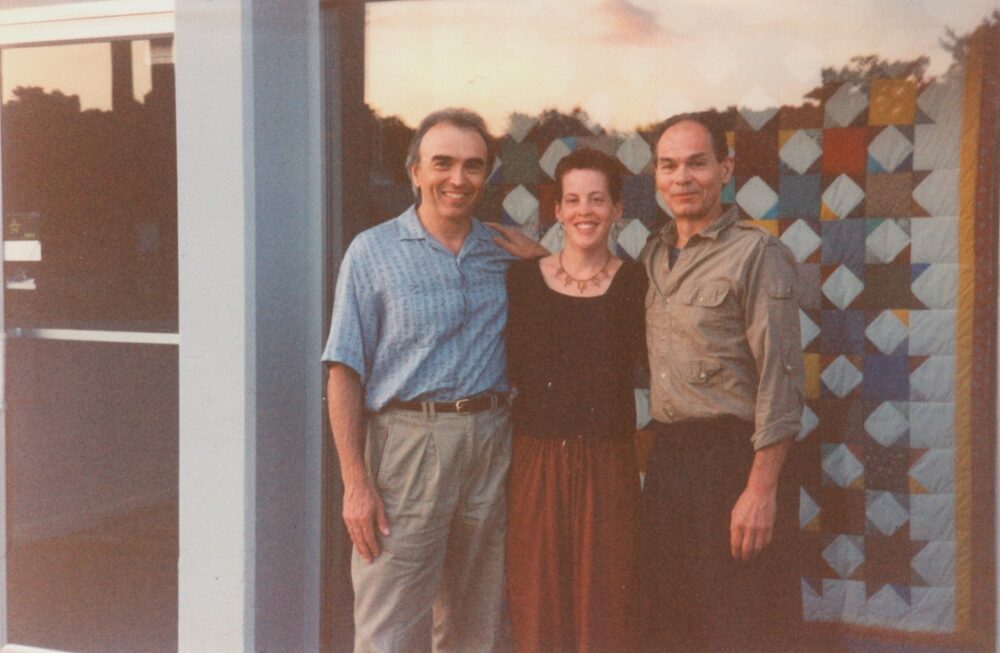
NOTE; The new theme photo at the top of Culture Currents (Vernaculars Speak) is in honor of my esteemed friend, Mitar Mitch Covic, remembered in this blog essay. The photo includes (from left) Kevernacular (Kevin Lynch), Jacqui Ulrich and Mitar Mitch Covic on a street on the west side of Chicago, in the early 2000s.
This article was originally published in slightly altered form in The Shepherd Express, here: https://shepherdexpress.com/music/local-music/remembering-manty-ellis-and-mitch-covic/