Stemper’s “Persistence of Honor” (Preferred performance link) and other upcoming Stemper events


Holland-Honor

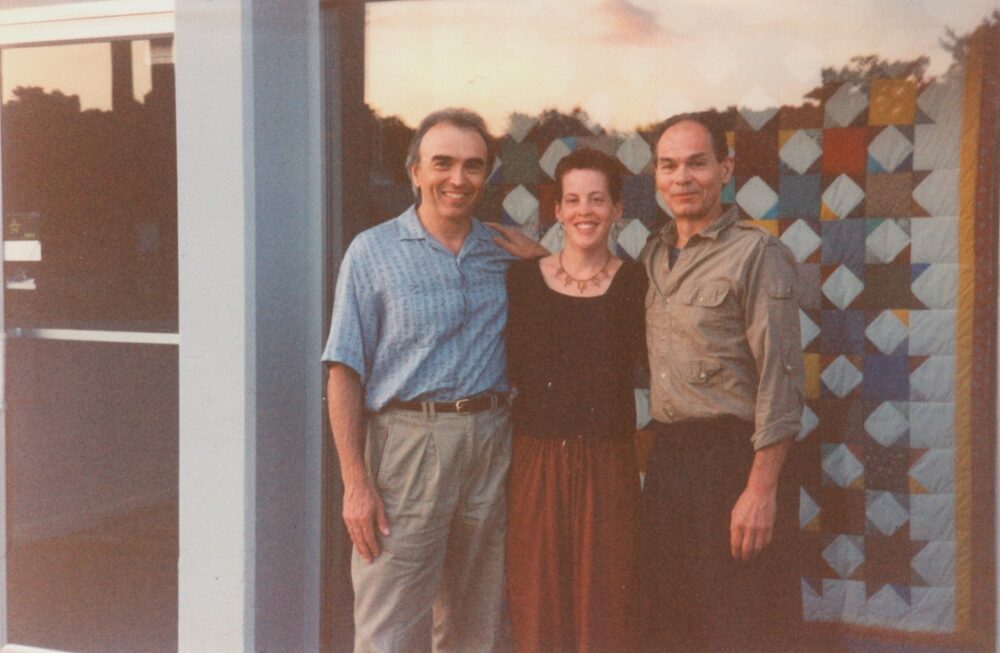
Here is a photo of the premiere performance of Frank Stemper’s “The Persistence of Honor,” in the Netherlands in 2009.

Here is a link to what composer Frank Stemper believes is the best recorded performance to date of  “The Persistence of Honor,” his piece for cello and chamber orchestra. This performance was by The New Chicago Chamber Orchestra, conducted by Edward Benyas, Music Director, with Eric Lenz on cello, on October 28, 2012 at Preston Bradley Hall in The Chicago Cultural Center: http://www.frankstemper.com/10ThePersistenceofHonor_000.mp3

I reviewed this composition in a recent Culture Currents blog https://kevernacular.com/?p=3450 based on a live rehearsal performance conducted also by Benyas, with a student of Lenz’s, Richard Davis, on cello on April 7 in Carbondale. I also referred to the score and this recording which is audible by clicking the “LISTEN” tab on Stemper’s website at http://www.frankstemper.com/STEMPER-COMPOSITIONS.htm

There are three more of Frank Stemper’s works upcoming:

APRIL 12, 3 PM Unitarian Church, Carbondale, String Trio (2008)Southern Illinois Chamber Music Society. 

JUNE 4, 4 PM Colorado State University, So It Goes (1999), Ensemble Pastiche

JUNE 22, 9 AM Zipper Hall at the Colburn School – Los Angeles, Isolated Criterion No. 2 (2008) Jacob Tews, violist

Go to Stemper’s site (above) for more information.


Stemper’s “Persistence of Honor” speaks volumes in pure music

stemper

Perhaps you haven’t heard of him, but Frank Stemper has built an auspicious career as a composer over his 30-year residency as director of the composition program at Southern Illinois University. He dwells beyond the fashionable circles of contemporary classical music which may catch periodic attention on NPR, or the rare forays of mainstream classical ensembles into contemporary repertoire.

Well, listen up (and below), judge for yourself. Stemper carries a strong reputation in many parts of the world as well as the U.S. by following his own vision, one that’s not easily pigeonholed or even marketed.

He is good enough to have been nominated for a Pulitzer Prize and a Grammy Award, and to receive an N.E.A. Fellowship. 1 He’s received enough honors and commissions to sustain a global reputation. And yet, the annual Outside the Box Festival of New Music he has long co-directed at SIU somehow reflects his own peculiar comfort area — out on the windswept fringes, perhaps not far from the precipice lurking over the tumble into obscurity. More specifically, Stemper has worked for many years exploring the formal and sonic possibilities of through-composed music in an expressionistic post-Schoenberg/Sessions/Carter mode and sometimes with strong jazz undercurrents (He began as a jazz pianist).

Some of Stemper’s most striking and indelible music has been driven by his social and political awareness — for example, “Secrets of War,” the vividly executed George W. Bush -era piece for orchestra and voices, and the 2007 chamber orchestra work “Global Warming,” stormy, fulminating musical statement on this vast geo-political issue. This was a point when climate change had reached a crisis mode — from the melting polar caps on down — in terms of human response to this creeping, increasingly devastating phenomena. And some of his most affecting and personal works are with texts, such as “A Love Imagined” — verse written shortly after poet Herbert Scott learned of the leukemia that eventually killed him — and “The Sensation of Waking,” with an autobiographical text by the composer. Stemper started early with text setting; his PhD dissertation work was Seamaster, a cantata for soprano and chamber orchestra, for which I provided a libretto. 2

Yet nothing has move me in Stemper’s oeuvre more than the “Persistence of Honor.” Though nominally programmatic, its emotional and dramatic power derives from pure orchestral music. The 10-minute work was commissioned and premiered by Het Wagenings Orkest ‘Sonante” in The Netherlands in 2009.

I had my first opportunity to hear it performed live at a dress rehearsal for the climaxing concert of SIU’s 2014 Outside the Box Festival, which centered on a retrospective of Stemper’s music, in honor of his retiring this year from his faculty position, though he will continue to compose, as he put it “without a net.”

Stemper marks the score of The Persistence of Honor with the instruction: “Mysterious, hazy.” And his metronome marking instructs that a quarter note be played at a fairly languorous 60 per minute tempo. (See link to page one of the score:)

HONORBEGINNING (1)

A mysterious legato tonality creeps in with violins sustaining a high B, against which first the oboe interposes four notes a whole step higher, and the flute inserts a B flat, then two As and two more B flats, for a distinctly warped dissonance. This icy legato glaze is immediately “out there,” recalling Gyorgy Ligeti’s space music for 2001: A Space Odyssey.  Then the solo cello enters to somewhat ground the music, with a mordant descending theme starting with a high flatted C (or B) 32nd note sliding into several B flats. So with the bitonal seconds (B against B flat) Stemper immediately creates a conflicted, ambiguous tonality that — by the time the cello completes its submerging line — begins to get under your skin.

And then the primary rising melody arrives, a steadily repeated motif that you seem to get to know even as it changes slightly each time it is re-articulated. The motif illustrates Stemper’s composing process because, compared to many of his scores for larger ensembles, this score is relatively simple. “Composing for me is a process of drawing out the consequences (as I perceive them) of an initial idea … Once the idea has become specific enough, it begins to generate its own continuation…The sense of the large structure becomes increasingly clear as the work progresses.” This is actually a quote Stemper has appropriated from his mentor, the late composer Andrew Imbrie, who had a philosophy “in complete parallel to my own,” Stemper has said.

But beyond the way the motif formally generates the music, you hear the melodic theme reaching, yearning, and pressing beyond itself to an outer edge that has a magnetic draw for the listener. The effect is like pulling you to an edge that may seem dangerous or uncertain as the pathway lengthens and blends into shadow.

Considered in the political context the composer wrote it, a historical framework is evident. That is, the will for freedom by America’s body politic as a whole. A sense of Jesse Jackson’s idealized “rainbow coalition” quietly animates this music. It moves persistently, though not without struggle, and its foreboding sense of both past and the future harkens to Civil War-era leader Frederick Douglass’ great declaration, “If there is no struggle, there is no progress.” That combination of humility and willfulness — the persistence of honor — permeates this music and drives it forward into the imagination of the listener, and ideally the greater American public. The cello’s lower theme, a descending, querulous line fighting the tonality, signifies the undercurrent of struggle, the consciousness of darker forces, and the persistent challenge of the Obama era.

President_Barack_Obama_Official_White_House_Photo_by_Pete_Souza_CNA_US_Catholic_News_3_14_12

President Barack Obama in a photo portrait by Pete Souza

At the six-and-a-half minute mark, “Persistence” wills itself to a new depth and breadth of intensity, and then retreats again to self-questioning.  Here one senses it’s parallel to political reality in a polarized America. Troubled interior dialogue ensues, then the rising theme retraces its steps yet again in a lower, more oblique tonality leading finally to the work’s highest pitch at the end, like a signal to the future, or to a dream deferred now come to fruition, or failure. To the crux of the matter.

Stemper’s “Persistence of Honor” will measure and stand the test of time.

____________

1 I nominated Stemper for the Pulitzer as a music critic for The Capital Times.

2 Given that collaboration and a lifelong friendship with the composer, I provide full disclosure of my connections to Stemper.

Addendum/correction: Although he was quite appreciative of my review, composer Frank Stemper wrote to make a couple of clarifications. Two of the compositions I referred to have broader thematic connotations than those I ascribed to them. Stemper notes that the correct title to his solo piano composition is “Global Warning” not “Global Warming” and that he was alluding to the pervasiveness of poverty, racism and international conflicts, as well as the human species’ selfishness and greed. He does lay great importance on the role of leaders. His program notes for the piece conclude: “Although this seems hopeless, there is at least one ideology that might lead to better conclusion for us: Art.”

“Global Warning” was written for the extraordinary Korean pianist Junghwa Lee, who performed it in Carbondale in April with electrifying power and precision.

Secondly, Stemper notes that “The Persistence of Honor” was composed before Barack Obama was elected, so the piece strives to pose musically the rhetorical question articulated by Charles Darwin: “Will honor rise above human evil, simply because it must in order for humans to continue?” Stemper is, however, profoundly impressed by what Obama has accomplished and stood for. He adds his piece does address “how our country became a complete country with his election — finally.” As such, he expresses a remarkable and rare optimism, though he says he’s cognizant of the current Republican Party’s lack of articulated ideals and obstructionism.


Dissenting thoughts on the Cuzner style

Cuzner MorganRon Cuzner (left), an active champion of the local jazz scene, greets saxophonist Frank Morgan, who spent much of his early performing years in Milwaukee and returned to play at the original Milwaukee jazz gallery and other area venues. Photo  (ca. 1990s) courtesy Pat Robinson.

My recent remembrance of beloved and peripatetic Milwaukee jazz radio programmer Ron Cuzner prompted appreciative responses from various musicians and fans. However, Cuzner’s presence was too strong and distinctive to prompt simply benign recollections.

Although most people appreciated the high and discerning quality of the straight-ahead jazz he played — except perhaps some advocating for more avant-garde music — there was a distinct difference of opinion on his one-of-a-kind announcing style.

I wanted to reproduce at least two of these comments along with my responses to them because they are from two people whom respect. The first, a recent e-mail exchange which combines intimations of dissent with humor, is from Mitar Covic, who was better known as Mitch Covic when he played bass for a number of Milwaukee-area jazz groups and bandleaders in the 1970s, including Buddy Montgomery, Berkeley Fudge and What on Earth?
Covic relocated to Chicago shortly after this collaborative efforts with Chuck LaPaglia at the Jazz Gallery when it opened in the late 1970s .

The second message was taken from the comments section of my Culture Currents blog, and written by Mike Drew, a long-time Milwaukee journalist. Drew covered jazz for The Milwaukee Journal in the 1970s and perhaps the 1960s. In the late 1970s, the Milwaukee television and radio beat became large enough that Drew took it over as a full-time job. This left the responsibilities of covering the revitalized Milwaukee jazz scene to first, Bill Milkowski (a noted jazz journalist and author now based in New York), and then myself. Drew still writes about jazz as a freelancer.


Mitar-CovicFormer Milwaukee bassist, composer and poet Mitar Mitch Covic. Photo courtesy Ron Seymour photography

From Mitar Covic:

Kevster,

Thanks for the Cuzner reminder. Of course I was a listener if not always a fan of his style.

And we had a volatile contretemps over my relationship with Chuck and the Jazz Gallery (I remind you that I lived in the upstairs apartment and shared the kitchen table with the likes of Barry Harris, Nat Adderley, Lee Konitz, and even a “bath” w. Sonny Stitt when he thought he had opened the door down to the club but fell into the tub with me……(we had to dry him out in both senses of the term). — Mitar

Mitar,
Thanks for the anecdote. I’m doing a follow-up blog, collecting some musicians’ responses to the first piece. May I use yours? I think I recall you alluding to differences you may have had with Cuzner. This adds nice color to my little story.
I remember sharing a toke once with Chuck and Dave Holland upstairs. However, I was not working that night. I had reviewed Holland the night before.
You weren’t really a business partner, right?
Best,
KL
Kevster:
I was (not) a co-founder; that was all Chuck’s idea and capital. He cashed out a pension policy and sold his 30 foot sailboat to fund the place.
A couple of years later, when the club was in financial difficulties,  Cuzner put in a sizable chunk of money. I’m not clear what the deal consisted of, or even if there was a formal contract. You need to go to Chuck for that info.
Later after years in the Bay area Chuck returned to Chicago but became reclusive, and he has been off my radar for many a year now, including what state he resides in.
Plus he’s pushing 80 years now, so move fast. You might also ask him why the El Rukn gang from Chicago shot up the 2nd floor windows of the Gallery. Also I have a great Barry Harris anecdote, one I reminded him of when I saw him play a couple of years ago here in town. — Mitar 
I reproduced Covic’s response to my last query so it is very clear that Chuck LaPaglia founded the Milwaukee Jazz Gallery on his own financial resources and initiative. Yet the venue was a community-oriented concept which Mitar Covic contributed to. Chuck and Mitar had shared ideas about the gallery while working on programming and administrative aspects of  Century Hall, an East Side Milwaukee meeting hall and arts venue in the 1970s.
Here is Chuck LaPaglia’s response to Covic regarding Cuzner and the Jazz Gallery:

Kevin,I have been reading and enjoying your Ron Cuzner blog. Ron Cuzner was someone I listened to the entire time I was in Milwaukee. Being a late-night introvert I spent a lot of time listening to his music. Ron had the unusual ability to make the music come alive with words. During my time in Milwaukee I ran into a large number of  people who claimed that Ron introduced them to,and educated them about jazz. Ron’s show and the Wisconsin Conservatory were two pillars of Milwaukee jazz that helped convince me to open the Jazz Gallery.Although I got a lot of advice and support from Ron when I first opened the club, he never offered any financial support. I can’t imagine that  Ron would have had a “sizable chunk of money” laying around.  It is true that after a couple of years I was in financial need, and there were numbers of people who donated monies to keep the club alive. Ron wasn’t one of them.

As far as the myth about the gallery being “shot up” by a gang, the real story is as follows….One night, after the club had closed, an unusually belligerent drunk refused to leave. While I was upstairs counting the money the staff was downstairs dealing with the drunk. A friend of one of the waitresses decided to intervene and after some pushing and shoving (no punches were thrown) the drunk left the bar. About an hour later, I was upstairs relaxing with some of the staff including the waitress’s friend, when someone drove by and began shooting into the upstairs apartment. I went to the police but was never able to identify the drunk. The much maligned El Rukin gang had nothing to do with the shooting.

Mitar was an important advisor in the early years of the Gallery. He was actually living at the Gallery and was my in-house counselor. (You may remember your first interview at the Gallery involved Mitch) When you talk to Mitar let him know that even though I’m 80 years, you don’t have to move that fast to catch me. He is right about my reclusiveness, but I only rate as a semi-recluse.  I have always been a little introverted and shy, and I tend to withdraw from time to time. On the other hand my life has included intense interactions with the world. All part of being human.

Keep up  the good work — Chuck LaPaglia

 ________________________

Here’s the second exchange of comments.

Mike Drew:

Michelle just sent me this. Lovely, thoughtful, kind and knowing.

Makes me want to read more of you. Where can I find your stuff? Good to catch a glimpse of you the other night at Wilson Center.
Is there a review available? Your thoughts?
BTW. I was never big Cuzner fan. The music was usually fine and it was
great to have it there. I liked his taste but the style was too self-reverential and affected for me. I won lots of CDs on his name-the-artist contest, which kept me up to 1:30, but not as many as the Sentinel’s Keith Spore.
I worshipped Dave Garroway, WMAQ Chicago, for about six years in the mid and late ’40s at midnight to 1:30 a.m. I listened to most of his 1160 Club jazz too many nights in my mid to late teens. Also a stylist, but a genius. Hooked me on Sarah, Ella, Woody, etc. whom he played and then replayed, pointing out things he loved the second time around.
I wrote him once asking the value of my 78 of Bob Crosby’s The Big Noise from Winnetka.
Here was his reply to an enchanted 15 year old: “Dear Old Delicate Mike. Your precious platter is worth two lonely dollars. Oversized Alohas for those incandescent phrases. Peace, Dave.”
No wonder he made it to the “Today Show,” where he was its first, and best,
anchor.”
Peace,
MD
________

My reply:

Been out of town, Mike, but thanks for reading and responding. I can’t comment on Garroway’s musical tastes having heard him only as a television personality on Today. He sounds like he was his own sort of national treasure. Giving you some wide berth to hold up Garroway as a standard, I would acknowledge Cuzner as being perhaps a peculiarly Midwestern oddity, as a personality. But he was also very good and thoughtful man with a strong vision which usually requires a certain ego, both of which were generously evident on his program.

As I grew to know the music with this great assistance, I accepted the oddities of his manner like those of a jazz soloist with an indelibly personal voice. Yes, he was self-conscious at times, perhaps proud, but I found him self-parodying as much as self-aggrandizing, because of his remarkably dry sense of humor, and the odd catch phrases, and personal anecdotes that made him into a someone you could understand and somewhat relate to — as in the anecdote about his aunt who called him “Butchie.” I related to his loneliness.

I think his style was partly his way of taking a stand for the sake of the music, of saying this is worth your attention. After all, if “Solitude” isn’t, what is? So his pregnant pauses were meant for you to open your mind up, to honor this music as you experience it as the most vital and mature indigenous art form of our own nation and people. Perhaps that sounds a little highfalutin’, but in my mind Cuzner — and especially what he contributed to Milwaukee’s culture — like a nocturnal Robin Hood of jazz, grows in stature over time rather than the reverse. — Kevin (Kevernacular)

I believe Cuzner’s rhythmically nuanced announcing style brought people back to the music, which was an art of rhythm more than anything. Many listeners may recall his opinion on “my very favorite drummer, Billy Higgins.”

Here listen to Higgins, who played with a variety of straight-ahead and more cutting-edge performers over his long career. In this live festival recording listen to Billy flesh out the dep pocket of his groove with bassist Ron Carter. Higgins did it in and in obtrusive but quite infectious style. Ron would’ve loved this: http://www.youtube.com/watch?v=NaWW6XzZq2Q


A couple of urgent cultural and political readings of late

snyder_1-032014_jpg_600x610_q85The Ukrainian opposition leader Vitali Klitschko attending a protest rally in Maidan square , Kiev, December 16, 2013. Courtesy New York Review of Books

Culture intersects naturally if uneasily with politics, which is why I’m compelled to note a few important readings I’ve done in news and cultural journals in the last few days because they resonate across our cultural spectrum.

First, the seemingly indispensable New York Review of Books, offers up the most troubling and compelling single piece of contemporary geopolitical and historical journalism I’ve encountered in quite some time. The operative word of the title is fascism as in “Fascism, Russia, and Ukraine” by noted Yale history professor Timothy Snyder. He zeros in on the current geopolitical crisis in Crimean Ukraine with chilling insight into how Russia (read powermonger Putin) and the Ukrainian government have conspired in asserting a far-right policy of so-called Eurasianism, as a serious and seemingly far-reaching political saber rattle with the European Union.

Snyder describes insidious creeping racist fascism in the mounting movement, including fairly virulent anti-Semitism and other racial hatred including advertisements showing “dark skinned people eating watermelon and throwing the rinds to the ground,” and calls for gays who die in car crashes “to have their hearts cut out.”

He also explains the complexities of these ideological deceptions wherein we find the new and politically savvy fascists labelling their protesting and opposing contingencies as so many Nazis.

“What does it mean when the wolf cries wolf?” Snyder asks rhetorically. “Most obviously, propagandists in Moscow and Kiev take us for fools – which by many indications is quite justified.”

One of his concluding points: “The current Russian attempt to manipulate the memory of the Holocaust is so blatant and cynical that those who were so foolish to fall for it will one day have to ask themselves just how, in the service of what, they have been taken in?”

It brings to mind Hannah Arendt’s still-controversial and yet seemingly provocative comments about “the banality of evil.” Evil seems less banal today yet still conspires, in its new ways, to politically anesthetize us.

I urge you to read Snyder’s piece, contemplate it, and act as you see fit.

http://www.nybooks.com/articles/archives/2014/mar/20/fascism-russia-and-ukraine/

Also, in the latest Sunday Review of The New York Times columnist Nicholas Kristof has an interesting quiz called “Do You Speak Dictator?”
It parallels Snyder’s concerns that international geopolitics are so chaotic and rife with corruption and moral compromise that we need maintain our guard more than ever. It’s a sad commentary that Kristof’s number two question — which leader has the higher domestic approval rating, Putin or Obama? — will reveal that Putin, after stealing Crimea rates higher with his public than Obama, after achieving quasi universal healthcare.

The quiz is an engaging work of cultural-political byplay, rife with urgent meaning:

http://kristof.blogs.nytimes.com/2014/03/29/my-quiz-on-dictators/?_php=true&_type=blogs&_r=0


Reprise: Nocturnal Milwaukee jazz DJ Ron Cuzner lives on in musicians’ memories

CuznerRon

Milwaukee jazz DJ Ron Cuzner died in March 2003. Courtesy Ron Cuzner.com 

I received a number of appreciative comments and memories from musicians who read my remembrance piece on Ron Cuzner for the anniversary of his death on March 29. The response indicates how much he meant to Milwaukee-area musicians, because for over three decades Cuzner promoted and played local artists as much as could be reasonably expected of a radio host trying to present the spectrum of straight ahead jazz. And he helped promote them in a concerts on his program and record store. So here are several intriguing, wistful and amusing recollections of Cuzner.

Perhaps my favorite is this remarkable anecdote by Daron Hagen, a renowned Milwaukee composer and 2012 Guggenheim Fellow who is known especially for his operas, such as “Shining Brow,” based on the most dramatic and tragic period of innovative architect Frank Lloyd Wright’s life. More recently, Daron gained widespread acclaim for his opera “Amelia,” the epic story of a pregnant young woman who In barks on an odyssey to gain understanding about her relationship to Navy pilot father who died in the Vietnam war.

Here is Hagen’s story:

“Cuzner was my partner in insomnia for years growing up in Milwaukee. Will never forget that soothing, knowledgeable voice, or his eclectic, always-superb taste in music. One night, working the register in an all-night “White Hen Pantry” convenience store in Brookfield, I remember, all alone, around four in the morning, freaking out when a crazy-looking dude walked in and began pulling stuff randomly off the shelves. I was playing WFMR. On came Cuzner’s soothing voice. I swear, the guy just dropped everything, sat down in the aisle, and began listening to him. A half hour later, when the police came by for donuts and coffee, he was still there. They asked him to get up and go. He left, peaceably, and smiled at me on the way out.”

Evidently the serenity and sublime energy of “The Dark Side” spoke mysteriously to the potentially dangerous stranger. Back then, and increasingly in retrospect, Cuzner’s somber opening theme song, “Solitude” by Duke Ellington, was a profound and timeless expression of humanity for the forsaken, the troubled or the lonely sorts of people haunting “Nighthawks,” Edward Hopper’s famous painting of sleepless city dwellers in an all-night coffee shop. I believe Cuzner understood all this as well as Ellington or Hopper.

hopper2

Edward Hopper’s famous 1942 painting “Nighthawks,” from in the collection of The Art Institute of Chicago. Courtesy shadeone.com.

And yet, several musicians also cherish Cuzner’s dry and eccentric wit. Although the Racine-born Cuzner was a devoted Chicago Cubs fan, he had slyly subversive attitude towards sports. This emerged in his peculiar way of announcing baseball scores during his required news reports.

He would often say something like, “In sports today, Milwaukee defeated Toronto, New York defeated Boston, St. Louis defeated Cincinnati, Los Angeles defeated San Francisco… and my beloved Chicago Cubs lost to Pittsburgh. The scores were five to one, seven to six, three to two, eight to four and nine to six.” It was up to the listener to figure out the precise connections between the teams and in the scores.

Acclaimed jazz guitarist-educator Jack Grassel, like Hagen, once held a dreary late-night service job that Cuzner helped him endure. Grassel recalls:

“When Cuzner was on the air at WZMF, I had a got a third-shift job as a desk clerk at a sleazy motel on Fond du Lac Avenue.  My job coincidentally had me work every hour that Cuz was on the air. I purchased an FM radio to take to work. So I heard every minute of every show for the entire year that I worked there. That must have been around 1960 or 68.  I had nobody to talk to because I worked alone. So did Ron, so I’d call him up and we’d talk almost every night.  Cuz was into Charles Lloyd that year and played the live Forest Flower album and Planet Earth by Cannonball Adderley often.  Some nights it was funky organ players all night.”

Cuzner was also eager to share his passion and knowledge of jazz with any fan who was interested. On the Ron Cuzner Facebook Page, John Doerge recalls “When Ron ran his jazz store in the early 1990s he gave me this list of basic jazz recordings that everyone should know.”

Doerge poasted a scan of the list Cuzner gave him, with the DJ’s markings on it. It would appear Cuzner used the libray as a set ‘s checklist for his show.

Cuzner basic library

Courtesy John Derge, Facebook page.

There are many other recollections and artifacts about Cuzner on the Facebook page as well as podcasts of his radio broadcasts, organized by Al Jewer. https://www.facebook.com/pages/Ron-Cuzner/97979281464

cuzner signaturei Ron Cuzner signed his name to as many of his thousands of LPs and CDs as possible, Here’s his signature on the Phil Woods album “Roundup.” Courtesy Steve Cohen 

Blues harmonica player, guitarist, singer and scholar Steve Cohen also buys and sells vintage, collectible long-playing albums. “A batch that I recently bought had Ron’s name on the back of the jacket of one of them,” Cohen says. “That was inspiring.” The LP, by alto saxophonist Phil Woods titled “Roundup” (see photo detail), includes Cuzner’s signature on both the front and the back of the album, illustrating his almost obsessive concern with putting his name on as many of his thousands of albums and CDs as possible, perhaps fearing a robbery during the long, nighttime hours of his program “The Dark Side.”

“Also I was on the WAMI ((Wisconsin Area Music Industry) Board of Directors a few years back,” Cohen says. “Through the efforts of the board, we were able to give Ron a Hall of Fame award, just shortly before he passed away. It was very gratifying to see him get some recognition. He was so important to so many of us.”


Remembering Ron Cuzner and jazz on “The Dark Side”

Cuzner

Ron Cuzner (Courtesy facebook.com

It was eleven years ago today, March 27 of 2003, when my mother called me from Milwaukee and told me Ron Cuzner had died that day, at 64. I was stunned to a Cuzner-like pregnant-pause silence. I had moved to Madison in 1989, so I lost my close connection to Ron in those pre-radio streaming years.

He had done his last Ellington “Solitude” intro, and uttered his last golden catch-phrase.
He and his jazz program The Dark Side had finally moved on to the light. 1

Cuzner was the one-of-a-kind disk jockey who exposed countless nocturnal Milwaukeeans to his beloved music on various radio venues, starting in 1968 with an “underground radio” station (along with WUWM’s Bob Reitman). His longest tenure was at the otherwise-classical music WFMR. Cuzner’s preferred time slot was midnight to sunrise. Yet hardly a vampire, he also emceed high-profile jazz concerts and ran a small jazz record store downtown.

Long-time Milwaukee Journal-Sentinel media critic Duane Dudek deemed him probably “the most singular stylist in Milwaukee radio history,” who “took a slow drawl, meticulous diction and an encyclopedic knowledge of jazz to almost every radio station in the city.” 2

In the darkness, he took his sweet time with you. Cuzner’s on-air silences involved exquisite timing between words or phrases — inserting languid grace into his delivery — the opposite of Top 40 DJ hyper-prattle. And sometimes, after the silence, the concluding phrase would be in a slightly lower, softer register: “With a song…in my heart.” He knew how such a deflation of tone could convey emotion, and sometimes pathos.

This guy from Racine would quote a humbling lyric: “They’re playing songs of love, but not for me.” He faithfully carried the torch for jazz but also another flame, for all the lonely people listening to him. Yes, his music kept him company through all those long, dark nights. But back then, he never knew really who or how many people were actually listening.

So Cuzner surely spent countless nights utterly alone until sunrise, feeling sometimes like the most forsaken bluesman. He likely suffered, at times, a bit of Naked City paranoia. He obsessively marked his name on most of his 10,000 CD cases and discs. His vast LP collection is gone, but his wife Janet donated his CDs to the library of the Wisconsin Conservatory of Music.

Cuzner’s program migrated almost as often as a restless pied piper, partly because of his dedication to a quintessentially American music that grew up flirting with commercial instincts like an illicit lover. But also radio station managers would simply pull the plug on his show — either a callow son-in-law program manager changing formats willy-nilly, or simply for tiring of Cuzner. But he understood the mercurial, ratings-obsessed radio business.

So, perhaps his style involved some self-preservation, the cool hipster carrying deep loss on his shoulders with effortless style. That announcing style had what some deemed a faintly patrician insouciance, with impeccable yet fluid and mellow diction. Somebody once niftily characterized his delivery as “an English butler who’d had a few martinis.” ( You can access podcasts of many of his shows on ITunes and on the Ron Cuzner Facebook page: https://www.facebook.com/pages/Ron-Cuzner/97979281464.

Another priceless bit, audible on the 7-11-99 podcast, is about how his grandmother “used to bake me pies and cookies and things; and she called me Butchie…” That one grew out, no doubt, of one of his signature bits: “I sincerely hope you are warm tonight, and that you are together tonight, and that your cookie jar is filled to the very brim… with the cookies of your choice, of course.”

These sugary bits had very personal resonance and poignancy, because Cuzner was a diabetic, and he died of that condition. Yes, his on-air persona was masterful shtick that grated on some people. But in retrospect, with nothing but recordings of him, the shtick is precious, in the best sense.

In person, he was laid back, soft-spoken, and yet articulate with, I think, a natural ease with diction. Unlike many of us, he took care to say what he meant as precisely and as well as possible, to honor his own thoughts. How many of us bother to do that anymore in conversation, or even when texting? Dwindling attention spans may have to do with human behavior as well as all the technology engulfing over our lives. So Cuzner ended up making a helluva lot of sense when you talked to him. Are there other people out there, who knew Ron or his show, who know what I’m talking about?

Most Cuzner fans likely have some great nocturnal memories of “The Dark Side.” If you were lucky enough not to be alone, how many times did he assist in a seduction, or in rekindled lovemaking?  An indelible memory for me was the night — while half asleep in my bedroom darkness — a thundering and clarion music broke unannounced from my radio speaker. The piano style sounded familiar but I’d never heard it ringing and roaring with such hair-raising authority.

When Cuzner announced the title “Ebony Queen” I learned it was from the new album by McCoy Tyner, Sahara. It was the breakout album of Tyner’s career. After leaving Blue Note Records, he had wood-shedded for several years and signed a new contract with Milestone Records. This was his first album since fully mastering an extraordinarily muscular new technique and expressive concept, bolstered by lightning bolt left-hand bombs, and piston-powered right-hand abandon. A deeply sonorous eloquence now informed his intimate lyricism. Tyner had reach an artistic level commensurate to his former bandleader, John Coltrane. It led to the most successful period of Tyner’s career, and demonstrated how bracing, inspired jazz could have commercial power.

And it was Cuzner who turned me onto this pivotal moment in the music’s history, among others.

He also aired his own critical opinion at times. He once commented on a Down Beat magazine review which referred to pianist Mulgrew Miller, bassist George Mraz and trumpeter Lew Soloff as “also-rans.” Then he played a dazzling cut from the recording of the three musicians. At the end, he repeated their names and added, “also-rans, indeed,” his voice dripping with irony. We lived in “Henry’s city,” as he put it, referencing Milwaukee’s long-time and sometimes baronial mayor Henry Maier. But from midnight to dawn, it was Cuzner’s city.

Cuzner city

The dark side of Ron Cuzner’s city. Courtesy facebook.com

He was a good friend to me and many members of the jazz community, especially the musicians, who often listened to Cuzner coming home from their late-night gigs. 3 We befriended each other when Ron became a customer of mine at Radio Doctors “Soul Shop” on Third and North Avenue, where I was the jazz record buyer. Later, I covered jazz for The Milwaukee Journal. Ron would eventually get me my first radio job, as a DJ at WLUM, when he left that station. 4

Cuzner w musicians

Ron Cuzner conducts an on air pow-wow with Milwaukee jazz musicians. Seated (from left to right) are trombonist Steve Blonien, pianist Ray Tabs, saxophonist Hattush Alexander, bassist Lee Burrows, trumpeter Tom Baker, saxophonist Warren Wiegratz and Cuzner. Courtesy rickjonesjazz.com.

I’m sure Cuzner had many highs and lows in his great career. But because he was there when we went to sleep, or when we couldn’t sleep — there for our highs and lows — he and his music became good friends for many people who never met him. 5

Ron Cuzner was, in his way, our musical consciousness. One of my personal favorite Cuznerisms was, “Twenty-two minutes after the hour. And the hour, of course …is absolutely inconsequential.” That’s funny, but it also conveys some of Cuzner’s hip, open-minded philosophy and the program’s aura of wee-hours timelessness. For years, many of us fell asleep to Cuzner, so he likely entered the corridors of our dreams, with his jazz infiltrating our alpha waves.

A Keith Jarrett album title sums up Cuzner well: The Melody At Night, With You.

Finally here’s Ron’s own farewell, a recording of his closing to his program each sunrise, accompanied by pianist Don Shirley’s gospel tune “Trilogy.”https://www.youtube.com/watch?v=UyUjoh3E3pw

Please feel free to add comments or memories of Cuzner and “The Dark Side.”

A shorter version of this article was published March 27, 2003 in OnMilwaukee.com

_______________

1 Listen here to Cuzner’s trademark show opening, Duke Ellington’s sublime “Solitude” with Cuzner piping up at about 3:30 in. http://www.youtube.com/watch?v=ZhycM79gSYs#t=24

2. http://www.jsonline.com/entertainment/tvradio/having-the-pipes-just-part-of-making-magic-on-the-on-radio-lc39ch8-134871563.html

3 Once while I was listening I heard Cuzner say, “It’s the suggestion of Kevin Lynch that you drive safely tonight. You see, his life could depend on it. A message of safety from Kevin Lynch, and from WFMR, Milwaukee.” (He borrowed many friends’ names for that bit, often after talking to them on the phone.) Then he played something for me, unrequested. It was the title tune from Dave Holland’s Conference of the Birds — music a tad more cutting edge than he normally played, but he understood my taste perfectly and nailed it.

4 That first job as a DJ was memorable, especially the night I was on the air when breaking news came over the teletype that Marvin Gaye had been murdered. What an announcement to read on the air! WLUM is an urban station and the studio phone lines lit up like small souls suffering in an earthly purgatory.

5 When Cuzner emceed jazz concerts fans had an opportunity to see the latest of his trademark caps. He even wore one with his swimming trunks when he hosted his pool parties. It was more than vanity to cover his bald head; he was quite fair-skinned, a true nocturnal creature.


And a few more big jazz dates for Jazz Appreciation Month

gomez

Bassist Eddie Gomez with the late pianist Bill Evans and producer Helen Keane ca. late 1960s. Courtesy drummer world.com

I must add a few more big name jazz dates for Milwaukee during April, National Jazz Appreciation Month.

After it was recently sold, The Jazz Estate has been in limbo in terms of future jazz events, although new owner Matt Turner had promised they would continue live jazz.
They appear to be doing that with a flourish!
This information is courtesy of trumpeter-bandleader and all-around jazz man-about-town, Jamie Breiwick.
Beside its six nights a week schedule, The Jazz Estate, 2423 N. Murray, Milwaukee, will feature these acts next month, with all shows starting at 9:30 p.m:

April 4: Eddie Gomez Trio. Gomez is the virtuoso and telepathic bassist who served as the longtime foundation of the historic Bill Evans Trio, which defined the art of the piano trio for the modern jazz era. Gomez has also performed with miles Davis, Dizzy Gillespie, Gerry Mulligan and Benny Goodman. His trio will include pianist Stefan Carlsson and drummer Rodrigo Villanueva. $20 at the door. Reservations accepted at 414-964-9923. Doors open at 8.

April 5 — The Greyhounds. This band from Austin, Texas cooks up classic funk and soul, with a lead vocalist. $10 at the door and available at: http://www.greyhoundsmusic.com/

April 11 — Charlie Hunter/Scott Amendola Duo. Seven-string guitar whiz Hunter and drummer Amendola are two-thirds of the ground-breaking jam band-meets-jazz band The Charlie Hunter Trio. This show is nearly sold out. $25 pre-sale and at the door. Doors open at 8. eight. Check the duo out in a live date at Sebastopol: http://www.youtube.com/watch?v=rHw-6PAuCgQ


Correction: Starting time of Brian Lynch Master Class.

My previous blog reported that trumpeter Brian Lynch will be conducting a master class at the Wisconsin Conservatory of Music, 1584 N. Prospect Ave., starting at 6 PM. I received that incorrect information from the conservatory.

But according to Mark Davis, director of the Conservatory’s Jazz Institute, the master class will run from 7 to 8:30 PM tonight.

It is free and open to the public.

It’s spring and jazz is busting out all over in Milwaukee

newport

The Newport Jazz Festival: Now 60! ensemble includes (foreground, left to right) vocalist-pianist Karrin Allyson, clarinetist-saxophonist Anat Cohen and trumpeter Randy Brecker. They will perform at the Sharon Lynne Wilson Center for the Arts in Brookfield on March 29 in a sold-out show. Courtesy springfieldmo.org

Up jumped spring and out broke big-time jazz, headed at a fast tempo straight for Milwaukee.
Over the next few weeks, this city will see jazz from Milwaukee-raised Grammy-winning trumpeter Brian Lynch, The Newport Jazz Festival‘s 60th anniversary tour, bebop sax great Charles McPherson, envelope-pushing saxophonist Tony Malaby and a powerful double bill of The David Bixler Quintet with The Manty Ellis Trio.
Furthermore, April is national Jazz Appreciation Month, and info on the vibrant range of local and regional jazz artists performing around town can be accessed on the performance calendar of Milwaukee Jazz Vision: http://www.milwaukeejazzvision.org.

Milwaukee’s jazz spring will climax at 7:30 April 26 when MacArthur “genius” Fellowship-winning pianist and composer Jason Moran brings his new touring show Fats Waller Dance Party to the South Milwaukee Performing Arts Center.

Here’s a closer look at each of these notable events:
Brian Lynch ResidencyWisconsin Conservatory of Music, 1584 N. Prospect Ave. Milwaukee, 414 276-5760 or 459-3455, Wednesday-Friday, March 26-28. Trumpeter Lynch returns to his alma mater for his annual spring residency. His recent recording project Unsung Heroes: A Tribute to Some Underappreciated Trumpet Masters, Volumes 1 and 2 (on Hollistic Musicworks) has garnered wide critical acclaim including on this blog.1 The perpetually resourceful, stylistically rich and melodic trumpeter has bolstered the ensembles of such iconic names as Art Blakey, Horace Silver, Phil Woods, Eddie Palmieri and Toshiko Akiyoshi. Lynch earned the 2006 Grammy for Best Latin Jazz Album for his collaboration with Palmieri, The Brian Lynch/Eddie Palmieri Recording Project – Simpatico.

Lynch will conduct a jazz master class at 6 p.m. Wednesday, March 26 at the Conservatory, which is free to the public. Then he’ll lead jazz combo workshops with area high school groups March 27 and 28, which are not open to the public.

The Conservatory will sponsor several other upcoming jazz-related events: Orquestra Tumbao, the school’s faculty Latin jazz ensemble will perform at 10 a.m. and 1:30 p.m. at the Lincoln High School Center for the Arts on April 11. A big band will stage “Swing! An Evening in Sinatra Style” with New York-based Frank Sinatra-style vocalist Michael Andrew on April 26 at Alverno College. Finally the crackerjack faculty ensemble We Six will perform with renowned bebop alto saxophonist Charles McPherson on May 1 at the Conservatory. http://www.wcmusic.org/

3_AnatCohen_JimmyKatz_2012-1342194158

Jazz clarinetist Anat Cohen. Courtesy anatcohen.com

Newport Jazz Festival: Now 60! — Sharon Lynne Wilson Center for the Arts, Brookfield. The good (and bad) news is that this concert was sold out almost two weeks before its date, which is March 29. (Tickets are still available for the same Newport line-up Friday March 28 at the Overture Center in Madison http://overturecenter.com/production/now-60-newport-jazz-festival) That follows on the heels of a near-sellout concert last month in the Wlison Center’s 650-seat Harris Hall by Grammy-winning and perennially poll-topping jazz vocalist Kurt Elling. 2 The touring Newport show honors the legendary jazz festival that had a massive influence on developing jazz audiences and the whole music festival phenomenon. Israeli-born Anat Cohen’s warm, supple clarinet style and forward thinking have pushed her instrument deep into the 21st century of mainstream jazz. Vocalist Karrin Allyson is a historically inquisitive and swinging stylist, and a frequent guest of NPR’s “A Prairie Home Companion.” Five-time Grammy-winning trumpeter Randy Brecker’s historic career includes stints with Blood, Sweat and Tears, Horace Silver, Art Blakey’s Jazz Messengers, and co-founding the seminal fusion groups Dreams and The Brecker Brothers with his late, great saxophonist brother Michael Brecker. Randy’s prolific career as a guest artist includes working with James Taylor, Bruce Springsteen, Parliament/Funkadelic, Frank Sinatra, Steely Dan, and Frank Zappa. Guitarist Mark Whitfield is among the leading current masters of the Charlie Christian/Wes Montgomery/George Benson tradition. With a rhythm section of pianist Peter Martin, bassist Larry Grenadier, and drummer Clarence Penn, this multi-generational ensemble will interpret Armstrong, Ellington, Miles Davis, Latin, Brazilian, fusion and more.


BixlerAlto saxophonist David Bixler. Courtesy myspace.com.

The David Bixler Quintet with The Manty Ellis Trio — The Jazz Gallery Center for the Arts, 926 E. Center St. Milwaukee. 414-374-4722. 7 p.m. Sunday, March 30. $10, or $5 for students. All ages show. —  New York-based Bixler is the lead alto saxophonist with the Chico O’Farrill Afro-Cuban Jazz Orchestra. In smaller groups, he works in a post-cool style, which delivers by artfully calibrating its passions. His alto is influenced by John Coltrane, Miles Davis, Charlie Parker and Lee Konitz. Here’s the Bixler Quintet performing “The Darkness is My Closest Friend”: http://www.youtube.com/watch?v=YOTx6amsafQHighly respected Milwaukee guitarist Manty Ellis led a powerhouse quintet at this venue last winter that showed his blues-cum-Montgomery-and-Coltrane stylings remain very potent. Ellis’ guitar should be the prime focus in this trio set.

Tony Malaby Trio — Sugar Maple, 441 E. Lincoln Ave. Milwaukee, 414-481-2393. 9 p.m. Thursday, April 3. $10 — This Bay View craft beer bar and avant performance space presents saxophonist Tony Malaby with  bassist Jason Roebke and drummer Frank Rosaly. New York-based Tucson native Malaby is significantly influenced by Chicago’s Association for the Advancement of Creative Musicians. That means his tenor and soprano sax styles encompass a daringly wide range of sonic and textural possibilities, including silence. This reflects the folk art/high art aesthetic of the internationally renowned Chicago creative music organization. Malaby’s auspicious resume includes membership in Charlie Haden’s Liberation Music Orchestra, Paul Motian’s Electric Bebop Band, Mark Helias’ Open Loose, and work with bandleaders Mario Pavone, Tim Berne and Marty Ehrlich. Malaby also recorded with the Fred Hersch Ensemble’s Leaves of Grass, the brilliant and moving 2005 settings of poetry by Walt Whitman, with musical readings by Kurt Elling and Kate McGarry. Malaby’s latest recordings are Tamarindo with bassist William Parker and drummer Nasheet Waits and the large ensemble Tony Malaby’s Novela with arrangements by Kris Davis. For info: http://www.tonymalaby.net. Here’s Malaby (saxophonist in colored shirt) with Motian’s Electric Bebop Band performing Thelonious Monk’s “Brilliant Corners” at the Chivas Jazz Festival https://www.youtube.com/watch?v=p4i3jhyIbho

jazz31dancers

Pianist Jason Moran (far right) in a giant Fats Waller bobble head with dancers in a Chicago performance of his Fats Waller Dance Party. Courtesy chicagotribune.com

Jason Moran and the Fats Waller Dance Party, South Milwaukee Performing Arts Center, 901 15th Ave., South Milwaukee  414-766-5049, 7:30 p.m. April 26. $45-$20 adults, $39-$18 Seniors (60+), $20-$12 students — Jason Moran is one of the most impressive, thoughtful and ingenious musicians in jazz today, qualities which have earned him widespread acclaim including a MacArthur “genius” Fellowship. His influences include Thelonious Monk, Duke Ellington and Andrew Hill. And although he has worked in high-toned multi-arts contexts, Moran is also among the first jazz musicians to incorporate hip-hop into their music, especially on his excellent Blue Note album Same Mother. 
Moran’s last two CDs, TEN and the soulful duo album Hagar’s Daughter with Charles Lloyd, were among the best jazz recordings of their respective years. His current show, in support of an upcoming album of Fats Waller music, evokes the legendary stride pianist-singer-entertainer in his Harlem Renaissance prime.

And yet this show is Waller updated with “rhythms coming out of 1960s-and-beyond dance music: Motown, house, hip-hop,” according to New York Times jazz critic Ben Ratliff. Bassist-singer Meshell Nedegeocello was part of the original ensemble as were a group of dancers doing swing-style choreography. It’s unclear, beyond Moran’s ensemble, who will make the South Milwaukee show. But the Harlem Renaissance allowed urbane African American arts to flourish, and nobody did it with more flair, wit and virtuosity than Fats Waller. So this figures to be a very special blending of historic and contemporary jazz talents. Here’s a teaser video for the show: https://www.youtube.com/watch?v=-aEnjom1R84


______________

1 The Culture Currents blog post on Brian Lynch’s Unsung Heroes recordings is at https://kevernacular.com/?p=2823

2. Such successful major jazz events — which got virtually no coverage by Milwaukee area print media — demonstrate that there is a healthy jazz audience in the Milwaukee area, and suggest that new communication avenues like blogging and social media are helping the hip word to get out.

Modern pioneers: How Lombardi’s Packers transformed football’s racial culture

LombardisLeftSide_cover

Lombardi’s Left Side — Herb Adderley, Dave Robinson and Royce Boyles. Forward by Bill Cosby. $26.98, Ascend Books, www.ascendbooks.com

 One foggy day in the early 1980s I walked down to the shore to take in the fresh, heavy atmosphere of Lake Michigan beside the Milwaukee Art Museum and War Memorial.

Then, out of the mist, a tall, agile man came jogging toward me. I quickly recognized the wide-set eyes and high, handsome cheekbones. It was Herb Adderley, probably my greatest athletic hero, like a vision, in the flesh. What struck me as he passed was his gliding, almost balletic lightness of foot, a rhythmic beauty in his stride, the proud bearing of his presence.

I turned and he disappeared, but fixed in my memory. I had always appreciated those physical qualities watching him play in his Hall of Fame career as a defensive back and kick returner for Green Bay Packers. A photo in Lombardi’s Left Side illustrates his artful way of catching long, end-over-end kickoffs – securely in his soft, bare hands rather than gathering it into his chest, so he could get a quicker start.

scan0295The great Packers coach Vince Lombardi had made Adderley the team’s first African-American first-round draft choice in 1961. He royally repaid Lombardi and Packer nation, over and over again. Some, like Pro Football Hall of Fame writer Ray Didinger say “Herb Adderley was the most complete NFL cornerback I ever saw. He could do everything. Some people call my radio show and say Dion Sanders is the best. Dion is in the Hall of Fame and deservedly so, but the next guy he hits will be the first. Herb could cover, hit, run and return kicks.”

Adderley gave important things to America as well. I knew Herb was a superb athlete. Now, after reading the book he has co-written with teammate Dave Robinson – Lombardi’s top draft pick in 1963 — and author Royce Boyles, I know Herb is a great American. He fought for personal and social justice with all the intelligence, skill and tenacity he brought to his job as a prototype “shutdown” cornerback, ball-hawk and dangerous kick returner.

scan0300

Herb Adderley displays his stunning athleticism with this field goal block. He was startled to realize he had penetrated so far that the ball hit him in the face. The Vikings coach objected that he was offside but apologized the next day when he saw the film.

Yes, it’s a sports book, but Lombardi’s Left Side distinguishes itself as the story of America’s sports culture and general society in the 1960s, and how that echoes down to the present.

I’ve read plenty about that football era, including Dave Mariness’ magisterial biography of Lombardi, When Pride Still Mattered. But there may be no book that has better highlighted and clarified the important role Lombardi played in advancing racial equality. I don’t think I’m overstating to suggest that Lombardi had a bit of Martin Luther King Jr. in him, and — tough guy that he was —  perhaps even some of Malcolm X.

Adderley points out that, with his Italian descent, Lombardi would get a deep tan during the team’s late summer training camps and, at least once, experienced racial discrimination. Before a preseason game with the lily-white Redskins in North Carolina, a restaurant refused to seat him with his own blonde wife. When Lombardi told Washington’s acknowledged-racist owner George Marshall of the incident, Marshall laughed at at him, which eventually ended the two team’s longstanding preseason games, after Lombardi began scheduling the games every other year at high school stadiums. Lombardi’s point to Marshall was that racial advancement was more important than revenues — the sort of principled act that amazed and inspired Herb Adderley, he writes.

Lombardi understood the complex tenor of his times, the 1960s. As comedian Bill Cosby, who played on the same Philadelphia high school basketball team as Adderley, writes in his forward, “It happened during a chaotic time in America.” And the book “captures it beautifully.”

scan0299

I think it’s a great book because there is much pain in that beauty — physical and psychological — especially regarding the ignorance and arrogance of racism, and the abuse of power, by both white and black men.

Coach Lombardi and two convention-defying African-American prize first-round draft choices had the right stuff to expose such societal and institutional flaws, and to work to change them, by example and by direct challenge.

The fast-reading story builds in dramatic tension, first over the course of the Lombardi era yet that saga is well-known, unfolding in the first great pro football dynasty in little Green Bay Wisconsin, population 80,000.

But the book’s edge comes from this story following the tumultuous racial undercurrents of the era. Though not many realized at the time, Lombardi opened the door for racial equality in pro football and the welcoming of diversity — especially towards African-Americans – which greatly increased the quality of play, despite the NFL’s ingrained mentality of white privilege, and several franchises (the Cowboys, Redskins and St. Louis Cardinals) that unflinchingly practiced racist policies, one of which Adderley would butt heads against directly.

Without flinching Lombardi drafted and traded for black football players in ratios as high as or higher than any team in the league, Royce writes. “He was not going to let any issue undermine team unity or keep them from getting excellent players, regardless of color.”

Lombardi’s was the first NFL team with an African-American starting linebacker (Robinson) and his dynastic defense included five great black players who contributed to the high standard of defense that won championships. Three comprised arguably the greatest left-side defense in pro football history — a key to defending against the naturally right-handed tendency of most offenses. These were end Willie Davis, linebacker Robinson and cornerback Adderley. 1 The other starting black defenders on those great teams were free safety Willie Wood, right corner Bob Jeter and right end Lionel Aldridge.

Tellingly the upstart expansion American Football League hired significantly more African-American players, and probably caught up with the senior league faster than many anticipated, because of that factor.

Remember, after the Packers won the first two dominating showdowns between the leagues, the Joe Namath-led New York Jets’ upset of the Baltimore Colts in Super Bowl III was one of the most startling reversals of destiny pro football had ever seen. The AFC team’s one-two punch at running back was a pair of black players, Matt Snell and Emerson Boozer.  A third outstanding black Jet on that team played like Adderley — left cornerback Johnny Sample who picked off an Earl Morrall pass at the Jets’ 2-yard line in the first half which proved pivotal in the 16-7 Super Bowl victory.

Adderley’s career is studded with highlights, including 48 interceptions, nine touchdowns and an average of 25.7 yards per kickoff return (over 3,000 career kick return yards) and being selected for the Pro Football Hall of Fame All-1960s team. His seven interceptions returned for touchdowns was in an NFL record at the time. He also has the same career value by NFL weighted approximate value ranking (106, or tied for 76th place) as Charles Woodson, the greatest Packer defensive back of the Mike McCarthy coaching era.

They were strikingly similar players: tough tacklers who knew how to take a calculated risk for a game-changing play.

Adderley also nabbed the first interception return for a touchdown in Super Bowl history, in 1967 against the Oakland Raiders. It was Vince Lombardi’s last game as a Packer coach which was a great loss for not only the team but Adderley. Lombardi’s replacement, over-his-head assistant coach Phil Bengston, alienated much of the team, including Adderley who asked to be traded and was sent — intentionally he says — to racism-infested Dallas in 1969. Though the talented Cowboys fared better than Bengston’s Packers.Adderley went from one bad coach to another. Yes, Cowboy coach Tom Landry is a Texas legend, but he hated Adderley from the start, for being a member of the team that had defeated his Cowboys in consecutive playoff games, including the brain-freezing Ice Bowl in 1967.

scan0302

How many fans recall Herb Adderley’s interception (here with co-author Dave Robinson), or his fumble recovery in the 1967 Ice Bowl? * Herb’s heroics are frozen in the annals of history by the Ice Bowl’s iconic final drive.

Landry despised Adderley’s fashionable muttonchops and the cool composure that belied the guts to play several seasons with a lacerated bicep. Adderley proved an inspiring leader for the Cowboys, who’d been incapable of “getting over the hump,” and several players, such as star running back Calvin Hill say they never would’ve won their first Super Bowl in 1971 if not for Adderley’s leadership and inspiration.  Cowboy defensive back Mel Renfro  said, after a 38-0 thrashing by The St. Louis Cardinals  “all hell broke loose from inside a number 26 jersey.”

“’What the hell is wrong with you? You guys act like a miserable bunch of losers,’” Adderley told the team. “The whole locker room got a wake-up call. Nobody had ever taken that approach before because Landry was so laid back as far as his emotions were concerned. Herb just tore into us and got our attention. He brought the Lombardi ambiance of ‘no crap.’ ‘Let’s get it done.’ He was very tough-minded.” 3

Green Bay’s ability to win close championship games was the hallmark of Lombardi’s greatness, and in big, tight games the Cowboys played well enough to lose: “they were in need of a heart transplant,” Royce writes.

Page by revealing page, the great Tom Landry shrinks into a very small man. He coached his team as if they were robots required to adhere to his complicated schemes. He ended up perversely benching Adderley — because he was using his intelligence, skills and instincts to make big plays, as Lombardi taught him to. Landry absurdly insisted that players rigidly follow his scheme, even if they gave up a touchdown. The book sheds light on some of the well-known photos of Landry grimacing in disgust after a loss.

Even worse, persistent racism infected the Cowboy clubhouse. On one occasion someone on the squad wrote the word “nigger” on top of the locker room bulletin board listing the NFL rushing leaders. An arrow led from the “n-word” to the name of the person atop the league leaders, the Cowboys’ own Calvin Hill. In another instance, the Cowboys’ former Olympic champion Bob Hayes was referred to as a “coon” in front of the entire team. “He pulled out a bone that looked like a chicken wishbone, referring to the term “coon bone.” Renfro recalls. Boyles notes that controversially slain Florida teen Trayvon Martin’s shooter allegedly referred to him as: a “f—ing coon.”

Adderley puts it bluntly: Tom Landry and Tex Schramm knew what was going on in Dallas and were part of it for not stopping it.”

In another instance, the two team leaders decided to keep a less talented white player and cut a more talented black player. “That racial tactic told me Landry didn’t put his best players on the field because of the color of their skin.” 4

The book’s final section is aptly climactic in its drama. It shows that the story has no race-baiting or politically correct agenda. It exposes African-American Gene Upshaw, head of the NFL Players Association  as exploiting countless retired NFL players for what amounted to personal greed. It took someone is courageous and respected as Adderley to file a class-action lawsuit on behalf of the league’s retired players to recoup some of the millions being earned by video games, such as popular John Madden game, that used numerous retired players’ names and identities, without a penny of compensation. It’s a sad and heroic chapter in NFL history and another remarkable measure of a man as a transformative hero in the sport, both during and after his playing career.

scan0298

Dave Robinson (89) displayed his intelligence, size and athleticism in this climactic play of the 1966 NFL championship game, by forcing Cowboy quarterback Don Meredith to throw a game-ending interception in the end zone.

OK, as an Adderley-idolizing would-be cornerback who broke his leg in a 7th grade St. Robert team practice, I admit I haven’t done justice to Dave Robinson’s role in this story. (Full disclosure, a linebacker broke my leg.) Robinson’s huge play to sniff out a roll-out pass and force a championship-clinching Dallas interception might have been the most crucial athletic play of the Lombardi era. However, it is forever overshadowed by the heroics of the final drive of The Ice Bowl.

But Adderley clearly is the star of this eye-opening and deeply gratifying story, and his close friend Robinson seems to concede that.

________________

All photos copyright 2012, Lombardi’s Left Side, by Herb Adderley, Dave Robinson and Royce  Boyles. 

* Your faithful blogger watched the entire Ice Bowl again for this review. Herb Adderley’s greatest play of the game actually ended it. After Bart Starr’s famous quarterback-sneak touchdown, Dallas had several chances to score the winning touchdown. If completed, Don Meredith’s long pass with seven seconds left along the sideline would have stopped the clock in Packer territory and given him a chance to throw into the end zone and win the game. But Herb Adderley soared high into the air and knocked the ball out of bounds. With that, the Packers won an NFL championship for a record third consecutive year.

1 With Robinson’s February induction into the Pro Football Hall of Fame, all three members of “Lombardi’s left side” are now enshrined in Canton.

 http://www.pro-football-reference.com/leaders/career_av_career.htm. Adderley’s NFL pick-six record would be surpassed by several players, but interestingly the two career leaders,  Ron Woodson with 12 TD interceptions and ex-Packer Charles Woodson with 11, took 17 and 16 career years respectively to accumulate their totals. Adderley played only 12 years, and in his last year recorded no interceptions while riding the Cowboy bench, due to Tom Landry’s personal animosity toward him and his Lombardi-trained style. (Another ex-Packer, Darren Sharper, ties Woodson’s 11, but took 14 years. Sharper’s recent legal troubles suggest that Lombardi’s rare skill with character building would not be transmitted by osmosis into the Mike Holmgren era.)

3. Herb Adderley, Dave Robinson and Royce Boyles, Lombardi’s Left Side, Ascend Books,  2012 202

4. Ibid. 206