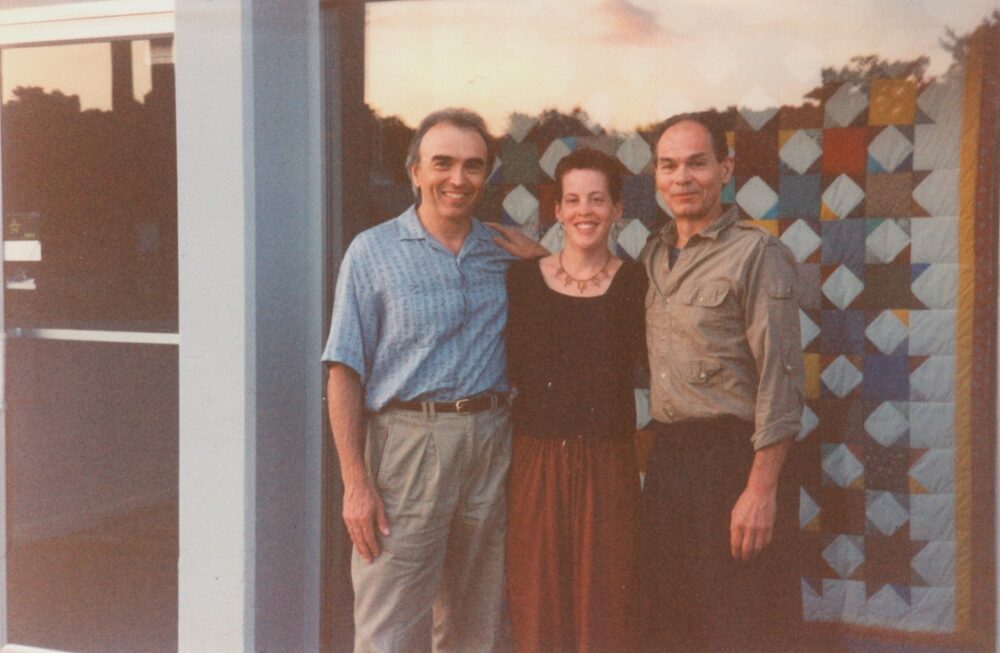


Wendy and Marvin Hill. Courtesy Wendy Carroll Hill
He’s been gone since 2003, but Marvin Hill is hardly forgotten. My home brims with his wondrous and witty linoleum-block prints. And just as his memorial postcard (see below) was graced with his self-description as “a very lucky man,” I feel blessed as well, with his art and for having known him. I don’t know when exactly Marvin made that self-portrait, but I suspect it was near the end of his life. He seemed like the sort who appreciated his time on this planet, and knew that he had left a rich legacy, filled with hundreds of pathways into his imagination, each adventure returned as a sharply-honed visual story of wonder, humor and mystery.
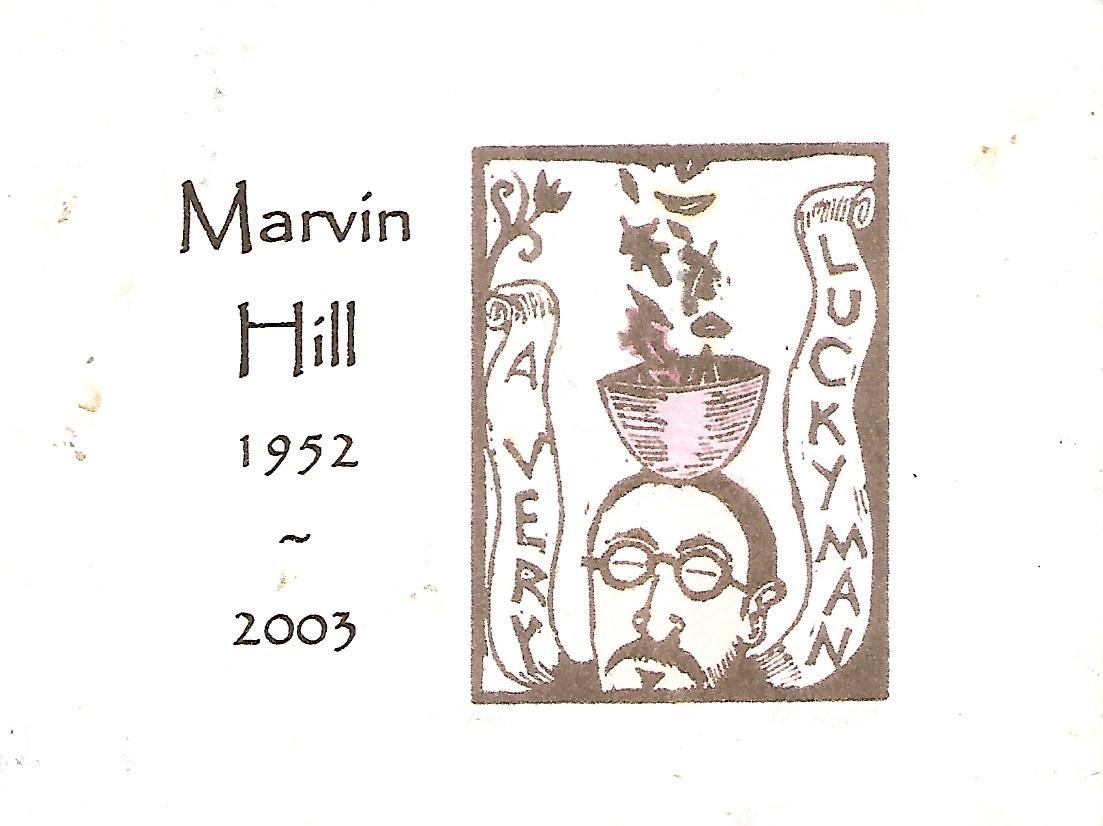
He died on this day, December Second, in 2003, of non-Hodgkin’s lymphoma, at 51. His widow, Wendy Hill, who did most of the hand-coloring for his prints, sent out the above postcard in June of 2005, to announce a Marvin Hill booth at Art Fair On the Square. As if nothing had changed, except that angelic tribute to Marvin’s life, talent and spirit. .
He was a sweet, but droll man, with a vibrant creative fire. I once visited his rural studio, slightly pungent with the smell of printer’s ink, and it seemed alive with a slightly cock-eyed aura of artistic affirmation. His artwork was popular, yet idiosyncratic and personal, never pandering. He was always one of the most interesting artists at any art fair he exhibited at, and he was duly feted when chosen as The Featured Artist, for the 1999 Art Fair on the Square in Madison. He designed the official T-shirt for that year’s fair, which he autographed for me and I still have it. Hill exhibited widely at fairs and galleries, and won national awards for his work. 1
Though he once lived on the same street in Milwaukee I now live on, he and Wendy ended up in Johnson Creek, halfway between Madison and Milwaukee, and Madison seemed his strongest market.
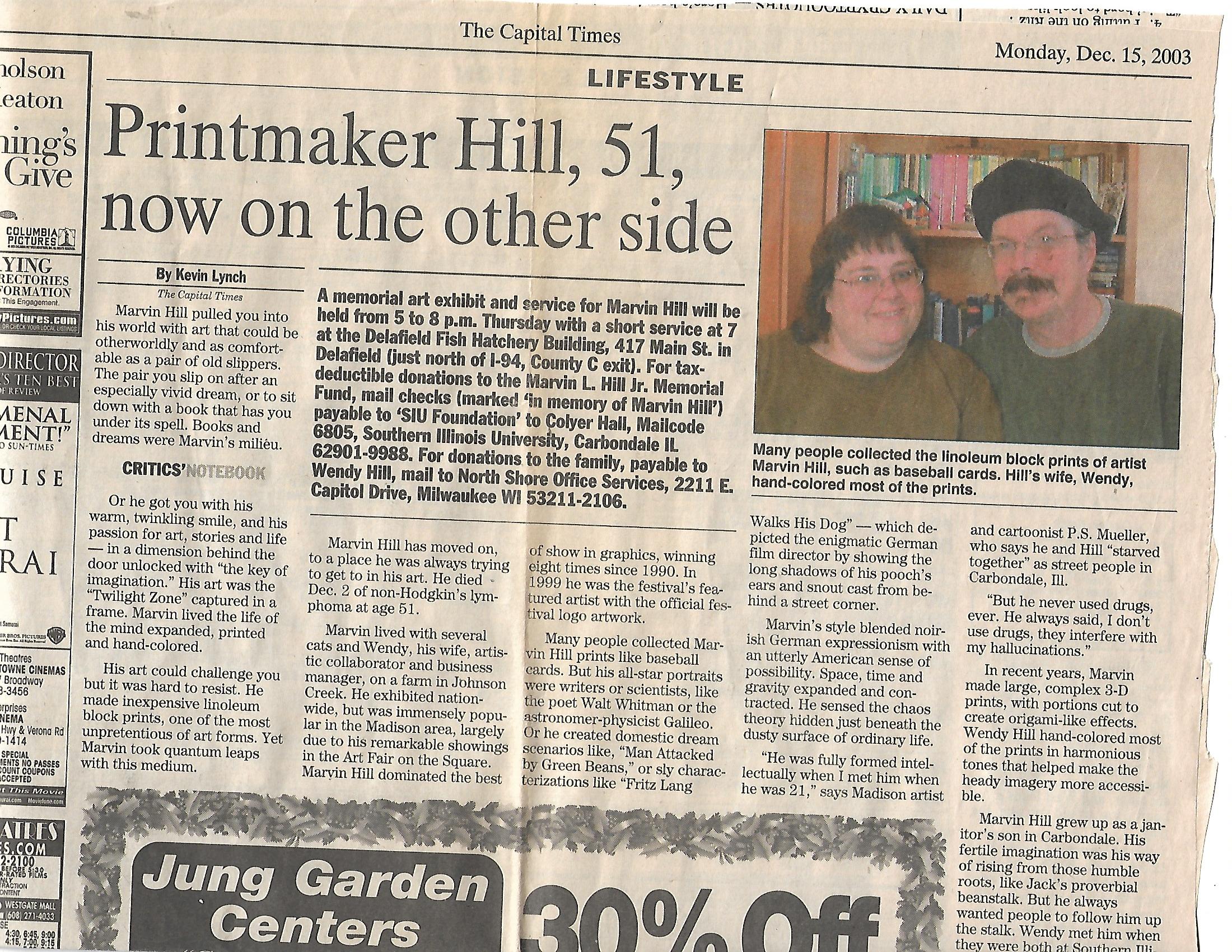
I wrote an appreciation of him when he died, for The Capital Times in Madison, and I’ll share some of my thoughts from that time:
“Marvin Hill pulled you into his world with art that could be otherworldly, or as comfortable as a pair of old slippers. The pair you slip on after an especially vivid dream, or to sit down with the book that has you under its spell. Books and dreams were Marvin’s milieu.
Or he got you with his warm, twinkling smile, and his passion for art, stories and life – in a dimension behind the door unlocked with ‘the key of imagination.’ His art was “The Twilight Zone” captured in a frame. Marvin lived the life of the mind, expanded, printed and hand colored.
His art could challenge you but it was hard to resist. He made inexpensive linoleum block prints, one of the most unpretentious of art forms. Yet Marvin took quantum leaps with this medium….
“Marvin’s style blended noir-ish German Expressionism with an utterly American sense of possibility. Space, time and gravity expanded and contracted. He sensed the chaos theory hidden just beneath the dusty surface of ordinary life.”
“‘He was fully formed intellectually when I met him when he was 21’, says Madison artist and cartoonist P.S. Mueller, who says he and Hill ‘starved together’ as street people in Carbondale, Illinois.
.” ‘But he never used drugs, ever. He always said, ‘I don’t use drugs, they interfere with my hallucinations.’ ” 2
That’s how funny and delightfully outre the guy could be.
Now, I will share some images of Marvin Hill art, with commentary.
He only made one print of my personal favorite among those I own (see his edition designation, “1/1” or “one of one” beside the title). This (and three Hill “artist’s proofs” I own — a test print marked “A/P” he sold inexpensively and may or may not have run an edition of) also confirmed to me a closeness in our aesthetic and literary sensibilities. They were sort of personal favorites that he made for himself, yet still offered to for sale. So they the A/P’s too might be one-of-a-kind Marvin Hills.
My favorite among these is also the smallest single image I ever saw him produce. It is titled “Fritz Lang walks His Dog” and I post an enlarged version for you to appreciate. Now, shrink it in your mind: The actual image is only 3/4 of an inch by 2 and 2/5th inches!
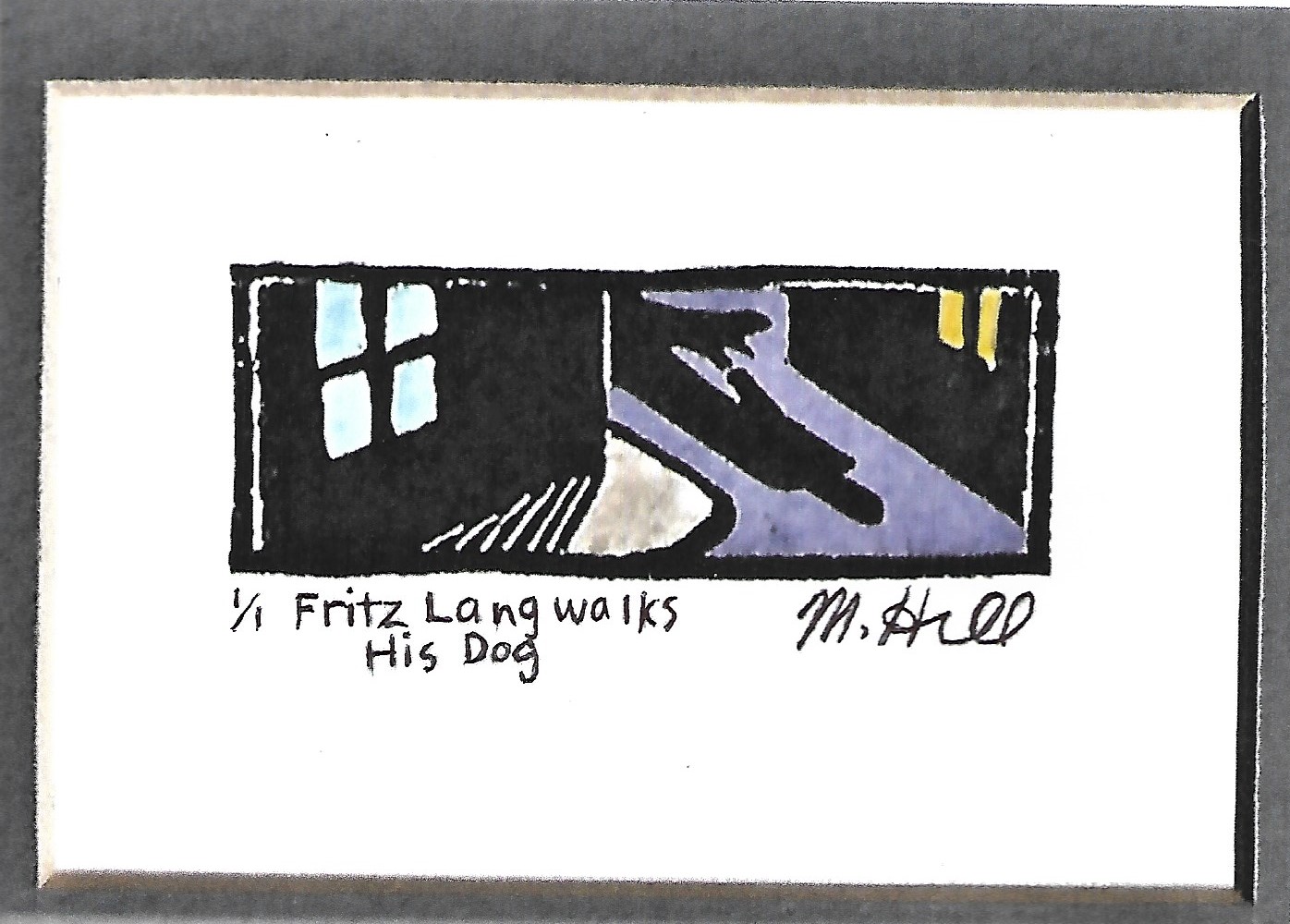
The enlargement allows you to see the image, but remember, enlarging also roughens its craftmanship. Hill wasn’t obsessive about razor-sharp technique, but his chops constantly served his quirky genius in perfect simpatico, perhaps like the great jazz trumpeter Miles Davis, at times a bit scraggly, but that enhanced the art’s peculiar, funky beauty.
The squinty size of “Fritz Lang” is a “big” part of the piece’s brilliance. It’s like a secret portal into his imaginative world, and into how his conception and style manifested themselves. The idea of movie director Lang and his dog recalls an Alfred Hitchcock movie cameo, though this is more sly, as we see only only the projected shadows of Lang and his dog. It also carries an ominousness, as Lang’s most seminal film is M with Peter Lorre as a serial killer preying on children in Berlin in London. The 1931 film, part of the German Expressionist art movement, is pretty much the prototype for all film noir. 3. Hitchcock arguably predates M with his 1926 fog-bound silent film The Lodger, about a London serial killer, both films likely inspired by Jack The Ripper’s legend.
But Peter Lorre’s creepy breakout performance, enhanced by his weird nasal-breathing speaking style and demonic laugh, helped give Lang’s “talkie” greater notoriety, for its shock value and aura of paranoia — and stylistically, with his more incisive cinematographic intersecting of light and shadow. Knowing all that, Marvin Hill uses his noir-ish wit to humanize the German director, while maintaining his mystique.
Another noir-ish Hill piece which was an “artist’s proof” shows how subtle his craft can be. It’s titled “Enter” (below).
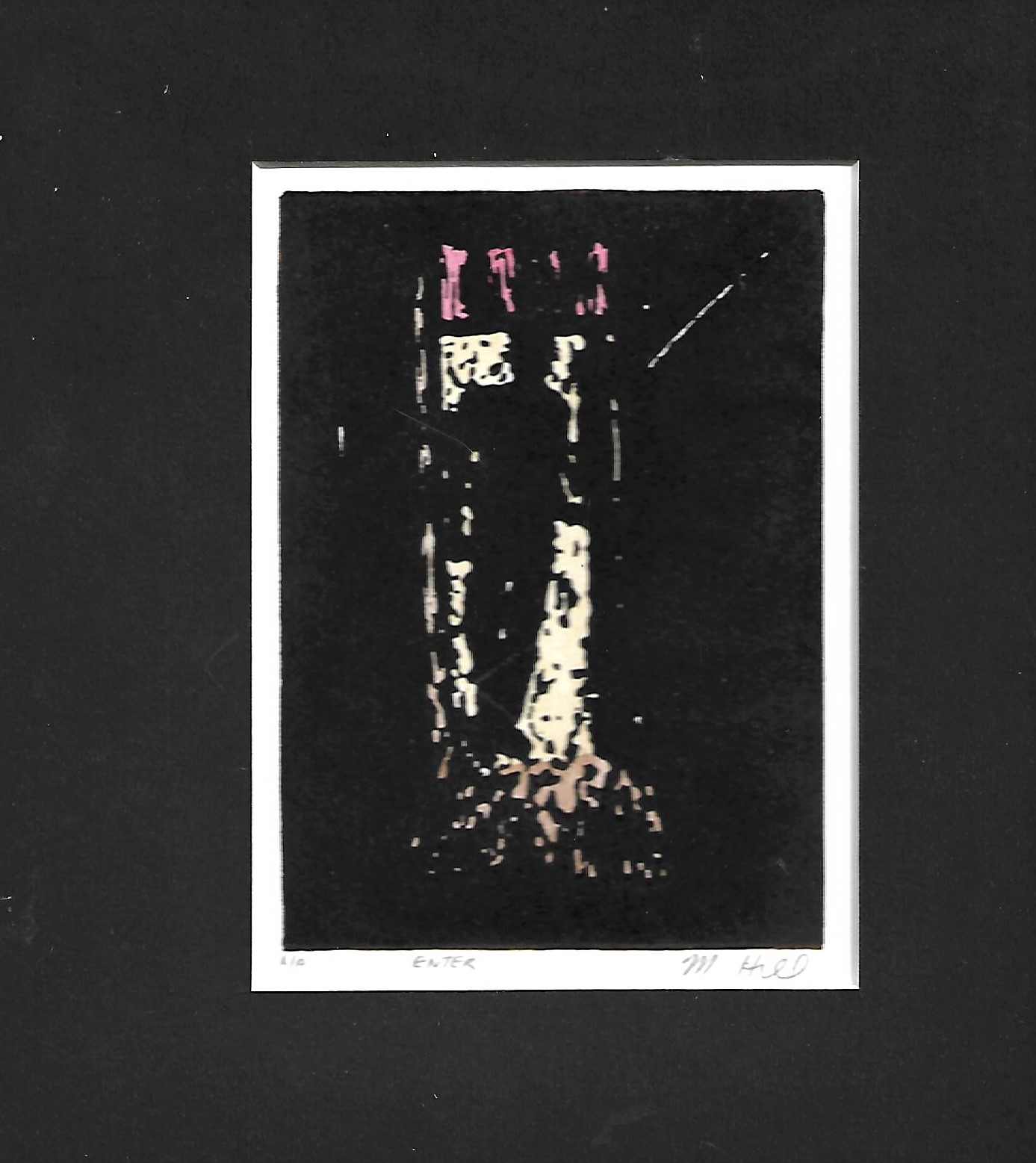
“Enter,” Marvin Hill. Hand-colored linoleum block print (artist’s proof)
The figure entering the dark room is engulfed in a sort of ectoplasmic atmosphere, an effect unusual for knife-executed block-cut prints. It’s unclear whether the figure is the vulnerable one, entering the dark enclosure, or the threatening one, entrapping a frightened person hiding within. The psychological ambiguity intensifies its power. I have positioned it as as a sort of “welcome” for guests to my home, or now, to my office.
A brighter, rather comical Hill print nevertheless retains his surrealistic weirdness. Some have characterized it as “a bit goofy,” true enough, but it held a place of honor in my divorcee bachelor-flat kitchen for many years.
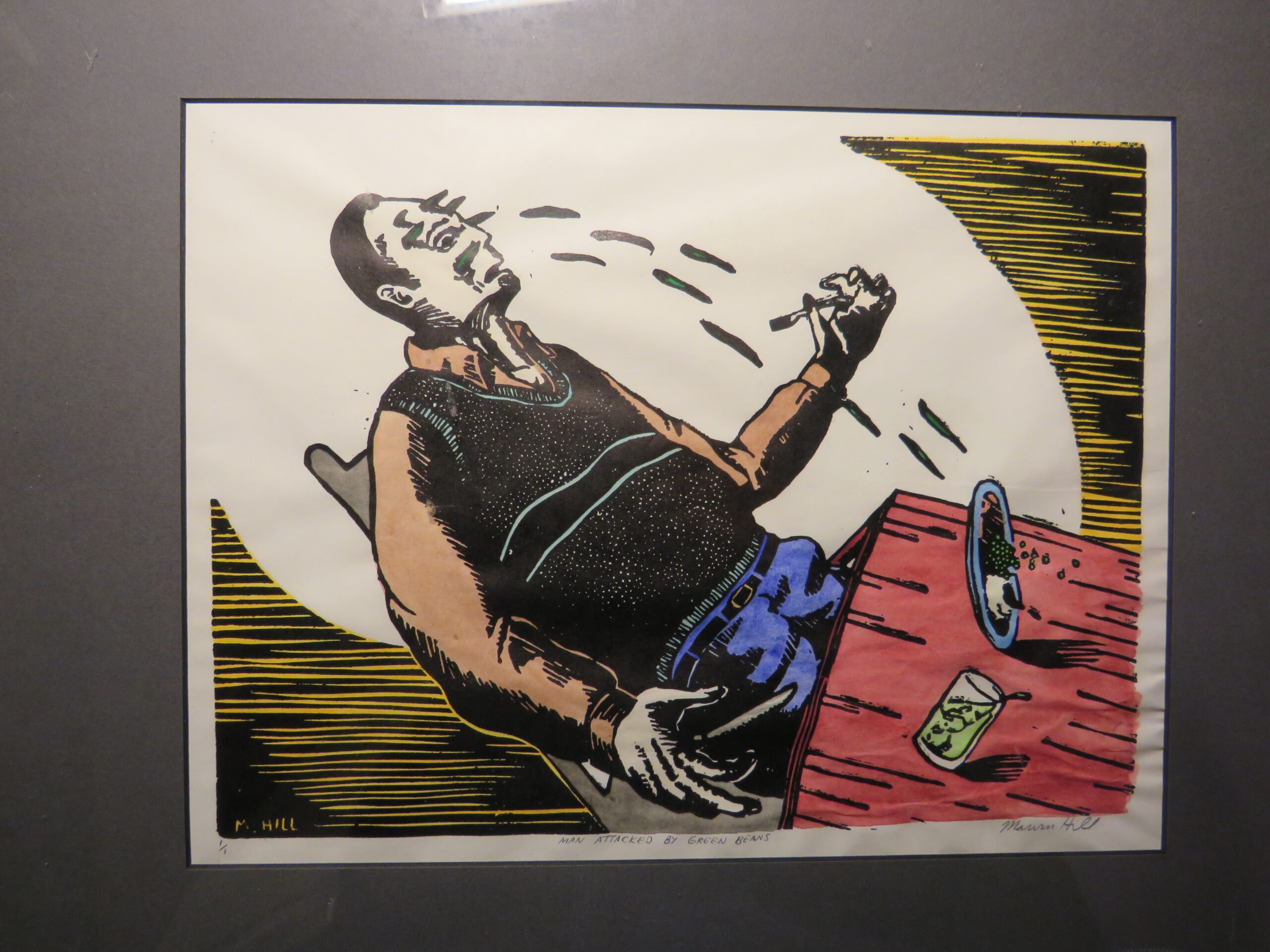
Marvin Hill, “Man Attacked by Green Beans,” hand-colored linoleum block print (artist’s proof).
I love the animation of “Man Attacked by Green Beans,” everything is flying askew (not unlike
Marvin could also celebrate serenity and domesticity, as in this elegantly framed (but still inexpensive) print, below, simply titled “e.”, as in the name of the sleeping feline in portrait.
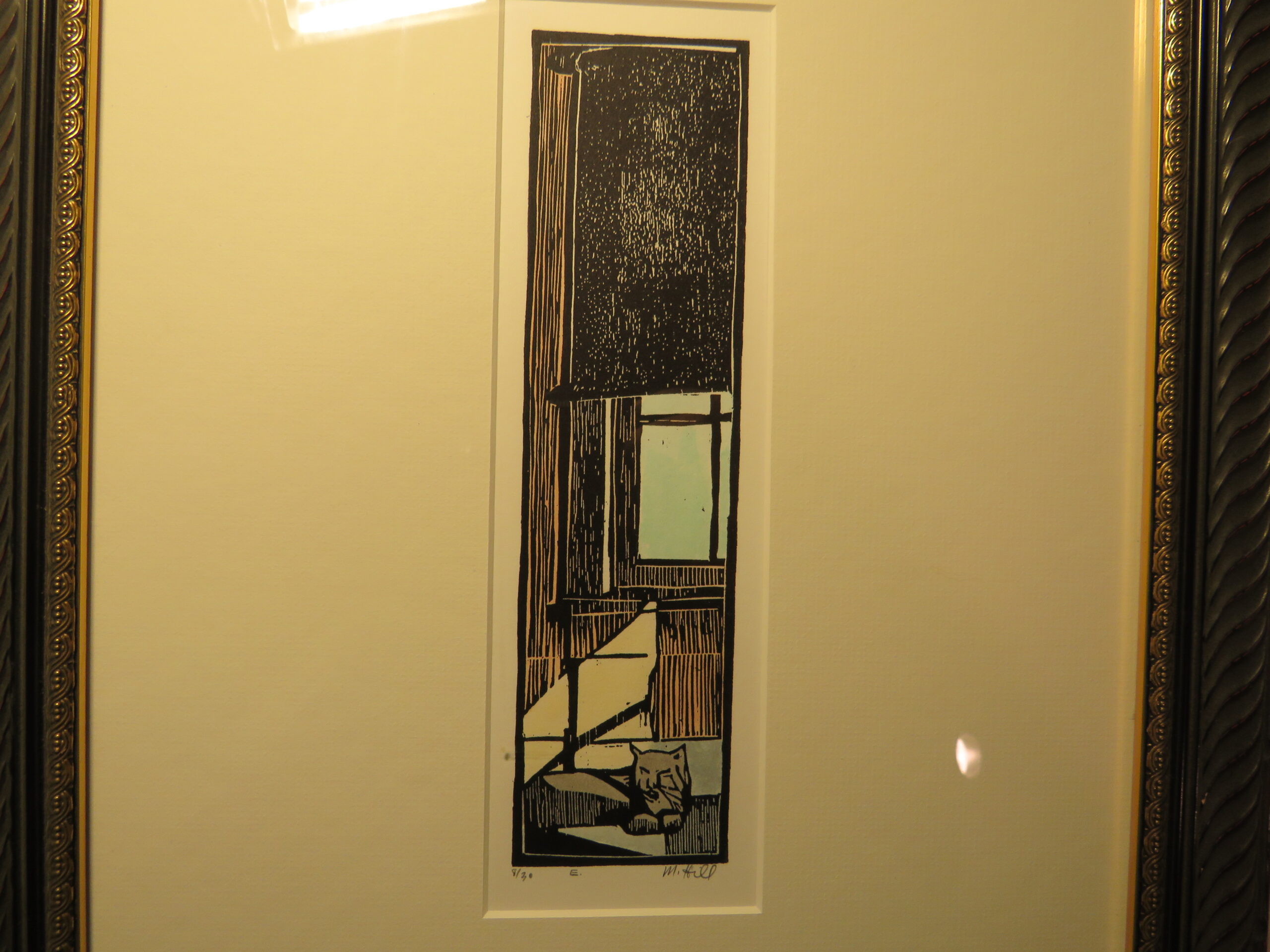
Marvin Hill, “e.”, hand-colored linoleum block print.
Next, the Deco-styed print (below) takes us into Hill’s dream realm, and suggests his striving to connect or follow nature, to transcend the limits of gravity-bound humanity. It feels like a late-period Hill, though I think it may be the first of his I purchased, before Wendy began hand-coloring his images. His sense of time was elastic, reaching into the fates of futurity as well as backward, with symbolic ease, and wonder.
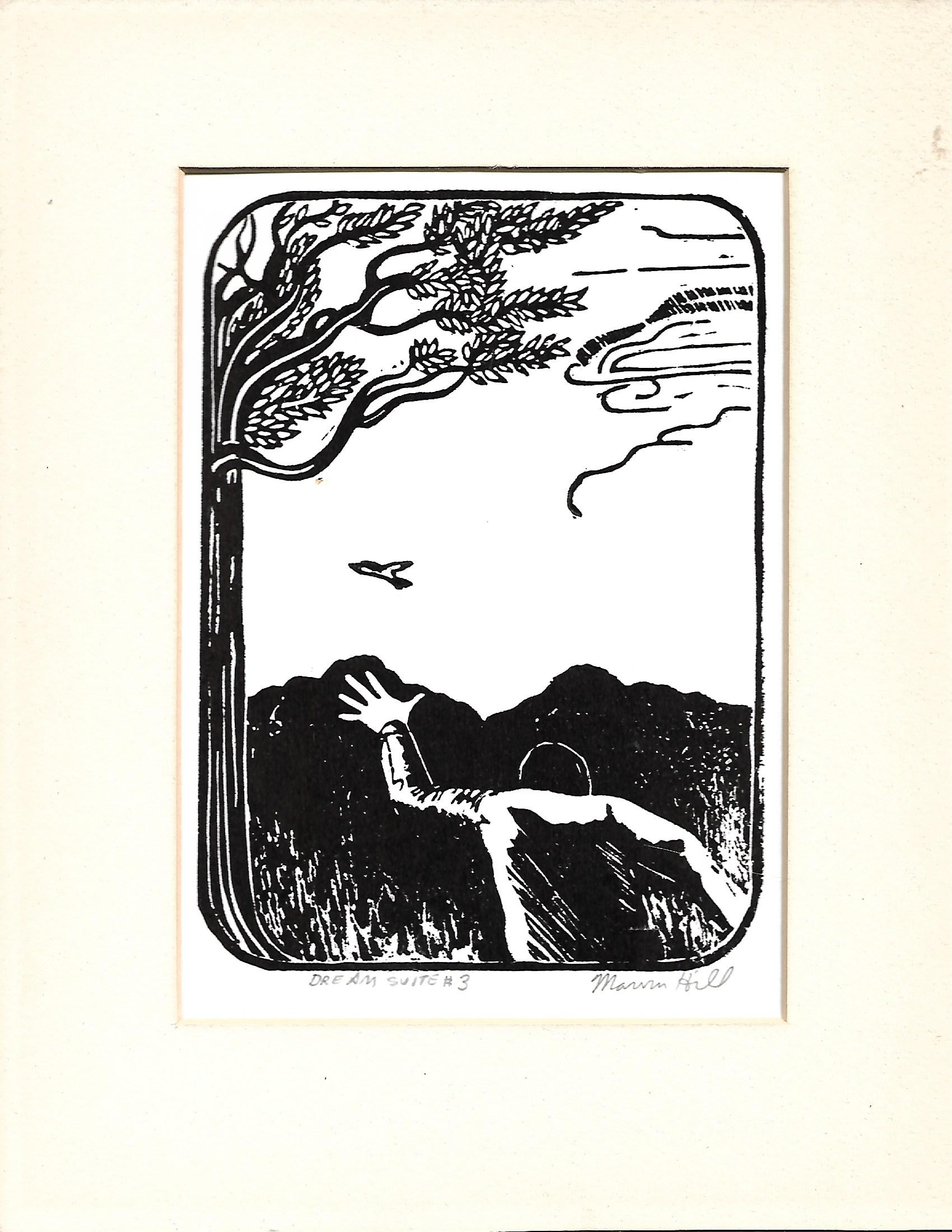
Marvin Hill, “Dream Suite # 3,” linoleum block print.
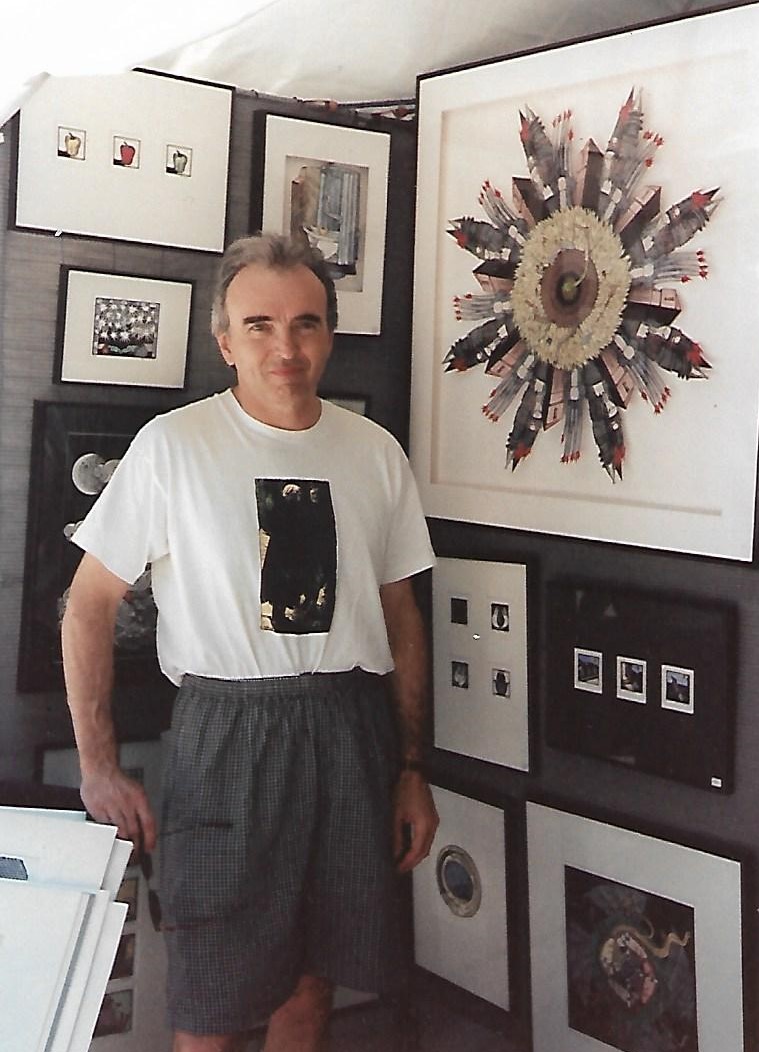
Photo of Kevin Lynch at Marvin Hill art booth at Art Fair on the Square, in Madison, by Beth Bartoszek Lynch.
This photo (above) was taken in summer of 2005, at the first posthumous booth of Marvin Hill art at Art Fair on the Square, maintained by his widow, Wendy Carroll Hill. It shows some of his small work and some of the more ambitious work he achieved late in his life, like the stunning, large mandala-like three-dimensional print, to the right of your blogger, in this photo. The several evident circular images, to me, suggest Marvin’s expression of a holistic experience of the world, his coming to grips with where his journey beyond might take him, not into nothingness, really, but to part of a circle (reincarnation?) that will be unbroken, bye and bye, one can hope.
Yet another marvelous Hill image, which my ex-wife and I bought together, and which she now possesses, depicts a shaman in a small shack high in the mountains. It might allude to the end of his life, or beyond. His corporeal end, to any outside observer, and to Wendy, was impossibly sad. He he lost the use of his hands and arms — an artist still at the peak of his powers, which at times seemed visionary, in his humble way. There are more sad details I won’t get into here. I will recount some of Wendy’s narrative, from my 2003 Capital Times obit appreciation:
“He couldn’t take care of himself, he couldn’t walk, but he was still so positive. One day, he looked out the window and said, ‘It’s all good.’
“I said, ‘It’s all good? It sucks! ‘
” He said, ‘No, I want to know what’s going to happen, what’s on the other side.’ ” 4
Fortunately for Wendy, Hill’s work has steadily sold online in recent years, and a goodly but diminishing amount remains available online, including more ambitious works. 5 One uses the above bird-seeking “Dream Suite” image as one of multiple motifs, each dominated by a blackbird in the dazzling 3-D montage titled “Jack’s Message Dream Suite.”
Another, “Lao Tzu and Rene Descartes Engage in a Philosophical Battle,” articulates his self-expressed intellectual hunger and spiritual curiosity (image below). It’s telling that Hill positions the ancient Chinese philosopher in the dominant dueling position. Descartes, riding a mechanical dragon, uses a book “shield” and wields a giant pointed circumference compass; while Lao, atop a “real” dragon, counters with a traditional saber and a walking stick. Mathematician, metaphysician, and philosopher Descartes is, of course, best known as the Western paragon of rationalist philosophy as a demarcation of reality. Though his historicity as a real person is debated, Lao is credited as the founder of Taoism and reputed author of the philosophical text Tao Te Ching.
By contrast to Western rationalism’s prioritizing the brain’s reasoning powers, Taoism embraces an inquiry into primary sources, the un-apprehended aspects, or vast realms of existence, that may help form our cosmos, our world and affect our lives. Accordingly Tao signifies “the source and ideal of all existence: it is unseen, but not transcendent, immensely powerful yet supremely humble, being the root of all things. People have desires and free will (and thus are able to alter their own nature). Many act ‘unnaturally’ upsetting the natural balance of the Tao. The Tao Te Ching intends to lead students to a ‘return’ to their natural state, in harmony with Tao.] Language and conventional wisdom are critically assessed. Taoism views them as inherently biased and artificial, widely using paradoxes to sharpen the point. ” 6
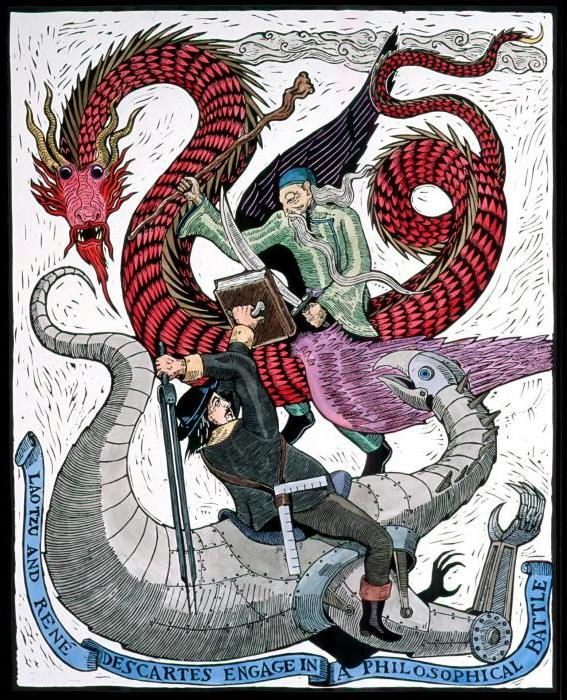
Marvin Hill, “Lao Tzu and Rene Descartes Engage in a Philosophical Battle.” Linoleum-cut block print. Courtesy www.marvinhill.com
Surveying Hill’s oeuvre, one senses his Taoistic leanings, an intense awareness of forces beyond the empirical. Another ambitious print, is even more surreal than “Man Attacked by Green Beans.” Titled “Nonattachment,” wherein gravity has evidently abandoned a man in his home, and he and his possessions all float freely. Is this evoking a strange scientific phenomenon, or an underlying truth of contingency regarding reason, and even ownership? Were Marvin’s humble and drug-free “hallucinations” also possibly insights? Given his ever-leavening humor, he was a serious reader, and a pan-cultural, pluralistic thinker, clearly interested in the dialectical (and in paradox), and beyond.
I think Marvin Hill’s equilibrium helped focus his insights. He seemed to know how far to go with his dreams. As D.H. Lawrence wrote: “The Holy Ghost (the winged soul within us) bid us never be too deadly in our earnestness, always to laugh in time, at ourselves and everything, Particularly our sublimities. Everything has its hour of ridicule – everything.” 6 Marvin could always laughed in time, like, say, pianist Victor Borge, a musical comedian with exquisite timing. A prime Hill illustration of perfect comic timing is the piece titled “Does Awakening Come All at Once?” The image is of a bespectacled man (le artiste?) getting a blueberry pie splat in the face. Or, there’s the tart irreverence of “Thoreau is Driven from the Garden by Unruly Nature,” the ironic title delivering plenty.
And then, the affliction arose and eroded him. Sorrow welled, though not Marvin’s, until his knife and wit lay still, for the last time, December 2, 2003.
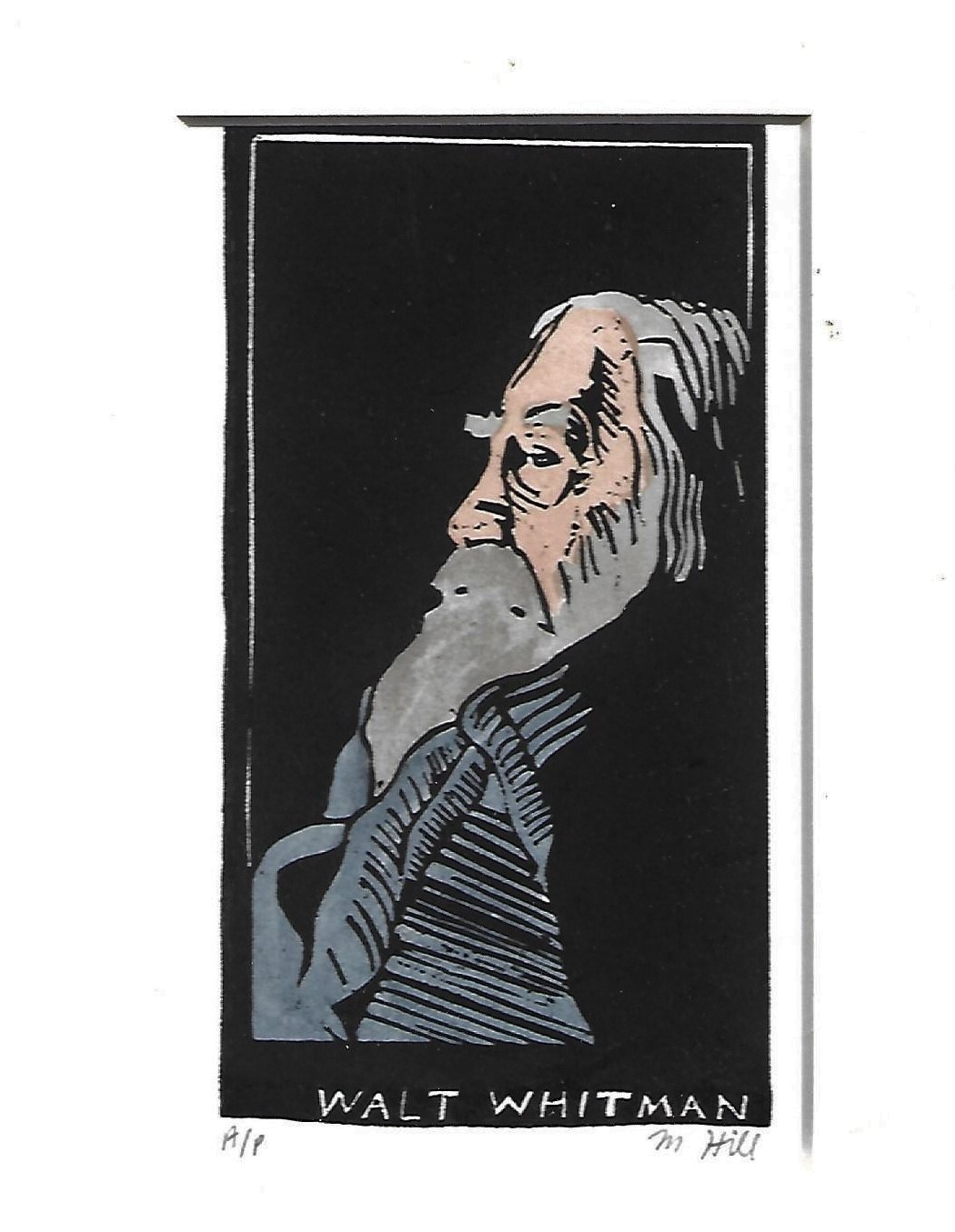
Finally, another Hill “artist’s proof” (below) would become a posthumous gift from him to me (actually sent to me by Wendy, in gratitude for my patronage and coverage of Marvin) – a portrait of the great American poet Walt Whitman, clearly in the autumn of his life. Marvin knew just how to visually honor the mighty, innovative, and quintessentially American poet, also known for his massive capacity for compassion, as a dedicated Civil War nurse. Hill depicts Whitman’s head, well, as if upon a hill. Whitman here seems like granite, or one more great face, to be carved into Mount Rushmore, alongside other American giants, including his contemporary Abraham Lincoln, whom Whitman honored in magnificent verse, better than any other poet.
I didn’t consciously intend this, but “Walt Whitman” sits in my office, atop a bookshelf, the highest location of any artwork I own.
_______________
1 Art Fair on the Square, held each Independence Day Weekend, is sponsored by The Madison Museum of Contemporary Art, and is one of the state’s most rigorously-juried outdoor art fairs, along with Milwaukee’s Lakefront Festival of the Arts.
2. Even given Mueller’s story about he and Hill as classic “starving artists,” Hill had earned an MFA in printmaking from Drake University.
3. Among other many great Fritz Lang (primarily) films noirs: include: “Metropolis (silent),” “You Only Live Once,” “Ministry of Fear,” “Scarlet Street,” “Clash By Night,” “The Big Heat,” “and “Beyond a Reasonable Doubt.”
4. Here’s a scan of my 2003 newspaper appreciation of Marvin Hill. You might save or download it to a picture file to magnify and read it better.
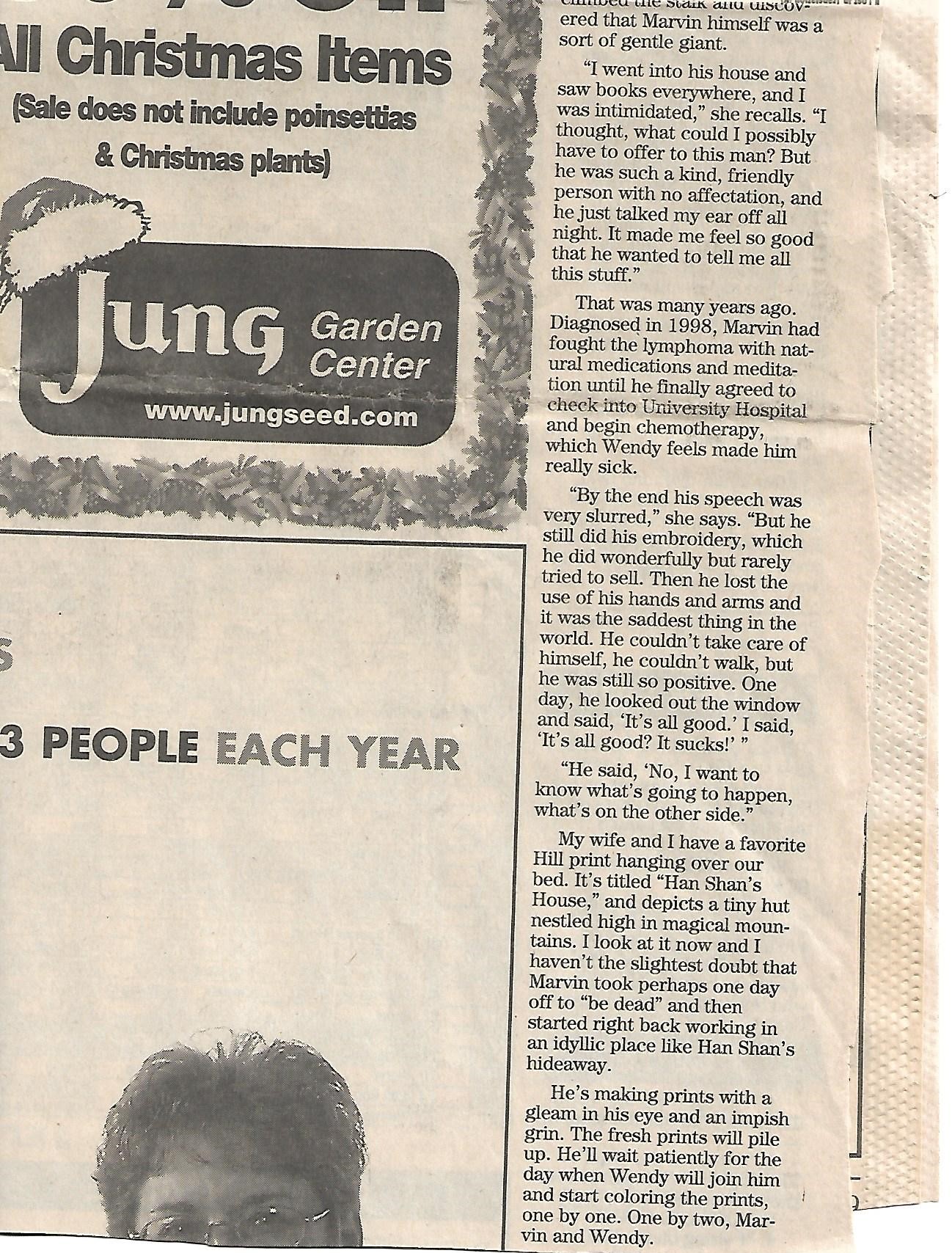
5. The Marvin Hill website: http://www.marvinhill.com
6.. https://en.wikipedia.org/wiki/Laozi
7. D.H. Lawrence, Studies in Classic American Literature, Penguin, 1923,1977, 79


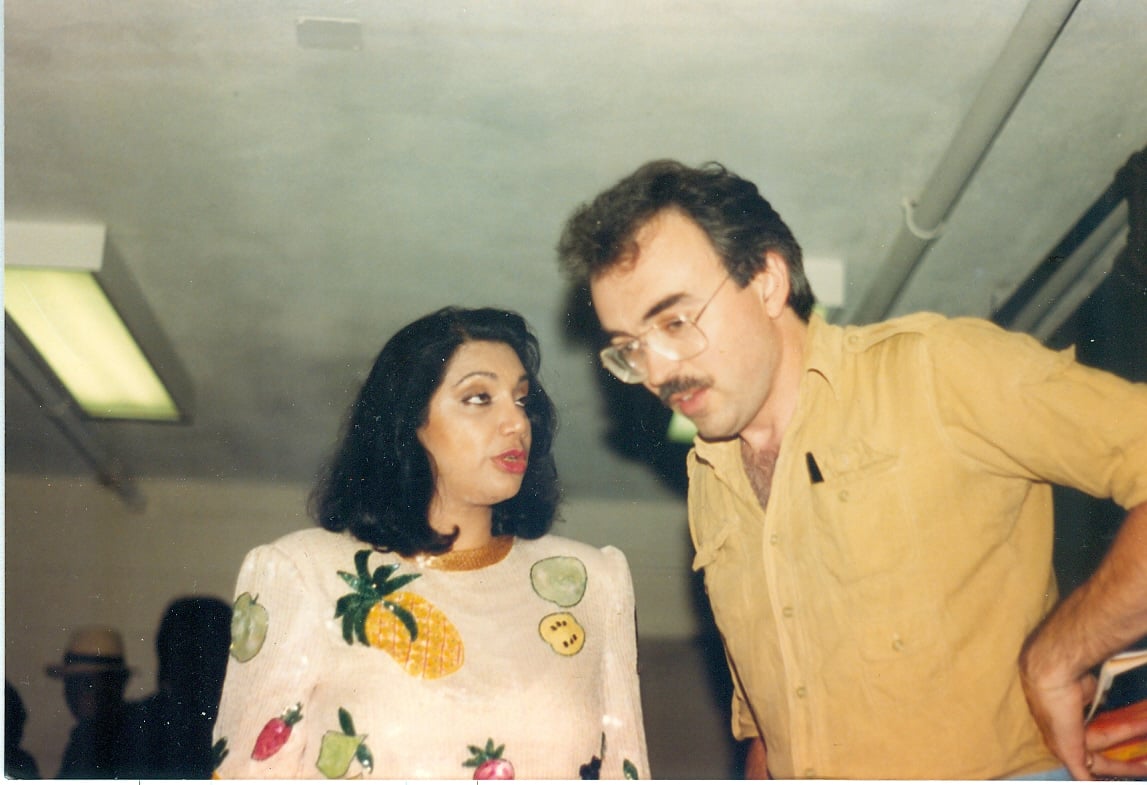




 Chuck LaPaglia, the founder and owner of the original Milwaukee Jazz Gallery, in his club during its run as a major jazz venue from 1978 to 1984, documented in a newly revised anthology of the club’s extensive press coverage. Courtesy Milwaukee Jazz Vision