
Amber Ascher takes her photography subjects onto “magical time trip”

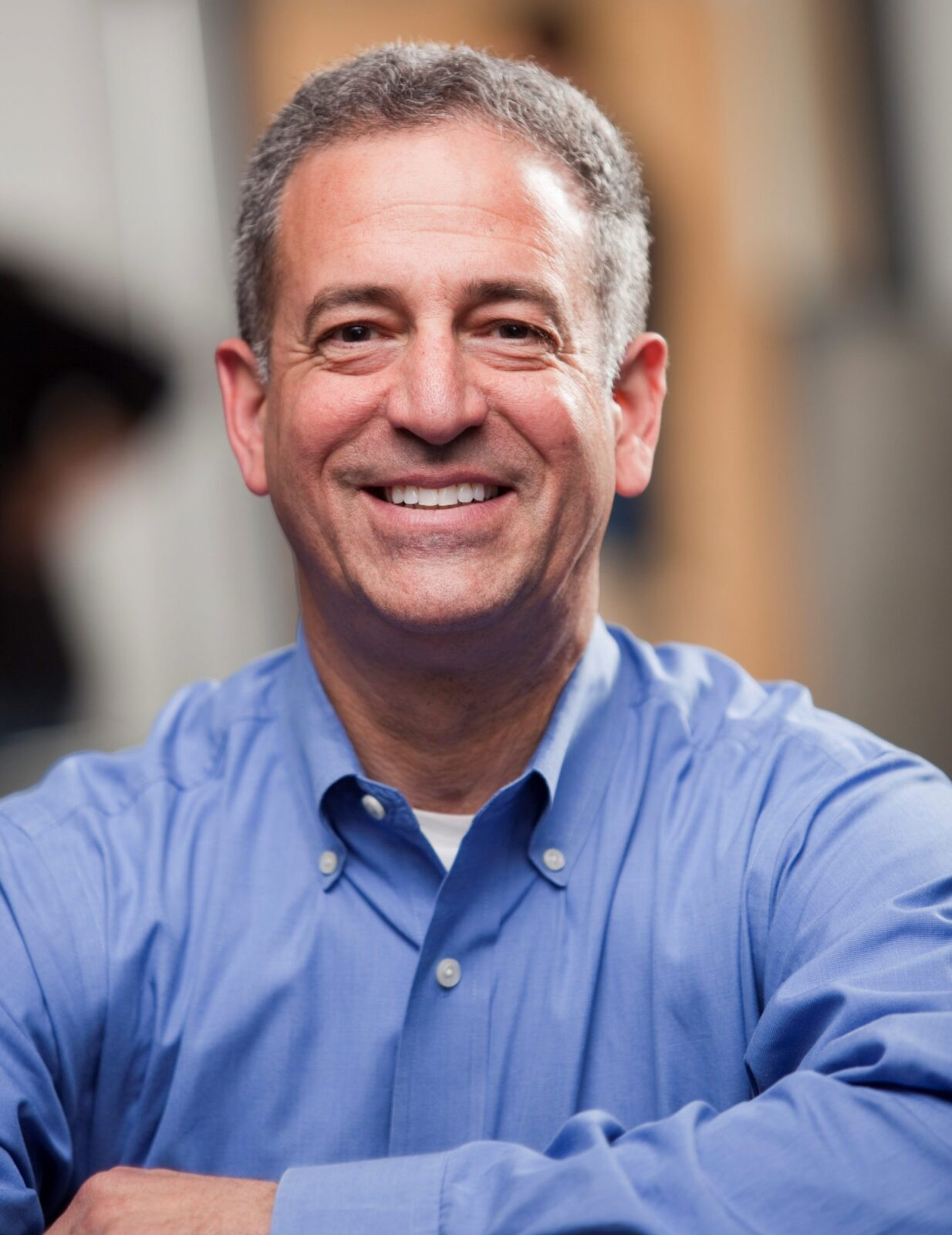
Tintype photographer Ambrer Ascher with her 1941 Easterman Kodok camera

All photographs freeze a moment in time. Yet the tintypes of Amber Ascher travel far

beyond that trope. As the moment freezes, it unlocks a door, transporting you through time. You finally return from a trip into the 1800s.

In the process, all the colors that tend to distract us from the essence of image and personhood fall away. We’re left with, in effect, a subject as imaginatively alive as those of, say Albrecht Durer, the Renaissance master of monochromatic graphic art, yet as vividly precise and evocative as the 19th century tintypes of Julia Margaret Cameron, whose portraits of such towering figures as Charles Darwin, Henry Wadsworth Longfellow and Alfred Lord Tennyson are considered definitive.

Milwaukeean Ascher, still comparatively new to her craft, might understandably shrink from such comparisons. However, she says Cameron, one of the first women photographers to be taken seriously, was an early inspiration for her, thanks to a Milwaukee Art Museum show of Cameron’s work a few years back.

She also knows that Cameron was also derided for her more soft-focus, atmospheric portraits, which were simply too radical and innovative for the time. “But she exhibited internationally and published two books,” she says.
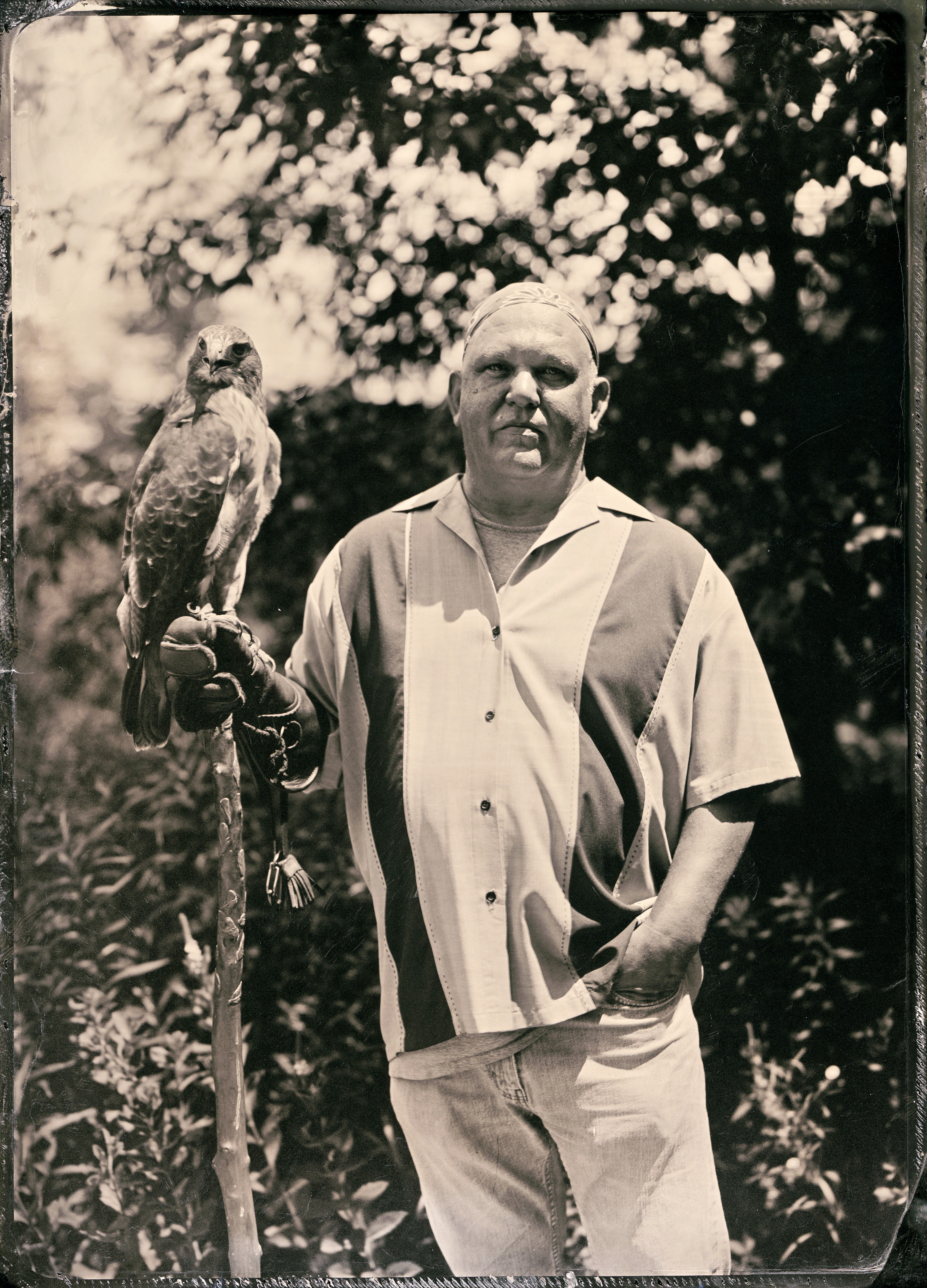
Schlitz Audubon Society raptor handler Doug Schommer with Skywalker, a red-tailed hawk. Photo by Amber Ascher.

Such a legacy by a great woman photographer feeds Ascher’s artistic motivation. Her talent, skill, and vision are evident. A chat with her can quickly delve deep into the abstruse, ancient technicalities of her art form, like a cobwebbed sorceress emerging, eyes aglow, from a mysterious darkroom cavern. And I’m not kidding about glowing eyes because tintype, aside from no color distractions, has a considerably higher pixel rate than digital photography. So, when Ascher’s camera focuses on a portrait sitter’s eyes they open so clearly as to be a short-cut, not just a window, into the subject’s soul.

We’re speaking of the phenomenon of the experience in this time-transport, something which many observers, including the well-spoken Ascher, are reduced to calling “magic” as you witness your own exquisitely rendered image becoming a reality, like a blooming rose, sped up to a matter of seconds.

Technically called wet plate collodion process, it involves creating a direct positive image on a thin 5 by 7-inch metal rectangle, the so-called “tin” coated with a thin coating of lacquer or enamel to support the photographic emulsion. Most popular in the 1860s and 1870s, it was described as the first “truly democratic” medium for mass portraiture.

“People are really interested in the history of it,” Ascher explains. “Tintypes altered human history for all time, because it was the first type of photography that was accessible to the average person. Daguerreotypes preceded them but were expensive to print and were actually dangerous.”
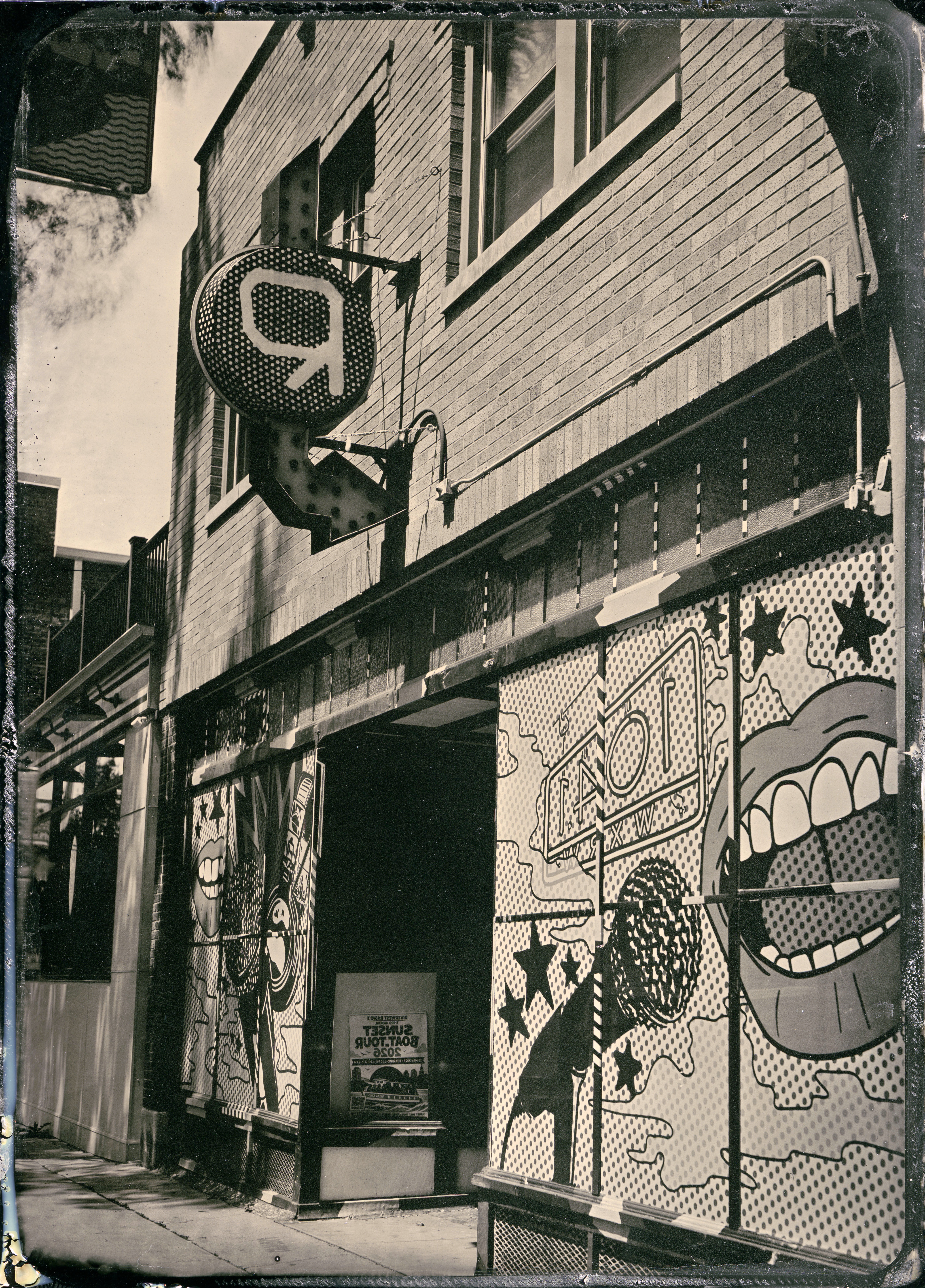
The storefront enTrance to Riverwest station. Photo By Amber Ascher

Aafter she takes out her image, she must develop it in a solution and, tipping it forward and backward in a small dish, as the subject watches her, the gentle wave effect produces a positive image in a matter of seconds, right before your eyes. Abracadabra!

Because it’s not a negative, the image is a reverse of its subject matter. So, your mole, or the crook in your smile, is on the other side of your face. That peculiar uncanniness too can send you into a bit of Alice-in-Wonderland tizzy. Ascher can make reproductions by scanning her prints, but nothing beats the vividness of the original. So, some people have a bit of breath stolen at that “magic” moment.

The photographer felt she should try the technique when, one day at The Pfister Hotel, she saw the work of Margaret Muza, who may be the only other person doing tin types in Milwaukee. “I was struck by the way the tintypes capture something below the surface level,” Ascher says.

Pop-up Sessions

But Muza does mostly work in her home whereas Ascher is seemingly everywhere lately, doing pop-up photo sessions at art fairs, and social gathering places like The Daily Bird coffeeshop, Amorphic Beer, Riverwest24, or the hugely successful Blueberry Festival (co-sponsored by The Polish Flat collectibles shop and Seven Swans restaurant), a gathering of largely younger artists and makers, where crowds clamored for Ascher’s work, and gave her a serious workout.

Those locales—as well as The Riverwest Farmer’s Market, where she sets up twice a month—are all venues in her own Riverwest neighborhood (Full disclosure, Ascher is a neighbor of this writer). But she’s ventured further to Bay View, the Schlitz Audubon Nature Center, and even The Driftless region, where she did a successful pop-up event outside of Driftless Books in Verona.
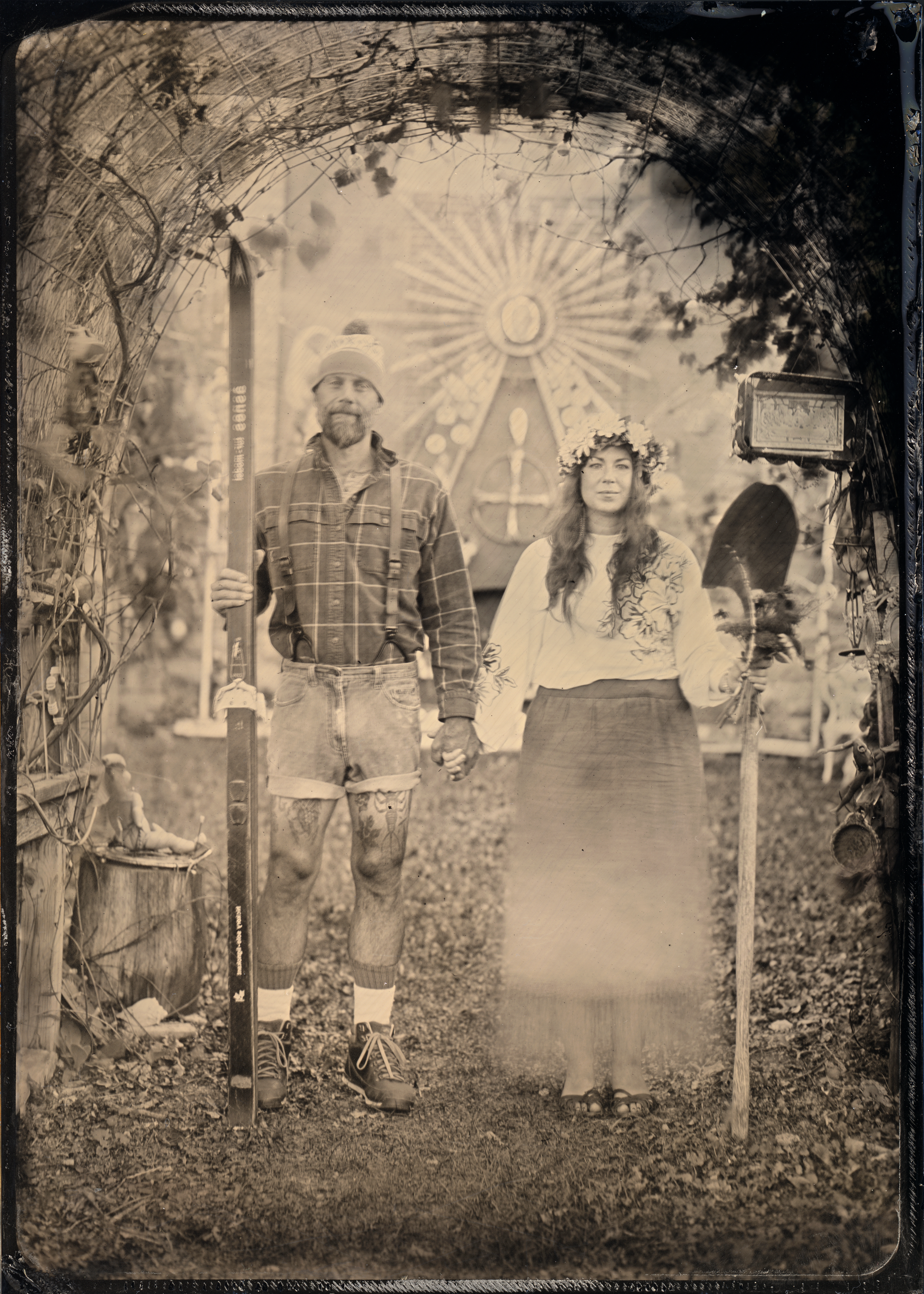
A couple pose for a portrait in the garden of Driftless Books in Verona, WI. Photo by Amber Ascher

Yet, truth is, this is a demanding medium with her doing pop-up darkroom chemistry in a self-contained tent-like enclosure. Then she emerges from behind the curtain like the Wizard of Oz, to dazzle her customers with the actual final liquid development. Except she’s not a duplicitous sort, like the daffy old wizard.

Soft, Swirling Edges
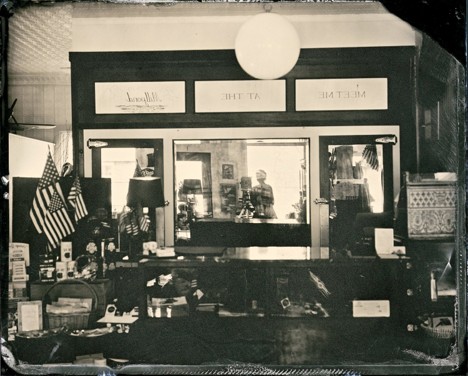
Folklore Mercantile, in Merton, WI. Photo by Amber Ascher

This photography requires a large, heavy camera, a 95-year-old Eastman Kodak 2-D. Its cooling bellows are wearing out. So she also newly purchased an Agfa camera, and an antique brass Petzval lens, which “produces a sharp center with a soft, swirling out of focus edges.” Set up on a tripod, this camera demands conditions like very little sunlight and not excessive heat. So maybe the summer pop-ups are a bit like a salmon swimming upstream. But what a swimmer.

In fact, Ascher is now looking hard to find a studio space she can afford. Something about the size of a bedroom or small kitchen and preferably with a walk-in closet space she can use as a darkroom. She quit a bartending job at Black Husky Brewing and, more recently, a few other side gigs to pursue photography full time.

Ascher took the initial dive into this art form after several desk jobs simply stifled her creative spirit. She admits to some ADHD and even autism, or what’s now diagnosed as “neurodivergent,” so this is the sort of outlet she needed. “(Her diagnosis) shaped the path I’m on because of finding that out.”  Other factors along the path were frequent solitary camping trips, and self-realizations arising from a period of studying on a yoga teaching program.

She also took a workshop with East Coast tintype master John Coffer. “So, I started on this journey to find what would be in line with my natural tendencies. It was honoring my soul’s calling.”

_____________

This article was originally published in The Shepherd Express, here: https://shepherdexpress.com/her-story/amber-aschers-photographic-time-trip/

Post-debate polling of crucial swing voters shows Kelda Roys as the best Dem to beat Tiffany

A collage of five campaign-style headshots features candidates in the Milwaukee mayoral race, showing studio and outdoor portraits of each contender in business or business-casual attire.
Candidates for Wisconsin governor 2026: (L-R) Democratic Socialist Francesca Hong, Republican Tom Tiffany, Democrats Kelda Roys, David Crowley, and Joel Brennan. Courtesy Milwaukee Magazine. 
I’ve been searching for post-debate polling on the Democratic gubernatorial primary, and The Milwaukee Journal Sentinel reported that Francesca Hong concurrently got a big polls boost, but not necessarily from the debate.
So here’s actual post-debate polling. I do like Hong, and if she could capture the governorship I’d be overjoyed. But as presidential candidate Kamala Harris learned, stuff like joy, cool as it is, won’t win an election
General elections are very different ballgames than primaries. Hong has built a sort of momentum with her big polling lead over the other contenders. But I’m still not confident she can win a general election outside of her very enthused Milwaukee-Madison strongholds (BTW, I know those places pretty well. They’re the two cities I’ve lived in during my whole 70-plus year life as a Wisconsin resident).
Sorry if you think I’m getting pragmatic, or “losing my spine,” a typical diss of those who take time to think or express concern about election dynamics. But at this urgent point we need to focus on who can beat Tiffany.
According to Wisconsin swing voters, that would appear to be Kelda Roys, an accomplished and well-defined progressive legislator. The Shepherd Express, a very left-leaning Milwaukee publication, just endorsed her along with MKE C.E. David Crowley.
So, I don’t understand reports of Roys still only getting 2% support.
I’m not a swing voter, I’m a strong liberal who almost invariably votes democratic, and occasionally “independent.”
Let’s not forget: What I’m sharing here is a survey of Wisconsin swing voters, who do typically decide an election. And especially in a state like this, which is famously one of the most purple “swing states” in the nation.
Hero background image
State Sen. Kelda Roys (second from right) talks with Wisconsin constituents. Courtesy Kelda Roys campaign website.
State Sen. Kelda Roys is my personal choice as the best, most accomplished, and best prepared progressive candidate. She also seemed the best debater, which will be important later against Tiffany when people really start paying attention. Roys, an articulate feminist, also doesn’t have the baggage the other leading candidates have for Republicans to exploit. Here is her website, to get to know her and see her concrete plans, rather than rhetoric, on most of the issues voters care about: https://urbanmilwaukee.com/2026/08/05/murphys-law-crowley-is-only-one-who-could-beat-hong/
If you’re interested, Bruce Murphy, editor of Urban Milwaukee, makes a strong argument for David Crowley: https://urbanmilwaukee.com/2026/08/05/murphys-law-crowley-is-only-one-who-could-beat-hong/
The Atlantic magazine has an excellent recent feature by Russell Berman on Wisconsin as a state that’s actually receptive to extreme candidates. Think of the original progressive firebrand, Bob LaFollette, and then 1950s reactionary Commie-baiting Sen. Joe McCarthy. More recently, think uber-liberal maverick Senator Russ Feingold and then oppressive conservative Governor Scott Walker.
Russ Feingold | ACS
Sen. Russ Feingold.
Plus, Michigan just had a leftist win its Democratic Senate primary. Can he win the general election?
So just maybe we’ll actually bring Fran Hong to the big dance and then give her the keys to the governor’s office!
But things are still dicey, right now.
OK, here’s a report on the swing voter poll results. Apologies for the lack of graphics. (Website link below):
‘THE SWING VOTER PROJECT ELECTABILITY INDEX WISCONSIN DEMOCRATIC GUBERNATORIAL PRIMARY
WHO IS THE STRONGEST GENERAL ELECTION CANDIDATE? Swing voters selected whether they would support each Democratic candidate in general election against Republican Tom Tiffany after viewing debate clips.
ROYS LED 57% FIELD AFTER THE DEBATE SUPPORT INCREASED AFTER THE DEBATE ROYS 27pt Increase insupport BRENNAN 20p pts Increase support BARNES 16pts Increase ent support Increase CROWLEY 12pts 12 12 Increase support HONG 10p ots Increase support support’. 
‘THE SWING VOTER PROJECT ISSUE INDEX WISCONSIN DEMOCRATIC GUBERNATORIAL PRIMARY ROYS LED SIX OF SEVEN ISSUE AREAS After each debate segment, swing voters selected the candidate they believed would do the better job on that. I POLICE ACCOUNTABILITY WINNER TAXES ON HIGH EARNERS ROYS PROPERTY TAXES ROYS SCHOOL SCHOOLVOUCHERS VOUCHERS ROYS AI DATA CENTERS ROYS ROYS CLOSING STATEMENTS …
ROYS BACKGROUND & ELECTABILITY ……………… BARNES’.  ‘THE SWING VOTER PROJECT 42% 40% 7pts Post- Post-Debate Debate Change Francesca Hong 15pts Post-Debate Post- Change David Crowley 60% 21pts Post-Debate Post-DebateChange Debate Change Post Kelda Roys 56% Opts Post- -Debate Change 52% 2pts Post- Post-Debate Change Mandela Barnes Joel Brennan’.
‘Trial heats against the Republican opponent Democratic share before and after the debate Kelda Roys Joel Brennan 73 Mandela Barnes 72 David Crowley 69 Francesca Hong 62 10 57 20 30 40 50 Weighted Democratic share (%) pre post 60 Democratic share against Tom Tiffany before and after the debate 70 70 80’.
 ‘THE SWING VOTER 2. PROJECT Net candidate favorability: Hong recorded the lowest score in the field. Hong finished at +13 net favorability. Roys finished at +55, Brennan at +50, Barnes at +47, and Crowley at +21.
Net candidate favorability: before vs. after 50 47 40 post pre 30 30 20 BM 13 21 10 12 Hong Francesca Bames Mandela Candidates ordered Crowley David Kelda Roy’s latest Marquette primary: Hong 8% Bares 16%, Crowley, Brennan %
Here’s a link to the website this poll report comes from: https://theswingvoterpilot.com/wisconsin#learnmore
Finally, here’s an extended quote from the aforementioned article from The Atlantic:

“But Democratic voters in Wisconsin are clearly thinking about the E-word too. As I followed Hennes on his canvassing route through Appleton, several people told him they liked Hong’s policies or were leaning toward her. But they also expressed some pause. “I like what she has to say,’ Bob Molitor, a 75-year-old retiree, said, ‘but we’ve got to get a winner.’

Wisconsin’s history suggests the concerns about Hong’s statewide appeal could be overstated. Michael Wagner, a University of Wisconsin political scientist, pointed me to research showing that voters do not punish more extreme candidates. Her chances might be better still in a midterm election when turnout is expected to be lower than a presidential year, he said. ‘An ideological extremist can absolutely win a statewide election in Wisconsin,’ Wagner said.”

__________