If These Quilts Could Talk: Signals along the Underground Railroad


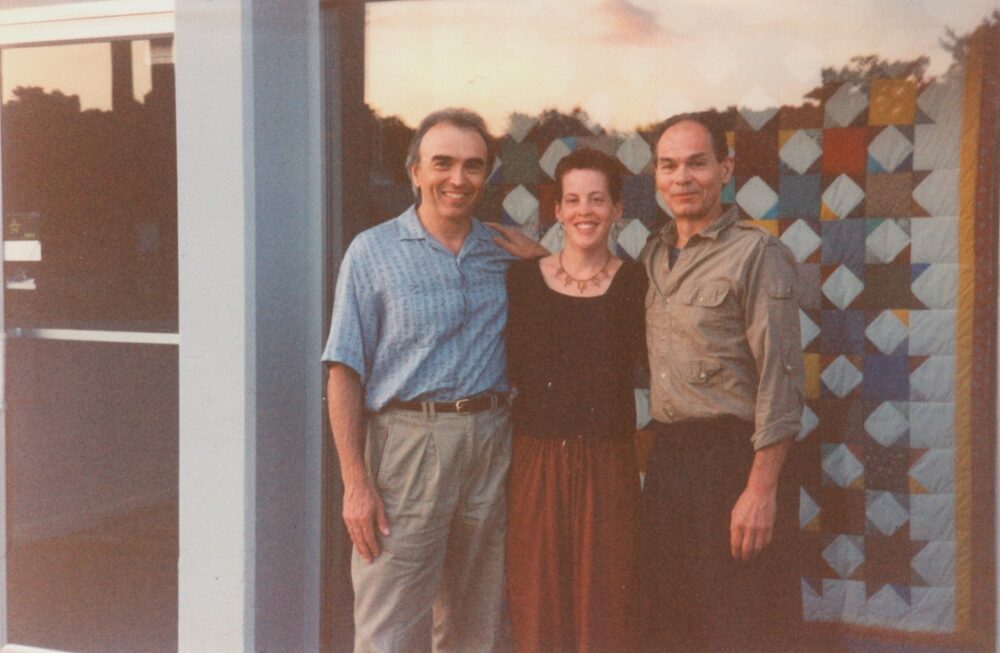
Rita Cox and her version of a monkey-wrench code quilt.

____________

If These Quilts Could Talk…African American Quilting Traditions. Quilts by Rita Cox and others. King Drive Commons Gallery and Studio, 2775 N. Dr. Martin Luther King, Jr. Drive, Milwaukee – 414.704.9117.

Remaining exhibit hours with Rita Cox, 11 a.m. to 2 p.m. Saturday, November 10 and 17. 

In a wooded region just over the Kentucky border in Ohio, the black woman peered outside and saw no one around. She dragged out a large, richly patterned quilt and hung it out on the clothes line, even though the quilt was not wet. The wind caught the cloth and the fabric danced ponderously alone, waiting for the right set of eyes to arrive to appreciate it.

The day passed and the woman inside the small cabin grew anxious, but held out faith.

Dusk fell and a small group of armed white horsemen trundled up the heavily rutted road. They halted their horses and one man in a uniform dismounted and began patrolling the yard. He poked at the quilt with his rifle. Then he walked up to the door and kicked the door open and found the cabin empty.

The woman had heard the men coming and had gathered her children and hid behind bushes away from their shack, but with a view of the intruders. The sheriff with the rifle, slightly frustrated, walked back out and suddenly fired a shot straight at the hanging quilt. The smallest hiding child wailed and her mother stifled her — that quilt kept the child and two sisters warm at night.

The family huddled in horror, certain the men would find them.

But the sheriff spit on the doorstep and cursed under his breath, then remounted and the group rode away.

Overcome, the mother fell from her crouch down to her knees, in gratitude.

What had happened?

In the same instant her child wailed, a hawk had swooped down with a fierce cry from the opposite direction, distracting the men from the child’s utterance.

Only an hour later, three Africans, fleeing from plantation bondage, came up the very same pathway. The mother, back in her home with her children, saw the three people out front, through the window. One of them noticed the large gunshot hole torn in the quilt.

“Get down, be quiet!” he hissed.

He breathlessly scanned the terrain and heard nothing but the wind whistling through the trees. All of the refugees crept closer to examine the gently waving quilt and, in the early moonlight, spied an image sewn into the cloth pattern — in the shape of a monkey wrench.

This was all they needed to know, for now. It was time for them to return home, pull out a wrench to tighten up the wheels of their wagon and swiftly make all preparations for the hard and perilous flight north, to Canada.

They would hope to reach the next signal — another hanging quilt with another covert symbol, another key to freedom. How much better a hanging quilt than a black man, as Billie Holiday sang, hanging like strange fruit from a poplar tree?

______________

A question remains. Did something like this quilt-signal scene ever take place?

The Fugitive Slave Act of 1850 decreed that any enslaved Africans who had escaped plantations must be returned to the owners. The woman hanging the coded quilt  violated the dubious federal law, risking recrimination as much as the fugitives. The law was stiflingly draconian: Any federal official who did not arrest – or any person aiding – slavery runaways were subject to six months’ imprisonment and a $1,000 fine. Law-enforcement officials were required to arrest any runaway suspect on no more evidence than a claimant’s sworn testimony of ownership. Officers capturing a “fugitive slave” * were entitled to a bonus or promotion for their work. Suspected runaways could not ask for jury trial or testify on their own behalf. 1

Underground Railroad scene painted by Paul Collins. Avisca.com

The quilt codes were reportedly used during the period of the Underground Railroad (approximately 1780-1860), the escape-route system for slavery refugees to reach Canada, where the Fugitive Slave Act didn’t apply (Wisconsin was the only U.S. state that did not enforce the act). So brave women began hanging the  signal-laden quilts out right on Southern plantations. Yet the quilt code is hidden in the lore of the oral tradition as surely as the quilts themselves. To date, no coded-quilt artifacts from that era remain, says artist Rita Cox, whose quilts are on display.

Nevertheless, quilts were a central part of enslaved and African-American women’s culture, and continue to be, as evidenced by the fascinating traveling exhibit The Quilts of Gee’s Bend at the Milwaukee Art Museum in 2003.

If These Quilts Could Talk…”, Cox’s evocative and provocative King Drive Gallery exhibit of Underground Railroad-inspired “code” quilts, documents what may have been a crucial aspect of communications among Africans attempting to escape bondage during the heyday of slavery and up to the Civil War.

A large crowd gathered for the exhibit opening recently during Gallery Night, a vibrant, multi-cultural event organized by gallery director Marquita Edwards, which included live jazz by the Larry Moore Trio, hot food, and performances by several members of the Hansberry-Sands Theater Company. Edwards sees the event as providing community healing though the arts, “a holistic, preventative approach to living.” She also operates a holistic fitness studio next door.

Photos of Rita Cox and pages of “Hidden in Plain View” by Richard Allen

Each of the large quilts by Cox is a down-home, New World symphony of vibrant colors, textures and patterns. By turns rough-hewn and elegant, the sewn cloth swatches nudge, elbow and commingle with each other. Yet Cox’s artful eye and mastery of both machine and hand stitching organizes each whole into visually pleasing rhythmic counterpoint.

On Gallery Night, the quilts’ visual musicality echoed the variations spun by saxophonist Moore, or drummer Kim Zick’s sharp partitions of sound and silence in her “Take Five” solo.

And within each quilt pattern lies a visual symbol that, according to the African-American oral tradition, signaled or instructed escaped black plantation laborers on how to reach freedom.

Although the story of “code quilts” has persisted in the black oral tradition at least since the 1800s, it gained little wider visibility or credence until the 1999 book Hidden In Plain View: A Secret Story Of Quilts And The Underground Railroad, which informed and inspired Cox’s quilts.

Pages from the book “Hidden in Plain View.” 

The book was written by art historian and Howard University professor, Raymond Dobard, Jr. and Jacqueline Tobin, a Colorado college instructor. Dobard based her interpretations of the quilt blocks on oral testimony of former attorney and quilt vendor Ozella McDaniel Williams, from her family’s oral lore. Williams recited a poem revealing the code to Tobin over a period of three years, (until the total “code” was revealed). Here’s an example of the covert information Tobin received from Williams:

“The monkey wrench (shifting spanner) turns the wagon wheel toward Canada on a bear’s paw trail to the crossroads.”

“Once they got to the crossroads they dug a log cabin on the ground. (bypass) told them to dress up in cotton and satin bow ties and go to the cathedral church, to  get married, and exchange double wedding rings

Flying geese stay on the drunkard’s path and follow the stars.”

Each boldfaced term above was illustrated as a quilt-code symbol. After the monkey wrench signal, an important ensuing symbol was the “bears claw,” which directed fugitives to follow bear tracks to water, to sustain them along the exodus.

An accomplished seamstress from childhood, Cox studied fashion design and business at Mount Mary College and learned quilting at an adult enrichment class offered by Milwaukee Public Schools.

“I gravitated to many of these symbols because I liked them before I even knew they were Underground Railroad symbols,” Cox explains.

Underground Railroad Monument, Battle Creek, Michigan http://www.avisca.com/Html/Avisca_2028.htm

Some historians dispute the coded quilts as mere legend because there is no written record before Dobard and Tobin’s book and — following the code of secrecy — many of the stories remained untold.

Yet the dire circumstances of the enslaved Africans’ situation make the story of the coded quilts a plausible reality of necessity, the mother of invention. Southern chattel slavery’s hardships and cruelty stain America’s soul, and were famously dramatized in Harriet Beecher Stowe’s novel Uncle Tom’s Cabin.

Cox reminds us that slave owners forbade Africans to keep many of their traditions, and functional literacy was outlawed for the enslaved.

But an ancient tradition persisted. “The African griot’s job in life was to memorize and pass on orally information to a whole village,” Cox says. “Because it’s not written down, Europeans don’t give it credence.”

“And some of the quilt symbols came from Africa. Unwittingly the slave holders allowed them make these quilt patterns. This gave you information on what to do and not do, without putting anyone in danger or tipping your hand. And they would not discuss the information among people they did not trust,” Cox added.

“How would they know where to go when they spent all their lives on a plantation? They needed a means of communication, because it was against the law for them to read and write.”

It’s rare that decorative art is so fraught with such dark and heroic history. Like a stroke of genius in an espionage caper, the secret symbols worked while hidden — in plain view. They say art imitates life but, in this case, cunning art helped liberate life.

________

The King Drive Gallery quilt exhibit is sponsored by The Martin Luther King Jr. Economic Development Corporation.

* Cox explains that the term “enslaved Africans” is preferred to “slave” because they did not simply “give up or give in to their oppressors; they resisted by every means possible.”

1 http://en.wikipedia.org/wiki/Fugitive_Slave_Act_of_1850


.

“In Memory of Elizabeth Reed” — and Duane Allman *

Duane Allman died 41 years ago today.  It reminds me of how long ago I heard something new rising from the South. I’d bought a new album by a group from Macon, Georgia simply titled The Allman Brothers Band.  I let the needle down into the vinyl grooves and my speakers burst with roaring blues-rock, vocals dripping with an earthy Southern growl, polyrhythmic drums (yep, two drummers) and searing double guitar work.

The album cover, a sepia-toned group portrait, exuded steamy old Savannah’s  “Midnight in the Garden of Good and Evil” atmosphere.

Plus, they had the guts and talent to open their debut album with an instrumental (“Don’t Want You No More”) which blended blues, rock and some Jimmy Smith-style grits-groove organ.

I was already a pretty serious jazz fan as well as an admirer of such good improvising rock-blues bands like The Grateful Dead, Cream, Jefferson Airplane and The Butterfield Blues Band.

Next thing I knew, the Allmans hit Milwaukee on a northern tour. So I had to check them out. I walked into The Scene, a hip downtown music club (where Jimi Hendrix and Miles Davis had played) and the band had just launched into something they called “In Memory of Elizabeth Reed.”

It lasted about 12 minutes and didn’t contain a single word. By the end I was floored. 1

Not unlike the well-known version on The Fillmore Concerts, this  “Elizabeth Reed” opened with guitarist-composer Dickey Betts’ languid dynamic swells, like dragonflies hovering over a porch of faux-Roman pillars graced with bottles of Southern Comfort. Then the melody arose, a wisp of lyrical reverie, followed by a march-like bridge to the main body of the piece. Allman biographer Scott Freeman has compared Betts’ intro to Miles Davis’ trumpet. That wasn’t the only jazz connection, besides the ensuing improvs. As on the Fillmore recordings, the band was swinging as much as it was rocking – the double trap sets unfurled a splashing flow, then accelerated into a bustling Latin surge beneath the solos — with bassist Berry Oakley lubing the motion. Freeman compares Duane’s Fillmore “Elizabeth Reed” solo to John Coltrane, a bit grandly. 2  

For sure, guitarist Allman does fire up bursts of incendiary heat and builds his solo with a superb sense of dramatic form and climax. Brother Gregg’s organ flows like a deep rolling river.

Here’s the band in New York doing “Elizabeth Reed” a few weeks after I saw them in Milwaukee http://www.youtube.com/watch?v=8UwkBmDMfR4

“Dickey Betts’ song, thank you,” Greg Allman calls out at end, at the Fillmore. I think he did the same in Milwaukee. This was a serious band. The tune’s lyrical ardor would emerge as one of the group’s strongest expressive strains in such hits as “Ramblin’ Man” and “Blue Sky”and the breathtaking instrumental “Jessica” –music with gloriously dancing solos and counterpoint over a rhythm section that had grown telepathic. “Lord, you know it makes me high, when you turn your love my way.”

The Allman Brothers Band at Fillmore East in 1971 ( L-R Jaimoe – drums, congas and timbales; Duane Allman, guitar; Greg Allman, organ and vocals; Dickey Betts (foregound) guitar; Berry Oakley, bass guitar; Butch Trucks, drums and tympani. Photo by Jim Marshall.

The band had made a poor impression, however, in front of industry professionals in their debut Northern gig, in Boston in December of 1969. (Freeman 57) The agents, bookers and critics felt something was missing.

Right. There was no hammy lead singer out front, miming oral sex with a mike. The Allmans’ vocalist sat workmanlike behind a big Hammond B-3 organ and the rest of the band just stood and played, as they did in Milwaukee, with a magnificent fire. Duane Allman’s droopy walrus mustache lent him an almost comically dolorous expression.

But this was a great band to me, and soon to countless others. The Allmans served up a hot, fresh gumbo that sounded as deeply American, in its way, as The Band had, though in a more rock-blues-jazz modality that spoke, sonically and lyrically, of the modern Southern experience, yet haunted by its history. It sounded like the best new American music I had heard from my generation in a while. There are reasons why the Allman Brothers became the most popular touring band in America in the early 70s — even with all that long jamming. It said something for what people were open to absorbing in a live concert regarding creativity that might risk big, American-style gestures.

Even the largely self-contained genius composer-guitarist Frank Zappa honored the Allmans by recording a long rendition of their monster jam staple “Whipping Post.”

Zappa’s version has an element of parody to it, knowing well that “Whipping Post” has launched thousands of concert matches, as an Allmans encore request. The shout “WHIPPING POST!” is now an old joke in rock music lore, a fan request that many bands must endure.

A Southern writer, Mark Kemp, has delved into the complexities of the emotional experience the Allmans convey on a moody song from their debut album called Dreams”: “I went up on the mountain/To see what I could see/ The whole world was falling/right down in front of me.”

Kemp felt he knew what Allman was talking about — the social chaos of Civil Rights era de-segregation  ironically produced new kinds segregation in the South before actual integration could occur. Integration among musicians had preceded the more agonizing integration of the larger Southern society, so now musicians found themselves caught in this new bind of social self-consciousness and political correctness. Suddenly everything in white-black relations was charged with the tension of liberation from the long white Southern social oppression.

The problems were understandable but things changed radically when Rev. Martin Luther King Jr. was assassinated. Kemp quotes ace white session musician Jimmy Johnson, from the legendary Muscle Shoals Studios, recalling that suddenly he and other white players, who’d backed great black artists like Aretha Franklin and Wilson Pickett, were no longer welcome on dates with black players.

“Wrong seemed right and right seemed wrong,” Kemp writes. (Kemp xii)

As a Northern fan of the Allmans, I’m fortunate to not have the Southerner’s experience as a burden, though I greatly appreciate Kemp’s insightful, candid testimony.

The second Allman Brothers album Idlewild South came out within a few months of the 1970 Milwaukee club date I witnessed, and it included Elizabeth Reed. But the album opened with an exhilarating gospel rave-up “Revival” and featured “Midnight Rider,”an evocative bit of myth-spinning: “I got one more silver dollar. But I’m not gonna let ‘em catch me, no, not gonna let em catch the midnight rider.” I played the heck out of the album, reliving The Scene gig.

Betts had taken the title to Elizabeth Reed from a gravestone he’d encountered along a river he often visited for solitude. Betts claims the tune was actually written for a girl of Italian descent, which is why it has a Latin feel to it (Freeman).

There was also something else in the band, especially going back to the song Dreams — in Duane Allman’s slide guitar, by turns caustic and bereaved — the melancholic remnants of a complex sense of loss, which perhaps all mindful Southerners live with in the long shadow of the Civil War, in their inchoate dreams, including the suppression, sublimatiion or shedding of racist impulses. That perceptual prejudice was merely more obvious and honest than in much covert Northern racism.

And the Allmans emerged from the South right when the music business began trusting a whole concert to a single group. Bill Graham had pioneered this with his famous Fillmore West and East venues. In the San Francisco space Graham would daringly pair one of the new rock groups with a big-name jazz band, eg. Led Zeppelin with Woody Herman’s Thundering Herd. Yet unknown names were also born there.

I once saw Carlos Santana help give a skinny, bushy-haired teenage guitarist a career break at the Fillmore West, by letting him come onstage and jam with Santana. The 16-year-old Neal Schon later gained fame in Santana’s band and as lead guitarist with Journey. The times they were a changin’.

Fortunately for the Allmans, Graham booked them unheard at Fillmore East in November of 1969 because their manager, Phil Walden, had managed Otis Redding (until the soul singer crashed into Madison’s frigid Lake Monona in December of 1967). That’s all Graham needed to know. (Freeman 59)

The next time I saw the Allman Brothers live they played in the Milwaukee Arena, the basketball Bucks home court. Their style hadn’t really changed much but they’d matured as a group and Dickey Betts’ gift for country-inflected lyricism had fully emerged. A superb pianist, Chuck Leavell, helped fill the gap after Duane Allman’s death (see 1 below).

They became the model for Southern rock bands to this day, from Lynyrd Skynyrd, The Marshall Tucker Band, The Charlie Daniels Band and Little Feat to Widespread Panic, Gov’t Mule, The Drive-By-Truckers, Kings of Leon and the Derek Trucks Band, led by the nephew of Allmans’ drummer Butch Trucks. Martin Scorsese would include an Allmans collection in the set of albums released in conjunction with his film series Martin Scorsese Presents the Blues, which includes a 19-minute live version of You Don’t Love Me, to testify to the centrality of the band’s improvisational powers.

Of course, a career peak for Duane Allman was recording the album Layla with Eric Clapton under the guise of Derek and the Dominoes. The two guitarists challenged and inspired each other to extraordinary levels of passion singing, songwriting and interpretation, as well as blazing guitar work.

It marked an occasion when these two musicians seemed to break through to a new stratosphere, by plumbing and redefining the blues, as white musicians doing justice to this profoundly rooted African-American men cultural form, by going out on a limb and letting their hearts and souls hang naked, in the deep sway of mutual conviction, commitment and genius. Riding a pile-driving rhythm section, Allman and Clapton reminded us of the universality of the blues, as if searing a black “BLUES” brand on our collective consciousness.

The two-record set adds up to one of the greatest albums of any American vernacular music, at once sui generis and a portrait of an America of many familiar hues.

Among Layla’srough-and-ready jewels  are “Bell Bottom Blues, “Anyday,” “Key to the Highway, “Why Does Love Got To Be So Sad?” “Tell the Truth,” “Have You Ever Loved A Woman?”, Jimi Hendrix’s “Little Wing,” “Thorn Tree in the Garden” and the remarkable title song, a love ode thatl, in seven minutes achieves, a near-epic emotional sweep through the piano-led suite-like transition to a lyrical embracing of life’s vicissitudes, which releases the tension song’s central expression of abject romantic desperation: “Layla, you got me down on my knees!”

But the Allman Brothers story all began with troubled dreams, as do many creative ventures. Perhaps another way of imagining the dreams that Greg Allman grappled with is to consider the struggle toward resolution also expressed in a person’s dream by a great Northern writer, Herman Melville, in the final poem of Battle Pieces: Aspects of the War, his collection of Civil War poems. Melville abhorred slavery but by the war’s end was deeply sympathetic to the people of the South. At the time, his poems were criticized for their lack of patriotic Union fervor. Robert Penn Warren has noted how, in the last poem of Melville’s collection, titled America, “the contorted expression on the face of the sleeping woman as she dreams the foul dream of earth’s bared foundations, is replaced, when she rises by a ‘clear calm look’”:

…It spake of pain,

But such a purifier from stain –

Sharp pangs that never come again –

And triumph repressed by the knowledge meet…

And youth matured from age’s seat –

Law on her brow and empire in her eyes.

So she, with graver air and lifted flag;

While the shadow, chased by light,

Fled along the far-drawn height,

And left her on the crag.


Warren continues: “’Secession, like Slavery, is against Destiny,’ Melville wrote in the prose Supplement to ‘Battle Pieces.’ For him, if history was fate (the ‘foulest crime’ was inherited and was fixed by geographical accident upon its perpetrators), it might also prove to be redemption.”  4

So time plays out its role in the South, foul crime an inheritance, as is its time and history. By 1969, Greg Allman’s dream of “falling down a mountain” may still be part of the long arduous historical process that began in 1866 with light chasing the shadow along the “far-drawn height,” and a woman “left on the crag.” Her dream may have begun a historical process, of multiple climbs and falls. So in 1969, the struggle to the mountaintop, a dream shared famously by Rev. Martin Luther King Jr., began again. King was buried by then, killed the year before by a petty criminal/drifter. But others would get there, he believed.

The redemption of the Allman Brothers tradition emerged full-blown in 2011 with two extraordinary  albums Greg Allman’s low country blues and the Tedeschi Trucks Band’s album Revelator .

Actually the tradition needs no redemption and Revelator more precisely represents a fresh expansive evolution, the marvelous gumbo of country blues, Allman Brothers jam soul power, vocalist-guitarist Susan Tedeschi’s remarkable amalgam of influences as a powerhouse singer, and gospel-jazz-R&B horn riffs and texture, topped by Derek Trucks’ soul-searing guitar.

There’s a handful of songs on the album that are the best she’s ever recorded, says Trucks, the singer’s husband. Tedeschi comments that she tried to sing as appropriately as she could for each song, which did not mean choosing a generic interpretive approach. “I’m not sit down and thinking I’m going to belt. I’m going to be real gospel -ey here I’m gonna be real country-pretty here. I’m not really thinking that; I’m just thinking what’s going on here musically and how can I put my heart into it and be as honest as I can.”

“She doesn’t have to belt and do the thing that she does so well in all the tunes,” Trucks says. “She really got comfortable singing in the lower part of her register, the sweet part of her voice, which I really love.”

Tedeschi adds. “It’s part really pretty intimate storytelling, and then we have some songs that are soul-gospel so I think it’s a nice mix.” http://www.vevo.com/watch/tedeschi-trucks-band/susans-vocal-approach/USSM21100891?source=ap

____________________

 Caricature of Duane Allman courtesy of truefire.com. Artwork by: http://www.exaggerart.com/

1. The Allmans’ date at The Scene in Milwaukee was September 9, 1970. B bootleg recordings of the gig is available online: http://www.guitars101.com/forums/f90/allman-brothers-1970-09-04-milwaukee-wi-105755.html

I now realize, from the bootleg, that I missed half the set, including Dreams, but walking in as they launched into Elizabeth Reed was unforgettably worth the price of admission. This was a few weeks before their second gig at Fillmore East in New York, on September 23. Their acclaimed recordings at that venue would come in March and June of 1971. Duane Allman died in October, 1971, at age 24, on his Harley Davidson motorcycle, a death witnessed by two women friends driving behind him. Bassist Berry Oakley was driving behind the two women.( Freeman 109). Oakley would die almost exactly a year later — also at age 24, also in a motorcycle accident — on a Macon street about a thousand feet from where Allman died (141).

  1. Scott Freeman, Midnight Riders: The Story of the Allman Brothers Band Little Brown & Co. 1995
  2. Mark Kemp, Dixie Lullaby: A Story of Music, Race and New Beginnings in a New South,  Free Press 2004
  3. Robert Penn Warren, Melville the Poet, from New and Selected Essays, Random House, 1989 p 229
  4. from a book in progress,  From the Silt to the Soul: The New Literature and Culture Of Roots Music.
  5. Special thanks to Stuart Levitan.


Undecided Voters (in Swing States?): Who Are Those Guys?

A portrait of undecided American voters 2012 1

The Pew Research Group,* along with documentary artist B Kliban, have identified a small but crucial block of undecided voters. Their different stripes, flavors, talents, spinal densities and erase-ial makeup reflect a range of American diversity that social and political scientists have heretofore been unable to ascertain,” Pew’s Ralph Schmortz commented.

Interviews with the potential voting group confirmed that they remain uninfluenced by televised debates and the incessant hounding of campaign advertising, whether negative, slide, print or digital.

The Cowboy Food Ventriloquist  was quoted (through his pineapple), regarding President Obama, “Squish, squish.” As for Gov. Romney, he summed up his opinion accordingly, “Drip, drip.” Researchers confirmed that at no time during the interview did the lips of the Texas ventriloquist ever move.

Furthermore, in the following scene, Kliban documented the now-explicily negative effects of negative political advertising on television.

Warning: This strong image may be unsuitable viewing for television and smart phone addicts and habitual screen loiterers:

Portrait of one lost undecided voter. How many more like him are there? 2

“Both candidates need every voter they can muster,” Schmortz opined. “This is no laughing matter.”

All seriousness aside, both campaigns still have their work cut out for them, he added.

* Just as we should remain skeptical of allegedly factual statements of candidates and their campaigns, Pew advises voters, decided and undecided, to not believe everything they read in blogs.

1  Kliban, B, Advanced Cartooning and Other Drawings, Andrews and McMeel, Kansas City, 1993, Library of Congress catalog card number 92 – 74805,  p. 130

2 Ibid, p. 60

Gifted trumpeter-composer Philip Dizack will play three Milwaukee dates

Trumpeter-composer Philip Dizack will present an “End of an Era” CD release concert at 7 p.m. Wednesday, October 24, with a jazz ensemble and string players, at the Jazz Gallery Center for the Arts, 926 E. Center St. ($15). Then he will play with a jazz quartet Friday, Oct. 25 and Saturday, Oct. 26 at The Jazz Estate, 2423 N. Murray Ave., at 9:30 p.m. ($5).

Phillip Dizack is coming home, to Milwaukee for three October nights promoting his superb new CD End of an Era.  You might think of him in the dawn if a new era.

The Milwaukee native is one of the strong and diverse generation of younger jazz trumpeters who are post-bop, post-Miles, even post-Wynton Marsalis — who helped bring the trumpet back to the forefront of jazz, where it was when the music was born, in the era of Buddy Bolden and Louis Armstrong.

I hesitate to say this is post-modern trumpet because this music implicitly honors rather than deconstructs that continuum.

A player like Dizack explores the introspective depths of the horn and challenges the limits of the instrument’s eloquence.  His chops, especially his embouchure (mouth application), invariably flow straight to the service of musical ideas and thematic concepts.

There’s catchy, punchy playing here but overall new CD End of An Era * has some of the feel of an ECM session — plenty of spacious medium-to-slow tempos. Dizack incorporates chamber-style strings judiciously in a set that sometimes broods, while buoyed by many moments of lyricism, here tethered, there unbound and fiery.

Check out this clip from a recent New York performance with the full concert ensemble, with strings, as he’ll present at the Jazz Gallery. http://www.youtube.com/watch?v=t71yTmUcEH0

The conceptual ambition and his trumpeter’s voice, warm but self-possessed, recalls the still under-recognized giant Tom Harrell.

And concepts dwell in most of these tunes. The title composition attempts to portray “the moment your world closes in around you, the time you’re forced to grow; the moment you realize that what you had, is no longer,” according to the trumpeter’s liner comments.

Other tunes range from an ode to tragedy and human tenacity “Yele” (Haitian for “Cry Freedom,”  regarding Haiti’s earthquake in 2010), to a cover of Coldplay’s “What If?” — with a gentle backbeat — and the original “Torch,” two probings of the complex shades of love and loss.

(Dizack, like many Generation X and Y jazz musicians – is highly conscious of contemporary pop music as distinctive cover material.)

With a variety of simpatico sidemen, notably saxophonist Jake Saslow and keyboardists Aaron Parks and Sam Harris, this recording feels like a highly personal yet quite accessible statement from a gifted and committed trumpeter-composer.

Few jazz musicians employ string ensembles on the road, so it will be very intriguing to see Philip Dizack making this much commitment to his art as live personal communication at the Jazz Gallery, in a Milwaukee Jazz Vision production.

The primary quartet will include pianist Stu Mindeman, drummer John Dietermeyer and Chicago bassist-composer Matt Ulery, who released his own ambitious, acclaimed album this year.

Dizack began playing the trumpet at age 10. While attending the Milwaukee High School of the Arts in 2003, he received a Clifford Brown/Stan Getz Fellowship from IAJE and NFAA, touring the United States, Canada and Japan. Later that year, he moved to New York to attend the Manhattan School of Music on a full-tuition scholarship. In 2007, he received his Bachelor’s Degree from the Manhattan School of Music with honors.

Since his move to New York in 2003, Dizack was named third place winner of the International Trumpet Guild Jazz Competition in 2004, first place winner of the National Trumpet Competition in 2005 and at the Carmine Caruso International Solo Jazz Competition in 2007, and semi-finalist in the 2008 Thelonious Monk Jazz Competition. His extensive press acclaim includes the 2007 Down Beat Magazine article, “25 [Trumpet Players] for the Future”. At the age of 22, he was the youngest member recognized.

* End of an Era is on Truth Revolution Records: http://truthrevolutionrecords.com/

Dizack portrait photo credit: Jeremy Hardy

http://www.milwaukeejazzvision.org/

http://www.jazzestate.com/


The original Milwaukee Jazz Gallery’s Shadow and Act

To put the original Milwaukee Jazz Gallery in the proper prism of my personal historical perspective, I regret somewhat that this small tribute must dispense with a disclaimer. I intend not one iota of the disrespect and neglect that jazz still endures, symptomatic of America’s peculiar culture, and the plight of the African-American — who spawned this serious art form. I try to lessen the music’s cultural neglect; yet I can only be honest. Jazz is not me; but it floats my aesthetic boat more consistently than any other form, in pure musical terms. It also fires my blood more than any other.

However, for several decades, my own professional identity has involved a struggle to escape the pigeonhole of being a jazz writer, which I am and hope to always be. Don’t infer ingratitude, for I believe the music has as much to say to the human soul about democracy and creativity as any art form, wordless or not.

But one reason I’m more than a jazz head is that I’m fascinated by our incredibly fertile culture (I suspect many jazz fans are too) : You can find art under any given rock, regardless of the paucity of pedigree or pretense of whatever crawls out.

I took quite seriously my decade-long role as The Milwaukee Journal’s jazz critic and as a freelance writer for various publications. Covering the Jazz Gallery was a big part of my beat. Yet one of my most indelible memories was an in-person interview in 1981 backstage at Summerfest with Bill Monroe, the father of bluegrass (which I will resurrect at the appropriate time). It felt like a coup; Monroe was a notoriously tough interview and I was a young-pup reporter in sneakers. I have always covered country artists as well as blues, rock, R&B, bluegrass, folk, and classical music, and served as backup art critic and wrote for the Lifestyle section.

I then covered all of the arts and books, as arts reporter for The Capital Times in Madison for 19 years.

That range of interest and experience is why this blog is called Culture Currents. And my insistence on the cultural vitality and importance of American vernacular music today is what the blog subtitle Vernaculars Speak is all about.

Nevertheless, jazz writing established me as a professional journalist, especially covering the improbable phenomenon of the Milwaukee Jazz Gallery during its prime in the late ’70s and early ’80s, as an ambitious venue for national and local acts. (I’ve  blogged previously about it and the venue’s new incarnation, the Jazz Gallery Center for the Arts, a very interesting and exciting multi-arts center.)

The Milwaukee Jazz Gallery’s founder and owner, Chuck LaPaglia, was recently in town from Oakland to hear David Hazeltine, the great Milwaukee-born pianist who is now New York-based and one of the top pianists in straght-ahead jazz. A bit of reminiscing led Chuck to recall an eccentric trait of the old Jazz Gallery grand piano, an 1888 Steinway owned by a concert pianist. It only had 85 keys, rather than the normal 88. I guess it befit a club somewhat cramped for space, though there are many smaller jazz clubs.

But Chuck recalled that one pianist would rehearse on the Jazz Gallery piano and — when leaning hard into a long, ascending arpeggio —  his right hand would fly off the “short” end of the keyboard and tumble down into space, a bit of Chaplinesque mime humor. I suspect the perpetually impish Milwaukee pianist Barry Velleman might’ve started the gag, and word got around about the digitally challenged piano.

Nevertheless, that old instrument was the heart, and a big part of the charm, of the club and invariably well-tuned.

In honor of the original Milwaukee Jazz Gallery, I choose to share an unpublished poem unearthed from my body of work for my Master’s degree in English – creative writing, from UW Milwaukee in 1988. The club had closed by then, but not after significantly triggering a vibrant local jazz scene that included a handful of cozily funky inner-city clubs, a few steady lighthouses of radio programming (notably Ron Cuzner’s deeply nocturnal The Dark Side), and the flourishing of the award-winning Wisconsin Conservatory of Music jazz program.

The four persons alluded to by first name in the poem are pianist-vibist Buddy Montgomery, guitarist George Pritchett, clarinetist Chuck Hedges (three of Milwaukee’s jazz royalty) and finally LaPaglia, who made it all happen with rare dedication, impeccable taste and a deep sense of the music’s history. The magnificent jazz singer Betty Carter, who played there several times, should need no introduction.

I and this poem implicitly concur with singer-songwriter Mike Mattison, who asserted at the end of part two of my recent blog about the Tedeschi Trucks Band: The blues are the fount of American music.

I believe the poem’s shadow metaphor arose from The Dark Side’s melancholy soundtrack to my dreams and my appreciation for Ralph Ellison’s great essay collection Shadow and Act, which articulates the cultural centrality of the blues as well as any text I know. I think the depth and complexity of “the blues act,” haunted by the shadow of the black person’s experience and identity (with the “double consciousness” that W.E.B. Du Bois first described), is the subject of his monumental novel Invisible Man. I hope these revelations do not explain this brief poetic elegy completely away, into invisibility.

For A Jazz Gallery

As the cat goes chasing

shadows I wonder

if I’m chasing shadows,

the shadows of a lifetime

fed by

unraveling blues held tight

by a drum.

Are they really unraveling?

Is the shadow being

shut in a closet,

vanquished from the

light of collective rays

beaming all colors

contained in the

goodest blacknuss?

So many are unwanted

by the controlling few

yet wanted by the

caring few

needed by how many more.

Buddy George Chuck and Chuck

Where do we go

Where do we stay

when the places

are shadowboxes

wearing Betty Carter’s

old smile and a padlock?

 Photo at top: Vibist Milt Jackson performing at the Milwaukee Jazz Gallery in the late 70s. Photo by Tom Kaveny.


Samsara: A Wordless World of Magnificent Images (opens Friday)

Edwardina Scissorhands? Dancers do a 1,000-hand dance in a scene from “Samsara”

All photos courtesy of Oscilloscope/Ron Fricke

Pall bearers hoist a giant rifle – the deceased’s bizarre coffin — through a graveyard. This solemn visual joke comments on cultural choices, and demonstrates how far director Ron Fricke has traveled rhetorically. He globetrots to film sense-gorging wordless cinematic symphonies, documenting humanity’s oft-dubious role in the ineffable spectacle of earth’s glories, wonders and destructiveness. With Samsara (Sanskrit for “ever turning wheel of life”) he demonstrates the shrewdness of tracing life’s comic intertwining with the myriad turns of fate. Deft irony may make this the hit this subgenre seems almost too pure enjoy.

If you’re new to Fricke’s art documentaries, be prepared to go without a soothing, handholding narrator voice, or subtitles indicating the locations or the events depicted. Some people find the lack of context in Fricke’s film’s occasionally frustrating. Fricke explains that the free-floating effect was intentional. “It’s not where you are or why that’s important, it’s what’s there,” Fricke said in an interview feature about his previous film Baraka, which fully asserted his feature-length stamp on this genre. “I think it’s about reconnecting and communicating on a level that I think is necessary.”

And yet there’s a certain form and echoing of subject and themes in Samsara, which ends with the same images it opens with. One might try a Zen or meditative approach to viewing. As a person who has practiced TM off and on through his adult life, I’ve never found meditation more fascinating and stimulating than Samsara.

We may be spoiled by high-grade cinematography today. But Fricke pushes the standards to extraordinary heights with rarely-used 77-mm film and a custom-built camera specially designed for both fast and slow time-lapse, which the director uses to wizardly effect, a sort of blend of Charlie Chaplin and Claude Monet. There are no other evident special effects, so it’s pure film-making in that sense. The images were transferred through the highest resolution scanning process available to the new 4K digital projection format which allows for sometimes-mesmerizing images of unprecedented clarity. As the director says, the main character is the locations — this often breathtaking movie is meant for immersion in the darkened theater experience.

This spectacular Bollywood-style scene from a choreographed martial arts exercise shows the director Ron Fricke’s gratifying wit  and light touch in Samsara.

Fricke contributed greatly to the creation of this a visual-intense style of storytelling when he did the cinematography for in Koyaanisqatsi in 1982 and then began directing and continued the wordless genre with Chronos (1985) and Baraka (1992), in collaboration with producer Mark Magidson, who also co-created Samsara.

Koyaanisqatsi, directed by Godfrey Reggio, employed a soundtrack of music by Philip Glass, but Fricke’s own projects have used Michael Stearns, one the most imaginative and talented composers in the so-called New Age genre, and actually a more enterprising and resourceful soundtrack composer than Glass. Stearns ingeniously and powerfully draws on field recordings of indigenous musicians and singers among the 25 countries visited and filmed over five years. At times, Stearns will layer disparate recordings together into what he calls a “world orchestra” effect, creating massive sonic chromaticisms.

Fricke differs from Reggio in that he does not overtly proselytize about technology’s deleterious effects on the planet (Koyaanisqatsi, means “Life out of Balance”). And especially in the new film, Fricke’s wit and humor consciously offset any morose solemnity, as troubling and heartbreaking as some images are, especially of the poverty stricken. So one wonders about the motivations to undertake a project so ambitious, risky and seemingly uncompromising.

“It’s very grueling working seven days a week” and driving and small plane driving conditions were often are dangerous, says producer Magidson.

Adds Fricke: “I would say we all almost got killed the on this project,” he said referring to the Baraka project. You get a little bit of a sense of the mountaineer’s “because it’s there” philosophy.

And you quickly get a sense of where Fricke’s anthro-sociological sympathies lie. The film opens with tight opening shots of three gaily made-up Asian female dancers wearing impish smirks, their heads twitching robotically.

A correlative shot quickly ensues — a close-up of a baboon sitting in water up to its neck, simply looking around. A highly sentient, human-like consciousness dwells vividly in his relaxed, roaming eyes, demonstrating how close we are to the higher primates. With his pointed, golden beard, the ape looks as much a shaman as a simian.

“I really believe we are connected to everything,” Fricke has said. “In a sense I’ve been invited to this planet like everybody else has. Life didn’t ask anybody to be on this guest list.”

“Invited to this planet” (in director Ron Fricke’s words), this child is about to be baptised

in Samsara.

Notice how that comment subtly conveys some of the paradoxical nature of existence, and that’s evident also in this film. He often shifts from enchanting to shocking in the blink of an eye. And his sense of visual rhythm often rides repeated patterns of activity — and surprises — as in his visits to various types of manufacturing plants: from a jittery, high-pressure clothes-iron assembly line to a coolly antiseptic sex-doll factory. We visit several meat and poultry processing centers, and the filmmaker’s avoidance of grisliness and his choreographic musicality sustain his high overall aesthetic, while providing enough pause, to perhaps push a number of borderline vegetarians to sprouts forever.

Previously Fricke has said his work was based on “humanity’s relationship to the eternal.” And for all the droll and puckish moments, that theme returns here. So we encounter exquisite and stately marvels of religious architecture and rituals, a virtual panoply of the human hunger for sacred sustenance.

Because the locations are the characters, two might be brethren misbegotten by Mother Earth; call them Spiritual and Capitalist Lemmings. See how the rise-and-bow supplication of thousands at an Islamic temple somehow echoes the stop-start spurts of rush-hour freeway traffic — the urgency and the uncertainty, the commingling of banal and transcendent yearning, which only such filmmaking can capture.

Samsara, rated PG-13, opens on Friday (Oct. 12) in Milwaukee at Landmark Downer Theatre, and at Sundance Cinema in Madison, and is showing nationwide into December.

Website: http://www.barakasamsara.com

A brief version of this review runs in the Oct. 10 issue of Shepherd Express.


this and photography


However, the DVD version includes a short behind-the-scenes featurette in which cinematographer Ron camera they built the main character is the location in essence that comes out of those images.

There’s not a more aesthetic format than widescreen 70 producer.


(Kevin Lynch)


which began when he filmed Koyaanisqatsi in 1982.

the gun barrel leading the procession fatefully.

The meat processing scenes veil grisliness with wit and artful choreography, yet still may inspire new vegetarians.

These visual and musical meditations aim for one’s nonverbal consciousness.

The dazzling 70-mm film aspires to invoke inward moral reflection as it carries us outward to the furthest reaches of humanity’s pan-cultural environmental footprint, a clownish stumble as much as an artful dance.

Some people find the lack of context in Baraka occasionally frustrating, not knowing where a section was filmed, or the meaning of the ritual taking place. However, the DVD version includes a short behind-the-scenes featurette in which cinematographer Ron Fricke explains that the effect was intentional. “It’s not where you are that’s important, it’s what’s there.”


No blog vote due to a misunderstanding

Humblest thanks and apologies to those who attempted to vote for my blog. The Shepherd Express Web editor apparently misunderstood that I was inquiring about an arts blog category, which is part of the paper’s web awards, conducted in the spring. I may bother you again, at that time. iyiyi.

A small request of my readers

Blog visitors,

I hate to do this but I’m requesting that if any of you have enjoyed my blog Culture Currents (Vernaculars Speak) enough to vote for it, that would be great. The Shepherd Express best of Milwaukee contest voting will end Oct. 4, in 2 days. To vote for best arts blog, go to expressmilwaukee.com/best of milwaukee2012. Thanks for your kind consideration and for reading. 

Here’s the link to the ballot:

https://expressmilwaukee.com/survey-8-2012-best-of-milwaukee-reader%255Cs-choice.html

Kevernacular (Kevin Lynch) 

Tedeschi Trucks Band – Part 2: A Comparison and a Closer Look

 “Revelator,” TTB’s debut album, won the 2012 Grammy for Best Blues Album

COMPARISON – So what other current American vernacular music group might be a contender for the best band on the scene today? Plenty of you may make staunch cases for innovative and artful bands like Wilco, My Morning Jacket, The Hold Steady, The National, The Drive-By Truckers and others.

But another band, like TTB, plumbs and propels roots-music genres with rare artistry. Alison Krauss & Union Station also boasts a great female lead singer/instrumentalist and a master string instrumentalist, and provide an interesting contrast as an acoustic band. This band has two strong lead singers in Krauss and Dan Tyminski, whose sinewy bluegrass voice dubbed George Clooney’s singing in the Coen brothers movie O Brother Where Art Thou? He and Krauss also greatly aided that soundtrack album’s remarkable advancement of bluegrass music into the mainstream. Union Station’s dobro player Jerry Douglas is among the most resourceful and fluent stylists in contemporary music and banjoist-guitarist Ron Block is no front porch picker.

Krauss’ wide-ranging Grammy-studded career speaks volumes for itself — recently highlighted by her stunning 2009 collaboration with Robert Plant, Raising Sand, which won the Album of the Year Grammy. She’s a rare and exquisite singer and interpreter and an expert bluegrass fiddler whose done as much as anyone in recent memory to bring traditional country and bluegrass to wider audiences.

But we’re comparing groups here. AK & US has a far longer and celebrated track record as a group and they matched TTB in their genre category by snagging the 2012 Grammy for Best Bluegrass Album for Paper Airplane. AK & US brilliantly combines bluegrass, country and folk musics with a contemporaneity that honors and expands those traditions. Comparably, TTB mixes blues, rock, R&B, gospel and jazz into their own meaty stew.

And Union Station’s Jerry Douglas is a truly eclectic innovator whose use of a slide resonator guitar, or dobro, underpins his kaleidoscopic spangled, bluesy style, as does Trucks’ bottleneck slide. Both players draw deeply from jazz as well. Douglas’ usually plays his evocative instrument standing but it hangs from his strap flat up like a lap steel. So few have comparably mastered the dobro that he’s been heard on 1,500 (count ‘em) recordings. He’s a walking one-man soundtrack, with his own load of country and bluegrass Grammies. John Fogerty calls him “my favorite musician.”

(L-R) Jerry Douglas, dobro; Alison Krauss vocals and fiddle, Dan Tyminski vocals and guitar.   Photo: AP/Mark Humphrey

Yet neither Krauss nor Douglas in Union Station has the stylistic and expressive range and dynamic power of Tedeschi-Trucks, though admittedly we’re comparing a largely acoustic group to an electric one.  And yet, TTB also plays pianissimo superbly.

Tedeschi has commented: “It’s amazing when you have two drummers. You can get really super quiet or you that you can get like a freight train is coming, you know (laughs). So I think having that dynamic range was really important was because I think people are really moved by dynamics as well as melody.” 2

Her band also has a strong second lead vocalist, Mike Mattison, the lead singer of Trucks’ band before his wife joined. Mattison has taken a back seat to her; yet Tedeschi is so compelling and dynamically varied that few want to stop listening to her. By contrast, the sweet, angelic purity of Krauss’s soprano, lovely as it is, calls for auditory contrast much sooner, to my tastes.

A CLOSER LOOK AT MUSICAL CHEMISTRY — Tedeschi and Trucks met in New Orleans when her band opened for the Allman Brothers Band’s 1999 Summer Tour. These great individual talents now compound each other. One apparently jealous concertgoer complained that Tedeschi spent too much time focused on Trucks playing onstage rather than playing to the audience. To me this reflects the couple’s intense synchronicity, wrought by their working together as two great musicians, in love. More than just a singer, she’s also a fine blues guitarist who obviously appreciates and feeds off of her husband’s instrumental brilliance. Such evident marital chemistry is pretty rare to witness onstage and a key to the heights this group has achieved so swiftly.

All of these elements are vividly evident in the turbo-charged performance of “Space Captain” from the 2010 Crossroads Guitar Festival. Here, sans guitar, Tedeschi is playing to the audience, exhorting them to clap along. As the song builds to its climax with Trucks’ solo, Tedeschi call and response-style interjections push the performance to an extraordinary peak of intensity and, given the “learning to live together” refrain, a kind of white-hot striving for some idealistic pinnacle of human possibility. This You Tube vid — uploaded on February 3, 2011 — had an amazing 733,506 hits when I last looked. http://www.youtube.com/watch?v=3Eb_UXDxUbs

Clearly the song that has caught the imagination of YouTube surfers. With Warren Haynes adding the Allmans’ double-lead guitar effect and David Hidalgo and bassist Conrad Lozano of Los Lobos sitting in, not to mention the wailing horns and the double drive of the two drummers — “Space Captain” soars virtually to the distant utopian planet they’re singing about. *

This band has a familial chemistry that, like many marriages, may not last a lifetime, but for now it’s incendiary. So you can’t help for rooting for the old marital institution in this case. This union benefits millions more than themselves and their family.

Tedeschi says she and Trucks felt affinity the first day they met: When I heard him play, I was like, “Gosh, he plays kind of like I sing,” she recalled to the Arizona Republic recently. “And he thought the same thing. In a lot of ways, when we sit down and play, it’s almost like we finish each other’s sentences, but musically. We have a really strong connection there. And Derek also has a connection with (bassist) Oteil Burbridge, because he’s been playing in the Allman Brothers with him for over a decade. So they have that ESP quality. And then, of course, Oteil has that with his brother, Kofi (the band’s keyboardist/flutist), because they’ve been brothers their whole lives. And I have it with Falcon (drummer Tyler Greenwell’s nickname). Falcon has it with JJ and before you know it, the whole band has ESP between each other. 3

Part of the group’s success is that, for all its instrumental prowess — all three horn players receive solo spotlights sooner or later —  it does not consider itself a jam band, and their song orientation has helped them reach a larger audience even though in concert their tunes typically stretch to 10 and 15 minutes. But there seems to be a discipline, a self-awareness and sense of form to the groups improvising, led by Trucks’ almost invariably well-structured solos and incisively crucial accompaniment their songs.

Consider a close listen to “Until You Remember.” A mournful brass obbligato opens, gently mocking the prayerful supplication that follows. The song then proceeds unassumingly, the singer beginning to seem self-pitying, rocking between F and D and A-flat and E flat, with the forsaken woman singing almost to herself.

Every night I pray/ that you’ll come back today/and hold me like you used  to

every night I spent/just waiting on your scent/needing just a trace of you

Then from F comes the falling pedal C sharp major chord which conveys both angst in the chromatic accidental and hope in the major tonality. Tedeschi implores:

I know it ain’t refined/but I’ll hold your place in line/’til you remember that your mine.

The pedal C sharp tolls over each of these phrases. That harmonic blues descent, combined with Tedeschi’s brave vocal response, is the majestic backbone of the song. Trucks then lashes the chord changes with blood-on-my-fingers guitar, even though it’s a mere few moments, rather than a drawn-out solo.

There song aches with an acknowledgment that, for all the singer’s willful passion, she may wait a long time for the beloved to truly remember “you’re mine.” So “Until You Remember” dwells in painful awareness, moral choices, loss, loneliness and desperate faith — a devastating distillation of all-too-common human experience.http://www.youtube.com/watch?v=8RRWQsZN1cc&feature=related

As with most of their originals, poised understatement and emotionally charged climaxes show the group’s artistic maturity.

A recent concert goer named Vuke perhaps over-enthused online about a Sept. 7concert at the Bob Hope Theater in Stockton California: “Derek Trucks was as you’d expect from a lad that grew up with the Allman Brothers Band…as good a guitar player as I’ve ever seen…(that includes Jimi, Eric, BB, Albert King, Buddy Guy, Muddy Waters, Jimmy Page). I’ve seen them all and it simply doesn’t get any better.”

Part of the effect of his playing is Trucks’ electrified finger style plucking and deep-seated harmonic resonances, drawing from Elmore James, as he has noted:

“There was something unleashed in his playing, that acoustic guitar with the electric pickup. When he’s singing, you hear his voice through the electric pickup.”

James also informs Trucks’ concise choice of notes: Of James’ solo in a 1960 version of “Rollin’ and Tumblin,'” he commented: “It’s real simple, but every note is in the right spot – funky and nasty. Say ‘Play that Elmore lick,’ and everybody knows what to do.” 4

Trucks normally plays that bottleneck in an open E tuning, which allows him a sort of modal and enharmonic freedom, and a sharp chromatic potency. But he can also play with deft finger fretting, often on the slower tunes.

This sophistication reflects the jazz and eastern music influences Trucks brings to the band. I didn’t warm up immediately to Truck’s style but now the slight chill effect of his slide tone sounds slightly akin to John Coltrane’s very tight reed sound, which conveyed an unlikely taciturn melancholy under all his expressionistic flights.

Then there’s the guitar-as-sitar intro to “These Walls” and the raga-like interlude on the live version of “Midnight in Harlem” on Everybody’s Talkin’.  The band’s jams on the second disc are often rave ups, like Stevie Wonder’s “Uptight” and the gospel classic “Wade in the Water.” The second disc of the live CD was criticized in a recent Down Beat review for including a certain amount of album “padding.”

Some of these moments may feel less than riveting to a home listener, but far more often the cover song arrangements and the solos display consistent wit, fire and imagination — possibly better appreciated as musical theater, especially bassist-vocalist Otiel Burbridge (who recently announced he was leaving for his family.).

From its searing peak moments to its most genre-stretching jams, this band represents a deep expansive redefinition of the blues.

As both leaders are serious guitarists, the band’s spiritual power may emanate partly from what rock critic-historian Robert Palmer has called The Church of the Sonic Guitar. The electric guitar has captivated generations partly because, as an ancient non-Western music theory goes, the instrument’s myriad untempered and unleashed vibrational overtones come from “a system of ratios or tonal portions that not only exist independently in nature but may underlie reality itself.” 5

The speed with which The Tedeschi Trucks Band has traveled so far in the last year also strongly suggests they may be carrying much of this nation’s very troubled Zeitgeist — in a more existential way which the music embodies, and transcends, as only great music can. It feels that way also because of how this band — of multiple racial hues — recasts America’s native culture which, like so much of our tragic and heroic history, emerges from the South. Yet the real forsaken lives that dwell in the blues today, the struggles of race and class, come from just about everywhere. If this motley-but-inspired crew doesn’t speak for the 99%, who does?

The band’s African-American Harvard-educated singer Mike Mattison (who wrote “Midnight in Harlem” and “Bound for Glory” among others) touched on this in the liner notes to Road Songs, the two-record live album that the Derek Trucks Band released shortly before that band’s hiatus, which led to the expanded new band.

“Like any southern band worth his salt, the DTB knows that the blues are the fount of American music itself – and that’s how we treat it,” Mattison wrote. “As a Northerner, I’ve learned that the South is like the blues is like the Derek Trucks Band: Everyone thinks they have it pegged it, but you don’t know what it means until you’ve lived in it a while.” 6

I’m sure Mattison would say as much about the Tedeschi Trucks Band. Does American music gets any better than this today? What do you think?

____________

* “Space Captain,” an old Joe Cocker song, was also Tedeschi and Trucks’ powerful contribution to Herbie Hancock’s ambitious international  Imagine recording project, which demonstrated a great sense of jazz dialogue amongst the musicians.


1 http://reviews.ticketmaster.com/7171/1567745/tedeschi-trucks-band-reviews/reviews.htm?page=38

2 Read more: http://www.rollingstone.com/music/lists/100-greatest-guitarists-20111123/elmore-james-19691231#ixzz26HGQ8UoI

3 http://www.guitarworld.com/interview-derek-trucks-susan-tedeschi-discuss-tedeschi-trucks-bands-new-album-revelator#slide-2

http://www.azcentral.com/thingstodo/music/articles/2012/08/27/20120827interview-susan-tedeschi-tedeschi-trucks-band.html#ixzz25d3Mv3iJ

5 ibid.

6 Suarez, Ernest “‘Already Free,’ Trucks Rolls On The Guitar Hero Pays Homage to the Past”. The Washington Post. http://www.washingtonpost.com/wp-dyn/content/article/2009/05/28/AR2009052801213.html. Retrieved 2009-10-03.

7 Rock ‘n Roll: An Unruly History, Robert Palmer, Harmony Books, 1995, 195

8 liner notes by Mike Mattison, Roadsongs, The Derek Trucks Band, Sony Masterworks CD, 2010

Is the Tedeschi Trucks Band the Best American Group Working Today?

The Tedeschi Trucks Band. Photo courtesy http://www.relix.com/blogs/exposed/2012/09/06/tedeschi-trucks-band-at-red-rocks-a-gallery

When Susan Tedeschi joined forces with Derek Trucks their combined surnames hardly made for a mellifluous moniker. But this crew is doing some of the heaviest lifting in contemporary music today, and delivering the goods to fresh and fertile places.

Their name’s assonance may grind like a 16 wheeler, but The Tedeschi Trucks Band hauls loads of subtle artistry along with its pile of stylistic influences. And with the results, I say, keep on truckin’.

Is Tedeschi-Trucks the best American band on the road today?

I can’t remember the last time I’ve felt compelled to ask such a question about a performing group, especially one who has only one studio album and one live recording.

It’s exciting to anticipate that they figure to have their best music ahead of them. Which is why, as they come close to the end of a long American tour (the final date is Oct. 27) it’s high time to assess this group’s startling impact. This sense of their fast ascendance is hardly just my impression or opinion. Consider the remarkably impressive average rating of the band’s current tour: 4 and one half out of five stars in 756 customer reviews on Ticketmaster. And 91% of these said they would recommend the show to a friend. 1

To fortify that live-concert poll, I’ll consider material that my blog readers can refer to: the band’s one studio album Revelator, their live recording Everybody’s Talkin’ and a number of You Tubes of concert footage.

Along with the extraordinary quality of the Grammy-winning studio recording, this group has become a phenomenon because of its in-concert range and dynamism. That’s demonstrated on the two record set Everybody’s Talkin’ album, which may find a ranking  among extraordinary two-record live rock albums worthy of their length: Bob Dylan’s The Royal Albert Hall Concert, Cream’s Wheels of Fire, The Grateful Dead’s Live Dead, Santana’s three-record set Lotus and the Allman Brothers’ Live at the Fillmore East.

I first got a sense of this group’s live potential when I saw them do Junior Wells’ “Little by Little” and Eric Clapton’s “Any Day” in the DVD of Clapton’s 2007 Crossroads Guitar Festival, when the couple toured with the current band’s predecessor, The Soul Stew Revival. http://www.youtube.com/watch?v=jiwktkw_rqE&feature=related

It was clearly evident how these performers could revitalize classic material with their cross-vernacular spin. “Any Day” was right in their wheelhouse, being from the Layla album by Derek and the Dominoes (a.k.a. Eric Clapton, Duane Allman and friends) which is a primary touchstone for guitarist Trucks’ style. (Trucks was named by his father — original Allman Brothers drummer Butch Trucks — for the Layla band’s mythical “Derek,” and Allman is admittedly his main guitar influence, along with Elmore James.) Here vocalist Mike Mattison shows his singing chops by sharing the lead vocals with Tedeschi. Truck’s solo climbs through vintage Allman Brothers licks — a hot melding of Duane Allman’s blues intensity and Dickey Betts’ lyrical ardor — and climaxes with some intoxicatingly woozy chords. It’s a performance that clearly gasses Clapton himself and emcee Bill Murray, among others, from the side stage.

I played this video for my cultural journalism class at Edgewood College and my students loved it. A couple of them came up to me afterwards and told me how much they enjoyed it, a rare occurrence.

Then came the band’s first album Revelator and, among other accolades, a Grammy award — which is not always an indication of the best recording in a given category. But in this case TTB’s 2012 Grammy for Best Blues Album indicates something that expands the blues category to its outer limits. And yet virtually nothing this group plays sounds outré or pretentious, unlike some of today’s big rock-pop acts, whose ambition can sometimes waterlog their artistry.

Okay let’s start with the core of the talent. How many would argue that this group doesn’t have the best combination of lead singer and lead instrumentalist of any group on the circuit today?

SUSAN TEDESCHI — The ravaged emotive textures that crawl out of her throat prompt the apt comparisons to Janis Joplin and Bonnie Raitt. But another predecessor dwells deeply in her style — Tracy Nelson, a still underappreciated contemporary of Raitt and Joplin. This is most evident in the bright, clarion alto that seems the real vortex of Tedeschi’s voice.

Nelson has long melded gospel, blues, rock and country, often with almost religious fervor, by contrast to the more secular sensibilities of Joplin and Raitt. Tedeschi often conveys a powerful sense of testifying, a pursuit of grace and redemption that feels authentic, especially in a song like the funky roof-raiser “Bound for Glory.” But also hear “These Walls,” about an impoverished woman who’s scuffling mightily since her man left. She prays “Oh Lord, don’t let these walls fall down.” Raised as a Catholic, Tedeschi found little inspiration in the church choir, so she attended predominantly African-American Baptist churches, feeling the music was “less repressed and more like a celebration of God.”
At the Berklee School of Music she sang in a gospel choir.

Yet the auburn-tressed Tedeschi hardly comes across as a church mouse. Onstage she’s open-hearted, tough, sensual and earthy — thus heightening the proverbial Saturday night/Sunday morning dichotomy of the classic gospel experience.

Yet as a mother of two, she shows no traces of, say, Joplin’s self-destructively desperate sexuality. And as an accomplished singer-songwriter-guitarist and bandleader of men in her own right, Tedeschi’s her own definition of a 21st-century liberated woman. If only Joplin could’ve lived to learn from her musical progeny’s apparently self-possessed wisdom. Being a Yankee from Boston (like fellow singer Mike Mattison, a Minneapolis-born black man) Tedeschi defies the estimable Muddy Waters dictum that “white kids…cannot vocal like the black man.” We know it ain’t a province of gender and today at least a few white Northern kids seem able to genuinely vocal the blues, perhaps because they did grow up in the culture, even if it was a conscious yet instinctive choice, as Susan’s was.

DEREK TRUCKS – He played with the Allman Brothers band as a young guitar slinger, and learned virtually all his primary bottleneck slide technique from the short-lived Duane Allman, mostly by poring over recordings and videos of the group. He was eight when Allman died in 1979 but Trucks had the virtuosic blues-jazz style down by 1993 (see you tube video). http://www.youtube.com/watch?v=-Iq1xw8-PtA

He retains a strong musical relationship with guitarist Warren Haynes who replaced Allman in the legendary band from Macon, Georgia that redefined Southern rock music virtually single-handedly. He was among the youngest ever to receive a Lifetime Achievement Grammy award this year, along with ten other members of the Allman Brothers Band.


Derek Trucks displaying his fingerstyle picking and bottleneck slide technique. http://www.relix.com/blogs/exposed/2012/09/06/tedeschi-trucks-band-at-red-rocks-a-gallery

Trucks is ranked 16 in Rolling Stone magazine’s 2001 list of 100 Greatest Guitarists. At 32, he’s also easily the youngest among the top 20, suggesting the potential he has shown on Revelator and the groups long current tour. 2
Consider also that Trucks, Gary Clark Jr. and Trombone Shorty represented a new generation of blues musicians when the guitarist and Tedeschi (who’s nine years his elder) played for President Obama and First Lady Michelle Obama and guests on for the PBS TV “In Performance at the White House” series on February 21. Showcasing the importance of the blues in American culture, the event also featured B.B. King, Buddy Guy, Shemekia Copeland, Keb Mo, Mick Jagger, Keith Richards and other major blues musicians.

As an implicit seal of approval, King, surely the greatest living blues musician, has been performing on some dates of the Tedeschi Trucks current tour.

SONGWRITING – Perhaps the most surprising aspect of Revelator was that all 13 titles were originals written by this band. This was as crucial to the new partnership as their performing prowess. On Trucks’ previous band’s albums “Songlines,” and “Already Free,” (which earned him his first Grammy for Best Contemporary Blues Album) Trucks says he “was interested in making more song-driven records, and Revelator is another step in that direction.

“We have great players in this band, and everyone gets a chance to shine on this recording without straying from the focus of the album. It’s all about serving the song, supporting what Susan’s doing and building the whole sound up into something bigger than our own individual input.” 1

The band’s dynamics and songwriting skills are exemplified by “Midnight in Harlem,” a swaying, moon-lit melody and vividly rendered lyric: I went down to the river/and I took a look around/There were old man’s shoes/There were needles on the ground… which also reveals Tedeschi’s Bonnie Raitt-esque sensitivity and Trucks’ mastery of the Allman brothers’ lyrical strain in a jazzy groove. http://www.youtube.com/watch?v=OOE0QmC49IE&feature=related

This is the first of two postings.