
Sam Francis Carried Printmaking into Deep and Beautiful Realms

francis bw photo

Here’s a view of the front section of the new Bradley Family Gallery, with some of Sam Francis’s white compositional prints (see below), and a photo of the artist at work in his studio. Courtesy Milwaukee Art Museum

Here lies the pulsing heart of the new addition to the now-sprawling interiors of the Milwaukee Art Museum. The exhibit Sam Francis: Master Printmaker, running through March 20, 2016, is located atop the lakefront side of the addition. And considering that blue was the hue that meant the most to Francis – a genius colorist — the locale overlooking deep blue-green Lake Michigan is apt.

However, the new Bradley Family Gallery is rather far-flung from the main entrance. Thankfully a new east entrance, right on the lakefront, offers a more direct way to most of the new gallery spaces — and to the Francis show. From that entrance, proceed to the long-established elevators or staircase and go to Level 2. Turn left from the elevator (or north from the staircase), and then take the next right. This will lead you to the north-side entrance to the Sam Francis exhibit.

The superlative show cherry picks about 50 prints from the 2009 Sam Francis Foundation gift to MAM of more than 500 prints, now the world’s largest museum repository of the artist’s works on paper.

Entering, you encounter Francis, in a blow-up photograph, in his studio, making a long gesture across a large lithograph stone. This act symbolizes how far Francis journeyed beyond the conventional parameters of graphic art. His printmaking also set him apart among the first generation of abstract expressionists. Most of them simply, if often brilliantly, applied paint directly to a canvas, and that was it.

Francis, by contrast, first studied medicine before straying into an art career. His mastery of printmaking may reflect his more scientific and methodical side. And yet, he blew off the doors of printmaking media, liberating it in the process.

Right from his first prints in 1950, he’s using the graphic inks as fluent and dynamic means, whether hearty brush swatches or the drips, drops and drabs that expanded on his canvas paint vocabulary. Jackson Pollock pioneered this seemingly haphazard technique, yet no artist used it with greater lyrical flair, sensitivity and refinement than Francis. Also, he deeply understood and acknowledged the nature of this way of artistic being. In a variation on Miles Davis’ explanation of jazz, Francis didn’t call his radical rule-breaking of print etiquette “mistakes.” “He called them surprises,” said master etcher Jacob Samuel, who worked with Francis during part of his career.

Francis embraced those surprises, he danced with them, gave them purpose and life, evocative presence and often eye-gorging beauty.

francis first stone 3

francis Chinese Planet

“First Stone” (1950, upper image) is one of the first lithographs that Sam Francis produced. “Chinese Planet” (above) is another early print. Both show the artist’s imaginative sense of form and virtuosic use of the famous drip painting technique pioneered by Jackson Pollock. Courtesy Milwaukee Art Museum

He soon found various motifs that lent breath to his color like the floating orb-like forms in “Chinese Planet.” In “Her Wet White Nothing” a delicious array of squibs and arabesques begin to envelop an empty middle open space, a sensual evocation with a balancing austerity that reveals and obscures, like a fogged, feverish dream.

But time after time, Francis dove deep into the white. The works here that use open, almost alabaster space as a central compositional focus typically work ink from the edges on inward. They contemplate the mystery of seeming colorlessness akin to “The Whiteness of the Whale,” the title of one of his renowned paintings, drawn from the same-named, mind-bending chapter in Melville’s Moby-Dick. 1

francis her wet white nothing

“Her Wet White Nothing” (1971) Sam Francis lithograph. Courtesy mutualart.com

Francis also plumbed the heady challenges implicit in the abstract expressionist enterprise and Zen Buddhism. “White Deeps” (1972) delves into the deep space that critic Clement Greenberg famously celebrated; here densely latticed framing leads the eye to the a cathedral-like inner space, conveyed in a receding scale of spots. The framing color hums with profound tones of blue. “Blue is the color speculation,” Francis said. “It is full of shadow. There is darkness in it. The resident quality of blue is darkness.”

There’s a spiritual aspect to the speculation. He seemed on a quest to discover an alternate yet nearby universe within the realm of stone, ink, and his expansive imagination.

The show also includes one of his actual studio lithography stones. On the stone you see a few splashes of tusche, the oily inking liquid he used with jubilant and knowing freedom. Francis’ color-fueled spirit search leads to some heroic-sized prints that grow tonally deeper and deeper. “Dark Mountain Gates” and “Green Buddha” commingle extraordinary depths of gray, blue and black, and here he imposes a large grid on the image. These armatures “caught little essences of the infinity that go floating by,” Francis mused, with his Zen monk-like aura.

Francis’ color-fueled spirit search leads to some heroic-sized prints. The most beautiful of these, “Golden Rain (Piogga Do’re)” from 1988, employs a ravishing orange-gold grid superstructure and delightful small gestural variations, in each of its segments.

francis gallery view

This view of the final room in the “Sam Francis: Master Printmaker” show includes, on the back wall, the large print “Golden Rain (Piogga Do’re)” Courtesy Milwaukee Art Museum

Having long absorbed his native California’s craggy textures, sunlight and surf, this artist explored form, and foremost color, as a life force and as a path to what Buddhists call The Middle Way. An imperfect Zen practitioner, his feel for The Way invariably strayed toward the sensual.

During the last year of his life, while suffering from prostate cancer he grew unable to paint with his right hand after a fall. Then, a final burst of energy he used his left hand to complete a dazzling series of about 150 small paintings before he died at 71 on Nov. 4 1994 in Santa Monica.

Now he lives again though his capacious prints, in the Milwaukee Art Museum. Come and meet them. They will greet you with a song in your eye, and perhaps your heart.

Francis Entrance

Entrance to the Milwaukee Art Museum’s new Bradley Family Gallery. Courtesy MAM.

__________

1 In this excerpt from the film The Painter Sam Francis, several commentators address the implications and challenges of this artist’s use of white space as a central focus and perhaps subject of some of his strongest work. http://blogs.getty.edu/pacificstandardtime/explore-the-era/archives/v46/

This review was originally published in OnMilwaukee.com http://onmilwaukee.com/ent/articles/samfrancismam.html


The Great Charles Woodson: Poster Boy for Packer Ageism? — Part 2

eagles-raiders-football-tracy-porter-charles-woodson_pg_600NFL Hall of Fame shoo-in Charles Woodson (top) broke up a sure touchdown pass to Steelers speedster Mike Wallace in the 2011 Super Bowl, breaking his collarbone on the play. The Packers decided he was over the hill for their youth-oriented roster in Feb. 2013.  Now a Raider, Woodson, with Tracy Porter (above, in 2014), remains a vocal and action-oriented team leader. Top photo courtesy magazz.com, lower courtesy gallery hip.com

I’ll not comment on Sunday’s Packer debacle in Arizona.

However, noting that a posting from last November about football great Charles Woodson is among my most frequently viewed posts lately, I decided to update the piece, for your consideration, in honor of Woodson, one of my four favorite Packers ever.1 My revised post starts with a story about the Packer-Bears game this Thanksgiving.

“We won this game early in the week in practice … with our preparation,” (Bears cornerback Tracy) Porter (above, with 2014 Raiders teammate Charles Woodson) said.

“This one came down to the final minute even after Porter’s interception. The Packers gained possession at their 20 with 2 minutes, 45 seconds remaining and drove to the Bears 8 with 51 seconds left. They called for four straight passes, and four straight times the defense held.

Porter put a gold star on his night on third-and-goal by slapping down a lob to James Jonesin the end zone. On fourth down, Rodgers rolled right to extend the play. He fired for Davante Adams, but rookie Bryce Callahan contested the throw, which sailed through the back of the end zone.” http://www.chicagotribune.com/sports/football/bears/ct-tracy-porter-interception-aaron-rodgers-spt-1127-20151126-story.html

That was Chicago Tribune reporter Rich Campbell’s description of perhaps the most sickening and ignominious second half of any Packer game this season — letting a lead slip away away before half time, then pissing the game away, on Thanksgiving Day. Bear fans everywhere gleefully stuck a fork in the dead Packer turkey’s rump.

I raise this unpleasant but perhaps instructive memory, because Woodson mentored Porter last season when they were teammates in Oakland. That includes instilling the young cornerback with his deeply savvy knowledge of the Packer offense. “Preparation” was the key to the Bears win, Porter said. He seemed to toy with the Packers, including Rogers, and was, in effect, Charles Woodson in a different guise.

Woodson is possibly the most gifted player to ever roam the Packers secondary, which is saying plenty if you think back to Darren Sharper, Leroy Butler, Willie Buchanon, Willie Wood, Herb Adderley and Emlen Tunnell, who played with the Packers late in his storied career. Not to mention Don Hutson, who played defensive back as a two-way player, but who’s an NFL legend as a dominating wide-receiver who opened the door to the NFL realizing the potential of a wide-open passing game.

Tunnell was a comparably great player to Woodson, I think, but he played most of his career with the Giants, and his last three with Green Bay. He ended his career with a NFL record 79 interceptions (since surpassed by Paul Krause), which he returned for 1,282 yards and 4 touchdowns, and 16 fumble recoveries, along with another 3,506 return yards and 6 touchdowns on special teams.[3]He was elected as the first African American in the Pro Football Hall of Fame in 1967.[3]

Woodson’s stats stand as an interesting comparison, which I won’t get into deeply here. But Woodson is sixth all-time with 65 career interceptions and 11 “pick sixes,” which is second all time. And he’s tied with Darren Sharper and Ron Woodson for most career defensive touchdowns, at 13. He has 139 passes defensed, and 20 quarterback sacks, along with 800 career solo tackles and 996 combined tackles.

Maybe one of the last NFL two-way players ever, Woodson started on both sides of the scrimmage at Michigan where he won a rare Heisman Trophy by a defensive player, and led the Wolverines to a national championship in 1997. And remarkably, Woodson also has 253 receptions as an offensive receiver in the NFL.

He was named AP Defensive Player in the Year with the Packers in 1997, and was absolutely crucial to the Packers winning the Super Bowl in 2011. But the longtime shutdown corner back lost a step as all players do over time, and was evolving into a mastermind and skilled safety.

And this is the supreme athlete that Packer GM Ted Thompson decided to toss in the old-man heap, from which Woodson’s first team, the Raiders, gladly snatched him up. In his third season back with Raiders this year, at age 39, he led the NFL in the early part of this season with five interceptions, better than any of the Packers current defensive backs have done all season. Check out the “old man” on this wide-ranging interception with the Raiders: http://www.nfl.com/videos/next-gen-stats/0ap3000000541140/Next-Gen-Stats-Charles-Woodson-s-interception

Had he stayed in Green Bay, he would’ve played safety better than anyone the Packers have installed at that position since he left. The immortal M.D. Jennings replaced him in the starting lineup. A sometimes uncanny playmaker, Woodson forced three fumbles in his first season back with the Raiders.

Even playing with a bad shoulder against the Packers two weeks ago, he had a forced fumble and made a terrific tackle behind the line of scrimmage, which unfortunately re-injured his shoulder. Yet he was back in the game shortly afterwards. His skill set and knowledge of the Packer offense allowed the Raiders to play him as a single deep safety so they could crowd the box and effectively shut down the Packer running game, which had trampled the Cowboys the previous week. And Woodson has two more games to add to his career totals.

Getting back to the magnificent Emlen Tunnell, Woodson was far more important to the Packers, helping them to their first Super Bowl in 2010 since the Butler-Brett Favre-Reggie White-led Packers of 1996, an all-around juggernaut who dominated the league all year. That was unlike the 2010 Aaron Rodgers-led Packers, a team that — with a modest 10-6 season record and a sixth seed in the playoffs — heroically put on a late-season charge with a stunning blast through the playoffs to beat the tough-nosed and talented Pittsburgh Steelers in the Super Bowl. As with most Super Bowl champs, a huge part of the story was the defense, led by Woodson. That thieving, opportunistic group had four Pro-Bowlers — Woodson, Clay Matthews, Nick Collins, and Tramon Williams, and also young nose tackle B. J. Raji, in his only great year as a Packer.

When Woodson retires at the end of this season, figure on him being one of the quickest inductees to the NFL Hall of Fame in recent history.

My first blog on the possible Packers ageism was prompted by a friendly debate with a good friend, but I’m not here to play “I told you so,” rather to honor Charles Woodson.

I know Culture Currents doesn’t have lots of sports fan readers. But I still invite anyone to weigh in on Woodson — and the possible Packer ageism topic — which relates to another mature cast-off picked up by the Raiders, receiver James Jones, who — after leading the Raiders and receptions last year — came back with the Pack this season and helped salvage the team’s foundering passing game, after the loss of Jordy Nelson.

Some people say Jones was over the hill two seasons ago, especially with Davante Adams “poised” to take over. How well has that worked out?

Here’s my initial post:

My dear fellow blog readers I invite you to weigh in on this, and I should be able to tabulate the votes given this blog’s meager readership.

I recently began a good-natured debate with my good friend Ed Valent,  a gentleman and an unassuming scholar, who enjoys the verbal joust and, especially, jest. 

After we began our little debate, I sent him the news of 38-year-old Packer cast-off Charles Woodson winning the AFC defensive player of the week award for his nine tackles (two for losses), quarterback sack and one pass defensed in the Raiders’ huge upset of the Chiefs recently.

I just don’t know if Ed knows how much of a loser he is on this issue. I’m talking about a loser like hairy, socially-award Rob Lowe who just has cable for his worldview, or at least for sorry-ass NFL “packaging” in his stinky-pizza man cave.

Put a cheesehead on Ed and he’d be Abert Einstein. For now, he’s Albert the Alleycat.

Sticks and stones aside, and seriously (somewhat, considering the state of the world), what do you think about this issue? It matters to me most pointedly because of the ageist subtext, but also as a green-as-Kermit-the-frog-doing-Irish Whiskey-shots Packer backer who, like Kermit, doesn’t know he’s just as ugly as the Rob Lowe of your choice.

Ah, but like Kermit (and Rob for the ladies) this proverbial Packer Backer is just as lovable as the Packers. 

Here’s the e-mail response which prompted my response (and invitation). And it goes without saying, Ed, you’re invited to defend your position further, if you so chose.

Ed sed: “If it were up to you to you, Favre would still be QB for the Pack.”

I wrote: “Ed, my man, 

You can punt jokes all you want to avoid the specificity of the issue which hurts the team. Here I’m talking about the team’s mistake over Woodson.

(And yet, James Jones still is also a better third receiver than any they have right now.)
Thus, their Super Bowl chances will continue to be hurt by a policy of excess youth — mark my words — though I hope I’m wrong.
Each personnel case should be judged on its own merits — not on a clearly ageist hiring and firing policy. Thompson has a decent personnel track record but it’s still too policy driven — or blindered, not knowing the man’s soul.
And the Pack is consistently well over the salary cap for a variety of reasons that make such indiscretions usually unnecessary.
But then, I admit I’m a fan who’s interested in the team’s truest best interests – to win, not squirrel away money like a  Scrooge.
To paraphrase Waylon Jennings, I don’t think Vince woulda done it this way.
Kevernacular (Bleeds Green like Kermit.)
So what do you think?
Do the Packers err on the side of an ageist, youth policy by not being more savvy about veteran team leaders who can still play, like Charles Woodson and James Jones?
Try not to bring Battered Batman Brett into this — if you can help it.
Please, vote and/or comment below,
1. Yes.
2. No.
3. I’m thinking, I thinking!
4 Better yet, comment, please!
____
My other favorite Packers are cornerback Herb Adderley, wide receiver James Lofton and safety LeRoy Butler.

Culture Currents Best Jazz Albums etc. of 2015

maria londonjazznews

thompson fields maria

Maria Schneider revisited the windswept and pastoral fields from her Minnesota childhood which inspired “The Thompson Fields.” Photos by Briene Lermitte

BEST JAZZ ALBUMS etc. 2015

Another very impressive year for jazz, especially as artists get increasingly ambitious — with DIY resources and will to realize their visions. That increasingly extends beyond the typical combo format, as the jazz orchestra and chamber ensemble recordings indicate (Maria Schneider, Ryan Truesdell, Tom Harrell, Henry Threadgill, Chris Potter). Which isn’t to say jazz is getting “stuffed shirt” or striving for classical decorum. This expansive yet experimental development was epitomized by Kamasi Washington’s astonishing, inspiring and soulful debut, the often-lyrical ’60s-to-the-present avant-jazz/hip-hop/R&B 3-CD album, aptly titled The Epic.

Best album winner Maria Schneider took another step forward in her impressionist mastery of an increasingly personal orchestral language (she won a Grammy for a classical music effort Winter Morning Walks a few years ago). The album package for The Thompson Fields is as gorgeous as the music.

The Thompson Fields, for its sonic richness, is also thoroughly Thoreau-esque. Schneider’s vivid awareness of small creatures, especially birds, and natural cycles suggests she knows her Aldo Leopold, as well. The album lets us engage in nature by evoking its experience existentially, personally and aesthetically. Go out and take the long, winding walk, it says in its siren songs, get lost in the teeming ecosystem luring you along. Schneider and her band mates implicity implore us to celebrate, and care enough about the besieged and poisoned environment to do something creative.

That means do what a person might do best to act and fight for change and replenishment of life, and for a sane balance between functional profit and respect for the natural splendor and resource that America is still envied for, which makes true, humane freedom worth fighting for. That includes the freedom to make great art and Schneider is a pioneer of musician-driven recording, organized funding and distribution, at the ArtistShare label. 1

Minnesotan Schneider also reminds us how much the Midwest has helped to reshape jazz and roots musics, since the blues revival of the ’60s when Chicago (along with Chicago blues-loving Brits) helped shape modern blues, and since the 1970s when Chicago’s Association for the Advancement of Creative Musicians redefined the parameters of exploratory jazz. Pianist Adegoke Steve Colson, innovative composer-reed player Threadgill and the three guest stars of Chicago-born drum master Jack DeJohnette’s Made in Chicago album (Threadgill, Roscoe Mitchell, and Muhal Richard Abrams) came from that important organization, which has worldwide influence today. Note that polymath saxophonist Jon Irabagon — on Dave Douglas’s album and a brilliant young leader and member of many hot jazz groups, including Mostly Other People Do the Killing — is from Gurnee, Ill. 2  Ryan Truesdell is from Verona, WI. Trumpeter David Cooper is from Madison. Longtime Carbondale, Ill.-based classical composer Frank Stemper recently re-located to his hometown of Milwaukee and reveals his jazz roots throughout his latest piano piece, “Blue 13,” the title of pianist Jungwha Lee’s album of Stemper’s piano music.

Readers may note my Midwestern bias. And I’ll admit ambitious jazz players often need to go to the East Coast at some point in their careers. But jazz also increasingly comes from roots that spring from all over the globe. Members of the extraordinary SFJAZZ Collective  — a brilliant model for creative composition, arrangement and ingenious jazz repertory — includes two Puerto Rican-born members, an Israeli, a Venezuelan and a Miami-native of Haitian descent, along with several other Americans. 3 Vijay Iyer is the son of Indian Tamil immigrants.

Yet, despite the larger and internationally informed ensemble expansions, it doesn’t take a village of musicians to do something great. Under-recognized pianist Colson made a big, historically resonant yet unpretentious statement on his two-CD solo piano Tones for… Similarly, David Torn’s Only Sky leaped far beyond the parameters of solo guitar. And the classic jazz piano trio remains vibrant and healthy, with the CDs of Vijay Iyer and Joey Calderazzo, among other recordings.

Alas, I didn’t have time to comment on all the recordings, so I expanded the list to 15 and post this in time for last-minute holiday gift Ideas. The links are to reviews or articles on Culture Currents postings which dealt with the specific recording, to some degree.

Buy recordings, support live music when you can, and enjoy.

  1. Maria Schneider Orchestra, The Thompson Fields (ArtistHouse) Review:https://kevernacular.com/?p=6297
  2. SFJAZZ Collective, Live @ SFJAZZ Center: The Music of Joe Henderson & Original  (SFJAZZ)  Feature/Review of concert recorded:https://kevernacular.com/?p=5106
  3. Ryan Truesdell’s Gil Evans Project, Lines of Color (ArtistHouse/Blue Note ) Feature:https://kevernacular.com/?p=6323
  4. Tom Harrell, First Impressions: Debussy and Ravel Project (High Note)
  5. Adegoke Steve Colson, Tones for Harriet Tubman, Sojourner Truth, Frederick Douglass (Silver Sphinx)
  6. Dylan Howe, Subterranean: New Designs on Bowie’s Berlin (Motorik)
  7. Dave Douglas Quintet, Brazen Heart (Greenleaf)
  8. Chris Lightcap’s Bigmouth, Epicenter (Clean Feed)
  9. Vijay Iyer TrioBreak Stuff (ECM)
  10. Henry Threadgill Zooid, In for a Penny, In for a Pound (Pi)
  11. David Torn, Only Sky (ECM) Review/Feature: https://kevernacular.com/?p=6128
  12. Jeremy Pelt, Tales, Musings and Other Reveries (High Note)
  13. Jack DeJohnette, Made in Chicago (ECM)
  14. Joey Calderazzo, Going Home (Sunnyside)
  15. David Cooper, The Journey (Self Release)

threadgill zooid

REISSUE/HISTORICAL

SelfDetermination

John Carter/Bobby Bradford, Self Determination Music  (Flying Dutchman)

Miles Davis, At Newport: 1955-1975 The Bootleg Series Vol. 4 (Columbia/Legacy)

Keith Jarrett/Charlie Haden/Paul Motian, Hamburg ’72 (ECM)

VOCAL

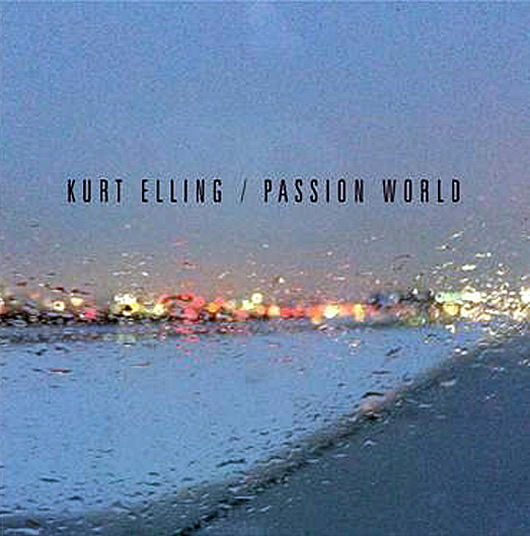
Kurt Elling, Passion World (Concord Jazz)

DEBUT

Kamasi Washington cover

Here’s the cover to Kamasi Washington’s 3-CD “The Epic.” Courtesy wbgo.org.

Kamasi Washington, The Epic (Brainfeeder) 

LATIN

Los Lobos, Gates of Gold (429)Feature/profile review for NoDepression.com: https://kevernacular.com/?p=6665

BLUES/ROOTS

James McMurtry, Complicated Game (Complicated Game) Review, also for NoDepression.comhttps://kevernacular.com/?p=6085

CLASSICAL/JAZZ

(tie) Chris Potter, Imaginary Cities (ECM) Feature:https://kevernacular.com/?p=6323

Junghwa Lee, Frank Stemper: The Complete Piano Music (Albany)

__________________

  1. For an understanding of how Schneider and ArtistShare have garnered public support and commissioning for new work go to this website:  https://www.youtube.com/user/MariaSchneiderOrch.
  2. Midwest readers note that saxophonist Jon Irabagon will perform in Milwaukee at 8:45 Tuesday, December 29 at The West End Conservatory, 5500 W. Vliet St. The Russ Johnson-Jon Irabagon Quintet with special guest tenor saxophonist Ohad Talmor, will include Chicagoans Matt Ullery on bass and Jon Deitemyer on drums. For information:https://www.facebook.com/events/1651837508388380/
  3. The SFJAZZ Collective, and the many touring jazz and jazz-oriented artists it hosts in a long season, benefit from San Francisco’s enlightened SFJAZZ Center, built and sustained expressly for the jazz art form. Culture Currents visited and reported on the Center and reviewed the concerts that would become the Collective’s live 2-CD set Music of Joe Henderson and Original Compositions album. Here’s the post, FYI: https://kevernacular.com/?p=5106

Maria Schneider album cover courtesy londonjazznews.com. Photo of Schneider courtesy hereandnow.wbur.com

Henry Threadgill Zooid album cover courtesy pirecordings.com

Carter/Bradford album cover courtesy acerecords.co.uk


Jazz singer Mark Murphy (1932-2015), “The next Sinatra,” did it his way


murphytopscan0639

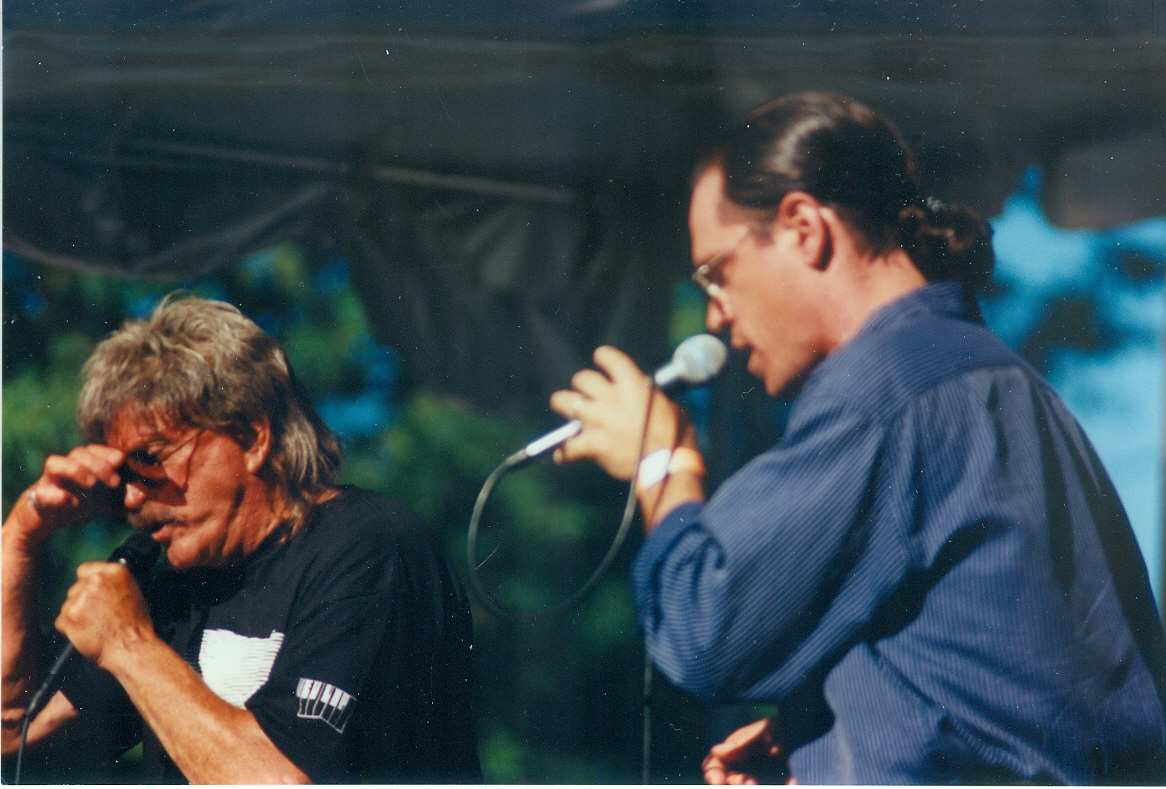
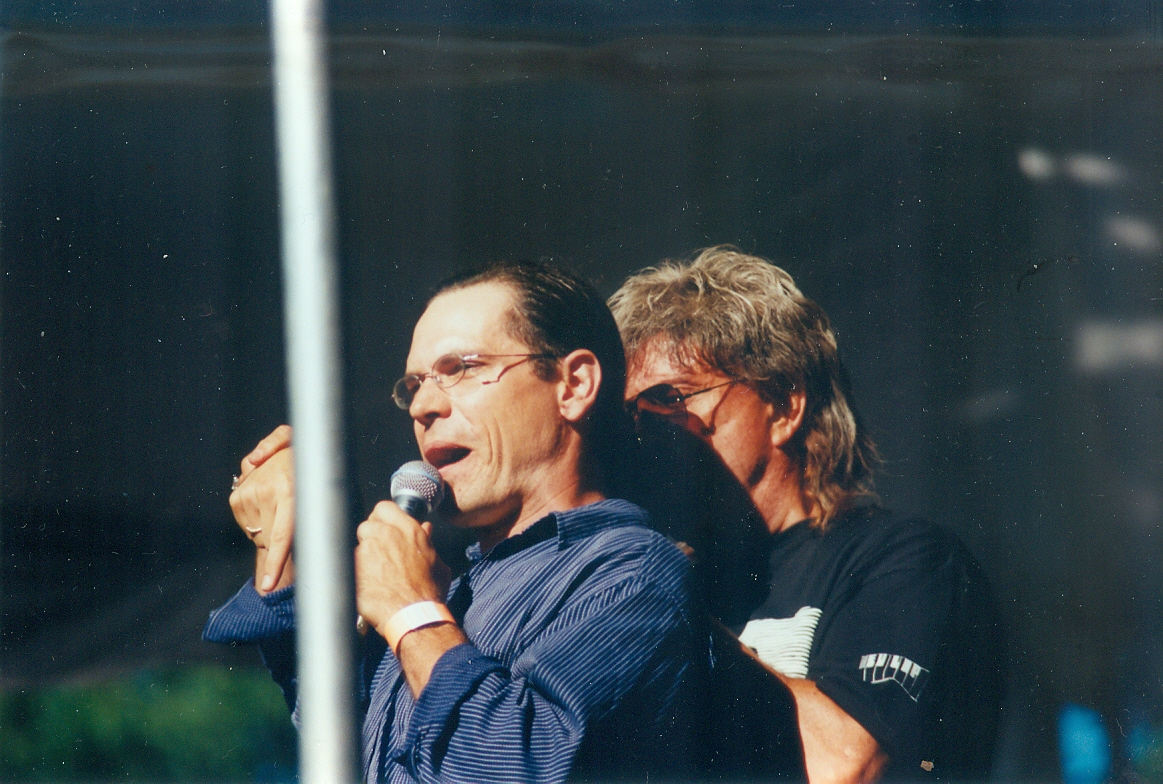
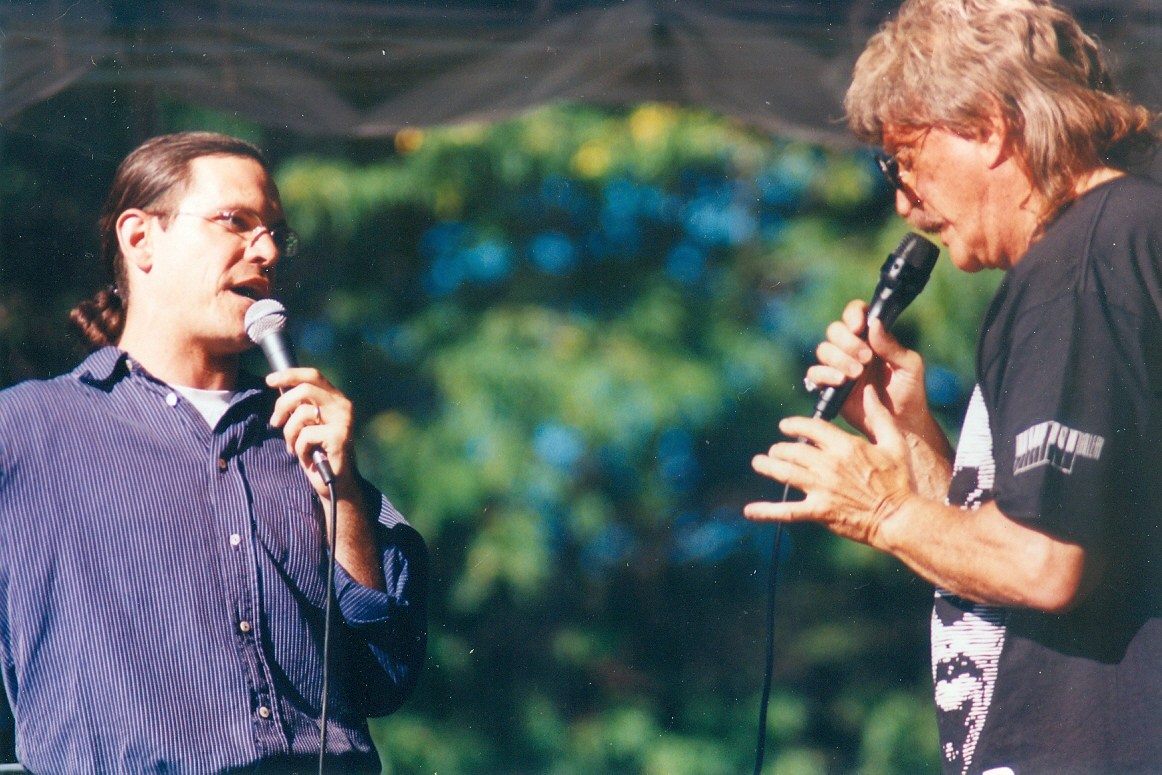
The late jazz vocalist Mark Murphy singing at the 1997 Chicago Jazz Festival, a performance he shared with Grammy-winning singer Kurt Elling, who was greatly influenced by Murphy. All photos by Kevin Lynch, except as noted.

Call me crazy but I see a little of Crazy Horse in Mark Murphy, the magnificent and fearless jazz singer who died October 22 at 83, of complications of pneumonia. More specifically, I see Murphy in the somewhat quixotic Crazy Horse Memorial sculpture, which I was reminded of while searching for news about Murphy in The New York Times. This was May of last year, but I had inklings about Murphy’s death, as he’d been seriously ill. 

At the time, I stumbled on an obit for 87-year-old Ruth Ziolkowski, who carried on her sculptor husband Korczak Ziolokowski’s dream. He had worked for years on his massive likeness of the great Lakota warrior Crazy Horse carved into the Black Hills of South Dakota.

In a sense, Ruth succeeded, because The Crazy Horse Memorial draws more than a million visitors a year, as is. And yet, her husband ultimately hoped to carve a full figure of Crazy Horse on his horse, out of the rock, and to date all that is visible is the famous Lakota’s 90-foot-tall head, impressive as that is. 1
With Murphy what counted was mainly his leonine head — what came out of his mouth from his brain, and his huge heart and soul.

And yet so much of him, like the full Crazy Horse figure, remained underground — his proper role as a highly influential innovator, and arguably the greatest male jazz singer of his generation (and right there with the greatest females). I’ve found that his historical recognition appears under-served in light of his somewhat controversial life, talent, dedication and courage. Of course, there’s controversy with the Lakota warrior because he defeated Gen. George Custer at the Battle of Little Big Horn. Crazy Horse fought against the US government’s removal — and effective permanent internment —  of Native American tribes to reservations. The issue hangs on your opinion of who the bad guys were in that battle.

And part of the craziness in Mark Murphy’s life was how far he stuck his neck out in the winds of derision — his artistic and personal risks. He isn’t unappreciated in the music business — he earned six Grammy nominations for Best Jazz Vocal Performance. But he never won the award. 

murphy10600

As noted jazz singer Jackie Allen, a student of the art form, told me, “Murphy was being groomed to be the next Sinatra, but he was just too far out. And I’m sure his being gay didn’t help him.”

So, part of being far out was coming out, as a gay man, very early in his career, which probably doomed his prospects as the next Sinatra, especially as old blue eyes had perpetuated the retro-straight-tough guy persona.

So Murphy fought for gay male jazz singers and performers from being culturally exiled.
Although things have improved, jazz remains straight male-dominated and the same is true of jazz critics and historians. And I have to wonder if Murphy’s neglect among major jazz critics and historians has anything to do with his genetic persuasion (as research has shown about gayness). Another of Murphy’s gay contemporaries, the exquisite singer-pianist Andy Bey, had a terrible time dealing with his sexual orientation in his chosen career, something illuminated in a compelling PBS documentary film on him.

murphy4scan0639

With Murphy, the inside story remains comparatively clouded. He may epitomize the cognitive dissonance that exists between jazz singers and jazz musicians, as symbiotic as their relationship is. Singers often get their band mates their most consistent and best-paying gigs. Yet too often musicians (I risk a stereotype, I admit) complain of gigs with a “chick singer.” The implication is the singer’s presumed inability to convincingly negotiate complicated chord changes or to sing in an improvisational manner or to scat sing, or her burdening musicians with renditions of hoary and sentimental standards.

Because male jazz singers are much rarer than female singers (an essay subject unto itself) this problematic relationship is less clearly articulated and understood, but it’s safe to think that a somewhat similar bandstand bias exists against the male singer (Murphy also played piano and sometimes did his own horn arrangements). What is striking and empirically evident is the lack of acknowledgment that Mark Murphy gets among jazz historians and critics who are assumed to be authoritative (see sidebar below, following footnotes). Today, with society’s fast acceptance of gayness, Murphy’s under-acknowledged pioneer’s suffering again recalls forsaken Crazy Horse’s.

But let’s reference a jazz singer’s opinion. Jackie Allen, once musically obsessed with Murphy, recorded a duet version of a signature Murphy song: “The Bad and the Beautiful” with the late singer’s number one artistic acolyte, Grammy-winning singer Kurt Elling, on her 2003 album The Men in My Life.

“I’d never heard anyone else sing it – or anyone else who could sing it, because it spans a couple of octaves,” Allen wrote in her liner notes. “So it was something I always wanted to do.”

So Murphy was “bad” as in problematic in some folks minds. But man, was he bad — and beautiful (as an artist and as a man, coming from this straight journalist’s judgement.)!

Some people complained that Murphy sometimes over-dramatized. If this criticism derived at all from the homophobic bias against “drama queens,” it’s good to remember that singing is always partly music-making and partly acting. A happily married heterosexual friend of mine, Bill Camplin, who’s a brilliant jazz-inflected folk singer, calls himself a “drama queen.” And I’m glad, because a sense of drama is essential to his art, as it was to Murphy’s and any jazz singer’s.

Murphy could go from deeply simmering dulcet tones to a soaring trumpet-strong cry with all too much ease for some, but he often carried a song to uncharted heights in the process.

I think it’s a confusion or perhaps anti-gay bias that denies the artistic necessity to be honesty vulnerable and expressive with a man’s self. Perhaps symptomatic of this is a comment that the highly estimable critic-historian Francis Davis made: “I thought it was amusing that Mark Murphy, a singer fans adore him for his alleged spontaneity, but whom I find unbearably ‘jazzy,’ did his numbers same way every time (during a 6-hour dress rehearsal).” 2

I would suggest that, on this occasion, Murphy was playing it straight for the sake of the continuity of a rehearsal, which is about getting things down and together that performers deem necessary, before they take the risks of performance for an audience.

For my money, Mark Murphy was more courageously improvisational than most jazz instrumentalists I’ve heard in a lifetime of listening and 35 years as a professional jazz journalist. Instrumentalists — in the protective perceptual bubble of pure music’s relative abstraction — are comparatively free of a singer’s risk of an audience rejecting a daring interpretation of a lyric and melody, especially familiar ones.

I only saw Murphy perform live once, but unforgettably in 1997, at a side stage of the Chicago Jazz Festival with Kurt Elling and his trio in, I believe, the two singers’ first ever performance together. I suspect Murphy’s appearance came at the behest of Elling, the popular Grammy-winning Chicago singer who’s primary vocal influence is Murphy. The simpatico artistic and emotional bond between the two singers was astonishing, at times dazzling, and moving. 3

As I hope the photos of that gig here show, Mark and Kurt (who’s married and straight) spent much of the set physically close to each other, glowing in mutual warmth, creativity and joy.  Yet amid all their electric energy, Murphy wore a black Miles Davis T-shirt, and he embodied a sort of Prince of Darkness reincarnated, replete with world-weary eloquence and forsaken romanticism.

murphyelling1scan0640

murphyelling2scan0641

Internationally acclaimed jazz singer Kurt Elling (in blue shirt, both photos) shared a remarkably simpatico experience onstage with Mark Murphy, his greatest influence, at the 1997 Chicago Jazz Fest.

Listen to Murphy’s live 1999 Vienna performance on the album Bop for Miles, which is often outrageous in its improv derring-do. Yet he sustains a superb voice and technical mastery of it, to make virtually all of this performance work beautifully. As the album’s annotator Bill Milkowski writes, on the evidence of this live performance, Murphy is “a grand high exalted mystic ruler of improvisation,” a gilded designation few instrumentalists get. I couldn’t agree more with Milkowski.

Yes, I’ve heard Murphy with a mouthful of ham at times, and stumble in a few of his madcap scat sorties. But I think good jazz singers ought to be guilty of both of those things at times, or they are probably not pushing the improvisational edge, with all the risk and significance that act might convey, not doing what we value them for doing.

(Here Murphy sings the modern standard “Speak Low” in 1992. Notice his elastic sense of time, how he fully re-imagines the song, yet even his scatting is deep in the rhythmic pocket:)


And the trademark grain in his low-to-mid range would gently plead, even as it understood loss and felt suffering.

An apparently straight jazz singer Gregory Porter helps illustrate these virtues by way of his own extending of Murphy’s legacy through Kurt Elling. “He opened some doors for me which I’m thankful for,” Porter said of Elling. “When I first started singing, I’d sing: ‘Skylark, do you have anything to say to me?’ And the way I was saying it wasn’t how it was originally recorded. I wanted to feel it, so I put the soul and gospel influence into my jazz. People would tell me, “you can’t sing it like that.” But that’s the way Kurt sings. I’d hear him insert a soulful expression into a standard. And now he’s made it acceptable.” 4

And that’s the way Mark sang, as well, on his own terms, always, his own man. Elling has also pointed out the literary contributions that Murphy made as a beat era-bred artist, sometimes setting poetry to music. The Murphy albums Bop for Kerouac and Kerouac Then and Now provide eloquent music musical testament to a great American writer who also remains undervalued, perhaps because of the seemingly haphazard way Kerouac wrote and lived out his most famous book, On the Road. Murphy also wrote and recorded resonant lyrics to a number of jazz instrumentals, notably Oliver Nelson’s “Stolen Moments” and Freddie Hubbard’s “(On the) Red Clay.” *

Among the better brief appreciations is from All-Music Guide’s Murphy biographer John Bush: “Mark Murphy often seemed to be the only true jazz singer of his generation. A young, hip post-bop vocalist, Murphy spent most of his career sticking to the standards — and often presented radically reworked versions of those standards while many submitted to the lure of the lounge singer — during the artistically fallow period of the 1970s and ’80s. Marketed as a teen idol by Capitol during the mid-’50s, Murphy deserted the stolid world of commercial pop for a series of exciting dates on independent labels that featured the singer investigating his wide interests: Jack Kerouac, Brazilian music, songbook recordings, vocalese, and hard bop, among others.” 5

murphycoverscan0600

This startlingly candid photo of Murphy, for the cover of a 2005 album, reveals the weight of the challenges he endured as an “out” gay artist long before that stance was as accepted as it is today. Courtesy Verve Records.

A comment Murphy made several decades ago about jazz seems to sum up his own life and career: He compared the art of jazz to basketball, recounts Down Beat magazine’s Michael Bourne: “You can imagine all the moves ahead ‘but it all changes, completely, bar to bar to bar. It’s really like dribbling in rhythm on a basketball court’ you can head for the basket, ‘but other players bump you, knock you around.'”

I’ll let Kurt Elling have the penultimate word. I interviewed him in 2007 and posed this question: You’re taking some daring leaps with the jazz singing tradition that extends through Eddie Jefferson, Jon Hendricks, Joe Williams and Mark Murphy. What do you value most in that vocal tradition? 7

“It’s tough to single out a thing,” Elling said. “The sound of it. The intelligence of it. The hip factor. The spirit of it. And also the camaraderie of it. I feel like those are my guys. I never met Joe, but I would hope that when we meet in heaven or something, they’ll say, “Right on, kid.” I do get that from Mark and Jon Hendricks. It makes me feel I’m doing what I’m supposed to be doing.

“All jazz people take their music very personally. We’re protective of the music because the world continues to not pay much attention to it. It’s something really profound and has so much to give, so I’m more hopeful than anything else.”

The profundity, spirit and hipness of Mark Murphy remain, and offer hope that his day in the sun will come.

____________

  • This late-career performance of “(On the) Red Clay” by an obviously less-than-healthy 80-year-old Mark Murphy  — with some gutsy, funky and delightful scat singing — shows Murphy’s courage and gifts, even in decline.

As envisioned, the memorial, when completed, would show Crazy Horse astride a horse and pointing east to the plains in a carving that would be 641 feet long and 563 feet high. Its height would be nearly twice that of the Statue of Liberty.

2 Francis Davis, Jazz and its Discontents, 2004, DaCapo, 100

3 In 2002, Elling produced the vocal summit “Four Brothers” at Chicago’s Park West Theater, which featured Elling, Mark Murphy, Kevin Mahogany, and Jon Hendricks. A cross-generational tribute to the art of singing jazz, “Four Brothers” toured Europe and the U.S. in 2003-04 to much acclaim. A final blowout performance in the summer of 2005 occurred in Chicago’s Millennium Park—a concert which featured Sheila Jordan in the fourth spot and was aptly named “Three Brotha’s and a Motha.’”

Down Beat magazine, Gregory Porter Blindfold Test, by Dan Oulette Nov., 2014, p. 106

http://www.allmusic.com/artist/mark-murphy-mn0000244552/biography

Down Beat magazine, January 2016, p. 8 http://www.downbeat.com/default.asp?sect=news&subsect=news_detail&nid=2883

7 Kurt Elling interview, Kevin Lynch, The Capital Times, January 19,

************************

SIDEBAR: Mark Murphy is largely neglected in many book-length critical jazz anthologies and histories.

I did an informal survey and determined that there are no indexed references to this important and influential jazz singer in the following books, all published during the prime arc of Mark Murphy’s career from the mid-1950s to the present (with each book’s amount of pages after the title). Among anthologies of highly respected jazz journalists, Gary Giddins’ two large volumes of seemingly definitive anthologies are Visions of Jazz: The First Century (690 pages), Weatherbird: Jazz at the Dawn of its Second Century (632). (Giddins is also the author of a biography of singer Bing Crosby). Nor is there any mention in celebrated  critic Whitney Balliett’s anthology Collected Works of Jazz 1954-2000 (873), largely from The New Yorker.

Among relatively recent and notable formal histories of jazz, there is nothing on Murphy in James Lincoln Collier’s The Making of Jazz: A Comprehensive History (543). More surprisingly, Murphy appears unacknowledged in both the massive and arguably definitive A New History of Jazz by Alan Shipton (965) and in perhaps the best and certainly most concise history, Ted Gioia’s A History of Jazz (444), the Second Edition of which was published in 2011. Murphy also gets no mention in Henry Pleasants’ eclectic 1974 The Great American Popular Singers: Their Lives, Careers & Art (384.)

By my arithmetic, the aforementioned titles add up to, in effect, Murphy singing his hip heart out while wandering through a 4,530-page desert of critical neglect.

Murphy fares somewhat better in the leading jazz recording guides although Jazz: The Rough Guide to Essential Recordings’ The 1995 edition includes a listing of only one album, 1991’s What a Way to Go and British critic (and Charles Mingus biographer) Brian Priestly comments, “Stylistically very consistent, he frequently uses jazz associated material for his own melodic improvisation scat singing and sounds infallibly ‘hip.'” Also British is the even more authoritative and comprehensive The Penguin Guide to Jazz. The Ninth Edition includes 13 Murphy titles including seven 3 1/2 star reviews on a four-star scale.
Interestingly the guide, written by British critics,  provides some of the best and most insightful summations of the American’s career, suggesting the proverbial prophet without honor in his own land. — KL

 These blog articles were also published at NoDepression.com.

Literary critic, writer and professor Ihab Hassan spent a lifetime questing for humanity

Hassan (1)  b

Courtesy ihabhassan.com.

A celebration of Ihab Hassan’s life and a memorial will be held at 3:30 p.m. on Nov. 19 at the Zelazo Center, 2419 E. Kenwood Blvdat the UW-Milwaukee, as part of a symposium that Hassan helped organize. It is free and open to the public.

By Kevin Lynch, UWM BFA ’73, MA English ’87

In these instant-gratification times, literature may seem a hoary, aging hero, a seeker with a backpack of musty books, plodding along the shore, risking being swept away by a tidal wave of technology.

I, for one, keep plodding, partly because my passion for literature was rekindled right when I was ready for it. A leave-of-absence from The Milwaukee Journal in the late 1980s helped me open another door. I began a Master’s degree program in English and encountered the most remarkable teacher of my life, Ihab Hassan. The University of Wisconsin-Milwaukee English professor emeritus died of a heart attack at 89 in Milwaukee on September 10th.

He is “arguably the most famous professor in the history of UWM,” Dave Clark, the school’s associate dean of humanities, told Journal-Sentinel obituary writer Meg Jones. “Now this is coming from the humanities dean, of course. But he’s an incredibly well-known international figure, widely credited with coining the current contemporary use of the term postmodernism.” 1

Indeed, the term – Hassan’s prescient insight into a tectonic shift in contemporary culture — was precise and resonant because it acknowledged the epic cultural force that modernism had on the way we live, think and understand each other, person-to-person, nation to nation. In retrospect, “postmodernism” might seem an unimaginative term because so many observers have aped its clear distinguishing function. Now we have “post-this-that-and-the-other-thing.” That showed Hassan’s influence, and his defining of the term helped clarify all the confusing reactions to the monumental anti-conventions of modernism, which was co-opted by absorptions of power, as Hassan understood quickly. Yet the rather inelegant term “post-modernism” was not characteristic Hassan, who was a lapidary wordsmith, among the most gifted and sometimes mandarin literary stylists I have ever read. His sumptuous vocabulary often challenged mine. “He just loved words. He gloried in them,” said Liam Callanan, a UWM associate professor of English. “He was absolutely the youngest octogenarian I ever met. He would have been young at any age, for his language. It was like watching a talented woodworker or sculptor at his craft.”

Beyond being a great literary critic, Hassan excelled as a teacher. He ingeniously demarcated the differences between modernism and post-modernism by creating a chart which listed terms of modernism with another column for the terms of postmodernism, which correlated most meaningfully to each modernist term. For example, Modernism: art object/finished work. Postmodernism: process/performance/happening. Have your dictionary ready for this list, but it clarifies the era’s often-confounding transition of thought and ideology as concisely as anything. 2

At a personal level, he possessed a certain Olympian air that inspired a tinge of awe, so it wasn’t necessarily easy to approach him. This Egyptian émigré was lean and handsome, with wavy silver hair, an impeccable dresser. He had a way with female students though he seemed devoted to his longtime wife and sometime-co-author Sally Hassan.

And yet, in literature’s often ambiguous and relative realm of judgment and interpretation, he loved to tease out insights from students. In our graduate seminar “Backgrounds to Modernism,” I was extremely gratified when I would answer a question he posed and he’d say, “Precisely!” with satisfied delight. In this class I read such modern classics as Thomas Mann’s Death in Venice, Virginia Woolf’s To the Lighthouse, Samuel Beckett’s Endgame, Freud’s Civilization and its Discontents, T.S. Eliot’s The Wasteland, Georg Lukac’s History and Class Consciousness, and Kafka’s The Trial. Heavy tomes, but Hassan made them compelling and important to us and our civilization.

Unforgettably, almost mysteriously, his affinity for Martin Heidegger in his abstract but beautiful book Language is the House of Being made me love a part of Heidegger’s capacious mind that seemed to utterly transcend his apparent Aryan racism. Remember, Hassan was an Egyptian, whom the Nazis probably would’ve ostracized if not exterminated. I did my term paper on Kafka and, with deft written comments he told me I had a “special feeling” for Kafka. Me? I felt like a knighted everyman who would later deeply connect with a Kafka precursor, Melville’s seemingly hapless scrivener Bartleby.

Hassan’s constructive critique also helped me to better guide a reader through my written thoughts with more signposts, to emphasize structural clarity. It wasn’t until years later, when I encountered a few lesser professors at Marquette University, that I realized how luminously Hassan had genuinely helped this student to succeed, and to become a better teacher.

And I’ll never forget one of his most offhanded, intimate seminar moments. As several of us chatted with him after one class, he summed up the groping conversation by saying, “Now, we are all pluralists.” The comment gently lifted us up to his windswept vista of broader, deeper understanding. At that point in time, pluralism — a non-confrontational, more inclusive term for the burgeoning multi-culturalism and globalism movements — signaled a cultural shift just beginning to groan into place, after postmodernism. 3 His observation in 1986 foretold the still-nascent Internet’s collective dynamics and ways of being, as Heidegger put it. Hassan didn’t hang on to one great accomplishment as time passed. He noted that predecessors used the term “postmodernism” before him, but he “stuck with the term and tried to clarify it.” 4  Humble and wise, he sidestepped his own renown and kept reading the zeitgeist. He decried the self-referential, insular specializing that began reducing so much “post-modernist” theory to academic or esoteric play.

As a professor of such cosmopolitan range and brilliance, Hassan gained international renown. He was a visiting professor in Sweden, Japan, Germany, France and Austria as well as schools in the United States. He won two Guggenheim Fellowships, in 1958 and 1962, and three Senior Fulbright Lectureships in 1966, 1974 and 1975.

rad innocence

Hassan’s “Radical Innocence” which reached mass-paperback audiences, is a classic examination of the contemporary American novel of the 1960s. Courtesy amazon.com.

So it was a huge coup for UW-Milwaukee — the little brother of the magnificent UW system’s jewel in Madison – to snag him in 1970. By then, Hassan sought a deeper sense of the peculiarly American mindset and genius, perhaps buried in the heartland somewhere. This Middle Eastern Americanist with his deep “background in modernism” had found a new concept for apprehending our native literature in his pioneering book Radical Innocence: The Contemporary American Novel published in 1961. He laid out important early templates for understanding Gore Vidal, James Baldwin, William Styron, Jack Kerouac, Ralph Ellison, Flannery O’Connor, Norman Mailer, John Cheever, Truman Capote, Saul Bellow, Carson McCullers, JD Salinger, Bernard Malamud and others – yes, a head-spinning literary hodgepodge that he made coherent. And the best short introduction to American literature I know of is Hassan’s 194-page Contemporary American Literature 1945-1972: An Introduction.

For me, and doubtless many others, the fact that he came from a Middle East culture as ancient as Egypt’s helped endow him, I believe, with an almost oracular perspective that I’ve never experienced with any other professor. Consider his small book Out of Egypt: Scenes and Arguments of an Autobiography in 1986. When she gifted the book to me at Christmas in 1986, my wife at the time, Kathy Naab, inscribed: “Follow a wise man out of Egypt and into the nether reaches of ‘reason, dream and love.’” Those three words gave you a sense of the range of his thinking, yes, even encompassing the intellectually derided ideas of “love” and “dream.”

In the autobiography, Hassan observed: “A Marxist, Zionist, or feminist may prove no more rational than some ‘mystics,’ yet no stigma attaches itself to their commitment. Is it because men forgive attachments to factions, fractions — my side, your side — but never to the whole? The threat of mysticism: not vagueness or unreason, but a loyalty wider than most of us can bear. In short, Eros diffused, the Self dispersed, the end of paideia.” 5


hassan

An exemplary book of Hassan’s mature period as a critic is “Selves at Risk: Patterns of Quest in Contemporary American Letters.” Courtesy amazon.com.


hassan

Courtesy yoyoseimo.blogspot.com.

And yet, despite his fame and glamor, he was the only teacher I’ve ever known who invited his students to his home for a seminar. On the last class of the semester, we came to the professor’s spacious residence on Terrace Avenue, overlooking Lake Michigan. Along the length of the connected living room and dining room stood one long wall of floor-to-ceiling bookshelves, jammed full, the most books I have ever seen in any home. Our gracious host then made a discussion of Samuel Beckett’s Endgame far less dire and bleak than it might have seemed otherwise.

My esteem for Hassan only grew in the years after his seminar, as I became an enthusiastic Americanist, in music, literature and art especially but particularly when I took the deep dive with Melville. I wrote a hopefully-forthcoming book called Voices in the River: The Jazz Message to Democracy, which explores the relationship between jazz, creative writing and the democratic process. I quote Hassan in it, and at one point was inspired to called him up from Madison, out of the blue, a student he’d had for one seminar 15 years earlier. He said he remembered me, and then I began babbling about my book, until Hassan deftly interrupted me. He chuckled and said, “You really don’t have to tell me your whole book. But it sounds like you have an excellent subject. Good luck with it.”

His words were golden to me. I imagine numerous UWM graduates have comparable memories of Ihab Hassan. After he retired, he continued to write, publish and stay active at UWM, and was helping organize a symposium Beyond Crisis: The Humanities in Renewal on November 19 at the Zelazo Center.

That date will now include a memorial event for Hassan, open to the public.

One of his major mature works was Selves at Risk: Patterns of Quest in Contemporary American Letters. At one point in the book, he stands on the shoulders of no less than Ralph Waldo Emerson and, indeed, sees further, regarding the human drive to quest:

“In the end, some Emersonian Whim is at the bottom of all quest, I think. But something else, too, that Emerson neglects: a wound. For the adventure/seeker is mainly a Westerner, scion of the rich of the earth, drawn to the wretched by a need, a dis-ease, they may find ludicrous. Though he may be neither soldier nor colonizer, domination no less than quest is the motive of his history and its deep wound. But this is also the wound from which history flows, sometimes suppurates. His flight from modernity cannot avail, nor his search for lost innocence, nor his nostalgia for otherness. His yearnings for desolation, of sand and snow, in Arabia or Antarctica, lead him to an abandoned Coke bottle more than (Wallace) Stevens’ jar ever ruled the hills of Tennessee. 6 Yet his will, malaise, disequilibrium, some radical whim or will or asymmetry in his being, has made our world knowable, made the world we know. Edging cultures, hedging histories, acting briskly, most often alone, the seeker — man or woman — gives us an indestructible perception that, from our best selves, speaks to all.”

His last published essay, in the current Antioch Review, is among his finest and most plain-spoken, a searing defense of the humanities that ranged from the humanist’s mightiest archetype Prometheus to Nietzsche, William James and crucially Steve Jobs. He titled it The Educated Heart: The Humanities in the Age of Marketing and Technology. He full understood the humanities’ limits, but finally he writes “Who, besides artists and writers — yes, and humanists — will speak to us of truths that we cannot prove but know in our marrows bones?” Hassan helps us know the nature and quality of those truths, as well as anyone. 7

In the end, his educated heart gave out, but never his intellect, passion or spirit. Ihab Hassan, born in Cairo, quested far around the globe many times. He was the best of questers, even in the worst of times. And he spoke indestructibly to all, to our best selves, our better angels.

  1. http://www.jsonline.com/news/hassan-coined-term-post-modernism-for-change-in-60s-literature-b99576689z1-327595561.html
  2. https://en.wikipedia.org/wiki/Ihab_Hassan
  3. 3. In Spring of 1986, Hassan explained this issue in a major essay “Pluralism in Postmodern Perspective,” in Critical Inquiry 12, 503, published later in his essay collection The Postmodern Turn: Essays in Postmodern Theory and Culture. Ohio State University Press, 167

    4. Postmodernism, etc:* Interview with Frank Cioffi http://www.ihabhassan.com/cioffi_interview_ihab_hassan.htm

    5.Ihab Hassan, Out of Egypt: Scenes and Arguments of an Autobiography 1986, Southern Illinois University Press, 79. With that last word of the quote, you see what I mean about Hassan’s vocabulary, and his philosophical perspective: Paideia: Ancient Greek Hist. Education, upbringing; spec. an Athenian system of instruction designed to give pupils a rounded cultural education, esp. with a view to public life. Hence: the sum of physical and intellectual achievement to which an individual or (collectively) a society can aspire; a society’s culture. From the Oxford English dictionary online http://www.oed.com/view/Entry/135951?redirectedFrom=paideia#eid

    6. Hassan alludes to Wallace Stevens’ well-known poem “Anecdote of the Jar,” which explores the question of the superiority between art and nature.

    7.http://review.antiochcollege.org/fall-2015


“The Changin’ Times” and The Drizzly November of Bob Dylan’s Soul

dylan getty

Bob Dylan writing in Woodstock, N.Y. during the period when he composed the songs for his earliest albums of originals. From the new book “Dylan:Disc by Disc” from Voyageur Press. Photo credit: Douglas Gilbert/Redferns/Getty Images

November has come, dour as a rusty pail, and I mourn my favorite month. October was a calendar painting delaying my spirit’s decay — when the leaves and thistle burnish and glimmer, and fill the air with the pungency of natural death cycles. So I’ll surely face the howling wind, as I’ve done Novembers past.

Yet old songs stir. I’ve realized that Bob Dylan did November’s song as well as anyone ever has. The times are a-changin’ to a wintry world and Dylan understood and expressed this in new found terms of old traditions. On the first page of Moby-Dick, Melville’s Ishmael had invoked “the damp, drizzly November of my soul,” when he found himself “involuntarily pausing before coffin warehouses, and bringing up the rear of every funeral I meet.”

Dylan invoked similar spirits in his early masterpiece, The Times They are a-Changin’  from 1964, even though he was merely 22 years old when he wrote and recorded these songs.

As often as we may have considered, loved or even forgotten it, the album is worth revisiting at least once again, to hunker in November’s chill.

This essay is also prompted by an elegantly crafted new coffee table-sized book Dylan: Disc by Disc, edited by Jon Bream and introduced by Ritchie Unterberger, with conversational and insightful comments on Dylan’s 36 studio recordings from Rodney Crowell, Robert Christgau, Tony Glover, Joe Henry, Jason Isbell, Rick Ocasek, Suzanne Vega, NoDepression.com editor Kim Reuhl and others.

Of course, we know that Dylan understood what he had accomplished with this album. He knew how, in 1964 it spoke to the war-mongering paranoia of presidential candidate Barry Goldwater, and a November election that resoundingly rejected that, with Dylan’s help. He spoke for the restless ferment rising from a new generation, and for black Americans finally calling for just rights with another poet/leader named King.

So it’s commonly understood as Dylan’s greatest protest album, and perhaps the greatest such album of all time. But it’s protest is not purely political or social rhetoric. It’s greatness lies in the cries for the lives of very specific people, whether very real or archetypes he dreamed up. Dylan’s complex compassion bleeds from his pores.

Yet he seemed to sense he could not top the album on its terms, so followed it with more private expression and poetic imagery in the ensuing Another Side of Bob Dylan. Nevertheless, he said he would always stand behind his earlier work, and I’m sure nothing gave him greater pride than The Times.

And yes, for me there’s irony in that I have stated previously and made it a mission to explore the increasing multitude of excellent singer-songwriters inspired by him, who followed and remain shortchanged because of his towering position. Still, this is an expanding literature of our roots musics, a new sort of American Renaissance.

Texas singer-songwriter Steve Earle once brashly declared “I’ll stand on Bob Dylan’s coffee table in my cowboy boots and say Townes van Zandt is the greatest songwriter in the world.” 1

Yet, Dylan, while he breathes, remains the man. I swear you can talk of Dylan as if Shakespeare’s in the room and learn anew. The bard of his times dramatizes the truth in echoing lives and circumstances, be they Elizabethan or mid-60s America. For one thing, many white people still fear a rainbowed nation, as in 1964 or like the racism dwelling in say, The Merchant of Venice or Othello.

Although The Times brims with poetic fire, Dylan chose here to speak as plainly as he could. In many ways, this was his noblest effort, rich with incident, detail, drama, romance and ardor. He seems as committed as ever. Each song deserves an encomium, but I will pick and choose somewhat, and try to offer fresh insights. I shy away from the opening title song, as iconic as it is, as his echoing fanfare of truth and challenge, partly because it also speaks in the broad abstract, even with his brilliant particulars.

dylan times liner

A liner photo from the 2005 CD re-issue of “The Times They are a-Changin’.”

I prefer to linger over the powerful story-songs and other pronouncements simmering with finely-hammered irony, and the two exquisite romances.

So “Ballad of Hollis Brown,” that sorriest of South Dakota settlers, follows with shuddering emotional power, driven beneath by the insistent drive of Dylan’s guitar drone, like church bells tolling in hell.

Your baby’s eyes look crazy/they’re a tuggin’ at your sleeve/you walk the floor and wonder why/every breath you breathe.

Doesn’t every despairing man ask why me? as a heart-lacerating refrain, even if there are logical reasons? What happened to bring it to this? I always worked things out, until now.

Your babies are crying louder now/It’s pounding on your brain/your wife’s screams are stabbing you/like the dirty drivin’ rain.

And then the horror creeps slowly upon his despair: Way out in the wilderness/a cold coyote calls/your eyes fixed on the shotgun/that’s hangin’ on the wall.

I’ll quote only the ending because hearing Dylan perform the climax is the only the way to do it justice. And yet astonishingly, for such tragedy, Dylan renders a last ray of hope with no false sentiment, not for this man in his befouled world. Nay, hope for every man who may be born that dark day, and learn and plow his field to plenty from the shroud of that November, even if he may not avoid such a fate himself.

https://www.google.com/webhp?sourceid=chrome-instant&ion=1&espv=2&es_th=1&ie=UTF-8#q=ballad%20of%20hollis%20brown&es_th=1

Dylan’s evocative mastery is as sternly cinematic as a black-and-white John Ford film. Indeed Ford could’ve wrought something with long craggy shadows from Dylan’s tale of Hollis Brown. Because we need remember, this is America as much as the ever-celebrated hope and will and caring.


dylan

Album cover photo by Barry Weinstein.

From this stark story, Dylan upshifts grinding gears to the epic American mythology of “With God on Our Side.” This is the second telling of his first great masterpiece of anti-war irony, “Masters of War” from the preceding album The Freewheelin’ Bob Dylan, which in many ways remains my favorite Dylan album, but only as a personal preference. And he brilliantly makes this broad-shouldered declamation with the most unassuming of introductions: Oh, my name is nothin’/ my age it means less/The country I come from/is called the Midwest.

His voice begins to recite our country’s darkest and most mythologized chapters with a slow, chest-heaving sorrow. Our history books tell it/ They tell it so well/The cavalries charged/The Indians fell/The cavalries charged/the Indians died/Oh the country was young/with God on its side.

Yes, we have Bury My Heart at Wounded Knee and other magnificent testaments. But has anyone ever told the Native American story with such succinct rightness?

Dylan takes us through the Spanish-American war and both world wars and faces the Cold War in which he wrote the song: But now we got weapons of chemical dust./If fire them we’re forced to/ then fire them we must./One push of the button/and a shot the world wide./And you never ask questions/when God’s on your side.

He tells us that he spent a long time thinking about these matters before the song came and, despite his simmering anger, he does not speak as a moral arbiter. He humbly allows us our freedom.

He invokes Judas Iscariot’s betrayal of Christ and concludes: so now as I’m leavin’/I’m weary as hell/The confusion I’m feelin’/Ain’t no tongue can tell/The words fill my head/and fall to the floor/if God’s on our side/ He’ll stop the next war.

Dylan is heroically honest yet bereft of a solution. Like so many before him, he invokes God in his darkest hour. I figure Dylan knew that God would not stop the next war, and this song remains the summation of the dire irony he laid before us, the countless grotesque ways that God’s name has been taken in vain. And Dylan seems to understand that the free will we exercise weighs on God’s heart much as anything. I suspect he might concur with Norman Mailer’s late-life cosmology which posited that God is not omniscient; rather that He is a flawed creative artist. So He may be unable to stop humanity’s fratricidal and ecological madness, until perhaps the Second Coming or whatever the final hour brings.

Dylan wisely follows this mighty jeremiad with pure grace, the album’s most hushed and intimate reflection, “One Too Many Mornings.” We hear what a superbly romantic singer he can be, the perfect counterpoint to his bracingly ironic voice.

The song takes a poetic measure of time akin to the following year’s “My Back Pages”: As the night comes in a fallin’/the dogs’ll lose their bark./And the silent night will shatter/from the sounds inside my mind/For I’m one too many mornings/and a thousand miles behind.

It’s a story of a young man reflecting from where he sits, having lain with his lover. That sun-filtered scene, and perhaps everything leading up to it, compels him to realize life can catch up to you, ambush you at any moment, even that one when you finally begin to truly savor it.

“North Country Blues” is a more muted death dirge than “Hollis Brown,” and a magnificent evocation of the coal miner’s life. It tells a true, harsh story that leads to the devaluing of the coal product and of the lives of those who labor for it.

So the mining gates locked/and the red iron rotted/and the room smelled heavy from drinking.

Where the sad, silence song/made the hour twice as long/as I waited for the sun to go sinking.

“Only a Pawn in their Game” tells the tale of Medgar Evers, one of the first martyrs of the civil rights movement. A handle hid out in the dark/ a hand set the spark/ two eyes took the aim/ behind the man’s brain/ but he can’t be blamed/ he’s only a pawn in their game.

Of course, it is a tale as contemporary as tomorrow. Because, for all the progress that Frederick Douglass believed in, and that we have accomplished, we struggle mightily with race, and the nation’s Original Sin. Dylan understands it is the contradictions of our system that betray us all, even the manipulators. Dylan sings with the weary regret of a witness who has seen it too many times before. That was 1964. How many of us are witnesses today of the same doleful sort? And what are we to do about it? Those were Dylan’s implicit questions, back then.

Again he wisely gives us respite, with perhaps his loveliest November evocation of romance in all its splintering splendor. “Boots of Spanish Leather” is like the ocean waves it uses as a metaphorical and literal setting for the distance between two lovers in a romance that may or may not have experienced one too many mornings. Dylan imagines the two lovers corresponding over the sea with letters. 2

One lover longs for the other’s lips. And yet, I got a letter on a lonesome day/it was from her ship a sailing/saying I don’t know when I’ll be coming back again/it depends on how I’m feelin’.

The seemingly forsaken lover musters gallant graciousness: So take heed, take heed of the Western wind/take heed of the stormy weather. And yes, there’s something you can send back to me/ Spanish boots of Spanish leather.

The lover repeats the word “Spanish” as a way of savoring the beautiful artifacts that might symbolize their love, and its leave-taking. It’s as if he cannot let go in that moment, and yet he does. Perhaps the vast ocean waves that have gently jostled beneath this tender story loosed the moorings of the love they once trusted as firmly entwined.

Oh, but if I had the stars from the darkest night/ and the diamonds from the deepest ocean/ I’d forsake them all for your sweet kiss/ for that’s all I’m wishing to be ownin’.

https://www.google.com/webhp?sourceid=chrome-instant&ion=1&espv=2&es_th=1&ie=UTF-8#q=boots+of+spanish+leather+

“The Lonesome Death of Hattie Carroll” tells another true story of American racial shame, one far less known, but no less potent, than Medgar Evers’. William Zanzinger killed Hattie Carroll, a maid. The wealthy young tobacco farmer reacted to his deed with a shrug of his shoulders/and swear words and sneering, and his tongue it was snarling/ In a matter of minutes on bail was out walking.

The killer gets a six-month sentence. Oh, but you who philosophize disgrace and criticize all fears/Bury the rag deep in your face/for now’s the time for your tears.

Perhaps no song Dylan ever wrote more effectively juxtaposes wrenching pathos with boot-heel disregard, and the curious and wide range of reaction to the events that is peculiarly American.

Finally “Restless Farewell” is perhaps Dylan realizing he needs to end his great testimony to the changing times. Changes few could have predicted or forewarned except someone like him. He became our Paul Revere, our Raven quoting doom, our secular minister who preached with a harmonica hooked to his a neck, a wily voice and words to anguish, wonder and march to.

And in 1964, he was our bard of November and its howling reprisal of summer’s lost innocence. Most remarkably, he was a kid from Hibbing, Minnesota, as extraordinarily gifted as he was obsessed with America’s vernacular musics, brash and brawling, impassioned and commingling.

Oh, every thought that’s strung a knot in my mind/

I might go insane if it couldn’t be sprung.

But it’s not to stand naked under unknowin’ eyes.

It’s for myself and my friends my stories are sung…

So I’ll make my stand/and remain as I am

And bid farewell and not give a damn.

___________

All lyrics, in italics, by Bob Dylan, copyright 1964

1 Today Earle competes for that title, as does Lucinda Williams or Roseanne Cash or Springsteen, among others. Or perhaps James McMurtry exemplifies the lessons that Dylan passed down on this album of monumental storytelling. His superb 2015 album Complicated Game demonstrates how he’s learned from Dylan as well as his father, the great Texan novelist Larry McMurtry, and made all that his own. So, if you want to go somewhere after The Times, where Dylan himself chose not to, go to James McMurtry who can sing story-songs with comparable compassion, anger and eloquence.

2 One of my very favorite interpreters of Dylan, Fort Atkinson, Wisconsin-based singer-songwriter Bill Camplin, brilliantly underscored the emotional contrast of man and woman in his interpretation of the “Spanish Boots” narrative on his album Dylan Project One. Camplin clearly uses both gender voices, rendering the female with conviction, thanks to singing which effortlessly shifts from high baritone to falsetto.


The day Elvin Jones fired up Milwaukee’s Lakefront Festival of Art in 1972


elvin (3)

Dave Liebman turns up the heat with a soprano sax solo with bassist Gene Perla and bandleader Elvin Jones accompanying. Saxman Steve Grossman lays out in the background. Photo by Kevin Lynch at the 1972 Lakefront Festival of Art. 

This blog is a birthday remembrance, honoring — one month late to the day — the monumental jazz drummer and innovator Elvin Jones, who was born on September 9, 1927 in Pontiac, MI, and died May 18, 2004. His passing prompted the original version of this appreciation, published in 2004 in The Capital Times Rhythm section, aptly enough. Now, the photo-essay aspect was also prompted by Racine trumpeter Jamie Breiwick’s assiduous recent efforts at building an archive of Milwaukee jazz history, here: http://mkejazzvision.org/milwaukee-jazz-archive/ – KL.

Elvin Jones has driven the jazz spirit in my mind and body since before I knew it. Besides countless jazz drummers, he’d influenced the double-drummer approach of The Grateful Dead and The Allman Brothers Band, and the Coltranesque dramatic flow of the Butterfield Blues Band’s pioneering instrumental epic “East-West” of 1966, which he praised with a sage sense of the musical zeitgeist. 1

I had already caught the Coltrane bug, and Jones’ drumming coursed though my veins as I followed Trane’s incandescent, rhythmically refracted quest.

Jones’ innovative drumming style boiled all the implications of a time signature into rolling accents and a sliding pulse that pulled the listener in, and freed the music with a balance of sly sophistication and muscular resonance. As the most integral member of the classic John Coltrane Quartet, Jones went somewhat underappreciated by wide audiences after he left that group. This was partly because his approach was baffling to many even as you heard and felt its effectiveness and power to carry and lift the music.

Some drummers picked up on his triplet-figured rhythmic attack and started approximating his ambidextrous polyrhythms, which created a unique dynamic tension across the drum kit while requiring a loose-limbed bodily execution. (Jones succinctly describes his polyrhythms as “many rhythms, coordinated rhythms”) But few could capture the essence of his marvelous motion. That included monstrous press rolls to rival Art Blakey’s and a roaring sonic totality when swinging alongside a saxophonist as inspired as Trane in full locomotion.

At times you could hear Jones grunting and groaning as he played, and those bodily exhalations seemed integral to his sense of rhythmic dynamic and propulsion, like a tai chi martial artist. The analogy came to mind not because I know he had knowledge of, or had studied, that artful discipline. But I know he was married to a Japanese woman, Keiko Jones, who also wrote music, sometimes for her husband’s group.

elvin band

I recall hearing (and meeting Elvin and Keiko) in 1972 at Milwaukee’s Lakefront Festival of Art, which was the occasion of the photos I took, which you see on this blog. I was with one of my best friends, Frank Stemper, then a local jazz pianist who would soon become a composer, earning a PhD. in music (on which I collaborated with him on his final project) and becoming the long-time director of the University of Southern Illinois– Carbondale music department. Frank’s compositions have been performed worldwide, he has a sophisticated sense of musical time and was a big Buddy Rich fan. And yet, that day, intently watching and listening to Elvin, Frank finally exclaimed, “What is he doing?!” (More on that concert later.) 2

elvin 3

Clockwise from top left: (1) Elvin Jones played so powerfully that he had to nail a board to the stage to keep his bass drum from moving. (2) He chats with a fan while pounding. (3, and above) His quartet essays an ensemble section and (4) the quartet is framed by the lovely setting of the 1972 Lakefront Festival of Art in Milwaukee’s Juneau Park, on Lake Michigan. 

Racine-born, Wisconsin Conservatory of Music-trained bassist Gerald Cannon,  who has played with many world-class jazz artists, commented “I was the last bassist to play with Elvin Jones. I was with the (Elvin Jones) Jazz Machine for about seven years, and I thought I knew how to play the bass before I played with Elvin. I was wrong. I learned more about dynamics, time, groove, and melody from Elvin than any band I had ever played with before him. I really learned to trust myself and my time with him. He was a great man. I miss him dearly. God Bless Elvin Jones.” 3

Indeed, Jones had evolved into a sui generis master musician with an ensemble concept which he developed in a series of superb albums on the Blue Note label. He showed that his post-Coltrane jazz would be diverse and subtle, but swinging and declamatory, and need not be deathly serious in manner.

Sadly a number of these albums remain un-reissued on CD. 4. So I don’t hesitate recommending wholeheartedly The Complete Elvin Jones Blue Note Sessions on the limited-edition label Mosaic Records ($128, mail order only at 203-327-7111 or www.mosaicrecords.com), an investment that is rewarding, pleasurable and a deep slice of obscured music from modern jazz’s greatest drummer. A debilitating arm injury prompted me to listen to the whole 8-CD set recently, but each album is worth savoring.

Jones’ wizardly multi-directional motion filled the rhythmic role of piano accompaniment and his coloristic approach to drum tones and savvy bassist Jimmy Garrison and reed player Joe Farrell provided a remarkably rich trio sound in his early Blue Note sessions “Puttin’ It Together” and “The Ultimate.” Farrell, who died in 1986 at 49, was a resourceful master of saxes and flutes, and would not be fully appreciated until his later work with pianist Chick Corea.

Farrell was a consistently delightful and inventive musical thinker on these dates. Jones expanded his ensemble on the albums Coalition and Genesis and especially on one of my favorite jazz albums of the 1970s, Merry-Go-Round. The date included the masterful baritone saxophonist Pepper Adams, ex-Basie tenor player Frank Foster and two young fiery Coltrane sax disciples, Dave Liebman and Steve Grossman. Merry-Go-Round had a carnivalesque variety and bristling joi de vivre, and among its highlights are Corea playing on the first recording of his small masterpiece of Latin jazz, “La Fiesta,” Liebman’s exultant hard swinger “Brite Piece” and bassist Gene Perla’s sassy strutter “’Round Town.”

elvin 4

Clockwise from top left: (1) With Elvin Jones at the drums, Dave Liebman solos on tenor sax, (2) then soprano sax. (3) Fellow saxman Steve Grossman tears it up (with bassist Gene Perla driving the pulse), and (4) finally Elvin Jones takes a drum solo.

I got a live earful of this great material at that unforgettable Lakefront Festival of Art performance. I also recall, near the stage, my dad Norm Lynch, a big jazz buff, hoisting my young sister Anne up on his shoulders, so she could better see and hear the fiery and sometimes blistering music. That muscular double-sax quartet (with Liebman, Grossman and bassist Perla) would soon produce an explosive multi-disc set called Live at the Lighthouse which is  intact in the Mosaic collection as an edgy, thrilling exposition of the band’s creative power. Throughout this mighty box set, Jones’ flaming, indefatigable musicality illuminates lyrical chamber trios, Latin-style percussion jams, octets and expansive live sets.

Still, it’s worth remembering, Elvin Jones came of age with John Coltrane, so to fully understand, or at least experience, him one must hear that body of work, largely available on Atlantic and Impulse Records.

“With John, everything I had learned up to that point, it gave it significance,” Jones recalls of the classic John Coltrane Quartet, with pianist McCoy Tyner and bassist Garrison. 5  Having descended from the mountainous vistas of Coltrane’s spiritual expedition, Jones brought his own music somewhat more down to earth, wind and fire. And yet he could still take you on a journey that you can take nowhere else.

________________________

All photos by Kevin Lynch. This article was originally published in shorter form in The Capital Times in 2004.

NOTE: One of the first women to break into the upper ranks of modern jazz was Marian McPartland. The pianist and her trio (pictured below), opened for Elvin Jones that day in Milwaukee. McPartland would later go on to host a popular NPR jazz radio program where pianists would visit her live in the studio, discuss their music and play live solos and duets with Marian.

Marian Mc

  1. Elvin Jones — upon hearing Mike Bloomfield’s long and highly influential composition “East-West” on the Butterfield Blues album East-West — commented, in part: “Very well done. This has a nice feeling. I’d give that five stars.” – Down Beat Blindfold Test, Nov. 17, 1966.
  2. Perhaps the best elucidation of Jones and his innovative percussion approach is on the video documentary Elvin Jones: Different Drummer. It includes Jones’ own vivid and eloquent descriptions of his style and its effects, which was a multi-color-related concept, as he explains it. https://www.youtube.com/watch?v=Qn1xMVmLbWk A technically superior document of Jones in extended performance is the DVD Elvin Jones: Jazz Machine from a 1991 concert.
  3. Gerald Cannon posted his remembrance of Jones on the comments section for the Different Drummer You Tube (see link in footnote 2).
  4. Check the online All Music Guide for comments on availability of individual albums: http://www.allmusic.com/artist/elvin-jones-mn0000179379/discography
  5. The Elvin Jones quotes in this article are from the documentary film Different Drummer.

“The Journey” — A Deathly Odyssey Teaches Trumpeter David Cooper about Music and Life

David cooper

David Cooper. Courtesy of Cooper’s blog allthingstrumpet.com

The David Cooper Quartet will perform Friday, October 9, 2015 @ 7:30 pm – 9:30 pm., at The Wisconsin Union’s Frederic March Play Circle, 800 Langdon Street,
Madison. Admission is free.
Presented by the Greater Madison Jazz Consortium InDIGenous series.
For virtuoso trumpeter David Cooper, the horn of plenty almost ran dry. Death Valley dry.

You know the cliché about art imitating life. What’s more significant is how music can sometimes embody life and life transform music. That happened to Cooper in ways he never dreamed of. In fact, he’s turned medical horror — a nightmare that threatened his life — into deathless music. The story speaks as much of courage as creativity, not to mention the endurance of pain, the face of mortality. Cooper is 51 years old.

We’re talking a trumpeter given a diagnosis of throat cancer in May 2014, shortly before the recent jazz recording The Journey was planned. It’s a bit like a boxer going down to the mat and the ref’s counting you down. Imagine the tragic movie Million Dollar Baby. The analogy is not much of a stretch.

Not only a cancer diagnosis but a fractured jaw. And it sort of gets grisly.

“I had to have all four wisdom teeth taken out,” Cooper recounts. “The cancer was under the skin so they were afraid it could potentially kill those teeth. To keep them clean would be just a mess, so they wanted to get rid of (the teeth) pre-emptively.

“So they knocked me out and actually fractured my jaw accidentally, removing the teeth. I started the radiation daily and chemo for six-weeks. They said in the last three weeks it won’t be good and after that it’s the worst, how treatment progresses.

“By the recording, I was in the third week of treatment. So my wife Kelly drove me back and forth to the studio, I couldn’t drive. The chemo and radiation just knocks you out, so I was loopy.”

Cooper, who lives in Black Earth and is professor of music and chairman of the music department at the University Wisconsin-Platteville, took a planned road trip to an international trumpet convention in June. 1

“Nothing had started, but my mind was reeling with the news of the cancer,” he recounts, and admits little recollection of the conference. “But the road trip now provided the context. I had time to think and listen to many of my favorite recordings.”

“Almost all the tunes are standards and are things I’d always wanted to do,” Cooper continued. “I thought, I have a bucket list of things to do. So I could write new heads, so they’re mine. Then I saw road signs and thought oh, that might be an interesting name for a tune.”

As the concept arose and came together the titles list congealed with an undercurrent of threat or danger: “Merge Left,” “Stop,” “Detour Ahead,” “Speed Zone,” “Rough Road Ahead,” “Slippery When Wet,” etc.

They serve as material for meaty musical interpretation, and as an extended metaphor for Cooper facing the threat of cancer and treatments, the violence to his person and psyche.

“There was a lot of fear and concern in that whole process,” he admits. Considering that, what’s amazing is how damn good The Journey is.

David Cooper b&w

The cover photo of Dave Cooper for “The Journey.” Courtesy union.wisc.edu

And Cooper feels his playing was compromised by the illness. He had anticipated this quandary. So in the previous months he busted his tail getting himself into “the best shape of his life” for playing. If one compares The Journey to his recordings of his transcribed Bach unaccompanied cello suites, one may perceive less technical assurance or — in to his previous jazz recordings — bravura. Throat cancer wreaks havoc on a horn player’s embouchure, he said.

“If you get out of shape you need to continually rebuild the mouth muscles by exercising. But the pressure on the lower jaw when I played, that was painful. I didn’t know why at the time. It wasn’t diagnosed as a fracture until months later. I thought I had an infection in December, which really scared me. My face was so swollen they had to wait until it died down to search for the cancerous spot.”

Picture, say, a lopsided watermelon wilting in the heat and sliced open just enough to stick a trumpet in, like a knife.  And Dave’s a handsome fella.

His wife, the talented jazz singer Kelly DeHaven, deserved none of this. “Kelly went through every bit of this with me. Now she’s kind of exhausted and beat up. She needs the time to be nurtured. She was a rock through all of this. They did this carpet bombing: ‘Here are your drugs, hope they knock down the swelling.’ That’s when we all hit rock bottom. It did turn out to be an infection caused by tooth extraction which never healed well. “

Nevertheless, the opportunity had arisen, almost like a long-unrequited musical love affair too sweet for disease to deny, an Affair to Remember. You may hear a sense of mature wonder, a life faced and lived, and perhaps inevitable angst, which can take you a long way as a listener.

The strong material, mostly based on changes of classic tunes, sounds time-tested. The music resonates in my memory as a listener.

“It helped to provide a good structure and familiarity so the rest of the guys could come into the pieces much faster and be comfortable,” Cooper says unassumingly. He considers himself lucky in another way

“This band was basically my dream team, of the people I’ve played with in the last ten years.” That would be Madison pianist Johannes Wallman, Appleton bassist Mark Urness and Chicago drummer Ernie Adams.

But here’s where Cooper’s journey really does detour, through a virtual Death Valley. And the guy riding stagecoach was that nasty outlaw named Side Effects. And there’s no end in sight for that road, not yet.

“I’m still dealing with the radiation in my throat,” Cooper explains. “My whole throat and jaw area all contain salivary glands and are affected. Well, (the doctors) fried those and now I have constant dry mouth. The embouchure is really compromised without saliva. So I have to think in shorter phrases and always have a bottle of water by my side. That began during the session. It felt like the face wasn’t mine.”

Sometimes necessity is the mother of invention, or the power of creation.

“Perhaps I didn’t have all my tools available to me, I had to be judicious about what I say, and how I say it, and be more succinct,” he says. “Now that I feel my playing is back to normal I think I’ve learned from that. I’m trying to say more with less.”

Cooper’s resourceful courage is almost palpable on The Journey. And the band swings, swerves and hums through it like a finely-tuned Maserati, masterfully hugging the curves of the tunes. Plus, you have Cooper taking “Merge Left” based on “Green Dolphin Street.” The opening salvo of C to Cm7 to D7 to D flat to C is among the standard repertoire’s most satisfying sequences of naturally transporting changes. Other tunes are based on Coltrane’s “Giant Steps,” Terence Blanchard’s “Transform,” Wes Montgomery’s “Road Song,” among others. “In some ways it’s like my maiden voyage.”

The recording ends with a warm exhalation, Cooper’s solo rendition of Hoagie Carmichael’s “Stardust,” dedicated to his father. Tom Cooper, a trumpeter, taught young Dave basic fingering and other essential lessons of musicianship.

“Because of my dad, I wasn’t in just a sea of people,” Cooper recollects. “I was at the top of the class. So because of my dad I began practicing to stay ahead. That kick-started me.”
Here’s to David Cooper taking his sweet time with his bucket list, for a long, journey down the road before stardust befalls him for the last time.

___________

1. Cooper has music degrees from three schools: a B.M. from Lawrence University, a M.M from Akron University and a D.M.A. from UW-Madison.


The Journey is available http://allthingstrumpet.com/shop/ and http://www.cdbaby.com/cd/davidcooper22 and amazon.com

This article was commissioned by the Madison Jazz Consortium and originally published in Jazz in Madison at http://www.jazzinmadison.org/the-journey-a-deathly-odyssey-teaches-david-cooper-about-music-and-life/

Los Lobos: The powerful and beautiful social comment of “Gates of Gold”

A cartoon strip by Brian McFadden that ran in The New York Times on Sept. 6 depicted a forlorn Statue of Liberty greeting a boatload of immigrants with a sign reading “Huddled Masses No Longer Welcome.” It’s timely, considering a new groundswell of build-a-border-wall, anti-immigrant politicians, and it all raises the question: What does it mean to be an American?

Here in the roots music sphere, the great Mexican-American band Los Lobos raises the same question, as well as others. Especially: What would this country be without its deep, meaningful roots in many other nations?

Los Lobos’ brilliant new album, Gates of Gold (released Sept. 25 on 429 Records), speaks volumes toward defining how America’s complex roots music culture feeds into the backbone of our national identity. It is possibly their best since 1992’s Kiko, and it reflects our national presumption of exceptionalism. Indeed, few American music groups embody “American exceptionalism” – in the best sense of that fraught term – more than Los Lobos. All its longtime members are second-generation Americans. Without the 14th amendment, enacted in 1865 to guarantee birthright citizenship, there might never have been a Los Lobos. Luckily, the promise of America has granted us their artistic legacy and their centrality to American culture.

The Wolves at the Door

Formed in 1973, Los Lobos remains amazingly vital and defiantly resourceful in their reimagining of American roots music. “The Wolves” have comprised the same men for decades: frontman Louis Perez; keyboardist Steve Berlin; singer, lead guitarist, and multi-instrumentalist David Hidalgo; singer-songwriter/guitarist Cesar Rosas; and bassist/guitarron player Conrad Lozano. They are too mature and knowing now to produce something like the innocent jubilation that bubbles up from their cover of the traditional “La Bamba” – a teenage rock and roll hit for Richie Valens during the “happy days” of the 1950s.

In the early 1980s, trailblazing roots music producer T Bone Burnett, who scouted them in Los Angeles for Slash/Warner Bros. Records, was struck by Los Lobos’ potential.

“They were the killingest band in town at that point,” Burnett recounts in Chris Morris’s excellent first-ever critical biography Los Lobos: Dream in Blue, published this year by University of Texas Press.

“With David Hidalgo,” Burnett continues, “you knew immediately that this was one of the most amazing guitarists, musicians, ever. That was not hard to tell. Cesar [Rosas] was such a bad, bad man. The whole band was great. Louie [Perez] is a killer writer.”

Burnett’s musical viewpoint and sensibility have helped shape much of the best of American music since that time. And Los Lobos dwells at the center of that whorl of roots, fed by a wellspring that has sustained them well, and for much longer than many others.

The personal story of the band’s primary lyricist, Perez, illustrates much of this, as do the songs that he’s created with co-songwriter Hidalgo since 1984, when their astonishing debut album, How Will the Wolf Survive?, was surpassed only by Bruce Springsteen’s Born in the U.S.A. and Prince’s Purple Rain for best album in The Village Voice Pazz and Jop Poll. Rolling Stone‘s critics’ poll declared them both band of the year and best new artist.

No question, they were – and are – a great rock band with magnificent strains of multi-cultural music genres and masterful songwriting. In the title song from that ’84 debut, Perez cast a scenario of fear and determination in the image of a wolf, which resonated metaphorically and asserted the band’s identity as Mexican-Americans.

Standing in the pouring rain
All alone in a world that’s changed
Running scared, now forced to hide
In a land where he once stood with pride
But he’ll find his way by the morning light

The song asked Americans to help keep hope and truth alive, as did the same recording’s more hopeful immigrant song “A Matter of Time.” Few songwriters have addressed the American immigrant experience so well since, though Perez says that the title song from Gates of Gold is another worthy metaphor:

Far away beyond those hills is a mystery untold
Far off almost out of sight, there’s beauty to behold
Which way to go, can’t say that I know
Mama, come gently rock my soul
and tell me please, what we’ll find behind those gates of gold.

Over the phone from his home in Los Angeles, Perez told me he doesn’t want to reduce the song to any single interpretation. Yet the notion of the “gates of gold” as signifying the American dream for a Mexican immigrant underlies the song’s genesis.

“It is evocative but not deliberate,” Perez says. “But I can’t deny I was thinking of my parents. They were immigrants from Mexico, so I had that sense of their experience as a challenge. I saw what they went through, and my father’s early death had something to do with that.”

Though it clearly speaks to the immigrant experience, the gates of gold image can be understood in a broader sense, Perez believes, considering any human’s journey through this life, which is universally laden with both potential glory and disaster. The uncertain path of an undocumented immigrant reflects that of every man, woman, and child. Despite the gilded image it presents, the music in the album’s title song is unpretentious.

It opens with plaintive but chipper mandolin by Hidalgo, and then a funky shuffle beat unfolds. It’s a road song, and sounds like a person plodding toward destiny in a beat-up car, or riding a burro, or trudging on foot. The music evokes not the proverbial dream, but rather the persistence and perseverance of the human spirit. Maybe the dream is tucked away in a tattered back pocket.

Over the song’s rhythm, Hidalgo’s sweet tenor voice sings hopefully yet warily: “Some say it’s a place where you never grow old.”

The album’s cover, a photograph by Perez himself, shows a humble dirt road curving toward a magnificently radiant sunrise. Inside, another photo on the CD itself – this one by Noe Montes –provides a hazy, atmospheric aerial view of a smog-covered Los Angeles freeway. This is the same place that singer-songwriter Guy Clark famously hoped to escape – a road to the future, in another richly metaphorical American song.

Perhaps there’s no chart-topping hit like “La Bamba” on Gates of Gold, but the album brims with musical texture, surprise, ingenuity, poetry, and melodic and harmonic intrigue. One might imagine it as a great, heaving American banner: as if Betsy Ross had re-woven the nation’s symbolic fabric with 300 years of history – all the strands of glory, suffering, and tragedy that America has become.

The Gears in this Engine’

Perez notes that a huge actual American expulsion of Mexican immigrants happened right after The Great Depression, the mass deportation of up to 2 million Mexicans, more than half of them American citizens, by some estimates.

“That’s something overlooked in history,” Perez asserts. “Later, Mexican people were invited here through the bracero [manual worker] program initiated during World War II to import workers from Mexico to work in agriculture and railroad, a lot of manual work that a lot of American males had done who were fighting in the war. And yet, my father was a soldier fighting in the Philippines, and he earned a medal for valor. Latinos fought right alongside white Americans.”

Perez notes that John Kennedy won a Purple Heart for his celebrated heroism on PT 109. Then he quips: “As I like to say about it, JFK got a book and a movie out of it; my father got malaria.”

“Mexican-Americans have been here for a long, long time,” Perez says.  “Our presence in the U.S. has always been a point of contention. Part of it is the proximity – we’re a chalk line away from Mexico. People don’t look at migration coming from Asia or Europe … [as posing] a threat. In the bracero program during World War II, they reached out for the best, most skilled workers. Americans learned a lot from those Hispanic workers. So we pay our taxes. People lose sight of how we make the gears in this engine turn.”

Which brings Perez to Los Lobos: “The group’s legacy reflects what it means to be an American band with a tradition that drew from our own contemporary experience. We made a tapestry of music, which somehow we made our own.”

Gates of Gold extends that tapestry like a stunning artifact wrought by master song and story weavers. The mastery shouldn’t surprise, but the group’s creative ingenuity continues to bear extraordinarily felicitous moments of music and Perez’s lyrical turns of phrase and idea. He even has a forthcoming book of various lyrics, prose, and drawings. The working title is Good Morning Aztlan, the same as the 2002 Los Lobos CD, “because that title song was a bittersweet portrait of people and life in East Los Angeles.”

Perez’s roots as a storyteller “go back to my family,” he says. “My mother played her folkloric Mexican songs a lot. My dad died when I was eight of a heart attack, in the family kitchen. So I needed to find something to fill a gap. I started thinking about things and imagining and writing little stories, about our life in the barrio.”

Perez met Cesar Rosas in middle school, but his songwriting began “when David [Hidalgo] and I were in high school and we were sort of hippies and both interested in the same kinds of music, especially left-of-center things like Ry Cooder’s Into the Purple Valley and Fairport Convention.

“We formed [our] band to do traditional Mexican music, which was really unusual for the time, for young kids to be doing music of a previous generation. So this gave us a foundation in terms of musical roots.”

Los Lobos also loved much of the new rock fermenting in the era, including Jimi Hendrix, Cream, and the Grateful Dead, as well as the blues greats. Hidalgo was a prodigy of sorts, adept at guitars, mandolin, fiddle, accordion, and melodica. That helped cement the band’s sound, but it also had to do with growing up in East Los Angeles, which was a rich wellspring of experience to respond to creatively.

“Boyle Heights, just east of the L.A. River, before it became primarily Mexican-American, was a Jewish community,” he adds. “I remember the Cantor’s Deli and pickle barrels and the Jewish Community Center. Mexican-American and Jewish communities merged to a certain degree. My uncle Jimmy Santiago married a Jewish woman named Ida Ginsberg. I have a half-Jewish, half-Mexican cousin. There were Russian, Serbian, and Japanese communities. I have Japanese friends. We all co-mingled, like in New York City.

“We created a barrio, which is Spanish for ‘neighborhood.’ Mexican restaurants arose, but the process can become a multivalent thing, or a bad thing. Sometimes you can draw a chalk line around yourselves, which can be unfortunate, though you feel comfortable and safe.

“There was a lot of oppression early on,” he continues. “My mother never wanted to talk about her experience because it was too painful. They’d rather have their parents and children become part of the American scheme of things.”

In the early ’60s, Perez’s mother put him in a Catholic parochial school, partly because the public school system discouraged, even punished, young people for speaking Spanish. As the cultural renaissance of the 1960s began, young Mexican-Americans in East L.A. joined in a huge walkout to protest the way the system was working in schools. The high schools seemed to overlook minority students as college-prep material, Perez says.

“They just sent them to shop classes, put them on the track to become laborers. But the white high school kids were college-bound.

“Today there are Latino political leaders all over the country,” he adds. “The entire American system has to take a look at who we really are. We are a cross-pollination of many different cultures.

“It was a rich community because we had all this tradition. I grew up listening to Mexican folkloric music because my mother loved it. I grew up across the street from our Lady of Guadalupe Church, which had many devotional songs. Mexican music on the weekends wafted through the air. Like many kids growing up in the U.S., we wanted to reject anything that represented [our] parents. But a lot of kids now, more than ever in East Los Angeles, totally embrace their culture. And now people like me have children who realize we need to be proud of our culture rather than sanitize ourselves. Unfortunately, political messages today say we pose a threat, that we’re criminals.”

Like a Family

Los Lobos in the early years (L-R, Louie Perez, Steve Berlin, David Hidalgo, Conrad Lozano and Cesar Rosas.)

The final member in the band’s lineup, Steve Berlin. arrived in 1982, with a Jewish Russian-American experience not unlike the East L.A. Chicanos.

Largely self-taught, as a teenager in Philadelphia Berlin played in a band that he says was “fairly advanced for the time.” They never recorded anything, but several of his bandmates later played with Frank Zappa. Berlin landed in Los Angeles with a version of the group called the Soul Survivors. When he encountered Los Lobos, Berlin had been working with Dave Alvin’s Los Angeles-based band the Blasters – which introduced Los Lobos to L.A.’s punk scene.

Berlin felt as though he was being underutilized by the Blasters, and his presence in Los Lobos flowed more easily. As the group’s only non-Hispanic member, Berlin feels profound kinship with his Chicano bandmates and the stories underlying Perez’s numerous songs about the culture.

Berlin’s Russian father was the last of 11 children and the first born in America. The elder Berlin could have been derisively deemed an “anchor baby” by politicians like Jeb Bush and Donald Trump; his son Steven grew up in the middle of America’s McCarthy-era Cold War versus Russia.

“We grew up in a typical second-generation American household, trying to do [the] best we could,” Berlin says. “We saw our parents struggle and they figured out how to make our lives way better than theirs were. [They emphasized] the idea of sticking with it.

“You see your parents live through shit and you resolve to do the best you can,” he adds. “In a weird way, it may reflect why [Los Lobos is] still together after all these years.”

To the band’s credit, when Berlin joined, it was a nearly seamless fit for the Jewish musician from Philly. Berlin’s saxophone played with Hidalgo’s accordion in a way that has become a signature Los Lobos sound, like a vocal trait that’s almost genetic.

“It was always kind of amazing to me, even in the early days,” he recalls. “There was no hazing process or anything. We spoke a musical language that surpassed whatever cultural differences [existed]. They went to school together, so my experience was different. But they always made me feel very at home.

“Like a family,” Berlin adds, “not every day was a picnic and we had our squabbles, but somehow we muddled through and are still here 40-odd years later.”

Roots and Branches

And, 40 years later, Los Lobos is well-loved both in Americana music and the Latin-American music community. They own four Grammy Awards and have recorded and performed with many major artists and at numerous major festivals. This year, the Americana Music Association presented them with a Lifetime Achievement Award for performance.

Perhaps a more palpable sign of their influence is the Los Lobos Cinco de Mayo Festival, begun in May 2012, at the Greek Theater in Los Angeles, where the band played some of its first gigs. Groups performing with Los Lobos at the inaugural festival included Los Santos Cecelia, a young East L.A. group that follows Los Lobos’ original neo-folkloric model and won a Grammy award in 2014 for their first album, Trienta Dias. Also present was Mariachi El Bronx, which blends traditional mariachi and punk rock and has included drummer David Hidalgo Jr. who plays on Gates of Gold (however Enrique “Bugs” Gonzalez remains the band’s touring drummer).

Other participants have included roots-gospel-rock steel guitarist Robert Randolph and Los Super Seven, a Tex-Mex super group that included Lobos among their personnel. A third Cinco de Mayo event occurred in 2014 with popular Los Angeles Chicano rock band Ozomatli.

One younger group that Los Lobos has profoundly influenced is Quetzal, which won a Grammy for their magnificent 2012 album Imaginaries, produced by Berlin.

The Grammy-winning group Quetzal

“Four homies from the neighborhood sticking it out for over 40 years has been inspiring to witness,” says the group’s founder, Quetzal Flores. His group, which radiates a strong feminist ethos, also thinks of themselves as a kind of family.

“The relationships built as a result of the music and band are based on a deep-rooted love and respect for each other.” Flores says. “Band members don’t always agree or see eye to eye, but there is a general understanding that gives us the space to participate and support one another in music and life.”

What first impressed Flores about Los Lobos’ music is how “their seamless embodiment of the Chicano experience through sound and poetry is in a stratosphere of its own.  I remember the first time I heard ‘Be Still’ [from The Neighborhood]. I was getting hit from all sides.  The complexity of growing up of Mexican descent while absorbing the beauty of the black American traditions resonated with my core. It gave birth to how Quetzal has imagined and reimagined itself.”

Last October, Los Lobos chose to perform their 1988 album, the all-Spanish La Pistola y El Corazon, in its entirety during a concert in Milwaukee’s Sharon Lynne Wilson Center of the Arts. The concert brimmed with joy, passion, and darker emotions. One sensed these compadres reaching deep inside themselves, giving it all up to the audience, even if many didn’t comprehend the Spanish lyrics.

When I asked Perez about the decision to perform that full album in Wisconsin, his answer was matter-of-fact: “We thought it was time to revisit this recording because this was an important part of who we are.”

Los Lobos w Kev

I got this photo op with Los Lobos before their “La Pistola y El Corazon” concert at the Sharon Lynne Wilson Center last October (L-R, David Hidalgo, Louie Perez, Cesar Rosas, Kevin Lynch, and Conrad Lozano. Not pictured: Steve Berlin). Photo courtesy of the Sharon Lynne Wilson Center for the Arts.

Los Lobos made the La Pistola record right after they had a number one hit with their cover of “La Bamba.” “Some writers said we committed professional suicide with La Pistola,” Perez adds, “but we felt it gave us the freedom to go back to what we have done in our earliest days.”

“When we created La Pistola, we had to make a decision. Were we going to be a pop band and play ‘La Bamba’ and sell corn chips for the rest of our lives and live comfortably? No, we couldn’t do that. I like the idea of La Pistola because the record would be available all over the world, like somebody in Kyoto listening to norteo music. So it was great.”

Pure Expression

Los Lobos developed the ability to reach deep back into their Latino roots while still feeding their ever-potent musical impulses, thanks to a crucial under-recognized figure, Jesus “Xuy” Leyba, Berlin says. Leyba, who managed Los Lobos for a number of years, was “the band’s patriarch. He was the guy who, in his way, told the guys to dream bigger. He was one of the first Chicano studies professors. He was an amazing human being, like a Gandhi or a Martin Luther King – a genuinely gifted soul.”

Guided by a larger light, Los Lobos’ winding road led to an artistic peak, the 1992 album Kiko. The landmark album was partly a reaction to the laborious and unsatisfying experience of creating the previous album, The Neighborhood. Despite guest spots from such notables as John Hiatt and Levon Helm, The Neighborhood suffered from over-production.

“At that point,” Perez remembers, “we had to clean the slate. We approached the next project, which became Kiko, and we went into it with abandon. … We met producer Mitchell Froom and engineer Tchad Blake, who were interested in the same thing: a very eclectic and artful production. We wanted to do something completely different, that wasn’t tempered by somebody saying ‘this is what we need to do.’

“That record was a way to open up a channel for pure expression. I didn’t have to feel oppressed by the technology. We went in to use the studio as a musical instrument. Rather than laying down tracks, we tried using the studio as its own medium.

“I was reading a lot of Japanese literature, and the song ‘Saint Behind the Glass’ is based on a Japanese thing, with repeating echoes, round and round. A lot of reviews talked about Kiko having a magic-realist quality, like [Colombian novelist] Gabriel Garcia Marquez, which I thought was cool, but I don’t know if we could live up to those standards. It was a heady thing.”

They decided to tackle Gates of Gold, their first studio album since Tin Can Trust in 2010, with a similar philosophy.

“We were getting closer to the recording date and David called me and said, do you have anything yet? And I said, ‘I was going to ask you the same thing,’” Perez laughs.

With pressure mounting, these old pros knew how to respond: First, they huddled in a rented writing room behind a nearby bookstore. Perez and Hidalgo began creating songs. They set some aside unfinished, while others came quicker, right in the studio with the blinking recording machines, bandmates, studio musicians, engineer, and assistants hovering. They did this in six different studio locations across North America, in California, Texas, Nashville, and Ontario.

For the fairly wrenching yet arresting album opener, “Made to Break Your Heart,” Perez says, “we agreed this was [going to be] a kind of retro thing. David was listening to Stephen Stills’ Manassas and Quicksilver Messenger Service bands and Mike Bloomfield’s innovative instrumental ‘East-West’ [with the Butterfield Blues Band]. So the slow section becomes this guitar opus. It was a lot of fun.”

The_Paul_Butterfield_Blues_Band_-_East-West

Indeed, Hidalgo’s guitar solo on that track travels light years in just a few bars – the thick, bluesy guitar texture bespeaks Stills’ brilliant short-lived Manassas group, and the song transcends its failed-love theme with an expansive mood akin to “East-West” and the tides of time, where the sea “washed away our names in the sand.”

The hippest-sounding tune on Gates of Gold is “When We Were Free,” with its slippery, jazzy backbeat provided by guest percussionist Marcos Reyes and guest drummer David Hidalgo Jr., who plays throughout the recording. Berlin’s sax blows sultry and sweet amid the song’s deliciously complex rhythm.

“There were early L.A. clubs that combined R&B and blues in a certain way, with such names as Johnny Otis and Bobby Blue Bland,” Berlin explains. “So David said, ‘I kind of hear it as that sort of thing.’ That put me in mind of the Jazz Crusaders. So we [asked], ‘How would the Jazz Crusaders play it?’”

Another song with ingenious sonic magic reminiscent of Kiko is “There I Go,” driven by an intriguing electronic smear sound that dances around Hidalgo’s vocals – something that Berlin conjured up from his electronic keyboards.

Meanwhile, roots-genre maestro Cesar Rosas peppers the album with two Spanish-sung romances and two heart-bloodied blues, “I Believed You So” and “Mean Mis-Treater Boogie Blues,” which rides a ZZ Top-style boogie groove, like a man driving his lovelorn frustrations into the night.

A Perez-Hidalgo mini-epic, “Song of the Sun” bears a mournful melody and imagines a dystopia one might fear in the nightmare of the realpolitik-run-amok, terrorist extremism, and climate change toward which the globe seems tilting. Perez decided to grapple with the daunting perspective by employing a literary device – a creation myth.

“Yes,” he says. “The song evokes where we are now and where we come from. It starts with the notion of a creation myth, which begins with an element, like water or fire. It also is not necessarily talking about [the] environment.”

In unrhymed free verse, the narrator depicts a scene as an attuned reportorial witness:

When fire came to be born
and it felt so hot on me
then burned the flesh of men
from their bones
and left their souls to wander…

“It gets a little heavy, but if I think too much about it I might change the truth of it,” Perez says. “So we left well enough alone.”

The song redeems its bleakness with a beautiful closing water image. And we should be thankful, because these wolf survivors can see the fire next time, right through the rain. They can see what humanity might face, what it might lose, if it doesn’t change its ways with the world. The dream-like gates of gold also flicker with flames.

If Perez prefers to address his sense of the world through lyric and metaphor, his disciple Quetzal Flores sees how the Los Lobos method emerges as socio-political truth. “So much of the immigration debate is driven by political agenda in the electoral sense,” Flores says. “Los Lobos is driven by the human agenda.  This is why a song like ‘A Matter of Time’ is as relevant today as it was when it was written.”

Steve Berlin minces no words. “You look at Donald Trump and Scott Walker and most everybody else in the Republican Party, and what they’re saying is both politically impossible and physically impossible,” Berlin says. “To deport 11 million people and to get the Mexican government to build a wall … . Obviously they’re trying to appeal to the least-informed people in this country, and they think that’s a ticket to success.

“God help all of us if any of them get close to the levers of power,” he adds. “Not only do I think they don’t have a clue, they don’t have a single policy success to point to. Some of these governors have wrecked their own states.”

“And right now, Mexico’s economy is doing so well,” he adds. “If you look more than an inch deep, the so-called immigration problem is that many Mexican workers are going back to Mexico, because they can get better work there than they can here. The economic problem is nothing like what Donald Trump is presenting.”

But a billionaire real estate-mogul-turned-politician is light years away from the immigrant experience. America has millions of stories like those of Los Lobos, which underscores the band’s essence to this nation’s culture, especially in a political season clamoring for “outsider” leadership. For this band, such inspiration might come from someone like the goddess invoked in the album’s final song. Named “Magdalena,” she possesses a Madonna’s grace, suggesting our deliverance may lie in the hands of a woman. With chest-heaving power chords, singer Hidalgo implores a woman with “midnight eyes black like coal” to help him in his spiritual quest. “Take my clothes,” he sings, “give away my jewels and all the gold. Let me walk along the holy road.”

The long artistic pilgrimage of Los Lobos has demonstrated that they’re not in it for the money, especially with the decisions made after “La Bamba.” The stunning new recording reminds us they’ve succeeded on their own terms, taking their place among the greatest of a true creative class that believes in the power of la familia in the largest sense, that which “takes a village,” as one more reflective American presidential candidate once said, quoting an African adage.

“There is so much trust and intuition we have between each other through 40 years,” Perez says. “I give so much credit to the rest of the band. We’re family. My son says, that’s Uncle Conrad. That says that Conrad is my brother. All we’re trying to do is make music and make some difference in this tiny space in this world, and bring joy to it.”

Burnett, in Los Lobos: Dream in Blue, sums up the group’s legacy: “I think Los Lobos have written some of the best social commentary music of the last half-century. They carried out a very courageous tradition, extraordinarily gracefully. … By their very existence, they were a social comment, and they lived up to that.”

This article was originally commissioned and published by NoDepression.com. Thanks to ND editor Kim Reuhl, Los Lobos, Kurt Nishimura, Chris Morris and The Sharon Lynne Wilson Center for the Arts.


Wit, wisdom, and evocation emanate from Richard Wiegel’s “Wiegel Room”

wiegel cover

Richard Wiegel – Wiegel Room

For this CD, the  leader of the popular Madison area roots-rock band The Midwesterners  left very little “Wiegel Room” for anything but his lonely and largely acoustic guitar. The strategy plays like a royal flush because he has some tricks up his sleeve. One tune, “Richard’s Rondo,” just won the Madison Area Music Award for best classical composition. He chose a classical form for “Rondo,” an utterly fetching sequence of expositions and recapitulations, enriched by bluesy harmonies.

This delicious CD is largely folk-blues based, as per 1960s virtuosos John Fahey and Leo Kottke and their country-blues/R&R precursors. The opening  “Buddy Holly” radiates all the genial charm of Buddy’s bespectacled smile and exuberant romanticism. By contrast, the mordantly vocal bottleneck slide picking  of  “Wednesday Blues”  sounds like  a working stiff mumbling  to himself, which the weight of “hump day” can induce. “Lazy A” is behind-the-beat picking with a third chorus of pinging chords hovering around the shuffling  A key like a taunting hummingbird. Throughout, Wiegel’s gifts for the droll aside and the lyrical sigh shine.

wiegel photo

Richard Wiegel. Courtesy richardwiegel.bandcamp.com

Wiegel periodically enhances himself with adroit but never-overdone overdubs. and a few used a loop pedal. However Wiegel says applying those techniques may add a dimension but “you get what you get, you can’t go back and redo anything. Kind of like a Chinese watercolor.”

And the wisely ironic closer, “Slippery Slope,” from a James McMurtry chord pattern, uses relatively new-tech electric distortion on a 1970s Fender Mustang electric guitar, and recalls Bill Frisell. Wiegel suggests a human character — in a primping, inflated theme – a blustery politician who may not know he’s slipping? Ah, hubris, that old devil moon, you got me flyin’ high and low.

Perhaps the humble, those with little “Wiegel Room” for success, shall finally inherit the earth.

___________

Wiegel reports that, with the loop pedal, he can perform all these songs live. His only current solo live date is at 5:30 p.m. Saturday, Sept. 5 at Fitz on the Lake, W11602 County Rd. V, in Lodi WI. For information visithttp://www.fitzsrestaurantlakewisconsin.com/. Wiegel Room is available at: www.richardwiegel.bandcamp.com And extensive liner notes to the recording are available at http://themidwesterners.com/news.

This review, in slightly shorter form, was originally published in The Shepherd Express.